

The DOI matches its Crossref record; 11 of the 11 references it cites were found in a registry or an index.
Active versus passive reading: how to read scientific papers?
Open accessAbstract
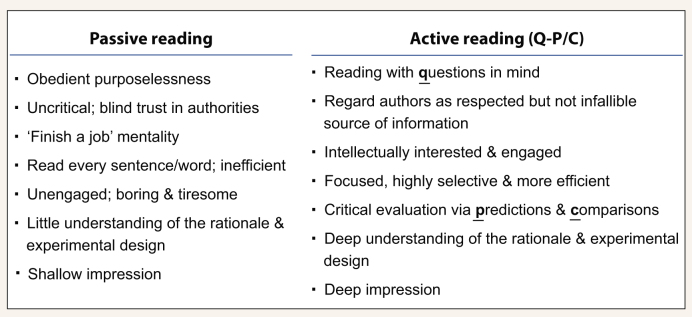
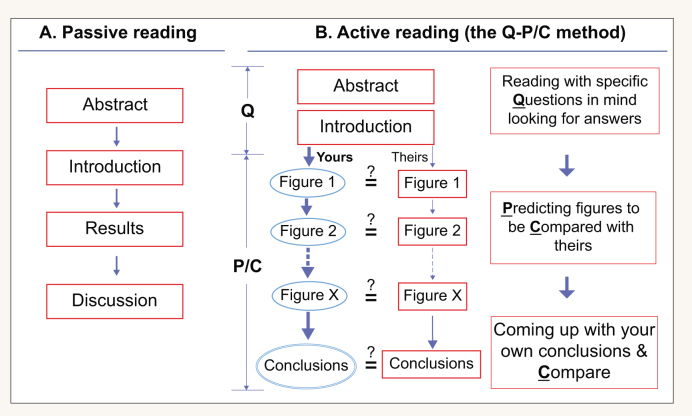
‘Any man who reads too much and uses his own brain too little falls into lazy habits of thinking.’ Albert Einstein (1879–1955) ‘Learning without thought is labor lost; thought without learning is perilous.’ Confucius (551–479 B.C.) The Confucian Analects, bk. 2:15 ‘To repeat what others have said, requires education; to challenge it, requires brains.’ Mary Pettibone Poole, A Glass Eye at a Keyhole (1938) ‘How do you read a scientific paper?’ may at first seem like a superfluous question. Given how most biomedical research papers are structured,1 it might be natural for beginning (or even not-so-beginning) students to assume that one should first read the Title, then the Abstract, followed by the Introduction. Most might elect to skip the Methods section that customarily follows the Introduction (although many journals now place it towards the end of a paper), as it contains far too many technical details and is therefore boring. The Results section, which contains the meat of the paper, i.e., experimental data presented in the form of figures and tables, might receive the most attention, with the Discussion section that follows as a close second. This kind of from-the-beginning-to-the-end and word-by-word reading is known as ‘passive reading’, which can be quite laborious and inefficient. In this paper, I will discuss the concept of ‘active reading,’ which I define here simply as reading with questions in mind and search for answers. In addition, you will ask yourself what experiments you would do next if you were the authors, and then compare your ideas with what was actually done in the paper.2 Reading this way fundamentally changes your mindset because the challenge keeps you intellectually engaged. You focus only on the parts of the paper that answer your questions, and glance through the rest; your reading therefore becomes highly selective. As a result, you can read faster and learn more. Although this paper will use biomedical research papers as examples, the same principles should apply to other scientific disciplines with minor modifications. Distinguishing features of Passive vs. Active reading. If you read a paper from-the-beginning-to-the-end, word-by-word, you are obediently following a path laid down by the author(s), who as a result, are de facto regarded by you as ‘authorities’ under this circumstance [1–3]. Reading a paper this way, without a particular expectation or purpose, is ‘passive reading,’ a practice similar to what Harvard educational psychologist William Perry (1913–1998) called ‘Obedient purposelessness’ [4]. It is inefficient and boring, because: First, if you set out with the intention to simply absorb whatever information that the author(s) have chosen to feed you, it is impossible, by definition, for you to be critical at the same time. Therefore, you lose the ability to assess the strengths and weaknesses of the paper. Second, because you are approaching the paper without expectations, reading through the paper will not likely generate any surprise or ‘Eureka’ moments and therefore becomes a chore. Third, while you might learn some facts and gain a general impression of the work, passively reading will not give you a deep understanding of the rationale and experimental strategies behind the work (Scheme 1). How can you improve the efficiency with which you do your reading? As an old saying goes, ‘you see only what you know,’ meaning you will be able to see an answer as such only if you were asking the question in the first place. Chinese scholar Huang Zongxi (黃宗羲, 1610–1695; [5,6]) once wrote: ‘If you read/do research with small questions in mind, you learn small things. If you do so with big questions in mind, you learn big things. If you do so with no question in mind, you learn nothing.’ Reading with specific questions in mind puts you in the mindset of searching for little gold nuggets buried in a pile of sand. If you know what you are looking for, your eyesight is sharpened. You can coast along in a low-energy state while searching [7,8], and switch to a high-energy state (to read more thoroughly and intensively) only when you find what you are looking for. Reading in this way is highly selective, and it prolongs your attention span and is much more efficient than passive reading – which tires you out easily because you have to be on high alert the whole time. Moreover, the rush of excitement when you find the answers that you are seeking, particularly if they help solve a problem that you have or provide you with new ideas (the ‘Eureka’ moments) can be quite stimulating. Active reading is thus more productive and enjoyable than passive reading (for active vs. passive reading, see Scheme 1). An obvious caveat to the above analogy of finding gold nuggets in a pile of sand is that you must first identify sand piles that are likely to be productive. Therefore, you should first practice active reading on papers that are published in highly selective, high caliber journals,
Overview
The claims and statistics of this paper haven’t been checked yet.
Run the check — free, no account needed. It reads the open-access text and checks the sources it cites.
Integrity signals
Registry
Cites
Statistics
Figures
Verification
Claims the paper makes
The claims and statistics of this paper haven’t been checked yet.
Run the check — free, no account needed. It reads the open-access text and checks the sources it cites.
Claims other papers make about this one
Each is checked against this paper’s own text: does it say what the citing paper says it does?
The check wasn’t confident either way, so it gives no verdict — never disputed.
In the citing paper
“According to the self-determination theory, autonomy and relatedness are central to sustained behavior change, and interactive interventions may better satisfy these psychological needs than passive reading materials [41,42].”
From Internet‐Based Telecare and Bibliotherapy Delivery of Acceptance and Commitment Therapy for Reducing Anxiety and Depression in Breast Cancer Patients: A Randomized Controlled Trial. (2026) · cites this paper as [42]
Experimental — accuracy not yet measured
Self-check
Percentages, sums and reported differences re-computed from the paper’s own numbers.
The self-check needs the paper’s full text.
Citations
Cites
The Structure of Scientific Revolutions
Hedesan, J., & Tendler, J. (2017) · Macat Library eBooks · doi:10.4324/9781912281589 · Cited by 5,450
Forms of Intellectual and Ethical Development in the College Years; A Scheme
Perry, W. G. (1970) · Cited by 4,179
The Structure of Scientific Revolutions
Sankey, H. (2002) · Australian & New Zealand Journal of Psychiatry · doi:10.1046/j.1440-1614.2002.t01-5-01102a.x · Cited by 1,881
Bean, J. C., & Weimer, M. G. (1996) · Cited by 1,448
Teaching Thinking Skills: Theory and Practice
Baron, J. B., & Sternberg, R. J. (1986) · Medical Entomology and Zoology · Cited by 902
K-W-L: A Teaching Model That Develops Active Reading of Expository Text
Ogle, D. M. (1986) · The Reading Teacher · doi:10.1598/rt.39.6.11 · Cited by 805
Hubbard, K. E., & Dunbar, S. D. (2017) · PLoS ONE · doi:10.1371/journal.pone.0189753 · Cited by 119
Advice for a Young Investigator
y Cajal, S. R. (1999) · The MIT Press eBooks · doi:10.7551/mitpress/1133.001.0001 · Cited by 110 · cited 2×
“5 As Santiago Ramon y Cajal (1852–1934) said in Advice for a Young Investigator [22]: it is important ‘to trace the history of the problem.”
BackgroundTustin, F. (1984) · Journal of Child Psychotherapy · doi:10.1080/00754178408254750 · Cited by 15
Excessive trust in authorities and its influence on experimental design
Sun, T. (2004) · Nature Reviews Molecular Cell Biology · doi:10.1038/nrm1429 · Cited by 10
Self-citationReading for Meaning: Skills Development for Active Reading
Ediger, A. M., Alexander, R. M., & Srutwa, K. (1989) · Medical Entomology and Zoology · Cited by 5
Research works printed but not linked: 11
- Sternberg, 1987, Teaching intelligence: the application of cognitive psychology to the improvement of intellectual skills, 186
- York-University-Learning-Skills-Services, Reading Skills for University
- Robinson, Effective Study
- Stangl, 1970, The PQRST method of studying
- Rider, Improving Student Writing through Reading Strategies
- Walker, Critical Reading. The WAC Clearinghouse, Colorado State University
- Strunk, 1999, The Elements of Style
- Princeton McGraw Center for Teaching and Learning, Active Reading Strategies: Remember and Analyze What You Read
- Dartmouth Academic Skill Center, Reading: Strategies for Improving Reading Rate and Comprehension
- Columbia Berick Center for Student Advising, The Power of Previewing—The KWL Reading Method
- Sun, Workshop on Scientific Methods: Survival Skills for Young Biomedical Investigators
Cited by
Sorted by citations
Group formation based on reading annotation data: system innovation and classroom practice
Liang, C., Toyokawa, Y., Majumdar, R., Horikoshi, I., & Ogata, H. (2023) · Journal of Computers in Education · doi:10.1007/s40692-023-00274-y · Cited by 6
“Among these designs, active reading is a method where students spontaneously think about questions, read texts to answer those questions, and deepen their understanding, rather than the traditional passive reading method (Sun, 2020).”
Liang, C., Toyokawa, Y., & Ogata, H. (2025) · International Journal of Computer-Supported Collaborative Learning · doi:10.1007/s11412-025-09452-9 · Cited by 7
“AR strategies have been shown to improve critical thinking and reading comprehension, fostering a more independent understanding of textual content (Sun, 2020).”
Scientific Publishing in Biomedicine: Information Literacy
Bahadoran, Z., Mirmiran, P., Kashfi, K., & Ghasemi, A. (2022) · Intern J Endocrinol Metab · doi:10.5812/ijem-128701 · Cited by 5
“with questions in mind, and search for answers (44).”
BackgroundText Selection and Preferences of EFL Students While Reading on Smartphones
Oh, C. M., Krısh, P., & Hamat, A. (2022) · International Journal of Information and Education Technology · doi:10.18178/ijiet.2022.12.10.1715 · Cited by 5
Picking Up Where the Authors Left Off: Reading Research in Medical Education
Hunderfund, A. N. L., Schumacher, D. J., Fung, C.-C., Sukhera, J. I., Young, M. E., & Balmer, D. F. (2023) · Academic Medicine · doi:10.1097/acm.0000000000005373 · Cited by 1
Metadata
- Authors
- Sun, T.-T.
- Affiliations
- New York University (US)
- Corresponding author
- Sun, Tung-Tien
- ORCID
- Sun, Tung-Tien
- Venue
- National Science Review
- Publisher
- Oxford University Press (OUP)
- Published
- 2020-06-19
- Volume
- 7
- Issue
- 9
- Pages
- 1422-1427
- ISSN
- 2053-714X (ISSN-L)
- 2095-5138
- PMC
- PMC8288757
- OpenAlex
- W3036166264
- Cited by
- 15
- References
- 11
- Citations by year
- 2026: 6 · 2025: 3 · 2023: 2 · 2022: 3 · 2021: 1
- FWCI
- 5.59
- Type
- journal article
- Language
- en
- Open access
- gold
- doi.org
- Licence
- Locations
- National Science Review (publishedVersion, cc-by)
- PubMed Central (publishedVersion, cc-by)
- PubMed (publishedVersion)
- Funders
- Johns Hopkins University
- York University
- School of Medicine, New York University
- Topics
- Social Sciences › Library and Information Sciences › Academic Writing and Publishing
- Social Sciences › Psychology › Developmental and Educational Psychology › Educational Strategies and Epistemologies
- Health Sciences › Health Professions › General Health Professions › Health Sciences Research and Education
- Keywords
- active reading, passive reading, scientific reading, reading comprehension, critical reading, reading strategies, selective reading, reading speed, critical thinking, reading comprehension improvement
About these checks
Registry, retraction, Cites and statistics results are computed, not judged, with one exception: a printed reference that no index lists is read once by a model before it counts as a citation error. Claims are extracted by a model and kept only when their quote appears verbatim in the text; each cited source is then checked, with a model’s help, for whether it says what the claim relies on. Those verdicts can be wrong — read the claim’s quote and the cited source before relying on one.
Statistics and arithmetic are recomputed, not judged.
Confidence bands are shown only for fields calibrated on our annotated test set. None is calibrated yet, so no band is shown.
What counts as a claim ›How we measure confidence ›How we check this ›
Are you an author, or do you see a problem with this page? Request a review
