

Quantum computing with neutral atoms
Open accessThe DOI matches its Crossref record; 22 of the 22 references it cites were found in a registry or an index.
Abstract
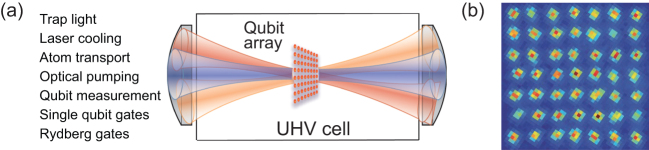
The power of quantum computation derives from algorithmic methods that exploit the availability of quantum superposition and entanglement to perform computations that are intractable with classical devices. The race is on to develop hardware that will unleash the promise of quantum algorithms. A handful of different types of hardware are currently being developed with the greatest efforts directed at superconducting, quantum-dot, trapped-ion, photonic, and neutral-atom approaches [1]. While all approaches have strengths and weaknesses, and are at different stages of development, the challenge of creating a practical design that can be scaled to a million or more qubits has not yet been met with any of the existing platforms. One may wonder if we really need a million qubits for a useful quantum computer. The answer depends on our ambition level. On the one hand it is widely believed that a quantum computer with less than 100 reliable qubits will be able to demonstrate a quantum advantage for a well defined computational problem [2]. Demonstration of a quantum computational advantage will generate great excitement in the halls of academia, but will have little broader import. A problem of great practical interest such as ab initio design of chemicals for increasing the yield of fertilizers for crop production, to name but one example, may also require just a few hundred qubits, provided computational sequences with circuit depth of 1010 or more operations can be reliably performed [3]. However, given the current performance of qubit hardware, which has demonstrated error rates not less than ∼10−3, computations with depth 1010 will only produce random outcomes of negligible value. The solution lies in the construction of error-correction circuitry operating on logical qubits, each composed of many physical qubits, which will enable logical error rates many orders of magnitude smaller than physical error rates. Although error correction is remarkably efficient for classical computing devices—Hamming codes detect and correct errors while only requiring roughly 10% overhead in the number of physical bits—quantum error correction is notoriously expensive. New approaches to error correction are the subject of intensive research with one promising direction being the development of codes that are optimized to suppress the dominant error mechanism in a particular physical platform [4,5]. Nevertheless, with physical error rates of 10−4, a plausible target for current qubit systems, the overhead required to reach logical error rates of 10−10 may be measured in thousands of physical qubits for each logical qubit. Thus a quantum computer able to perform deep calculations on a few hundred logical qubits could require a million physical qubits. A consequence of the cost of quantum error correction is that any viable approach to large-scale quantum computing needs to combine high-fidelity quantum logic operations with a capability for integrating large numbers of physical qubits. From this perspective neutral-atom qubits appear particularly promising [6] as they have already demonstrated control of more qubits than any other platform with recent experiments in 1D [7], 2D [8,9], and 3D [10] geometries showing control of up to 50 atomic qubits. Large qubit arrays can potentially be prepared in 1D, 2D, or 3D geometries. The number of proximal qubits increases with the dimensionality, which is advantageous for implementation of error correction code words, and points towards a preference for 2D or 3D arrays. On the other hand, the added overhead of compensating crosstalk incurred when targeting atoms inside a 3D volume makes parallel operations on multiple qubits challenging. A 2D geometry, as shown schematically in Fig. 1, may be an optimal choice since qubit control and measurement can be performed with lasers propagating normal to the plane of the array so that individual qubit sites can be addressed independently. With demonstrated array periods of a few micrometers we require a footprint of less than 1 mm2 for 104 qubits. Conceptual picture of a 2D neutral-atom qubit array. a) High-numerical-aperture lenses project several different wavelengths of light for control and measurement of the qubits. Specific choices of optical wavelengths depend on the atomic species. Not shown are optics for initial laser cooling, transport to the array, beam scanning, and imaging for qubit measurement. b) Averaged fluorescence image of 49 atomic qubits on a 2D grid with |$3.8 \, {\mu} \rm {m}$| spacing [8]. From a fundamental perspective the prospects for scaling neutral-atom systems are particularly promising due to the exceptionally large ratio between coherent and incoherent coupling rates. Neutral-atom qubits are encoded in hyperfine ground states for which coherence times of the order of 10 s have been demonstrated [10]. This implies a dephasing rate |$\gamma \sim 0.1 \, \rm s^{-1}$|. The coherent coupling that enables quantum logic o
Overview
The claims and statistics of this paper haven’t been checked yet.
Free: it reads the open-access text and checks the first 5 claims that cite a source we can check. Create a free account to check every claim.
Integrity signals
Registry
Cites
Statistics
Figures
Verification
Claims the paper makes
The claims and statistics of this paper haven’t been checked yet.
Free: it reads the open-access text and checks the first 5 claims that cite a source we can check. Create a free account to check every claim.
Claims other papers make about this one
Each is checked against this paper’s own text: does it say what the citing paper says it does?
The source backs part of the claim, not all of it — or backs it for a different population, condition or comparison.
In the citing paper
“Both argued that simulating quantum mechanics on classical computers requires resources growing exponentially in the problem instance size, so that certain problems will remain out of reach, regardless of the ingenuity of the algorithm designers.”
From Quantum Chemistry in the Age of Quantum Computing (2019) · cites this paper as [29]
Experimental — accuracy not yet measuredIn the citing paper
“Exact simulation of quantum chemistry systems is widely regarded as one of the problems that would benefit enormously from quantum hardware 29 .”
From Quantum Chemistry in the Age of Quantum Computing (2019) · cites this paper as [29]
Self-check
Percentages, sums and reported differences re-computed from the paper’s own numbers.
The self-check needs the paper’s full text.
Citations
Cites
Ladd, T. D., Jelezko, F., Laflamme, R., Nakamura, Y., Monroe, C., & O’Brien, J. L. (2010) · Nature · doi:10.1038/nature08812 · Cited by 3,592
Quantum information with Rydberg atoms
Saffman, M., Walker, T. G., & Mølmer, K. (2010) · Reviews of Modern Physics · doi:10.1103/revmodphys.82.2313 · Cited by 2,836
Self-citationProbing many-body dynamics on a 51-atom quantum simulator
Bernien, H., Schwartz, S., Keesling, A., Levine, H., Omran, A., Pichler, H., Choi, S., Zibrov, A. S., Endres, M., Greiner, M., et al. (2017) · Nature · doi:10.1038/nature24622 · Cited by 2,460
Fast Quantum Gates for Neutral Atoms
Jaksch, D., Cirac, J. I., Zoller, P., Rolston, S. L., Côté, R., & Lukin, M. D. (2000) · Physical Review Letters · doi:10.1103/physrevlett.85.2208 · Cited by 1,540
Cavity-based quantum networks with single atoms and optical photons
Reiserer, A., & Rempe, G. (2015) · Reviews of Modern Physics · doi:10.1103/revmodphys.87.1379 · Cited by 1,000
An atom-by-atom assembler of defect-free arbitrary two-dimensional atomic arrays
Barredo, D., de Léséleuc, S., Lienhard, V., Lahaye, T., & Browaeys, A. (2016) · Science · doi:10.1126/science.aah3778 · Cited by 860
Elucidating reaction mechanisms on quantum computers
Reiher, M., Wiebe, N., Svore, K. M., Wecker, D., & Troyer, M. (2017) · Proceedings of the National Academy of Sciences · doi:10.1073/pnas.1619152114 · Cited by 745
Quantum computational supremacy
Harrow, A. W., & Montanaro, A. (2017) · Nature · doi:10.1038/nature23458 · Cited by 702
Quantum computing with atomic qubits and Rydberg interactions: progress and challenges
Saffman, M. (2016) · Journal of Physics B: Atomic, Molecular and Optical Physics · doi:10.1088/0953-4075/49/20/202001 · Cited by 687
Self-citationHigh-Fidelity Control and Entanglement of Rydberg-Atom Qubits
Levine, H., Keesling, A., Omran, A., Bernien, H., Schwartz, S., Zibrov, A. S., Endres, M., Greiner, M., Vuletić, V., & Lukin, M. D. (2018) · Physical Review Letters · doi:10.1103/physrevlett.121.123603 · Cited by 424
Research works printed but not linked: 1
- Lienhard V, de Léséleuc S, Barredo D Phys Rev X 2018; 8: 021070.
Cited by
Quantum Chemistry in the Age of Quantum Computing
Cao, Y., Romero, J., Olson, J. P., Degroote, M., Johnson, P. D., Kieferová, M., Kivlichan, I. D., Menke, T., Peropadre, B., Sawaya, N. P. D., et al. (2019) · Chemical Reviews · doi:10.1021/acs.chemrev.8b00803 · Cited by 1,560
Quantum Chemistry in the Age of Quantum Computing
Cao, Y., Romero, J., Olson, J., Degroote, M., Johnson, P., Kieferová, M., Kivlichan, I., Menke, T., Peropadre, B., Sawaya, N., et al. (n.d.) · OPUS - Open Publications of UTS Scholars (University of Technology Sydney) · Cited by 1,265
Quantum Computer Systems for Scientific Discovery
Alexeev, Y., Bacon, D., Brown, K. R., Calderbank, R., Carr, L. D., Chong, F. T., DeMarco, B., Englund, D., Farhi, E., Fefferman, B., et al. (2021) · PRX Quantum · doi:10.1103/prxquantum.2.017001 · Cited by 248
Quantum Computer Systems for Scientific Discovery
Alexeev, Y., Bacon, D., Brown, K. R., Calderbank, R., Carr, L. D., Chong, F. T., DeMarco, B., Englund, D., Farhi, E., Fefferman, B., et al. (2021) · DSpace@MIT (Massachusetts Institute of Technology) · doi:10.6082/h7fqg-6vt65 · Cited by 240
A concise review of Rydberg atom based quantum computation and quantum simulation*
Wu, X., Liang, X., Tian, Y., Yang, F., Chen, C., Liu, Y.-C., Tey, M. K., & You, L. (2021) · Chinese Physics B · doi:10.1088/1674-1056/abd76f · Cited by 192
High-Fidelity Bell-State Preparation with Ca + 40 Optical Qubits
Clark, C. R., Tinkey, H. N., Sawyer, B. C., Meier, A. M., Burkhardt, K. A., Seck, C. M., Shappert, C. M., Guise, N. D., Volin, C. E., Fallek, S. D., et al. (2021) · Physical Review Letters · doi:10.1103/physrevlett.127.130505 · Cited by 165
Native qudit entanglement in a trapped ion quantum processor
Hrmo, P., Wilhelm, B., Gerster, L., van Mourik, M. W., Huber, M., Blatt, R., Schindler, P., Monz, T., & Ringbauer, M. (2023) · Nature Communications · doi:10.1038/s41467-023-37375-2 · Cited by 192
“(1) is generated by a pair of perpendicular laser beams, one ofwhich is parallel and the other perpendicular to the applied magnetic field, each with a waist of approximately 45μm, see Fig.”
BackgroundPractical Guide for Building Superconducting Quantum Devices
Gao, Y. Y., Rol, M. A., Touzard, S., & Wang, C. (2021) · PRX Quantum · doi:10.1103/prxquantum.2.040202 · Cited by 128
Quantum logic and entanglement by neutral Rydberg atoms: methods and fidelity
Shi, X. (2022) · Quantum Science and Technology · doi:10.1088/2058-9565/ac18b8 · Cited by 98
Feng, L., Tan, W. L., De, A., Menon, A., Chu, A., Pagano, G., & Monroe, C. R. (2020) · Physical Review Letters · doi:10.1103/physrevlett.125.053001 · Cited by 87
Control of Transverse Motion for Quantum Gates on Individually Addressed Atomic Qubits
Cetina, M., Egan, L. N., Noel, C., Goldman, M. L., Biswas, D., Risinger, A. R., Zhu, D., & Monroe, C. (2022) · PRX Quantum · doi:10.1103/prxquantum.3.010334 · Cited by 54
Fault-tolerant connection of error-corrected qubits with noisy links
Ramette, J., Sinclair, J., Breuckmann, N. P., & Vuletić, V. (2024) · npj Quantum Information · doi:10.1038/s41534-024-00855-4 · Cited by 111
“We show that the system can tolerate 14 times higher noise at the interface compared to the bulk, with only a small effect on the code ’ s threshold and subthreshold behavior, reaching threshold with ~1% bulk errors and ~10% interface errors.”
Artificial Intelligence in Medicine Using Quantum Computing in the Future of Healthcare
Davids, J., Lidströmer, N., & Ashrafian, H. (2022) · Springer eBooks · doi:10.1007/978-3-030-64573-1_338 · Cited by 47
Quantum Divide and Compute: Exploring the Effect of Different Noise Sources
Ayral, T., Régent, F.-M. L., Saleem, Z. H., Alexeev, Y., & Suchara, M. (2021) · SN Computer Science · doi:10.1007/s42979-021-00508-9 · Cited by 50
A low-noise on-chip coherent microwave source
Yan, C., Hassel, J., Vesterinen, V., Zhang, J., Ikonen, J., Grönberg, L., Goetz, J., & Möttönen, M. (2021) · Nature Electronics · doi:10.1038/s41928-021-00680-z · Cited by 34
“We rewrite equation (5) with the help of its Fourier–Bessel series as”
MethodMaronese, M., Moro, L. D., Rocutto, L., & Prati, E. (2022) · Springer eBooks · doi:10.1007/978-3-030-89746-8_2 · Cited by 52
Approaches to Constrained Quantum Approximate Optimization
Saleem, Z. H., Tomesh, T., Tariq, B., & Suchara, M. (2023) · SN Computer Science · doi:10.1007/s42979-022-01638-4 · Cited by 40
Nondestructive Cooling of an Atomic Quantum Register via State-Insensitive Rydberg Interactions
Belyansky, R., Young, J. T., Bienias, P., Eldredge, Z., Kaufman, A. M., Zoller, P., & Gorshkov, A. V. (2019) · Physical Review Letters · doi:10.1103/physrevlett.123.213603 · Cited by 33
A network-ready random-access qubits memory
Langenfeld, S., Morin, O., Körber, M., & Rempe, G. (2020) · MPG.PuRe (Max Planck Society) · Cited by 18
Guo, R., He, X., Sheng, C., Yang, J., Xu, P., Wang, K., Zhong, J., Liu, M., Wang, J., & Zhan, M. (2020) · Physical Review Letters · doi:10.1103/physrevlett.124.153201 · Cited by 21
“Neutral atoms confined in an closely spaced array of optical dipole traps (ODTs) manifest outstanding scalability and thus are being intensively developed for quantum simulation and quantum computation [1–4].”
BackgroundOptimal control transport of neutral atoms in optical tweezers at finite temperature
Pagano, A., Jaschke, D., Weiss, W., & Montangero, S. (2024) · Physical Review Research · doi:10.1103/physrevresearch.6.033282 · Cited by 22
“Neutral atom quantum processing units based on optical tweezers [1–7] open the possibility to modify the connectivity of qubits at runtime of the algorithm.”
BackgroundQuantum Local Search with the Quantum Alternating Operator Ansatz
Tomesh, T., Saleem, Z. H., & Suchara, M. (2022) · Quantum · doi:10.22331/q-2022-08-22-781 · Cited by 26
Multigrating design for integrated single-atom trapping, manipulation, and readout
Liu, A., Liu, J., Peng, W., Xu, X., Chen, G.-J., Ren, X., Wang, Q., & Zou, C. (2022) · Physical Review A · doi:10.1103/physreva.105.053520 · Cited by 14
“Therefore, our work provides a unique approach to realize a scalable atom arrays, which holds great potential for the application in sensing, metrology [52, 53] and quantum information processing [4, 6, 54].”
MethodStade, Y., Schmid, L., Burgholzer, L., & Wille, R. (2024) · IEEE International Conference on Quantum Computing and Engineering (QCE) · doi:10.1109/qce60285.2024.00098 · Cited by 33
“So far, previous work has considered a monolithic architecture where all operations are performed in the same region [46].”
Tao, Z.-J., Yu, L.-G., Xu, P., Hou, J., He, X., & Zhan, M. (2022) · Chinese Physics Letters · doi:10.1088/0256-307x/39/8/083701 · Cited by 15
High-numerical-aperture and long-working-distance objective for single-atom experiments
Li, S., Li, G., Wu, W., Fan, Q., Tian, Y., Yang, P., Zhang, P., & Zhang, T. (2020) · Review of Scientific Instruments · doi:10.1063/5.0001637 · Cited by 13
Reducing Rydberg-state dc polarizability by microwave dressing
Bohorquez, J. C., Chinnarasu, R., Isaacs, J., Booth, D. W., Beck, M., McDermott, R., & Saffman, M. E. (2023) · Physical Review A · doi:10.1103/physreva.108.022805 · Cited by 10
“Neutral atom arrays are a promising platform for quantum information processing thanks to their inherent scalability and the excellent coherence properties of the hyperfine ground states used to encode qubit states[1].”
BackgroundSelf-citationAkopyan, L. A., Zalivako, I. V., Lakhmanskiy, K., Khabarova, K. Y., & Kolachevsky, N. (2020) · Journal of Experimental and Theoretical Physics Letters · doi:10.1134/s0021364020210043 · Cited by 9
Quantum technology: a financial risk assessment
Nguyen, P.-N. (2025) · Digital Finance · doi:10.1007/s42521-025-00127-6 · Cited by 18
“Neutral atom-based quantum computers manipulate individual atoms trapped using optical or magnetic potential (Saffman 2019; Wintersperger et al. 2023).”
Microscope objective for imaging atomic strontium with 0.63 micrometer resolution
Knottnerus, I. H. A., Pyatchenkov, S., Onishchenko, O., Urech, A., Schreck, F., & Siviloglou, G. A. (2020) · Optics Express · doi:10.1364/oe.388809 · Cited by 8
Optimal control in phase space applied to minimal-time transfer of thermal atoms in optical traps
Morandi, O., Nicoletti, S., Gavryusev, V., & Fallani, L. (2025) · Physical Review A · doi:10.1103/d857-7cwr · Cited by 9
A systematic review of strategic approaches and applications in quantum computing
Sharma, N. V., & Saxena, V. (2025) · Optical and Quantum Electronics · doi:10.1007/s11082-025-08364-0 · Cited by 5
“Meanwhile, neutral atom platforms have gained attention due to their scalability and flexible qubit arrangement (Saffman 2019).”
Architecture for a quantum repeater based on Rydberg-atom quantum processors
Zhang, Y., Jie, Q., Li, M., Wu, S.-H., Wang, Z.-B., Zou, X., Zhang, P., Li, G., Zhang, T., Guo, G.-C., et al. (2025) · Physical Review Applied · doi:10.1103/8rss-rqr2 · Cited by 7
Tedeschi, L. O. (2025) · Journal of Animal Science · doi:10.1093/jas/skaf445 · Cited by 7
Multi-controlled Phase Gate Synthesis with ZX-calculus applied to Neutral Atom Hardware
Staudacher, K., Schmid, L., Zeiher, J., Wille, R., & Kranzlmüller, D. (2024) · QPL · doi:10.4204/eptcs.406.5 · Cited by 11
“The benefit and potential of the resulting approach are shown by synthesizing gate functionality for the recently emerging neutral atoms platforms [17, 20, 32, 41–44].”
BackgroundWang, J., Ji, Y., Wang, J., Yang, L., Li, D., & Xiu, X. (2025) · Advanced Quantum Technologies · doi:10.1002/qute.202400604 · Cited by 5
Artificial Intelligence in Medicine Using Quantum Computing in the Future of Healthcare
Davids, J., Lidströmer, N., & Ashrafian, H. (2021) · Springer eBooks · doi:10.1007/978-3-030-58080-3_338-1 · Cited by 5
Fast nuclear-spin entangling gates compatible with large-scale atomic arrays
Shi, X.-F., & Lu, Y. (2023) · Physical Review A · doi:10.1103/physreva.110.012610 · Cited by 4
“…atomic qubit array as in [5, 16–30], the spatial change [31]of magnetic field B z in an anticipated large-scale array with practically useful millions of qubits [33] can result in spatial change of frequency separation of the two qubit states, which effectively makes the qubits no longer identical.”
BackgroundMethodMamat, B., Sheng, C., Zhang, Y.-Q., Hou, J., Xu, P., Wang, K., Zhuang, J., Wei, M.-R., Liu, M., Wang, J., et al. (2024) · Physical Review Applied · doi:10.1103/physrevapplied.22.064021 · Cited by 6
Barium-based Rydberg-atom quantum technologies with long Rydberg coherence
Shi, X.-F. (2025) · Physical Review A · doi:10.1103/bbv3-d4ch · Cited by 2
Enhancing single-atom loading in tightly confined dipole traps with an ancillary dipole beam
Chen, G.-J., Wang, Z.-B., Gu, C., Zhao, D. Y., Zhang, J.-Z., Zhang, Y., Dong, C., Huang, K., Guo, G., & Zou, C. (2024) · Physical Review A · doi:10.1103/physreva.109.043105 · Cited by 2
“In recent decades, trapping single neutral atoms has at-tracted significant attention for its potential applications in studies of matter waves [1, 2], light-atom interactions [3– 9], and quantum information sciences [10–13].”
BackgroundOptimal State Preparation for Logical Arrays on Zoned Neutral Atom Quantum Computers
Stade, Y., Schmid, L., Burgholzer, L., & Wille, R. (2024) · Design, Automation and Test in Europe · doi:10.23919/date64628.2025.10993241 · Cited by 12
“Single-qubit gates are realized as state transitions driven by global and local lasers [14], [18].”
A practical guide for building superconducting quantum devicesPreprint
Gao, Y. Y., Rol, M. A., Touzard, S., & Wang, C. (2021) · arXiv (Cornell University) · doi:10.48550/arxiv.2106.06173 · Cited by 2
“Rapid progress on the construction of robust quantum hardware has been made in a variety of different physical systems, such as trapped ions [258, 259], photons [260, 261], neutral atoms [262], and spins [263, 264].”
BackgroundDiBrita, N. S., Leeds, D., Huo, Y., Ludmir, J., & Patel, T. (2024) · doi:10.1145/3676536.3676697 · Cited by 6
“While the recently demonstrated Rydberg atom quantum computers also suffer from hardware errors, it has advantages such as longer qubit de-coherence times, multi-qubit operations, and reconfigurable qubit connectivity [12, 33, 37].”
Gomes, N. D., Magalhães, D. V., Kondo, J. D. M., & Marcassa, L. G. (2024) · Results in Physics · doi:10.1016/j.rinp.2024.108081 · Cited by 3
“…excited Rydberg atoms has become pivotal for advancing several quantum technologies, spanning from quantum information [1, 2], computation [3, 4], simulation [5, 6], highly sensitive electromagnetic sensors [7–12], to understanding the physical background behind non-equilibrium phase…”
BackgroundAnalysis of Heralded Higher-Fidelity Two-Qubit Entangling Gates with Self-Correction
Sun, Y. (2025) · Chinese Physics Letters · doi:10.1088/0256-307x/42/7/070602 · Cited by 1
Routing-Aware Placement for Zoned Neutral Atom-based Quantum Computing
Stade, Y., Lin, W.-H., Cong, J., & Wille, R. (2025) · 2025 IEEE/ACM International Conference On Computer Aided Design (ICCAD) · doi:10.1109/iccad66269.2025.11240721 · Cited by 20
“One-qubit operations, such as rotational operations, are realized through state transitions driven by global and local lasers [16], [20].”
Enhanced atom-by-atom assembly of defect-free two-dimensional mixed-species atomic arrays
Wei, M.-R., Wang, K., Hou, J., Chen, Y., Xu, P., Zhuang, J., Guo, R., Liu, M., Wang, J., He, X.-D., et al. (2026) · Physical Review Applied · doi:10.1103/4hhn-pjbj · Cited by 6
Toward Large Nonradiating Qubits: When Quantum Engineering Meets Photonics
Basharin, A. A. (2026) · Advanced Quantum Technologies · doi:10.1002/qute.202500587 · Cited by 3
Chatterjee, S., Behera, B. K., & Seo, F. J. (2023) · Applied Sciences · doi:10.3390/app132112075 · Cited by 4
“In addition, several qubit systems, including neutral atoms [9], ions [10], polar molecules [11], electrons or nuclear spins in semiconductors quantum dots [12], and photons [13], have been proposed for quantum simulating systems.”
BackgroundOptimal sampling of tensor networks targeting wave function's fast decaying tails
Ballarin, M., Silvi, P., Montangero, S., & Jaschke, D. (2025) · Quantum · doi:10.22331/q-2025-04-18-1714 · Cited by 9
“The basis states α forming the projection in z -direction are an intuitive choice for the experiment, which for example can be sampled in an atom-qubit experiment with a fluorescence snapshot [1, 3, 9].”
Pagano, A., Jaschke, D., Weiß, W., & Montangero, S. (2024) · Zenodo (CERN European Organization for Nuclear Research) · doi:10.5281/zenodo.12526755 · Cited by 1
Measurement of magnetically insensitive state coherent time in blue dipole trap
Li, X., Wang, Z., Li, S.-K., Tian, Y., Li, G., Zhang, P., & Zhang, T. (2020) · Acta Physica Sinica · doi:10.7498/aps.69.20192001 · Cited by 1
Universal Quantum Gates based on Quantum DotsPreprint
Tiwari, Y., & Poonia, V. S. (2021) · arXiv (Cornell University)
Single photon detection and manipulation in photonic integrated circuits
Yanikgonul, S. (2021) · DR-NTU (Nanyang Technological University) · doi:10.32657/10356/151499
Spin-photon interfaces in diamond and SIC systems
Mu, Z. (2022) · DR-NTU (Nanyang Technological University) · doi:10.32657/10356/156199
Gomes, N. D., Magalhães, D. V., Kondo, J. D. M., & Marcassa, L. G. (2024) · SSRN Electronic Journal · doi:10.2139/ssrn.4882715
Quantum error correction using multiple nitrogen-vacancy center qubits
Quraishi, H. A., & Majidi, M. A. (2024) · Journal of Physics Conference Series · doi:10.1088/1742-6596/2866/1/012081
A 780nm Fully-Fibered Laser System, for Quantum Sensors in Hollow-Core Photonic Crystal Fibers
Marchesini, M., Dondi, M., Rossi, L., Bolognini, G., Prevedelli, M., & Minardi, F. (2024) · Italian Conference on Optics and Photonics (ICOP) · doi:10.1109/icop62013.2024.10803640
Proposal for the high-dimensional quantum computation in ladder-shaped atomic tweezer arrays
Deng, X., Peng, G., Xiang, D., Xu, X., Cao, L., & Hu, Z.-K. (2025) · Quantum Frontiers · doi:10.1007/s44214-025-00077-5
On-chip microwave coherent source with in-situ control of the photon number distribution
Mastrovito, P., Ahmad, H. G., Porzio, A., Esposito, M., Massarotti, D., & Tafuri, F. (2025) · Communications Physics · doi:10.1038/s42005-025-02219-6 · Cited by 1
Experimental observation of subabsorption
Gold, D. C., Sağlam, U., Carpenter, S., Yadav, A., Beede, M., Walker, T. G., Saffman, M. E., & Yavuz, D. D. (2025) · Physical Review A · doi:10.1103/6xnl-814s
“Recent advances in neutral atom quantum computing have achieved atomic arrays that can trap 1000 atoms or more [71–73].”
Self-citationHardware-Aware Compilation for Different Quantum Computing Platforms
Schmid, L., Schoenberger, D., Stade, Y., Burgholzer, L., & Wille, R. (2026) · Springer eBooks · doi:10.1007/978-3-032-09303-5_5
Control of Open Quantum System : Examples & Methods for Non-Markovian Dynamics
Fischer, J. (2022) · theses.fr (ABES) · doi:10.70675/1104e035z7c25z4ef1zb2e6za69dff2efa53
Pre-distillation of magic states via composite schemes
Erew, M., Goldstein, M., Oz, Y., & Suchowski, H. (2026) · Physical Review A · doi:10.1103/ngrr-863r · Cited by 2
Recent advancements in quantum machine learning applications: A review from smart grid viewpoint
Shaabani, M. H., Miri, S. P., Moghadasi, S. R., Arani, Z. D., Roknabadi, M. H. A., & Gharehpetian, G. B. (2026) · Applied Soft Computing · doi:10.1016/j.asoc.2026.115956 · Cited by 1
Photonic Integrated Circuit Optical Phased Array for Neutral Atom Qubit Control
Bassett, C., Ganguly, I., Hubert, F., Kaehr, B., Ding, R., Jau, Y., & Gehl, M. R. (2026) · Conference on Lasers and Electro-Optics · doi:10.1364/cleo_at.2026.am1b.2
Refined coherent control of atomic qubits via a wave-function approach conditioned on no-decay
Anonymous (2026) · Physical Review A · doi:10.1103/zt89-smxw
A study of qubit modalities in contemporary quantum computing
Govindankutty, A. (2026) · Discover Quantum Science · doi:10.1007/s44464-026-00033-9 · Cited by 1
QUBO-Based Scheduling of Heterogeneous Quantum Computing Resources in Scale-Free Industrial Networks
Wang, Y., Wang, X., Pan, Y., & Gao, Q. (2026) · Youth Academic Annual Conference of Chinese Association of Automation (YAC) · doi:10.1109/yac71005.2026.11616218
Photon emission from a tweezer-trapped single atom in an optical microcavity
Huang, D., Zhou, X., Shen, Z., He, S., Huang, Q., Wang, J., Li, C., & Guo, G.-C. (2026) · Chinese Optics Letters · doi:10.3788/col202624.112702
Metadata
- Authors
- Saffman, M.
- Affiliations
- University of Wisconsin–Madison (US)
- Corresponding author
- Saffman, Mark
- ORCID
- Saffman, Mark
- Venue
- National Science Review
- Publisher
- Oxford University Press (OUP)
- Published
- 2018-09-10
- Volume
- 6
- Issue
- 1
- Pages
- 24-25
- ISSN
- 2053-714X (ISSN-L)
- 2095-5138
- PMC
- PMC8291449
- OpenAlex
- W2891267877
- Cited by
- 69
- References
- 21
- Citations by year
- 2026: 9 · 2025: 14 · 2024: 13 · 2023: 4 · 2022: 7 · 2021: 11 · 2020: 9 · 2019: 2
- FWCI
- 3.10
- Type
- journal article
- Language
- en
- Open access
- hybrid
- doi.org
- Licence
- Locations
- National Science Review (publishedVersion, cc-by)
- PubMed Central (publishedVersion, cc-by)
- PubMed (publishedVersion)
- Funders
- National Science Foundation
- Topics
- Physical Sciences › Computer Science › Artificial Intelligence › Quantum Computing Algorithms and Architecture
- Physical Sciences › Physics and Astronomy › Atomic and Molecular Physics, and Optics › Cold Atom Physics and Bose-Einstein Condensates
- Physical Sciences › Physics and Astronomy › Atomic and Molecular Physics, and Optics › Quantum Information and Cryptography
- Keywords
- quantum computing, neutral atoms, trapped-ion quantum computing, quantum error correction, logical qubits, quantum bit error rate, scalability, quantum advantage, quantum chemistry simulation, superconducting qubits, photonic qubits, trapped-ion qubits, quantum dot qubits, quantum simulation of molecules
About these checks
Registry, retraction, Cites and statistics results are computed, not judged, with one exception: a printed reference that no index lists is read once by a model before it counts as a citation error. Claims are extracted by a model and kept only when their quote appears verbatim in the text; each cited source is then checked, with a model’s help, for whether it says what the claim relies on. Those verdicts can be wrong — read the claim’s quote and the cited source before relying on one.
Statistics and arithmetic are recomputed, not judged.
Confidence bands are shown only for fields calibrated on our annotated test set. None is calibrated yet, so no band is shown.
What counts as a claim ›How we measure confidence ›How we check this ›
Are you an author, or do you see a problem with this page? Request a review
Data sources
Bibliographic data: Semantic Scholar, OpenAlex, Crossref.
Contains information from the Semantic Scholar Academic Graph Datasets, made available under the ODC Attribution License (ODC-BY 1.0).
Semantic Scholar’s data is described in: Kinney, R., et al. (2023). The Semantic Scholar Open Data Platform. arXiv:2301.10140.
