

End-Stage Liver Disease Is a Strong Predictor of Early Mortality in Cryptococcosis
Open accessThe DOI matches its Crossref record; 18 of the 18 references it cites were found in a registry or an index.
Abstract
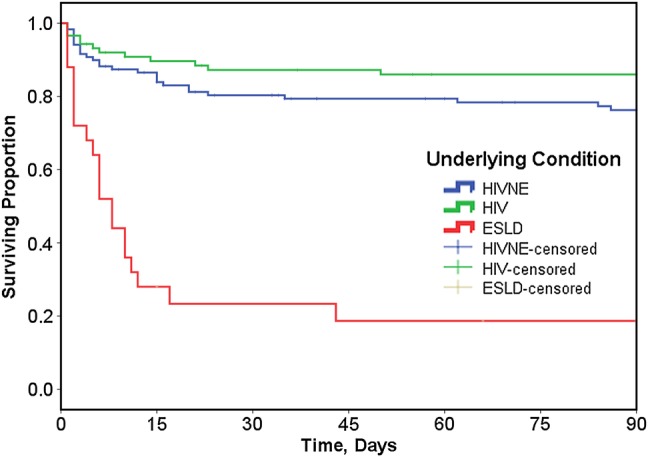
Background. Cryptococcosis in the setting of end-stage liver disease (ESLD) has been associated with high mortality. We sought to compare the outcome of cryptococcal disease in patients with ESLD to that of human immunodeficiency virus (HIV)-positive patients and to those patients without HIV or ESLD. Methods. We assembled a retrospective cohort of 232 consecutive cases of cryptococcosis in our institution, from 2002 to 2014, inclusively. We analyzed the cases for comorbidities, type of infection, and survival. Data were analyzed with t tests, Fishers Exact test, and Kaplan-Meyer analysis. Results. Twenty-five (10.8%) patients with cryptococcal infection had concomitant ESLD; of these, 5 (20%) presented with peritonitis. Most (17 of 25, 68%) did not have any other cause of immunocompromise that has been more classically associated with cryptococcosis. Patients with ESLD had a significantly higher mortality than HIV-positive patients and HIV-negative patients without ESLD (HIVNE) (80% vs 13.6% and 22.7%, respectively; P < .001). In addition, fatal outcome in ESLD patients occurred more rapidly than in HIVNE patients, with a median survival of 6 days (vs 17), despite a comparable time to diagnosis (6.2 vs 6.6 days). Conclusions. Cryptococcosis is an important morbidity in patients with ESLD. Patients with ESLD who are infected with Cryptococcus have a high and rapid mortality. This suggests that a high level of vigilance for cryptococcal infection should be kept in patients with ESLD.
Overview
The claims and statistics of this paper haven’t been checked yet.
Free: it reads the open-access text and checks the first 5 claims that cite a source we can check. Create a free account to check every claim.
Integrity signals
Registry
Cites
Statistics
Figures
Verification
Claims the paper makes
The claims and statistics of this paper haven’t been checked yet.
Free: it reads the open-access text and checks the first 5 claims that cite a source we can check. Create a free account to check every claim.
Claims other papers make about this one
Each is checked against this paper’s own text: does it say what the citing paper says it does?
The cited source says what the claim attributes to it.
In the citing paper
“Although the liver is not the target organ of C. neoformans, evidence suggests liver disease is a risk factor for cryptococcosis [111–114].”
From Mechanisms of fungal dissemination (2021) · cites this paper as [113]
In the citing paper
“This demonstrates an important role for KCs in reducing fungal dissemination to other organs by directly removing organisms from circulation [116], and likely explains the association between liver disease and increased susceptibility to fungal infections [112–114].”
From Mechanisms of fungal dissemination (2021) · cites this paper as [113]
Self-check
Percentages, sums and reported differences re-computed from the paper’s own numbers.
The self-check needs the paper’s full text.
Citations
Cites
Park, B. J., Wannemuehler, K. A., Marston, B. J., Govender, N., Pappas, P. G., & Chiller, T. M. (2009) · AIDS · doi:10.1097/qad.0b013e328322ffac · Cited by 2,014 · cited 1×
“Worldwide, it is estimated that there are 1 million cases and 625 000 deaths annually due to cryptococcal meningitis in HIV-infected individuals alone [3].”
BackgroundImmune Dysfunction and Infections in Patients With Cirrhosis
Bonnel, A. R., Bunchorntavakul, C., & Reddy, K. R. (2011) · Clinical Gastroenterology and Hepatology · doi:10.1016/j.cgh.2011.02.031 · Cited by 396 · cited 2×
“In addition, monocyte, neutrophil, macrophage, and lymphocyte chemotaxis and function have been shown to be diminished in ESLD [11].”
BackgroundEpidemiology of cryptococcal meningitis in the US: 1997–2009
Pyrgos, V., Seitz, A. E., Steiner, C. A., Prevots, D. R., & Williamson, P. R. (2013) · PLoS ONE · doi:10.1371/journal.pone.0056269 · Cited by 309
Brizendine, K. D., Baddley, J. W., & Pappas, P. G. (2013) · PLoS ONE · doi:10.1371/journal.pone.0060431 · Cited by 265 · cited 4×
“Although considerable improvements have been made to treatment, mortality associated with cryptococcosis is dependent on the underlying predisposing condition [4, 5].”
BackgroundResultInfluentialSingh, N., Alexander, B. D., Lortholary, O., Dromer, F., Gupta, K. L., John, G. T., del Busto, R., Klintmalm, G. B., Somani, J., Lyon, G. M., et al. (2007) · The Journal of Infectious Diseases · doi:10.1086/511438 · Cited by 264 · cited 1×
“Even after liver transplant, cryptococcosis appears to have a higher risk of dissemination and a more severe presentation than patients with other solid organ transplants [10].”
BackgroundBaddley, J. W., Perfect, J. R., Oster, R. A., Larsen, R. A., Pankey, G. A., Henderson, H., Haas, D. W., Kauffman, C. A., Patel, R., Zaas, A. K., et al. (2008) · European Journal of Clinical Microbiology & Infectious Diseases · doi:10.1007/s10096-008-0529-z · Cited by 171 · cited 1×
“3-fold higher rate of dissemination than other non-HIV patients [9].”
BackgroundRisk Factors for Invasive Cryptococcus neoformans Diseases: A Case-Control Study
Lin, Y.-Y., Shiau, S., & Fang, C.-T. (2015) · PLOS ONE · doi:10.1371/journal.pone.0119090 · Cited by 128
Hsu, C. C. S., & Leevy, C. M. (1971) · PubMed · Cited by 117
Cryptococcus neoformans Infection in Patients With Cirrhosis, Including Liver Transplant Candidates
Singh, N., Husain, S., de Vera, M., Gayowski, T., & Cacciarelli, T. V. (2004) · Medicine · doi:10.1097/01.md.0000126760.45299.69 · Cited by 113 · cited 4×
“Although considerable improvements have been made to treatment, mortality associated with cryptococcosis is dependent on the underlying predisposing condition [4, 5].”
BackgroundInfluentialPrevention and treatment of infections in patients with cirrhosis
Ghassemi, S., & García–Tsao, G. (2007) · Best Practice & Research Clinical Gastroenterology · doi:10.1016/j.bpg.2006.07.004 · Cited by 111 · cited 1×
“A total of 70%–96% of radiolabeled Gram-negative bacteria injected into healthy volunteers are localized to the liver within 10 minutes of injection [14].”
Background
Cited by
Pulmonary cryptococcosis: A review of pathobiology and clinical aspects
Setianingrum, F., Rautemaa-Richardson, R., & Denning, D. W. (2019) · Medical Mycology · doi:10.1093/mmy/myy086 · Cited by 289
Mechanisms of fungal dissemination
Strickland, A. B., & Shi, M. (2021) · Cellular and Molecular Life Sciences · doi:10.1007/s00018-020-03736-z · Cited by 127
George, I. A., Spec, A., Powderly, W. G., & Santos, C. A. Q. (2018) · Clinical Infectious Diseases · doi:10.1093/cid/cix867 · Cited by 116
Self-citationMarr, K. A., Sun, Y., Spec, A., Lu, N., Panackal, A. A., Bennett, J. E., Pappas, P. G., Ostrander, D. B., Datta, K., Zhang, S. X., et al. (2019) · Clinical Infectious Diseases · doi:10.1093/cid/ciz193 · Cited by 107
Self-citationFungal dissemination is limited by liver macrophage filtration of the blood
Sun, D., Sun, P., Li, H., Zhang, M., Liu, G., Strickland, A. B., Chen, Y., Fu, Y., Xu, J., Yosri, M., et al. (2019) · Nature Communications · doi:10.1038/s41467-019-12381-5 · Cited by 83
Hevey, M. A., George, I. A., Raval, K., Powderly, W. G., & Spec, A. (2019) · The American Journal of Medicine · doi:10.1016/j.amjmed.2019.04.026 · Cited by 74
Self-citationCoussement, J., Heath, C. H., Roberts, M. B., Lane, R. J., Spelman, T. D., Smibert, O. C., Longhitano, A., Morrissey, O., Nield, B., Tripathy, M., et al. (2023) · Clinical Infectious Diseases · doi:10.1093/cid/ciad321 · Cited by 69
Cryptococcosis Today: It Is Not All About HIV Infection
O’Halloran, J. A., Powderly, W. G., & Spec, A. (2017) · Current Clinical Microbiology Reports · doi:10.1007/s40588-017-0064-8 · Cited by 61
Self-citationInvasive fungal infections in acute and chronic liver impairment: A systematic review
Lahmer, T., Pietrobom, P. M. P., Schmid, R. M., & Colombo, A. L. (2021) · Mycoses · doi:10.1111/myc.13403 · Cited by 61
Spec, A., Olsen, M. A., Raval, K., & Powderly, W. G. (2017) · Clinical Infectious Diseases · doi:10.1093/cid/ciw786 · Cited by 53
“Sites of infection and associated predisposing factors were defined as previously described [2].”
BackgroundResultInfluentialSelf-citationSalazar, A. S., Keller, M. R., Olsen, M. A. A., Nickel, K. B., George, I. A., Larson, L., Powderly, W. G., & Spec, A. (2020) · EClinicalMedicine · doi:10.1016/j.eclinm.2020.100563 · Cited by 33
“Episodes of hepatic encephalopathy or culturenegative spontaneous bacterial peritonitis presenting as non-differentiating sepsis in cirrhotic patients could be due to cryptococcosis [12,19].”
BackgroundMethodResultInfluentialSelf-citationHevey, M. A., George, I. A., Rauseo, A. M., Larson, L., Powderly, W. G., & Spec, A. (2020) · Journal of Clinical Microbiology · doi:10.1128/jcm.01563-20 · Cited by 32
“Patients with cirrhosis are already known to have more severe cryptococcal disease and poorer outcomes (9).”
BackgroundSelf-citationCryptococcal meningitis in AIDS
Spec, A., & Powderly, W. G. (2018) · Handbook of clinical neurology · doi:10.1016/b978-0-444-63849-6.00011-6 · Cited by 36
Self-citationInvasive fungal infections in liver diseases
Barros, N., Rosenblatt, R. E., Phipps, M. M., Fomin, V. G., & Mansour, M. K. (2023) · Hepatology Communications · doi:10.1097/hc9.0000000000000216 · Cited by 35
“7% in the HIV-positive and HIV-negative groups, respectively.[165] Cryptococcal infection has a 90-day mortality of 14% though it can be higher in patients with disseminated disease and renal failure[166] but may be worse in patients with liver diseases owing to a delay in diagnosis.”
BackgroundCryptococcal Traits Mediating Adherence to Biotic and Abiotic Surfaces
Camacho, E., & Casadevall, A. (2018) · Journal of Fungi · doi:10.3390/jof4030088 · Cited by 28
“, individuals with end-stage liver disease, reported a mortality as high as 80% [11].”
BackgroundYoon, H., Felsen, U. R., Wang, T., & Pirofski, L. (2019) · Medical Mycology · doi:10.1093/mmy/myz082 · Cited by 26
Mortality After Cryptococcal Infection in the Modern Antiretroviral Therapy Era
Hevey, M. A., Presti, R. M., O’Halloran, J. A., Larson, L., Raval, K., Powderly, W. G., & Spec, A. (2019) · JAIDS Journal of Acquired Immune Deficiency Syndromes · doi:10.1097/qai.0000000000002095 · Cited by 26
“Survivors (n=55) (%) Early-Mortality (n=17) (%) Late-Mortality (n=33) (%) Mean age at diagnosis (SD), years 39 (10) 41 (9) 41 (9) Male sex 41 (75) 13 (77) 30 (90) Race African American 38 (69) 14 (82) 28 (85) Non-African American 17 (31) 3 (18) 5 (15) Site of Infection CNS 36 (66) 8 (47) 27 (82) Pulmonary 3 (6) 3 (18)…”
Self-citationKupffer cells in liver homeostasis and disease: from immune sentinels to metabolic gatekeepers
David, B. A., Andreata, F., Blériot, C., Ginhoux, F., Kubes, P., & Iannacone, M. (2026) · Nature reviews. Immunology · doi:10.1038/s41577-026-01288-0 · Cited by 31
Cryptococcal meningitis in non-HIV patients in the State of Amazonas, Northern Brazil
Pinheiro, S. B., de Sousa, N. S. O., Cortez, A. C. A., Rocha, D. F. S., Menescal, L. S. F., Chagas, V. S., Pérez-Gómez, A. S., Cruz, K. S., Santos, L. O., Alves, M. J., et al. (2020) · Brazilian Journal of Microbiology · doi:10.1007/s42770-020-00383-1 · Cited by 26
“Various studies indicated that HIV-negative patients with cryptococcosis are significantly older compared with HIV-positive cryptococcosis patients [5, 7, 35].”
BackgroundResultInfluentialClinical Predictors Impacting Cryptococcal Dissemination and Poor Outcome in Patients With Cirrhosis
Cheng, J.-H., Yip, C., Jiang, Y., Zhou, L., Que, C., Luo, Y., Wang, X., Zhao, H., & Zhu, L. (2021) · Open Forum Infectious Diseases · doi:10.1093/ofid/ofab296 · Cited by 21
“Notably, cirrhosis also increases the susceptibility to Cryptococcus and is reported as an independent risk factor for cryptococcosis [6].”
BackgroundElements of dissemination in cryptococcosis
Bednarek, J. M., & Brown, J. C. S. (2024) · mBio · doi:10.1128/mbio.02155-23 · Cited by 22
“There is also a correlation between liver diseases and susceptibility to C. neoformans infection (145, 146).”
Xu, L., Zhang, X., Guo, Y., Tao, R., Dai, X., Yang, Z., Huang, Y., Zhu, B., & Xu, Y. (2018) · Medical Mycology · doi:10.1093/mmy/myy154 · Cited by 16
Epelbaum, O., de Moraes, A. G., Olson, J. C., & Lionakis, M. S. (2025) · Intensive Care Medicine · doi:10.1007/s00134-025-07797-1 · Cited by 19
Cryptococcal infection in haematologic malignancies and haematopoietic stem cell transplantation
Nematollahi, S., & Dioverti, M. V. (2020) · Mycoses · doi:10.1111/myc.13153 · Cited by 16
Bhatt, M., Porterfield, J. Z., Ribes, J. A., Arora, V., & Myint, T. (2021) · Mycoses · doi:10.1111/myc.13323 · Cited by 13
Guan, S.-T., Huang, Y., Huang, S., Hsiao, F., & Chen, Y. (2023) · Medical Mycology · doi:10.1093/mmy/myad125 · Cited by 16
“21 , 22”
Huang, S., Chuang, Y., Lee, Y., Hung, C., Sheng, W., Su, J.-J., Sun, H., Chen, Y., & Chang, S. (2019) · PLoS ONE · doi:10.1371/journal.pone.0221657 · Cited by 10
Overview of Fungal Infections ☆
Tan, G. S. E., & Hsu, L. Y. (2018) · Elsevier eBooks · doi:10.1016/b978-0-12-801238-3.98320-x · Cited by 13
A Mimic of Hepatic Encephalopathy: Two Cases of Cryptococcal Meningitis in North America
Ting, P.-S., Agarwalla, A., & Woreta, T. A. (2019) · Journal of Clinical and Translational Hepatology · doi:10.14218/jcth.2019.00005 · Cited by 8
“The frequently observed lag time to diagnosis makes cryptococcal meningitis an often fatal disease in cirrhosis.(4,6) If the diagnosis is not made early or missed prior to liver transplantation, the outcome can be devastating.”
BackgroundMansoor, A., Thompson, J. M., & Sarwari, A. R. (2021) · Scandinavian Journal of Infectious Diseases · doi:10.1080/23744235.2021.1889656 · Cited by 8
“suppressive therapy, and hepatic failure [3,4].”
Three-year mortality in cryptococcal meningitis: Hyperglycemia predict unfavorable outcome
Tsai, S.-T., Lin, F., Chen, P., Chiang, H., & Kuo, C. (2021) · PLoS ONE · doi:10.1371/journal.pone.0251749 · Cited by 8
“A comparative study of the outcomes of cryptococcal disease between patients with advanced liver disease and HIV infection revealed that end-stage liver disease was a strong predictor of early mortality [19].”
BackgroundFungal infections in liver cirrhosis
Iqbal, H., Mehmood, B. F., Jones, K., Sohal, A., & Roytman, M. M. (2024) · Translational Gastroenterology and Hepatology · doi:10.21037/tgh-24-6 · Cited by 8
“Data are limited regarding cryptococcal infections in advanced liver disease, however, cirrhosis has been identified as an independent risk factor for developing cryptococcal infection (41).”
BackgroundCoussement, J., Heath, C. H., Roberts, M. B., Lane, R. J., Spelman, T. D., Smibert, O. C., Longhitano, A., Morrissey, C. O., Nield, B., Tripathy, M., et al. (2024) · Clinical Infectious Diseases · doi:10.1093/cid/ciae630 · Cited by 8
Vidal, J. E., Moraes, C. D. A., de Siqueira, R. E. B., Miranda, N. B., Marcusso, R. M. N., Boulware, D. R., & de Oliveira, A. C. P. (2020) · Mycopathologia · doi:10.1007/s11046-020-00512-2 · Cited by 8
Case Series of End-Stage Liver Disease Patients with Severe Coccidioidomycosis
Ho, D., Kelley, K. D., Dandekar, S., Cohen, S. H., & Thompson, G. R. (2023) · Journal of Fungi · doi:10.3390/jof9030305 · Cited by 7
Koba, S., Ueda, K., Mori, M., Miki, K., & Imashuku, S. (2018) · Case Reports in Hepatology · doi:10.1155/2018/5174518 · Cited by 6
An unusual cause for rib osteomyelitis in the tropics: Cryptococcal osteomyelitis
Ramesh, V., Polati, V. R., Nimmala, P., Anand, M., Narreddy, S., & Saidulu, G. (2020) · Tropical Doctor · doi:10.1177/0049475520929827 · Cited by 6
“Brucellosis must be considered among the causes of glomerulonephritis in endemic regions.(3,4) Our patient is suspected of acquiring the disease from animals or animal products.”
BackgroundGiacomelli, A., & Antinori, S. (2021) · Elsevier eBooks · doi:10.1016/b978-0-12-818731-9.00125-7 · Cited by 5
Yetmar, Z. A., Ranganath, N., Mendoza, M. A., & Razonable, R. R. (2022) · Mycoses · doi:10.1111/myc.13467 · Cited by 4
Cryptococcosis at the university hospital of Marseille: A case series
Dollo, I., Menu, E., Dudouet, P., Aubry, C., L’Ollivier, C., & Ranque, S. (2024) · Journal de Mycologie Médicale · doi:10.1016/j.mycmed.2024.101500 · Cited by 6
Unmasking the Unusual: Cryptococcal Pericarditis in a Patient with Liver Failure – a Rare Occurrence
Phang, C. R., Farooqi, A., & Sangwan, Y. S. (2024) · American Journal of Case Reports · doi:10.12659/ajcr.943530 · Cited by 4
“Cryptococcosis occurring in individuals with end-stage liver disease has a high mortality rate [5].”
BackgroundMejía-Chew, C., Sung, A., Larson, L., Powderly, W. G., & Spec, A. (2020) · Mycoses · doi:10.1111/myc.13199 · Cited by 4
Self-citationMurali, S., Schweid, K., Chebaya, P., Rao, S. S., & Rufa, E. (2021) · Medical Mycology Case Reports · doi:10.1016/j.mmcr.2021.08.007 · Cited by 4
Fiorica, G., Cervera-Hernandez, M. E., Pirofski, L., Hemmige, V. S., & Yoon, H. (2025) · Open Forum Infectious Diseases · doi:10.1093/ofid/ofaf263 · Cited by 3
“The likely mechanism involves impaired cell-mediated immunity and complement deficiencies that compromise opsonization and antibody-mediated protection [27–29].”
Hypoxemic Respiratory Failure and Coccidioidomycosis-Associated Acute Respiratory Distress Syndrome
Heidari, A., Kaur, S., Pearson, S. J., Munoz, A., Sandhu, H., Mann, G., Schivo, M., Zeki, A. A., Bays, D. J., Wilson, M., et al. (2024) · Open Forum Infectious Diseases · doi:10.1093/ofid/ofad679 · Cited by 3
“Chronic liver disease is a known immunocompromising illness that has been associated with mortality in other fungal diseases ( Candida [22] and Cryptococcus [23]) but not definitely demonstrated in coccidi-oidomycosis [24].”
BackgroundYang, Y., Shang, J., Xu, S., & Wang, Z. (2024) · Infection and Drug Resistance · doi:10.2147/idr.s491615 · Cited by 2
Berinstein, J. A., Likhitsup, A., Vedula, S. C., & Conjeevaram, H. S. (2017) · Cureus · doi:10.7759/cureus.1976 · Cited by 2
“A recent study demonstrated a significantly higher 90-day and more rapid mortality in patients with cryptococcal infection and ESLD compared to patients without ESLD (80% 90-day mortality and a six-day median survival compared to 18% 90-day mortality and 14-day median survival) [9].”
BackgroundLiu, M., Sun, L., Zhu, Z., Wei, L., Qu, W., Zeng, Z.-G., & Liu, Y. (2021) · Experimental and Clinical Transplantation · doi:10.6002/ect.2020.0222 · Cited by 2
Patel, D. D., Khillan, V., Patel, N., & Kale, P. R. (2023) · Indian Journal of Medical Microbiology · doi:10.1016/j.ijmmb.2023.100465 · Cited by 2
Daryani, D., Lybik, N., & Saffo, S. (2025) · Scandinavian Journal of Infectious Diseases · doi:10.1080/23744235.2025.2549386 · Cited by 1
“Although our conclusions are mechanistically plausible and generally consistent with the findings of previously published work, there are important methodologic limitations that should be highlighted, namely due to the retrospective nature of our study [15,16,24].”
InfluentialAn Unusual Cause of Recurrent Pleural Effusion
He, K., Priyank, K., & Weber, D. M. (2019) · Infectious Diseases in Clinical Practice · doi:10.1097/ipc.0000000000000795 · Cited by 1
“Patients with endstage liver disease that acquire cryptococcal infections have a more severe course compared with those who are HIV positive and HIV negative.(14) Our patient has several risk factors for opportunistic infection, including HCV cirrhosis, uncontrolled diabetes mellitus, stage 4 chronic kidney disease se…”
BackgroundManagement of HIV-Associated Cryptococcal Meningitis
Osborn, M. R., Spec, A., & Mazi, P. B. (2023) · Current Fungal Infection Reports · doi:10.1007/s12281-023-00458-0 · Cited by 1
Self-citationCryptococcal Meningitis Presenting as Chronic Headache in an Apparently Immunocompetent Patient
Rahatgaonkar, A., Ali, M. J., Ranka, R., Dhar, M., & Kant, R. (2023) · Cureus · doi:10.7759/cureus.48668 · Cited by 2
Patel, K., Twohig, P. A., Peeraphatdit, T. B., Stohs, E. J., Samson, K. K., Smith, L. M., Patel, J. A., & Manatsathit, W. (2024) · Clinics and Research in Hepatology and Gastroenterology · doi:10.1016/j.clinre.2024.102337 · Cited by 1
An unusual case of tropical pyomyositis: cryptococcal pyomyositis
Ramesh, V., Polati, V. R., Prakasham, P. S., Narreddy, S., Saidulu, G., & Varahala, S. (2020) · Tropical Doctor · doi:10.1177/0049475520927633
“Risk factors include known causes including advanced liver disease and sarcoidosis.(8,9) The spectrum of disease caused by Cryptococcus species consists predominantly of meningoencephalitis and pneumonia, but skin and soft tissue disease is also known.”
BackgroundCryptococcosis in Liver Transplant Candidates and Recipients
Gore, S. J., & Forrest, G. N. (2020) · Current Fungal Infection Reports · doi:10.1007/s12281-020-00399-y
da Silva, A. C. F., Cunha‐Silva, M., Mazo, D. F. D. C., Mana, M. F., de Paula, R. V., de Ataíde, E. C., Boin, I. D. F. S. F., Stucchi, R. S. B., & Sevá‐Pereira, T. (2021) · Transplant Infectious Disease · doi:10.1111/tid.13583
NEUROCRYPTOCOCOSIS: A DISEASE THAT DOES NOT OPEN SPACE FOR NEGLIGENCE IN HIV POSITIVE PATIENTS
Teodoro, D. T., Braudes, I. C. S., Santos, A. E. M. D. S., Firmino, F. F., Senhorinha, G. M., & de Lucena, L. S. (2021) · Health and Society · doi:10.51249/hes01.03.2021.354
Cryptococcal Meningoencephalitis
Kharel, G. (2024) · Springer eBooks · doi:10.1007/978-981-99-8676-7_4
Case 40-2024: A 56-Year-Old Woman with End-Stage Liver Disease and Headache
Herzig, S. J., Kozak, B. M., Kotton, C. N., Fogerty, A. E., & Turbett, S. E. (2024) · New England Journal of Medicine · doi:10.1056/nejmcpc2402504
Invasive fungal disease in patients with end-stage liver disease
Shou, Y., & Liu, Z. (2025) · Infectious Diseases & Immunity · doi:10.1097/id9.0000000000000168
“[12] Notably, the prevalence of non-albican Candida species reported in patients with cirrhosis has increased over the past 10 years.”
Cryptococcal Meningoencephalitis in an Immunocompetent Patient: A Case Report
McGee, K. A., Zarandi, P. A., Tripathy, S., & Mathew, S. (2025) · Cureus · doi:10.7759/cureus.100500
“Common risk factors include HIV, AIDS, and organ transplantation, with more uncommon causes like prolonged glucocorticoid treatment, genetic disorders, liver disease, and sarcoidosis [9-11].”
Herbel, S., Paccoud, O., de Montmollin, É., Grenier, B., Picard, M., Vigneron, C., Osman, D., Gall, A. L., Guitard, J., Joffre, J., et al. (2026) · Clinical Infectious Diseases · doi:10.1093/cid/ciag091
Park, S. O., Stack, M., Drake, T. C., Hasbun, R., & Ostrosky-Zeichner, L. L. (2026) · Open Forum Infectious Diseases · doi:10.1093/ofid/ofag342
“Mortality from cryptococcosis in patients with end-stage liver disease (ESLD) has been reported to be as high as 75% to 80% in several studies [28, 31].”
Disseminated Cryptococcosis in a Liver Transplant Recipient
Shen, M., Zhu, X., & Lang, J. (2026) · Gastroenterology Nursing · doi:10.1097/sga.0000000000000994
Metadata
- Authors
- Spec, A., Raval, K., & Powderly, W. G.
- Affiliations
- Washington University in St. Louis (US)
- St. Luke's Hospital (US)
- Corresponding author
- Spec, Andrej
- Venue
- Open Forum Infectious Diseases
- Publisher
- Oxford University Press (OUP)
- Published
- 2015-12-15
- Volume
- 3
- Issue
- 1
- Pages
- ofv197-ofv197
- ISSN
- 2328-8957 (ISSN-L)
- PMC
- PMC4730110
- OpenAlex
- W2281735690
- Cited by
- 65
- References
- 18
- Citations by year
- 2026: 4 · 2025: 5 · 2024: 10 · 2023: 7 · 2022: 1 · 2021: 11 · 2020: 9 · 2019: 8 · 2018: 6 · 2017: 3 · 2016: 1
- FWCI
- 2.62
- Type
- journal article
- Language
- en
- Open access
- gold
- doi.org
- Licence
- Locations
- Open Forum Infectious Diseases (publishedVersion, cc-by-nc-nd)
- PubMed Central (publishedVersion, cc-by-nc-nd)
- PubMed (publishedVersion)
- Digital Commons@Becker (Washington University School of Medicine) (submittedVersion)
- HighWire Press Open Archive (submittedVersion)
- Topics
- Health Sciences › Medicine › Infectious Diseases › Fungal Infections and Studies
- Life Sciences › Immunology and Microbiology › Parasitology › Parasitic Infections and Diagnostics
- Life Sciences › Immunology and Microbiology › Parasitology › Parasitic infections in humans and animals
- Keywords
- cryptococcosis, end-stage liver disease, Cryptococcus, mortality, HIV coinfection, peritonitis, immunocompromised patients, survival, opportunistic fungal infection
About these checks
Registry, retraction, Cites and statistics results are computed, not judged, with one exception: a printed reference that no index lists is read once by a model before it counts as a citation error. Claims are extracted by a model and kept only when their quote appears verbatim in the text; each cited source is then checked, with a model’s help, for whether it says what the claim relies on. Those verdicts can be wrong — read the claim’s quote and the cited source before relying on one.
Statistics and arithmetic are recomputed, not judged.
Confidence bands are shown only for fields calibrated on our annotated test set. None is calibrated yet, so no band is shown.
What counts as a claim ›How we measure confidence ›How we check this ›
Are you an author, or do you see a problem with this page? Request a review
Data sources
Bibliographic data: Semantic Scholar, OpenAlex, Crossref.
Contains information from the Semantic Scholar Academic Graph Datasets, made available under the ODC Attribution License (ODC-BY 1.0).
Semantic Scholar’s data is described in: Kinney, R., et al. (2023). The Semantic Scholar Open Data Platform. arXiv:2301.10140.
