

Expressions of uncertainty in online science communication hinder information diffusion
Open accessThe DOI matches its Crossref record; 64 of the 64 references it cites were found in a registry or an index; 7 of the 57 sources its claims cite were checked for support.
Abstract
Despite the importance of transparent communication of uncertainty surrounding scientific findings, there are concerns that communicating uncertainty might damage the public perception and dissemination of science. Yet, a lack of empirical research on the potential impact of uncertainty communication on the diffusion of scientific findings poses challenges in assessing such claims. We studied the effect of uncertainty in a field study and a controlled experiment. In Study 1, a natural language processing analysis of over 2 million social media (Twitter/X) messages about scientific findings revealed that more uncertain messages were shared less often. Study 2 replicated this pattern using an experimental design where participants were presented with large-language-model (LLM)-generated high- and low-uncertainty messages. These results underscore the role of uncertainty in the dissemination of scientific findings and inform the ongoing debates regarding the benefits and the risks of uncertainty in science communication.
Overview
CoChat Summary
TL;DR
Across a field study of over 2 million science-related tweets and a controlled experiment, messages expressing more uncertainty were shared less often. The authors conclude that uncertainty expressions can hinder diffusion of scientific findings, while cautioning against simply avoiding uncertainty communication.
Key findings
- In Study 1, higher tweet- and user-level uncertainty predicted lower retweet counts. A 1-point higher user-level uncertainty was associated with a 29% lower retweet count; 1 SD higher user-level uncertainty corresponded to roughly 10% fewer retweets. A 1-point higher tweet-level uncertainty was associated with a 10% decrease in retweet count in Model 2 (5% in Model 1); 1 SD higher tweet-level uncertainty corresponded to about 4% fewer retweets.
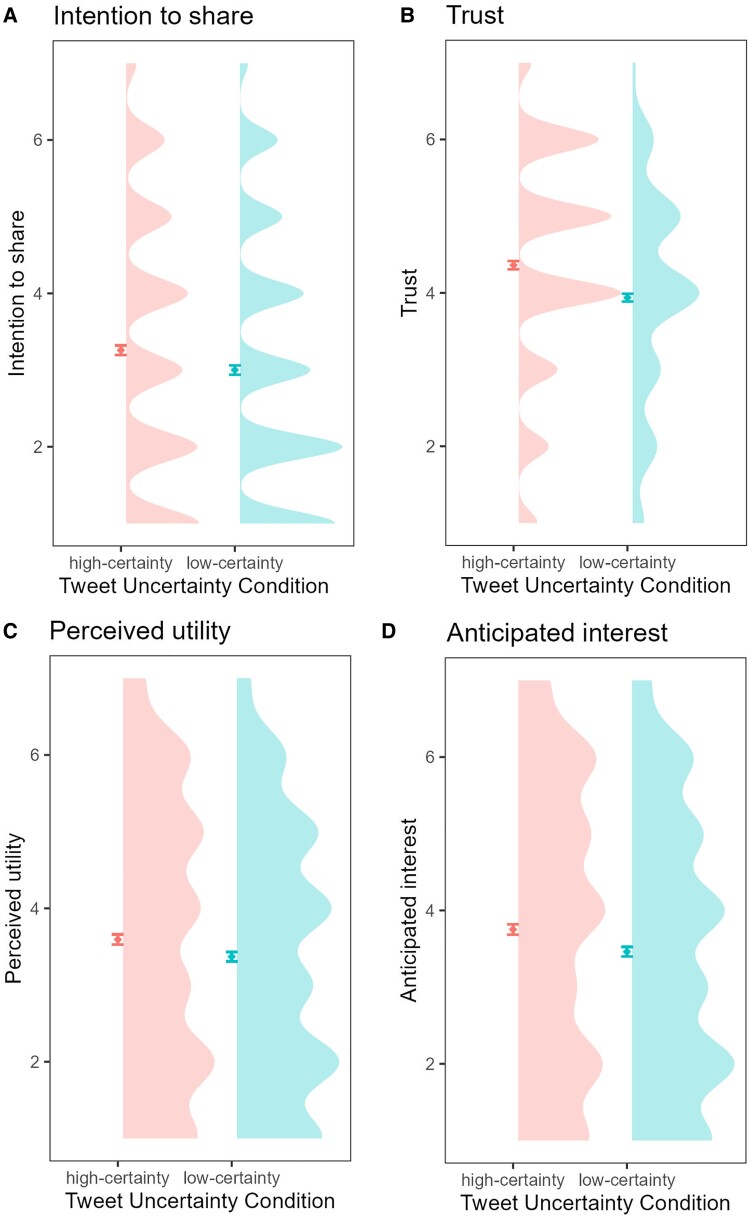
- In Study 2 (final N = 292), participants were less willing to share uncertain than certain messages (d = 0.22, P < 0.001), trusted uncertain messages less (d = 0.39, P < 0.001), anticipated them to be less useful (d = 0.17, P < 0.001), and less interesting to others (d = 0.21, P < 0.001).
- The manipulation check showed low-certainty messages were rated as less confident (M = 2.46, SD = 0.19) than high-certainty messages (M = 3.65, SD = 0.39), t(9) = 9.57, P < 0.001; participant confidence ratings correlated with model-based uncertainty at r = −0.91.
- In Study 1, follower count was the strongest nonlinguistic predictor: a 1 SD increase in follower count was associated with 66% more retweets; the effect of decreasing uncertainty by 1 SD on retweet count (∼4%) was equivalent to having 42,717 extra followers.
Methods
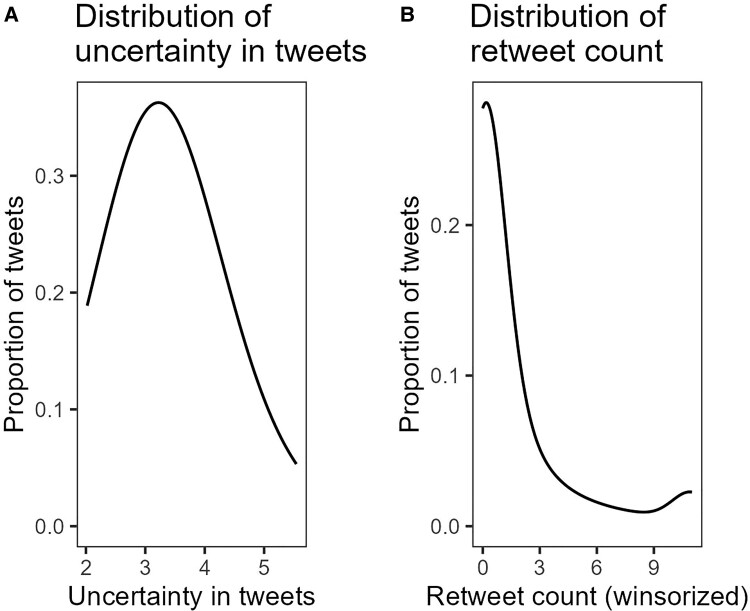
- Study 1: Downloaded 4,131,722 tweets posted November 2017–January 2023 via Twitter API v2 using research-related keywords; after cleaning, retained 2,441,158 unique tweets. Used 10% for exploratory analyses and 90% holdout for preregistered confirmatory analyses. Uncertainty was measured with a SciBERT-based NLP model scored 1–7 and reverse-coded; outcome was retweet count. Main analysis used multilevel negative binomial regressions with random intercepts for tweet authors and a random slope for tweet-level uncertainty, plus controls.
- Study 2: Recruited 300 Prolific participants; 7 failed an attention check, leaving 292. From Study 1, 10 messages were selected and ChatGPT generated high- and low-certainty versions. Each participant read five high-certainty and five low-certainty messages; each message was rated by 30 participants. Multilevel models with random intercepts for participants and tweets tested effects on intention to share, trust, perceived utility, and anticipated interest.
- Both studies were preregistered.
Limitations
- Stated: The authors did not formally test mediation because of limitations of cross-sectional mediation analysis; Study 1 was observational and could not ascertain causality; the methods did not distinguish verbal from numerical/technical uncertainty, and the uncertainty measure was closest to verbal uncertainty; consensus uncertainty was not investigated.
- Stated/evident: Study 2 measured intention to share rather than actual sharing behavior, and used 292 Prolific participants and 10 LLM-generated stimuli, which may limit generalizability.
- Evident: Study 1 relied on Twitter/X data from 2017–2023 and keyword-based sampling, so findings may not represent all online science communication; retweet count is only one measure of diffusion.
Model-written summary. Check it against the paper before relying on it.
Integrity signals
Registry
Cites
Statistics
Figures
Verification
Claims the paper makes
4 Valid · 3 Not valid · 25 Not checked · 54 Own results and interpretations
At least one cited source doesn’t support this claim or points to a different paper, and none confirmed it — see the verdicts below.
In the paper
“anticipated them to be less useful (d = 0.17, P < 0.001)”
- Also stated in: § General discussion · plain
“we documented lower trust, less perceived utility and diminished interest in uncertain (vs. certain) versions of the same message.”
§ Expressions of uncertainty in online science communication hinder information diffusion > Results
What the sources say
- Disputedcites [9] Van Der Bles AM, van der Linden S, Freeman AL, Spiegelhalter DJ. 2020. The effects of communicating uncertainty on public trust in facts and numbers. Proc Natl Acad Sci U S A. 117: 7672– 7683. 32205438 PMC7149229 sourceExperimental — accuracy not yet measured
Our copy contains no measure of participants' anticipated 'usefulness' of the messages: the dependent variables in Experiment 1 (Materials and Methods, Experiment 1, Measures) and the later experiments are perceived uncertainty, trust in numbers, trust in source, competence, affect and recall. The only d = 0.17 the paper reports is in Results (Experiment 1, trust-in-numbers paragraph): the numerical-vs-control comparison (M = 4.31 vs. 4.52, Mdiff = -0.21, 95% CI [-0.43; 0.01], d = 0.17), explicitly described as 'no significant difference' — contrary to attributing d = 0.17 with P < 0.001 to this source. The Discussion likewise states that numerical uncertainty did not substantially decrease trust and that uncertainty 'never significantly increased perceived trust or reliability either', so the paper does not support an anticipated-usefulness effect of this size and significance. (LLM, conf=0.65)
Checked by a reasoning model — may be wrong.
plainn = 2,920 ·- Asserted: passes — The authors put it forward as true.
- Checkable: passes — It can be checked against evidence.
- Load-bearing: passes — The paper’s conclusions depend on it.
- Based: passes — The paper gives a reason why it holds.
- Also stated in: § General discussion · plain
Every source the paper cites for this claim was checked and supports it.
In the paper
“Also, online comments to New York Times articles featuring a higher prevalence of uncertain language were less likely to garner recommendations from readers (14).”
§ Expressions of uncertainty in online science communication hinder information diffusion > Uncertainty in science communication and beyond
What the sources say
- Supportedcites [14] Evans AM, Stavrova O, Rosenbusch H, Brandt MJ. 2021. Expressions of doubt in online news discussions. Soc Sci Comput Rev. 41: 163– 180. source
The Conclusion (p. 15) states that New York Times comments containing doubtful language received fewer user recommendations. The Importance of Being Doubtful (p. 14) reports that a one-standard-deviation increase in doubtful language was associated with a 7% decrease in recommendations. (LLM, conf=0.94)
plainstates an association- Asserted: passes — The authors put it forward as true.
- Checkable: passes — It can be checked against evidence.
- Load-bearing: passes — The paper’s conclusions depend on it.
- Based: passes — The paper gives a reason why it holds.
- Supported
The cited sources that could be checked couldn’t confirm or dispute this claim.
In the paper
“and less interesting to others (d = 0.21, P < 0.001).”
- Also stated in: § General discussion · plain
“we documented lower trust, less perceived utility and diminished interest in uncertain (vs. certain) versions of the same message.”
§ Expressions of uncertainty in online science communication hinder information diffusion > Results
What the sources say
- Could not verifycites [9] Van Der Bles AM, van der Linden S, Freeman AL, Spiegelhalter DJ. 2020. The effects of communicating uncertainty on public trust in facts and numbers. Proc Natl Acad Sci U S A. 117: 7672– 7683. 32205438 PMC7149229 sourceExperimental — accuracy not yet measured
Our copy of van der Bles et al. (2020) reports no measure of anticipated interestingness to others: the outcome measures listed in Materials and Methods (Experiment 1 and Experiment 5 sections) are perceived uncertainty, trust in the number, trust in the source/statisticians, competence, trust in the journalist/article, and affect on a feeling thermometer, and the Results sections (pp. on Experiments 1-5) discuss only those trust- and uncertainty-related outcomes. The only 'd = 0.21' in our copy is a sensitivity-analysis detectability threshold for experiment 4 in the Discussion ('f = 0.107, d = 0.21'), alongside the statement that the smallest effects of interest reported are broadly d = 0.26 to 0.72, so the cited statistic cannot be located as a reported effect. Searched: 'interesting to others', 'how interesting would the information be to other people', 'anticipated interest/boring/engaging', and 'd = 0.21 P < 0.001'; nothing in our copy addresses or contradicts the claim's point directly, so it is neither supported nor refuted here. (LLM, conf=0.70)
plainn = 2,920 ·- Asserted: passes — The authors put it forward as true.
- Checkable: passes — It can be checked against evidence.
- Load-bearing: passes — The paper’s conclusions depend on it.
- Based: passes — The paper gives a reason why it holds.
- Also stated in: § General discussion · plain
The cited sources support only part of this claim — read each source’s verdict below.
In the paper
“trusted uncertain messages less (d = 0.39, P < 0.001)”
- Also stated in: § General discussion · plain
“we documented lower trust, less perceived utility and diminished interest in uncertain (vs. certain) versions of the same message.”
§ Expressions of uncertainty in online science communication hinder information diffusion > Results
What the sources say
- Partly supportedcites [9] Van Der Bles AM, van der Linden S, Freeman AL, Spiegelhalter DJ. 2020. The effects of communicating uncertainty on public trust in facts and numbers. Proc Natl Acad Sci U S A. 117: 7672– 7683. 32205438 PMC7149229 sourceExperimental — accuracy not yet measured
Our copy supports the direction only for part of the claim: the Internal Metaanalysis (Results) reports an overall significant decrease in trust in numbers with uncertainty communication (d = −0.34) and a small decrease in trust in the source (d = −0.12), but explicitly states these effects 'seem to be driven by verbal uncertainty' (d = −0.55 and −0.21) rather than numeric uncertainty (d = −0.15 and −0.03). Experiment 1 (Results) and Experiments 2–5 show no significant decrease for numerical uncertainty versus the certain control condition, and the Discussion concludes numeric ranges 'did not substantially decrease trust' — so the unqualified statement that participants trusted uncertain messages less than certain ones overstates the source. No comparison in our copy of uncertain versus certain/certain-control messages carries the attributed statistic d = 0.39 with P < 0.001 (the only d = 0.39 values are the Experiment 3 'estimated +/−' versus 'estimated' source-trust contrast and the Experiment 1 verbal-versus-numeric Mdiff = −0.39, d = 0.31). (LLM, conf=0.78)
plainstates an associationn = 2,920 ·- Asserted: passes — The authors put it forward as true.
- Checkable: passes — It can be checked against evidence.
- Load-bearing: passes — The paper’s conclusions depend on it.
- Based: passes — The paper gives a reason why it holds.
- Also stated in: § General discussion · plain
A result the paper reports from its own data — it cites no other source for it, so there is none to check. The quote shows it is in the paper.
In the paper
“This comparison showed that, for the same user, tweets with a 1 SD higher moral–emotional language score or a 1 SD higher negative emotion language received about 1.6 and 0.3% more retweets, respectively”
§ Expressions of uncertainty in online science communication hinder information diffusion > Results
plainstates an association- Asserted: passes — The authors put it forward as true.
- Checkable: passes — It can be checked against evidence.
- Load-bearing: unclear — It is unclear whether the paper’s conclusions depend on it.
- Based: passes — The paper gives a reason why it holds.
- Rests on an assumption not shown here.
47 more claims
Create a free account to see all 86 claims and to verify the 50 references still open.
- Probably not a substantial claim. 24
- The quote only partly states this claim. 3
- It may state two separate claims as one. 11
Claims other papers make about this one
Each is checked against this paper’s own text: does it say what the citing paper says it does?
The cited source doesn’t support the claim as written.
In the citing paper
“prior work has shown that experimental manipulations of doubtful language in science communication messages leads to greater public engagement22,63.”
From Scientific publications that use promotional language in the abstract receive more citations and public attention (2025) · cites this paper as [63]
Checked by a reasoning model — may be wrong.
Experimental — accuracy not yet measuredThe cited source doesn’t support the claim as written.
In the citing paper
“prior work has shown that experimental manipulations of doubtful language in science communication messages leads to greater public engagement22,63.”
From Scientific publications that use promotional language in the abstract receive more citations and public attention (2025) · cites this paper as [22]
Checked by a reasoning model — may be wrong.
Experimental — accuracy not yet measuredThe cited source says what the claim attributes to it.
In the citing paper
“Most importantly, recent studies have shown that incorporating uncertain language in science communication reduces trust in the message content as well as in its source, and even hinders information diffusion20–22.”
From Scientific publications that use promotional language in the abstract receive more citations and public attention (2025) · cites this paper as [22]
The check wasn’t confident either way, so it gives no verdict — never disputed.
In the citing paper
“there are theoretical grounds to suggest that the use of promotional language enhances impact by amplifying perceptions of novelty and importance—key factors influencing academic success.”
From Scientific publications that use promotional language in the abstract receive more citations and public attention (2025) · cites this paper as [63]
Experimental — accuracy not yet measured
Statistics recomputed
Every reported test result, recomputed from its test statistic and degrees of freedom. A result shows as not adding up only once an independent check has confirmed it.
- Consistentt(9) = 15.91reported p < .001 · recomputed p < .001
“t(9) = 15.91, p < .001”
- Consistentt(9) = 9.57reported p < .001 · recomputed p < .001
“t(9) = 9.57, p < .001”
Self-check
Percentages, sums and reported differences re-computed from the paper’s own numbers.
Each contradiction between two passages listed here was confirmed by an independent check.
Rated minor: it would not touch a result — a value no result rests on, a p-value that stays on the same side of the significance level, or a conflict that is clerical, resolved elsewhere in the paper, or outside its own findings.
In the paper
§ Expressions of uncertainty in online science communication hinder information diffusion > Methods > Dataset
“Note: Model-based uncertainty ranged from 1 = very uncertain to 7 = very certain (M = 3.33, SD = 0.53).”
§ Expressions of uncertainty in online science communication hinder information diffusion > Methods > Measures
“We reverse-coded the score such that higher values indicate more uncertainty and refer to this measure as model-based uncertainty.”
Rated minor: it would not touch a result — a value no result rests on, a p-value that stays on the same side of the significance level, or a conflict that is clerical, resolved elsewhere in the paper, or outside its own findings.
In the paper
§ Expressions of uncertainty in online science communication hinder information diffusion > Methods > Measures
“Twelve participants did not pass an attention check asking them to select a specific response instead of answering the question and were removed. To maximize inter-rater reliability, each participant rated 10 tweets and each tweet was rated by 25 participants (45).”
§ Expressions of uncertainty in online science communication hinder information diffusion > Methods > Measures
“We selected 100 tweets from the exploratory sample (50 tweets with the highest and 50 with the lowest certainty scoreb). We then recruited 252 participants from Prolific Academic and asked them to rate the tweets on uncertainty.”
Rated minor: it would not touch a result — a value no result rests on, a p-value that stays on the same side of the significance level, or a conflict that is clerical, resolved elsewhere in the paper, or outside its own findings.
In the paper
§ Expressions of uncertainty in online science communication hinder information diffusion > Methods > Procedure and measures
“Overall, each participant read five high-certainty and five low-certainty messages, and each message was rated by 30 participants.”
§ Expressions of uncertainty in online science communication hinder information diffusion > Results
“Note: N = 2,920; All coefficients are significant with P < 0.001; Perceived uncertainty (manipulation check) is recoded such that higher values indicate greater uncertainty.”
Rated minor: it would not touch a result — a value no result rests on, a p-value that stays on the same side of the significance level, or a conflict that is clerical, resolved elsewhere in the paper, or outside its own findings.
In the paper
§ Expressions of uncertainty in online science communication hinder information diffusion > Results
“analytic language (d = 0.27, P = 0.007) and positive emotion words (d = 0.49, P = 0.019) were positively—not negatively as in Study 1—associated with the intention to share.”
§ Expressions of uncertainty in online science communication hinder information diffusion > Results
“| Analytic language | −0.03 | −0.06–−0.01 | 0.007 | −0.02 | −0.04–0.00 | 0.073 | −0.02 | −0.05–0.00 | 0.106 | −0.02 | −0.04–0.01 | 0.270 |”
Citations
Cites
Language Models are Few-Shot Learners
Brown, T. B., Mann, B., Ryder, N., Subbiah, M., Kaplan, J., Dhariwal, P., Neelakantan, A., Shyam, P., Sastry, G., Askell, A., et al. (2020) · arXiv · doi:10.48550/arxiv.2005.14165 · Cited by 23,372
Kaugeranna, R., Kaugeranna, E., & Aion, (. S. 4. 6. (2023) · DROPS (Schloss Dagstuhl – Leibniz Center for Informatics) · doi:10.4230/lipics.giscience.2023.43 · Cited by 13,690
The spread of true and false news online
Vosoughi, S., Roy, D., & Aral, S. (2018) · Science · doi:10.1126/science.aap9559 · Cited by 8,847 · cited 1×
“This raises the question of whether any rapidly spreading online information, such as misinformation and fake news (63), likely contains more certain language.”
BackgroundEmotion shapes the diffusion of moralized content in social networks
Brady, W. J., Wills, J. A., Jost, J. T., Tucker, J. A., & Van Bavel, J. J. (2017) · Proceedings of the National Academy of Sciences · doi:10.1073/pnas.1618923114 · Cited by 1,580 · cited 4×
“These effects held up when we controlled for other linguistic features shown to play an important role in information diffusion (here: moral and emotional words, negativity) (32, 48), as well as users’ follower counts and tweet publication date.”
BackgroundMethodResultInfluentialPennycook, G., & Rand, D. G. (2021) · Trends in Cognitive Sciences · doi:10.1016/j.tics.2021.02.007 · Cited by 1,360
Judd, C. M., Westfall, J., & Kenny, D. A. (2012) · Journal of Personality and Social Psychology · doi:10.1037/a0028347 · Cited by 1,236 · cited 1×
“The study used a mixed design where participants and messages were treated as random effects (49).”
MethodShifting attention to accuracy can reduce misinformation online
Pennycook, G., Epstein, Z., Mosleh, M., Arechar, A. A., Eckles, D., & Rand, D. G. (2021) · Nature · doi:10.1038/s41586-021-03344-2 · Cited by 1,155
Eysenbach, G. (2011) · Journal of Medical Internet Research · doi:10.2196/jmir.2012 · Cited by 1,083
Out-group animosity drives engagement on social media
Rathje, S., Van Bavel, J. J., & van der Linden, S. (2021) · Proceedings of the National Academy of Sciences · doi:10.1073/pnas.2024292118 · Cited by 560
Morality and competence in person- and self-perception
Wojciszke, B. (2005) · European Review of Social Psychology · doi:10.1080/10463280500229619 · Cited by 553 · cited 1×
“Models of social perception suggest that besides competence, attributions of morality (including trustworthiness and honesty) dominate social perception (25).”
Background
Research works printed but not linked: 2
- Pei J, Jurgens D. 2021. Measuring sentence-level and aspect-level (un)certainty in science communications. Proceedings of the 2021 Conference on Empirical Methods in Natural Language Processing, November 7–11, 2021, Virtual Event / Punta Cana, Dominican Republic. p. 9959–10011.
- Linguistic inquiry and word count: LIWC2015. Austin, TX: Pennebaker Conglomerates. www.LIWC.net, 2015.
Cited by
Stavrova, O., Kleinberg, B., Evans, A. M., & Ivanović, M. (2025) · Communications Psychology · doi:10.1038/s44271-025-00293-8 · Cited by 8
Self-citationForegrounding doctoral knowledge and knower in the age of Generative Artificial Intelligence
McKenna, S. (2025) · Transformation in Higher Education · doi:10.4102/the.v10i0.653 · Cited by 5
Wulandari, A., Nugroho, C., Wulan, R. R., Fitriawan, R. A., & Qathrunnada, Z. (2026) · Cogent Social Sciences · doi:10.1080/23311886.2026.2717796 · Cited by 1
Expertise scientifique, débat public et décisions de sécurité sanitaire
Oualikene-Gonin, W., Castel, P., Paccaud, F., Maison, P., & Ankri, J. (2025) · Bulletin de l Académie Nationale de Médecine · doi:10.1016/j.banm.2025.10.014 · Cited by 1
The measurement of uncertainty in science communication: A scoping review
Liao, Y. (2026) · Public Understanding of Science · doi:10.1177/09636625251412716 · Cited by 1
Measuring and Analyzing Subjective Uncertainty in Scientific CommunicationsPreprint
Sourati, J., & Shao, G. (2025) · arXiv (Cornell University) · doi:10.48550/arxiv.2503.21114 · Cited by 1
The gendered effects of reputational shocks in team-based production environmentsPreprint
Bello, P., Carrer, L., & Casarico, A. (2026) · SSRN Electronic Journal · doi:10.2139/ssrn.7162420
Engaging with uncertainty when engagement is uncertain
Altimir, N. (2026) · Frontiers in Bioinformatics · doi:10.3389/fbinf.2026.1801017
Hedging, ambiguity, and the rejection of misinformation: evidence from Chinese readers
Li, R., & Fu, C. (2026) · Frontiers in Psychology · doi:10.3389/fpsyg.2026.1880060
Conceptual Approaches to Uncertainty Communication in Materials AI: A Review Study
Nkosi, T., Molefe, L., Dlamini, S., Mokoena, A., & Ndlovu, K. (2025) · Journal of Artificial Intelligence for Materials Science · doi:10.68159/l397814019
Li, R., Chen, B., & Fu, C. (2026) · Journal of Multilingual and Multicultural Development · doi:10.1080/01434632.2026.2672748
Metadata
- Authors
- Stavrova, O., Kleinberg, B., Evans, A. M., & Ivanović, M.
- Affiliations
- Tilburg University (NL)
- Allstate (United States) (US)
- Institut za ispitivanje materijala IMS a.d. Beograd (RS)
- Corresponding author
- Stavrova, Olga
- Venue
- PNAS Nexus
- Publisher
- Oxford University Press (OUP)
- Published
- 2024-10-01
- Volume
- 3
- Issue
- 10
- Pages
- pgae439-pgae439
- ISSN
- 2752-6542 (ISSN-L)
- PMC
- PMC11489878
- OpenAlex
- W4403124114
- Semantic Scholar
- e5d388d4013ca82398ba91f1ea20ef82a909154e
- Cited by
- 9
- References
- 63
- Citations by year
- 2026: 5 · 2025: 4
- FWCI
- 2.50
- Type
- journal article
- Language
- en
- Open access
- gold
- doi.org
- Licence
- Locations
- PNAS Nexus (publishedVersion, cc-by-nc)
- PubMed Central (publishedVersion, cc-by-nc)
- Research portal (Tilburg University) (publishedVersion, cc-by-nc)
- PubMed (publishedVersion)
- MADOC (University of Mannheim) (submittedVersion, cc-by-nc)
- Topics
- Social Sciences › Library and Information Sciences › Academic Publishing and Open Access
- Social Sciences › Sociology and Political Science › Climate Change Communication and Perception
- Social Sciences › Sociology and Political Science › Misinformation and Its Impacts
- Keywords
- uncertainty communication, science communication, information dissemination, social media sharing, Twitter, large language models, public perception of science
About these checks
Registry, retraction, Cites and statistics results are computed, not judged, with one exception: a printed reference that no index lists is read once by a model before it counts as a citation error. Claims are extracted by a model and kept only when their quote appears verbatim in the text; each cited source is then checked, with a model’s help, for whether it says what the claim relies on. Those verdicts can be wrong — read the claim’s quote and the cited source before relying on one.
The claim verdicts this report counts are experimental: their accuracy is not yet measured.
A language model drew the claims from the paper on 2026-10-08, under version 3 of the claim definition (model deepseek-v4.1-flash, prompt extract-v3).
A second model labelled each claim on 2026-10-08 (model jev-1.13-20260917, definition revision gold-guideline-v0.2).
Cited sources are checked with a language model’s help (qwen3.8-omni-flash and gpt-6-sol).
Statistics and arithmetic are recomputed, not judged.
Confidence bands are shown only for fields calibrated on our annotated test set. None is calibrated yet, so no band is shown.
What counts as a claim ›How we measure confidence ›How we check this ›
Are you an author, or do you see a problem with this page? Request a review
Data sources
Bibliographic data: Semantic Scholar, OpenAlex, Crossref.
Contains information from the Semantic Scholar Academic Graph Datasets, made available under the ODC Attribution License (ODC-BY 1.0).
Semantic Scholar’s data is described in: Kinney, R., et al. (2023). The Semantic Scholar Open Data Platform. arXiv:2301.10140.
