

The relationship between alcohol use and long-term cognitive decline in middle and late life: a longitudinal analysis using UK Biobank
Open accessThe DOI matches its Crossref record; 45 of the 45 references it cites were found in a registry or an index.
Abstract
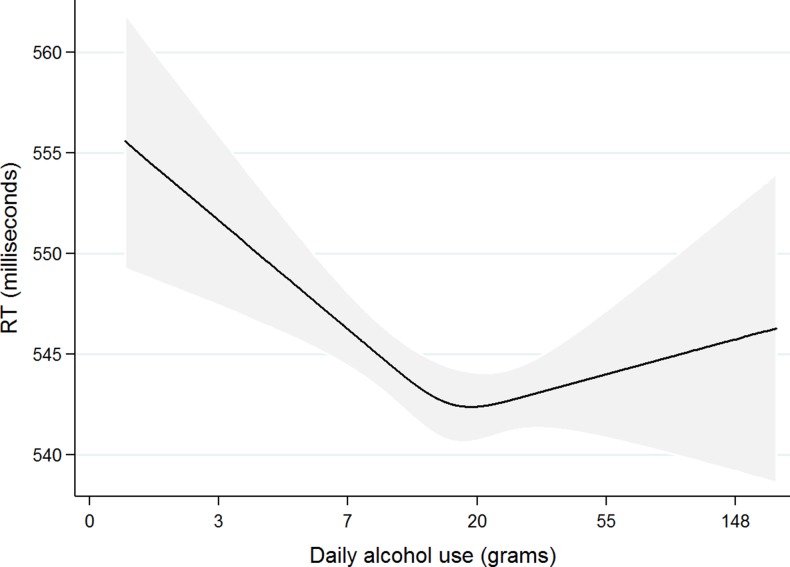
Background: Using UK Biobank data, this study sought to explain the causal relationship between alcohol intake and cognitive decline in middle and older aged populations. Methods: Data from 13 342 men and women, aged between 40 and 73 years were used in regression analysis that tested the functional relationship and impact of alcohol on cognitive performance. Performance was measured using mean reaction time (RT) and intra-individual variation (IIV) in RT, collected in response to a perceptual matching task. Covariates included body mass index, physical activity, tobacco use, socioeconomic status, education and baseline cognitive function. Results: A restricted cubic spline regression with three knots showed how the linear (β1 = -0.048, 95% CI: -0.105 to -0.030) and non-linear effects (β2 = 0.035, 95% CI: 0.007-0.059) of alcohol use on mean RT and IIV in RT (β1 = -0.055, 95% CI: -0.125 to -0.034; β2 = 0.034, 95% CI: 0.002-0.064) were significant adjusting for covariates. Cognitive function declined as alcohol use increased beyond 10 g/day. Decline was more apparent as age increased. Conclusions: The relationship between alcohol use and cognitive function is non-linear. Consuming more than one UK standard unit of alcohol per day is detrimental to cognitive performance and is more pronounced in older populations.
Overview
The claims and statistics of this paper haven’t been checked yet.
Free: it reads the open-access text and checks the first 5 claims that cite a source we can check. Create a free account to check every claim.
Integrity signals
Registry
Cites
Statistics
Figures
Verification
Claims the paper makes
The claims and statistics of this paper haven’t been checked yet.
Free: it reads the open-access text and checks the first 5 claims that cite a source we can check. Create a free account to check every claim.
Claims other papers make about this one
Each is checked against this paper’s own text: does it say what the citing paper says it does?
The source backs part of the claim, not all of it — or backs it for a different population, condition or comparison.
In the citing paper
“The study reported that those who drank more than 12 units per week declined slightly more in reaction time in a perceptual matching task than those who drank less (β2=−0·07, 95% CI −0·09 to −0·04).”
From Dementia prevention, intervention, and care: 2020 report of the Lancet Commission (2020) · cites this paper as [106]
Experimental — accuracy not yet measuredThe source backs part of the claim, not all of it — or backs it for a different population, condition or comparison.
In the citing paper
“Drinking less than 21 units of alcohol per week (1 unit of alcohol=10 mL or 8 g pure alcohol) might be associated with a lower risk of dementia.”
From Dementia prevention, intervention, and care: 2020 report of the Lancet Commission (2020) · cites this paper as [106]
Experimental — accuracy not yet measured
Self-check
Percentages, sums and reported differences re-computed from the paper’s own numbers.
The self-check needs the paper’s full text.
Citations
Cites
Sudlow, C., Gallacher, J., Allen, N., Beral, V., Burton, P., Danesh, J., Downey, P., Elliott, P., Green, J., Landray, M., et al. (2015) · PLOS Medicine · doi:10.1371/journal.pmed.1001779 · Cited by 12,728
Self-citationThe global prevalence of dementia: a systematic review and metaanalysis.
Prince, M., Bryce, R., Albanese, E., Wimo, A., Ribeiro, W., & Ferri, C. P. (2013) · Alzheimer's & Dementia · doi:10.1016/j.jalz.2012.11.007 · Cited by 4,941
McCance and Widdowson's The Composition of Foods
England, P. H. (2002) · Royal Society of Chemistry eBooks · doi:10.1039/9781849735551 · Cited by 2,209
Dose‐response analyses using restricted cubic spline functions in public health research
Desquilbet, L., & Mariotti, F. (2010) · Statistics in Medicine · doi:10.1002/sim.3841 · Cited by 1,980
Defeating Alzheimer's disease and other dementias: a priority for European science and society
Winblad, B., Amouyel, P., Andrieu, S., Ballard, C., Brayne, C., Brodaty, H., Cedazo-Minguez, A., Dubois, B., Edvardsson, D., Feldman, H., et al. (2016) · The Lancet Neurology · doi:10.1016/s1474-4422(16)00062-4 · Cited by 1,676
Townsend, P. (1987) · Journal of Social Policy · doi:10.1017/s0047279400020341 · Cited by 1,294
Holmes, M. V., Dale, C. E., Zuccolo, L., Silverwood, R. J., Guo, Y., Ye, Z., Prieto-Merino, D., Dehghan, A., Trompet, S., Wong, A., et al. (2014) · BMJ · doi:10.1136/bmj.g4164 · Cited by 669
Widespread and sustained cognitive deficits in alcoholism: a meta-analysis.
Stavro, K., Pelletier, J., & Potvin, S. (2013) · Addiction Biology · doi:10.1111/j.1369-1600.2011.00418.x · Cited by 594
Mechanisms of Neurodegeneration and Regeneration in Alcoholism
Crews, F. T., & Nixon, K. (2009) · Alcohol and Alcoholism · doi:10.1093/alcalc/agn079 · Cited by 571
Alcohol, dementia and cognitive decline in the elderly: a systematic review
Peters, R., Peters, J., Warner, J., Beckett, N., & Bulpitt, C. (2008) · Age and Ageing · doi:10.1093/ageing/afn095 · Cited by 453
Cited by
Dementia prevention, intervention, and care: 2020 report of the Lancet Commission
Livingston, G., Huntley, J., Sommerlad, A., Ames, D., Ballard, C., Banerjee, S., Brayne, C., Burns, A., Cohen-Mansfield, J., Cooper, C., et al. (2020) · The Lancet · doi:10.1016/s0140-6736(20)30367-6 · Cited by 10,430
RetractedAssociation of relative brain age with tobacco smoking, alcohol consumption, and genetic variants
Ning, K., Zhao, L., Matloff, W. J., Sun, F., & Toga, A. W. (2020) · Scientific Reports · doi:10.1038/s41598-019-56089-4 · Cited by 176
Neurocognitive consequences of chronic cannabis use: a systematic review and meta-analysis
Figueiredo, P. R., Tolomeo, S., Steele, J. D., & Baldacchino, A. (2020) · Neuroscience & Biobehavioral Reviews · doi:10.1016/j.neubiorev.2019.10.014 · Cited by 144
Lovell, M. E., Akhurst, J., Padgett, C., Garry, M. I., & Matthews, A. (2020) · Experimental and Clinical Psychopharmacology · doi:10.1037/pha0000326 · Cited by 100
Chronic tobacco smoking and neuropsychological impairments: A systematic review and meta-analysis
Conti, A. A., McLean, L., Tolomeo, S., Steele, J. D., & Baldacchino, A. (2018) · Neuroscience & Biobehavioral Reviews · doi:10.1016/j.neubiorev.2018.11.017 · Cited by 117
“Previous research demonstrated that these variables could affect negatively the cognitive ability of individuals (Mani et al., 2013; Murman, 2015; Piumatti, 2018;Salthouse 2009 ).”
Brennan, S., McDonald, S. J., Page, M. J., Reid, J. E. A., Ward, S. A., Forbes, A. B., & McKenzie, J. E. (2020) · Systematic Reviews · doi:10.1186/s13643-019-1220-4 · Cited by 80
Age-Related Differences in Brain Morphology and the Modifiers in Middle-Aged and Older Adults
Zhao, L., Matloff, W., Ning, K., Kim, H., Dinov, I. D., & Toga, A. W. (2019) · Cerebral Cortex · doi:10.1093/cercor/bhy300 · Cited by 68
“2017), and cognitive functions (Mukamal et al. 2003; Stampfer et al. 2005; Piumatti et al. 2018), that is, com-”
BackgroundAssociations between alcohol use and accelerated biological ageing
Bøstrand, S. M. K., Vaher, K., de Nooij, L., Harris, M. A., Cole, J. H., Cox, S. R., Marioni, R. E., McCartney, D. L., Walker, R. M., McIntosh, A. M., et al. (2021) · Addiction Biology · doi:10.1111/adb.13100 · Cited by 51
Sex and APOE genotype differences related to statin use in the aging population
Dagliati, A., Peek, N., Brinton, R. D., & Geifman, N. (2021) · Alzheimer's & Dementia: Translational Research & Clinical Interventions · doi:10.1002/trc2.12156 · Cited by 25
“A recent study (27) used the RT to assess cognitive decline relationship with alcohol consumption.”
MethodImpact of common ALDH2 inactivating mutation and alcohol consumption on Alzheimer’s disease
Seike, T., Chen, C., & Mochly‐Rosen, D. (2023) · Frontiers in Aging Neuroscience · doi:10.3389/fnagi.2023.1223977 · Cited by 28
“An analysis of 13,342 individuals aged 40 to 73 years using UK Biobank data showed that alcohol consumption exceeding 1 drink per day was associated with a significant cognitive decline (Piumatti et al., 2018).”
MethodZheng, J.-W., Ai, S., Chang, S., Meng, S., Shi, L., Deng, J., Di, T.-Q., Liu, W.-Y., Chang, X.-W., Yue, J.-L., et al. (2024) · Molecular Psychiatry · doi:10.1038/s41380-023-02375-7 · Cited by 27
Cumulative life course adversity, mental health, and cognition in the UK biobank
Künzi, M., Gheorghe, D. A., Kliegel, M., Ballhausen, N., Gallacher, J., & Bauermeister, S. (2022) · Scientific Reports · doi:10.1038/s41598-022-18928-9 · Cited by 28
Self-citationLinli, Z., Rolls, E. T., Zhao, W. D., Kang, J., Feng, J., & Guo, S. (2022) · Progress in Neuro-Psychopharmacology and Biological Psychiatry · doi:10.1016/j.pnpbp.2022.110698 · Cited by 26
“…sex (Gennatas et al., 2017), handedness (Jang et al., 2017), ethnicity (Tang et al., 2010), body-mass index (BMI) (Hamer and Batty, 2019), alcohol drinking frequency (Piumatti et al., 2018; Zahr and Pfefferbaum, 2017), imaging sites (Alfaro-Almagro et al., 2021), and TIV (Barnes et al., 2010).”
BackgroundGrønkjær, M. S., Flensborg‐Madsen, T., Osler, M., Sørensen, H. J., Becker, U., & Mortensen, E. L. (2019) · Alcohol and Alcoholism · doi:10.1093/alcalc/agz038 · Cited by 21
Chen, X., Liu, Z., Sachdev, P. S., Kochan, N. A., O’Leary, F., & Brodaty, H. (2021) · Journal of the Academy of Nutrition and Dietetics · doi:10.1016/j.jand.2021.10.018 · Cited by 22
Exploring Successful Cognitive Aging: Insights Regarding Brain Structure, Function, and Demographics
Xu, X., Lin, L., Wu, S., & Sun, S. (2023) · Brain Sciences · doi:10.3390/brainsci13121651 · Cited by 22
“While these software packages are valuable tools, the potential for processing-related biases should be considered when interpreting the results.”
MethodElatfy, A., Vrahimis, S., Conti, A. A., & Baldacchino, A. (2024) · Frontiers in Psychiatry · doi:10.3389/fpsyt.2024.1384408 · Cited by 17
Flanigan, M. R., Royse, S. K., Cenkner, D. P., Kozinski, K. M., Stoughton, C., Himes, M. L., Minhas, D. S., Lopresti, B. J., Butters, M. A., & Narendran, R. (2021) · Translational Psychiatry · doi:10.1038/s41398-021-01374-y · Cited by 17
Khan, J. (2022) · Scientific Reports · doi:10.1038/s41598-022-25563-x · Cited by 17
A Machine Learning Approach towards Detecting Dementia based on its Modifiable Risk Factors
Bin-Hezam, R., & Tomas, E. (2019) · International Journal of Advanced Computer Science and Applications · doi:10.14569/ijacsa.2019.0100820 · Cited by 17
The impact of early adversity on later life health, lifestyle, and cognition
Künzi, M., Gheorghe, D. A., Gallacher, J., & Bauermeister, S. (2024) · BMC Public Health · doi:10.1186/s12889-024-20768-3 · Cited by 18
Self-citationChen, S., Chen, S., Hanewald, K., Si, Y., Bateman, H., Li, B., Xu, X., Samtani, S., Wu, C., & Brodaty, H. (2024) · The Journals of Gerontology Series A · doi:10.1093/gerona/glae128 · Cited by 12
Animal models for studies of alcohol effects on the trajectory of age-related cognitive decline
Foster, T. C. (2022) · Alcohol · doi:10.1016/j.alcohol.2022.04.005 · Cited by 12
Tian, Y. M., Zhang, W. S., Jiang, C. Q., Zhu, F., Jin, Y. L., Zhu, T., Cheng, K. K., & Xu, L. (2022) · BMC Psychiatry · doi:10.1186/s12888-022-04298-z · Cited by 11
Li, C., Gheorghe, D. A., Gallacher, J., & Bauermeister, S. (2020) · Evidence-Based Mental Health · doi:10.1136/ebmental-2020-300147 · Cited by 12
Self-citationCould Alcohol-Related Cognitive Decline Be the Result of Iron-Induced Neuroinflammation?
Wilcockson, T. D. W., & Roy, S. (2024) · Brain Sciences · doi:10.3390/brainsci14060520 · Cited by 9
“Heavy drinking was also associated with shrinkage in the right hippocampus, a brain region crucial for memory, as observed by MRI scans [3,9].”
BackgroundCalvin, C. M., Hagenaars, S. P., Gallacher, J., Harris, S. E., Davies, G., Liewald, D. C. M., Galé, C. R., & Deary, I. J. (2019) · Scientific Reports · doi:10.1038/s41598-018-36629-0 · Cited by 10
Self-citationA perspective on autophagy and transcription factor EB in Alcohol-Associated Alzheimer’s disease
Zhang, C., Chen, H., Rodriguez, Y., Ma, X., Swerdlow, R. H., Zhang, J., & Ding, W. (2023) · Biochemical Pharmacology · doi:10.1016/j.bcp.2023.115576 · Cited by 8
Resistance and Resilience to Alzheimer's Disease
Latimer, C. S., Prater, K. E., Postupna, N. O., & Keene, C. D. (2023) · Cold Spring Harbor Perspectives in Medicine · doi:10.1101/cshperspect.a041201 · Cited by 8
Mazumder, A. H., Barnett, J. H., Lindberg, N., Torniainen‐Holm, M., Lähteenvuo, M., Lahdensuo, K., Kerkelä, M., Hietala, J. A., Isometsä, E. T., Kampman, O., et al. (2021) · Brain Sciences · doi:10.3390/brainsci11060688 · Cited by 7
The Long-Term Effects of Early-Life Adversity on Health, Lifestyle, and Cognition
Ahn, S., Kim, S., Zhang, H., Dobalian, A., & Slavich, G. M. (2025) · Bulletin of pioneering researches of medical and clinical science · doi:10.51847/6zhsvrwk26 · Cited by 5
Chen, H., Hinz, K., Zhang, C., Rodriguez, Y., Williams, S. N., Niu, M., Ma, X., Chao, X., Frazier, A. L., McCarson, K. E., et al. (2024) · Biomolecules · doi:10.3390/biom14121537 · Cited by 6
“Extensive clinical studies strongly support a link between alcohol use disorders with AD and ADRD [4,5].”
Does habitual moderate alcohol consumption enhance working memory performance?
Cansino, S., Torres-Trejo, F., Estrada-Manilla, C., & Ruiz‐Velasco, S. (2023) · Current Psychology · doi:10.1007/s12144-023-05459-3 · Cited by 4
“Alcohol consumption has been associated with faster perceptual processing when measured by paper-and-pencil instruments (Kumari et al., 2014 ; Zanjani et al., 2013 ) but with slower processing when measured by reaction times (Piumatti et al., 2018).”
Kamsvaag, B., Bergh, S., Benth, J. Š., Selbæk, G., Tevik, K., & Helvik, A. (2021) · Aging & Mental Health · doi:10.1080/13607863.2021.1950618 · Cited by 5
Lee, Y., Bhurosy, T., Chang, Y., Liu, C., & Shelley, M. (2022) · Journal of Substance Use · doi:10.1080/14659891.2021.2022224 · Cited by 4
“Furthermore, in the UK, it has been suggested that consuming more alcohol than the UK standard for daily consumption might be detrimental to cognitive function, especially among older adults (Piumatti et al., 2018).”
BackgroundParodí, J. (2018) · Current Chemical Biology · doi:10.2174/2212796812666180710125905 · Cited by 3
Prävention demenzieller Erkrankungen
Schippinger, W., & Pichler, G. (2023) · Zeitschrift für Gerontologie und Geriatrie · doi:10.1007/s00391-023-02175-2 · Cited by 5
Kohli, M., Paolillo, E. W., Saloner, R., Umlauf, A., Ellis, R. J., & Moore, D. J. (2020) · Alcoholism Clinical and Experimental Research · doi:10.1111/acer.14379 · Cited by 3
“, roughly 14 grams of pure alcohol) per day, at which point performance worsened (Piumatti et al., 2018).”
BackgroundGrønkjær, M. S., Flensborg‐Madsen, T., Osler, M., Sørensen, H. J., Becker, U., & Mortensen, E. L. (2024) · Nutrients · doi:10.3390/nu16213714 · Cited by 2
Reaction Time and Visual Memory in Connection to Alcohol Use in Persons with Bipolar Disorder
Mazumder, A. H., Barnett, J. H., Isometsä, E. T., Lindberg, N., Torniainen‐Holm, M., Lähteenvuo, M., Lahdensuo, K., Kerkelä, M., Ahola‐Olli, A., Hietala, J. A., et al. (2021) · Brain Sciences · doi:10.3390/brainsci11091154 · Cited by 2
“Findings from normal population studies mostly suggest mild to moderate alcohol use not to be associated with cognitive impairment [30,31,32,33].”
BackgroundDementia and Cognitive Impairment
Chong, Y. F. V., & Tang, S. (2024) · Elsevier eBooks · doi:10.1016/b978-0-323-99967-0.00134-4 · Cited by 2
Bhusri, L., Bathla, M., Gupta, P., & Singh, A. H. (2021) · Journal of Datta Meghe Institute of Medical Sciences University · doi:10.4103/jdmimsu.jdmimsu_11_20 · Cited by 1
Younger, drunk, and fast: Paradoxical rapid reaction time in hazardous drinkers
Powell, A., Sumnall, H. R., & Montgomery, C. (2023) · Journal of Psychopharmacology · doi:10.1177/02698811231177216 · Cited by 1
“In addition, Piumatti et al. (2018) conducted a longitudinal analysis and found that RT was faster (improved) with every 1 g/day of alcohol but slowed as this increased beyond 10 g/day, with increasing age also identified as a factor in cognitive decline.”
MethodBaranger, D. A. A. (2018) · Open Scholarship Institutional Repository (Washington University in St. Louis) · doi:10.7936/2npp-kp25
Prävention demenzieller Erkrankungen
Schippinger, W., & Pichler, G. (2024) · Der Nervenarzt · doi:10.1007/s00115-024-01641-5
Adolescent Addictions and Risky Behaviors: Implications for Health
Fernández Martínez, M. E., Seabra, P., & Martínez Fernández, M. C. (2025) · Frontiers research topics · doi:10.3389/978-2-8325-6203-1
Trares, K. (2023) · heiDOK (Heidelberg University) · doi:10.11588/heidok.00032858
Tian, Y. M., Zhang, W. S., Jiang, C. Q., Zhu, F., Jin, Y. L., Zhu, T., Cheng, K. K., & Xu, L. (2022) · Figshare · doi:10.6084/m9.figshare.21456118
Ageing and Health: Navigating Disease, Care, and Prevention among Older People
Chen, S. (2024) · UNSWorks (UNSW Sydney) · doi:10.26190/unsworks/28776
A Life Course Approach to Understanding Preserved Cognition in Late Life
Doyle, C. E. (2025) · Digital Commons - University of South Florida (University of South Florida)
Kamsvaag, B., Bergh, S., Benth, J. Š., Voshaar, R. C. O., Tevik, K., Selbæk, G., & Helvik, A. (2026) · PLoS ONE · doi:10.1371/journal.pone.0340484
Older adult solitary drinking: associations with subjective and objective cognitive functioning
Skrzynski, C. J., & Bryan, A. D. (2026) · Frontiers in Aging Neuroscience · doi:10.3389/fnagi.2025.1678121
Zhang, W., Qiu, L., Liu, Y., Wang, Y., Tang, M., Chen, L., & Jiang, X. (2026) · Journal of Cerebral Blood Flow & Metabolism · doi:10.1177/0271678x261415785
“40,41”
Cuperfain, A. B., Pishdadian, S., Binns, M. A., Black, S. E., Chertkow, H. M., Freedman, M., Louis, J., Ma, C., Masellis, M., McLaughlin, P. M., et al. (2026) · Journal of Alzheimer s Disease · doi:10.1177/13872877261444995
Metadata
- Authors
- Piumatti, G., Moore, S. C., Berridge, D. M., Sarkar, C., & Gallacher, J.
- Affiliations
- University of Geneva (CH)
- Cardiff University (GB)
- Swansea University (GB)
- University of Hong Kong (HK)
- University of Oxford (GB)
- Corresponding author
- Piumatti, Giovanni
- Venue
- Journal of Public Health
- Publisher
- Oxford University Press (OUP)
- Published
- 2018-01-09
- Volume
- 40
- Issue
- 2
- Pages
- 304-311
- ISSN
- 0943-1853 (ISSN-L)
- 1741-3842
- 1741-3850
- PMC
- PMC6051452
- OpenAlex
- W2767464623
- Cited by
- 51
- References
- 45
- Citations by year
- 2026: 4 · 2025: 1 · 2024: 9 · 2023: 7 · 2022: 8 · 2021: 7 · 2020: 5 · 2019: 5 · 2018: 5
- FWCI
- 3.22
- Type
- journal article
- Language
- en
- Open access
- hybrid
- doi.org
- Licence
- Locations
- Journal of Public Health (publishedVersion, cc-by)
- Europe PMC (PubMed Central) (publishedVersion, cc-by)
- PubMed Central (publishedVersion, cc-by)
- PubMed (publishedVersion)
- Archive ouverte UNIGE (University of Geneva) (publishedVersion, other-oa)
- ORCA Online Research @Cardiff (Cardiff University) (acceptedVersion)
- The HKU Scholars Hub (University of Hong Kong) (submittedVersion, cc-by-nc-nd)
- Archive ouverte UNIGE (University of Geneva) (submittedVersion, cc-by)
- Funders
- Economic and Social Research Council (ES/L015471/1)
- DECIPHer a UKCRC Public Health Research Centre of Excellence
- British Heart Foundation
- Medical Research Council (WT087640MA)
- MRC Dementias Platform UK (MR/L023784/1, MR/009076/1)
- Topics
- Health Sciences › Medicine › Pathology and Forensic Medicine › Alcohol Consumption and Health Effects
- Health Sciences › Medicine › Psychiatry and Mental health › Dementia and Cognitive Impairment Research
- Health Sciences › Medicine › Epidemiology › Substance Abuse Treatment and Outcomes
- Keywords
- alcohol consumption, cognitive decline, middle-aged and older adults, reaction time, within-person variability, nonlinear dose-response relationship, aging, older adults, cognitive function
- MeSH terms
- Adult, Aged, Alcohol Drinking, Female, United Kingdom, Humans, Longitudinal Studies, Male, Middle Aged, Reaction Time, Risk Factors, Socioeconomic Factors, Task Performance and Analysis, Exercise, Body Mass Index, Cognitive Dysfunction, Tobacco Use
About these checks
Registry, retraction, Cites and statistics results are computed, not judged, with one exception: a printed reference that no index lists is read once by a model before it counts as a citation error. Claims are extracted by a model and kept only when their quote appears verbatim in the text; each cited source is then checked, with a model’s help, for whether it says what the claim relies on. Those verdicts can be wrong — read the claim’s quote and the cited source before relying on one.
Statistics and arithmetic are recomputed, not judged.
Confidence bands are shown only for fields calibrated on our annotated test set. None is calibrated yet, so no band is shown.
What counts as a claim ›How we measure confidence ›How we check this ›
Are you an author, or do you see a problem with this page? Request a review
Data sources
Bibliographic data: Semantic Scholar, OpenAlex, Crossref.
Contains information from the Semantic Scholar Academic Graph Datasets, made available under the ODC Attribution License (ODC-BY 1.0).
Semantic Scholar’s data is described in: Kinney, R., et al. (2023). The Semantic Scholar Open Data Platform. arXiv:2301.10140.
