

Morphological classification of radio galaxies with Wasserstein generative adversarial network-supported augmentation
Open accessThe DOI matches its Crossref record; 57 of the 58 references it cites were found in a registry or an index.
Abstract
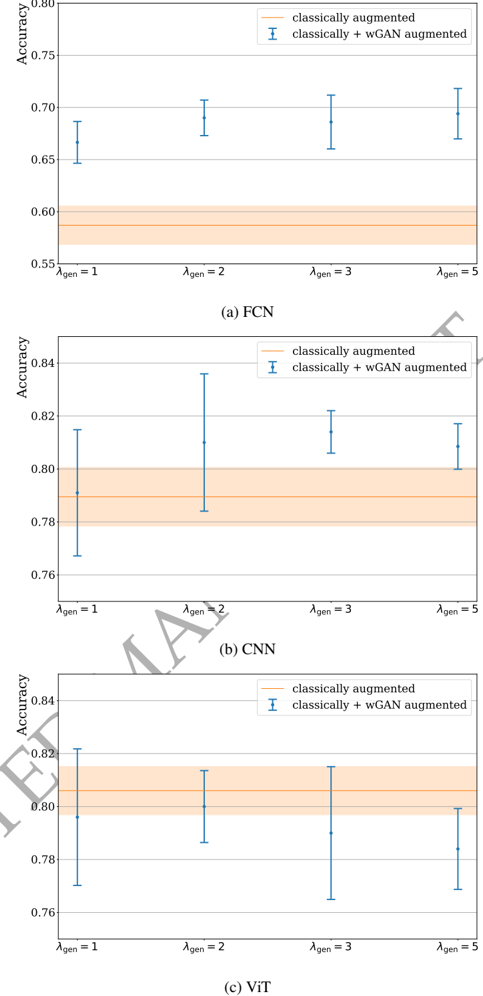
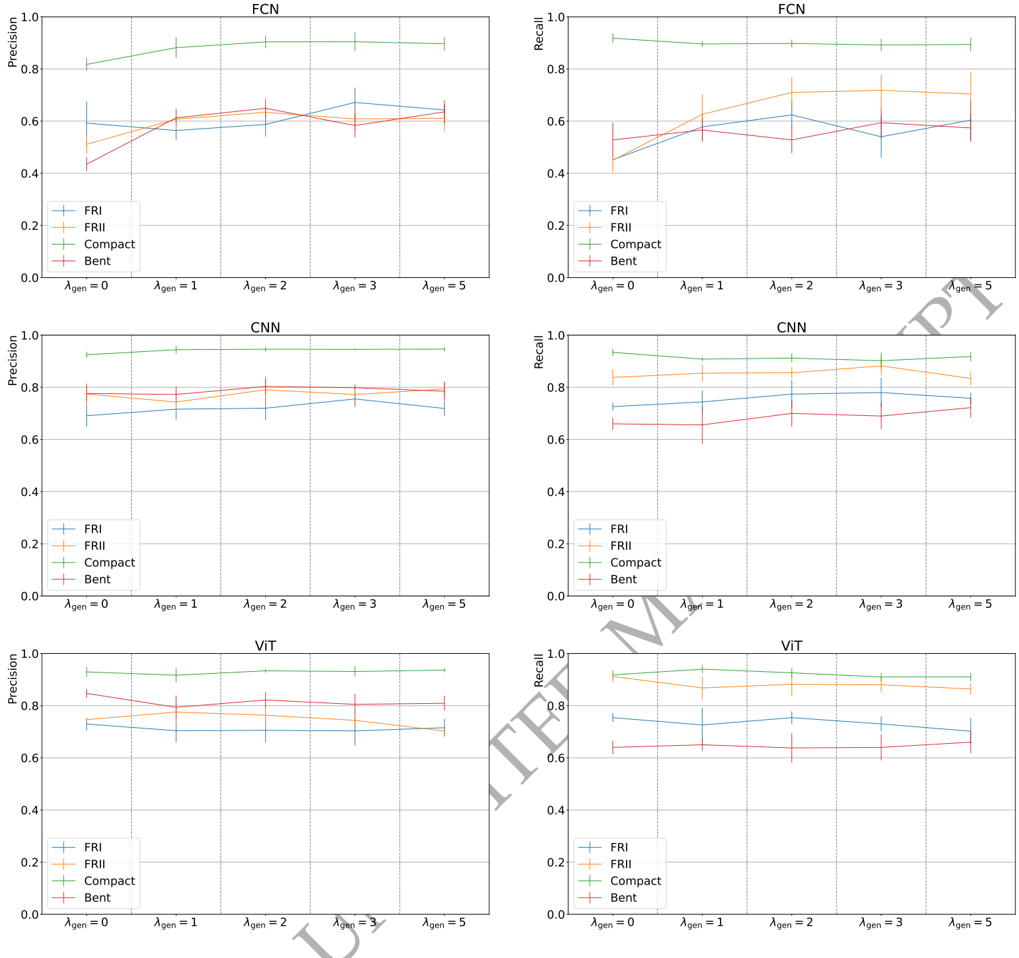
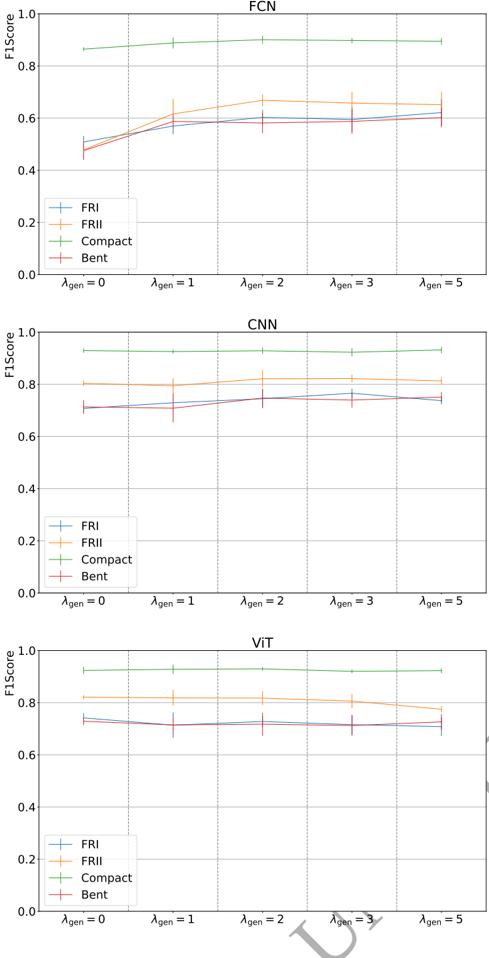
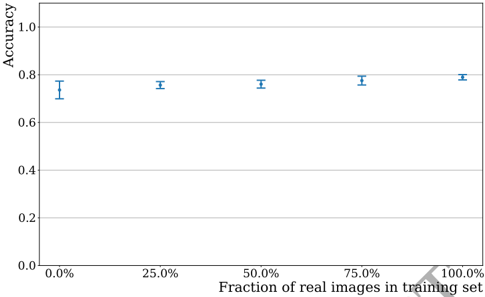
Machine learning techniques that perform morphological classification of astronomical sources often suffer from a scarcity of labelled training data. Here, we focus on the case of supervised deep learning models for the morphological classification of radio galaxies, which is particularly topical for the forthcoming large radio surveys. We demonstrate the use of generative models, specifically Wasserstein generative adversarial networks (wGANs), to generate data for different classes of radio galaxies. Further, we study the impact of augmenting the training data with images from our wGAN on three different classification architectures. We find that this technique makes it possible to improve models for the morphological classification of radio galaxies. A simple fully connected neural network benefits most from including generated images into the training set, with a considerable improvement of its classification accuracy. In addition, we find it is more difficult to improve complex classifiers. The classification performance of a convolutional neural network can be improved slightly. However, this is not the case for a vision transformer.
Overview
The claims and statistics of this paper haven’t been checked yet.
Free: it reads the open-access text and checks the first 5 claims that cite a source we can check. Create a free account to check every claim.
Integrity signals
Registry
Cites
Statistics
Figures
Verification
Claims the paper makes
The claims and statistics of this paper haven’t been checked yet.
Free: it reads the open-access text and checks the first 5 claims that cite a source we can check. Create a free account to check every claim.
Self-check
Percentages, sums and reported differences re-computed from the paper’s own numbers.
The self-check needs the paper’s full text.
Citations
Cites
Advances in Neural Information Processing Systems 19
(2007) · The MIT Press eBooks · doi:10.52202/085713 · Cited by 15,539
Unsupervised representation learning with deep convolutional generative adversarial networks
Radford, A., Metz, L., & Chintala, S. (2015) · arXiv · doi:10.48550/arxiv.1511.06434 · Cited by 12,235 · cited 1×
“Since we work with image data, it has proven to be the most promising approach to construct a wGAN setup based on convolutional layers (Radford et al. 2015).”
MethodTransformers in Vision: A Survey
Khan, S., Naseer, M., Hayat, M., Zamir, S. W., Khan, F. S., & Shah, M. (2022) · ACM Computing Surveys · doi:10.1145/3505244 · Cited by 3,595 · cited 3×
“…in natural language processing, like BERT (Devlin et al. 2018) and GPT (Radford et al. 2018, 2019; Brown et al. 2020), vision transformers are frequently used in computer vision tasks e.g. classification, object detection and segmentation (Khan et al. 2022; Shamshad et al. 2023; Ulhaq et al. 2022).”
BackgroundMethodThe FIRST Survey: Faint Images of the Radio Sky at Twenty Centimeters
Becker, R. H., White, R. L., & Helfand, D. J. (1995) · The Astrophysical Journal · doi:10.1086/176166 · Cited by 2,911 · cited 1×
“…Alhassan et al. (2018); Tang et al. (2019); Samudre et al. (2021); Maslej-Krešňáková et al. (2021) use Convolutional Neural Networks (CNNs) trained on data from the FIRST (Faint Images of the Radio Sky at Twenty-Centimeters) survey (Becker et al. 1995) for the classification of radio galaxies.”
MethodThe Morphology of Extragalactic Radio Sources of High and Low Luminosity
Fanaroff, B. L., & Riley, J. M. (1974) · Monthly Notices of the Royal Astronomical Society · doi:10.1093/mnras/167.1.31p · Cited by 2,759
LOFAR: The LOw-Frequency ARray
van Haarlem, M. P., Wise, M. W., Gunst, A. W., Heald, G., McKean, J. P., Hessels, J. W. T., de Bruyn, A. G., Nijboer, R., Swinbank, J., Fallows, R., et al. (2013) · Astronomy & Astrophysics · doi:10.1051/0004-6361/201220873 · Cited by 2,662
Self-citationLintott, C. J., Schawinski, K., Slosar, A., Land, K., Bamford, S., Thomas, D., Raddick, M. J., Nichol, R. C., Szalay, A., Andreescu, D., et al. (2008) · Monthly Notices of the Royal Astronomical Society · doi:10.1111/j.1365-2966.2008.13689.x · Cited by 1,488
Transformers in Medical Imaging: A SurveyPreprint
Shamshad, F., Khan, S. H., Zamir, S. W., Khan, M. H., Hayat, M., Khan, F., & Fu, H. (2022) · Medical Image Anal. · doi:10.48550/arxiv.2201.09873 · Cited by 1,386 · cited 2×
“classification, object detection and segmentation (Khan et al. 2022; Shamshad et al. 2023; Ulhaq et al. 2022).”
MethodHeating Hot Atmospheres with Active Galactic Nuclei
McNamara, B. R., & Nulsen, P. E. J. (2007) · Annual Review of Astronomy and Astrophysics · doi:10.1146/annurev.astro.45.051806.110625 · Cited by 1,326 · cited 1×
“Studying radio galaxies helps to understand the effects of massive black holes on their environment (see e.g. McNamara & Nulsen (2007)).”
BackgroundThe LOFAR Two-metre Sky Survey: II. First data release
Shimwell, T. W., Tasse, C., Hardcastle, M. J., Mechev, A. P., Williams, W. L., Best, P. N., Röttgering, H. J. A., Callingham, J. R., Dijkema, T. J., de Gasperin, F., et al. (2019) · Astronomy & Astrophysics · doi:10.1051/0004-6361/201833559 · Cited by 585 · cited 1×
“(2019);Shimwell&etal.”
Self-citation
Research works printed but not linked: 12
- 3. Arjovsky, M., Chintala, S., & Bottou, L., 2017. Wasserstein gan. Balakrishnan, V., Champion, D., Barr, E., Kramer, M., Sengar, R., & Bailes, M., 2021. Pulsar candidate identification using semi-supervised generat- ive adversarial networks, MNRAS, 505(1), 1180-1194.
- 7. Bieringer, S., Butter, A., Diefenbacher, S., Eren, E., Gaede, F., Hundhausen, D., Kasieczka, G., Nachman, B., Plehn, T., & Trabs, M., 2022. Calom- plification -the power of generative calorimeter models.
- 10. Bowles, M., Bromley, M., Allen, M., & Scaife, A., 2021. E(2) equivariant self-attention for radio astronomy. Downloaded from https://academic.oup.com/rasti/advance-article/doi/10.1093/rasti/rzad016/7180988 by guest on 28 May 2023 · doi:10.1093/rasti/rzad016/7180988
- Jonas, 2016, Proc. MeerKAT Sci.: On the Pathway to the SKA–PoS(MeerKAT2016), Vol. 277, The MeerKAT Telescope, 1
- 34. Krizhevsky, A., Sutskever, I., & Hinton, G. E., 2012. Imagenet classification with deep convolutional neural networks, in Proceedings of the 25th International Conference on Neural Information Processing Systems - Volume 1, NIPS'12, p. 1097-1105, Curran Associates Inc., Red Hook, NY, USA.
- 35. Kummer, J., Rustige, L., Griese, F., Borras, K., Brüggen, M., Connor, P. L. S., Gaede, F., Kasieczka, G., & Schleper, P., 2022. Radio galaxy clas- sification with wgan-supported augmentation, in INFORMATIK 2022, Lecture Notes in Informatics (LNI) -Proceedings, vol. P-326, pp. 469- 478, Gesellschaft für Informatik, Bonn.
- 38. Ma, Z., Zhu, J., Li, W., & Xu, H., 2018. Radio galaxy morphology generation using residual convolutional autoencoder and gaussian mixture models, in 25th IEEE ICIP, pp. 3044-3048.
- 40. Ma, Z., Zhu, J., Zhu, Y., & Xu, H., 2019. Radio galaxy morphology simulation via residual conditional variational autoencoder, in 15th International Conference on Computational Intelligence and Security (CIS), pp. 151- 155.
- 46. Mosiane, O., Oozeer, N., Aniyan, A., & Bassett, B. A., 2017. Radio Frequency Interference Detection using Machine Learning., in Materials Science and Engineering Conference Series, vol. 198 of Materials Science and Engineering Conference Series, p. 012012.
- 55. Radford, A., Narasimhan, K., Salimans, T., Sutskever, I., et al., 2018. Im- proving language understanding by generative pre-training.
- 56. Radford, A., Wu, J., Child, R., Luan, D., Amodei, D., Sutskever, I., et al., 2019. Language models are unsupervised multitask learners, OpenAI blog, 1(8), 9.
- 67. Slijepcevic, I. V., Scaife, A. M. M., Walmsley, M., & Bowles, M., 2022b. Learning useful representations for radio astronomy "in the wild" with contrastive learning.
Cited by
Advances on the morphological classification of radio galaxies: A review
Ndung'u, S., Grobler, T., Wijnholds, S. J., Karastoyanova, D., & Azzopardi, G. (2023) · New Astronomy Reviews · doi:10.1016/j.newar.2023.101685 · Cited by 29
Deep-learning-based radiointerferometric imaging with GAN-aided training
Geyer, F., Schmidt, K., Kummer, J., Brüggen, M., Edler, H. W., Elsässer, D., Griese, F., Poggenpohl, A., Rustige, L., & Rhode, W. (2023) · Astronomy and Astrophysics · doi:10.1051/0004-6361/202347073 · Cited by 23
Self-citationThe universe is worth 643 pixels: convolution neural network and vision transformers for cosmology
Hwang, S. Y., Sabiu, C. G., Park, I., & Hong, S. E. (2023) · Journal of Cosmology and Astroparticle Physics · doi:10.1088/1475-7516/2023/11/075 · Cited by 16
“[42] tested the morphological classification of AI-augmented images of radio galaxies, where a Fully-Connected Neural Network (FCN) model outperforms both CNN and ViT.”
Methodradio-llava: Advancing vision-language models for radio astronomical source analysis
Riggi, S., Cecconello, T., Pilzer, A., Palazzo, S., Gupta, N., Hopkins, A., Trigilio, C., & Umana, G. (2025) · Publications of the Astronomical Society of Australia · doi:10.1017/pasa.2025.10082 · Cited by 17
Classification of radio sources through self-supervised learning
Pérez, N. B., Brüggen, M., Kasieczka, G., & Lucie-Smith, L. (2025) · Astronomy and Astrophysics · doi:10.1051/0004-6361/202554735 · Cited by 15
Self-citation
Metadata
- Authors
- Rustige, L., Kummer, J., Griese, F., Borras, K., Brüggen, M., Connor, P. L. S., Gaede, F., Kasieczka, G., Knopp, T., & Schleper, P.
- Affiliations
- Deutsches Elektronen-Synchrotron DESY (DE)
- Universität Hamburg (DE)
- University Medical Center Hamburg-Eppendorf (DE)
- Corresponding author
- Rustige, Lennart
- Kummer, Janis
- Griese, Florian
- ORCID
- Venue
- RAS Techniques and Instruments
- Publisher
- Oxford University Press (OUP)
- Published
- 2023-01
- Volume
- 2
- Issue
- 1
- Pages
- 264-277
- ISSN
- 2752-8200 (ISSN-L)
- OpenAlex
- W4378533237
- Cited by
- 14
- References
- 53
- Citations by year
- 2026: 2 · 2025: 7 · 2024: 3 · 2023: 2
- FWCI
- 1.63
- Type
- journal article
- Language
- en
- Open access
- gold
- doi.org
- Locations
- RAS Techniques and Instruments (publishedVersion, cc-by)
- arXiv (Cornell University) (publishedVersion)
- Desy Publications Database (Deutsches Elektronen-Synchrotron DESY) (submittedVersion, other-oa)
- arXiv (Cornell University)
- DESY Publication Database (PUBDB) (Deutsches Elektronen-Synchrotron)
- Funders
- Universität Hamburg (LFF-HHX-03)
- Topics
- Physical Sciences › Physics and Astronomy › Astronomy and Astrophysics › Galaxies: Formation, Evolution, Phenomena
- Physical Sciences › Physics and Astronomy › Astronomy and Astrophysics › Radio Astronomy Observations and Technology
- Physical Sciences › Physics and Astronomy › Astronomy and Astrophysics › Astrophysical Phenomena and Observations
- Keywords
- radio galaxies, morphological classification, WGAN, synthetic data augmentation, data scarcity, supervised deep learning, convolutional neural networks, vision transformer
About these checks
Registry, retraction, Cites and statistics results are computed, not judged, with one exception: a printed reference that no index lists is read once by a model before it counts as a citation error. Claims are extracted by a model and kept only when their quote appears verbatim in the text; each cited source is then checked, with a model’s help, for whether it says what the claim relies on. Those verdicts can be wrong — read the claim’s quote and the cited source before relying on one.
Statistics and arithmetic are recomputed, not judged.
Confidence bands are shown only for fields calibrated on our annotated test set. None is calibrated yet, so no band is shown.
What counts as a claim ›How we measure confidence ›How we check this ›
Are you an author, or do you see a problem with this page? Request a review
Data sources
Bibliographic data: Semantic Scholar, OpenAlex, Crossref.
Contains information from the Semantic Scholar Academic Graph Datasets, made available under the ODC Attribution License (ODC-BY 1.0).
Semantic Scholar’s data is described in: Kinney, R., et al. (2023). The Semantic Scholar Open Data Platform. arXiv:2301.10140.
