

Affective evaluation of errors and neural error processing in obsessive-compulsive disorder
Open accessThe DOI matches its Crossref record; 50 of the 51 references it cites were found in a registry or an index, and 1 are not checked yet.
Abstract
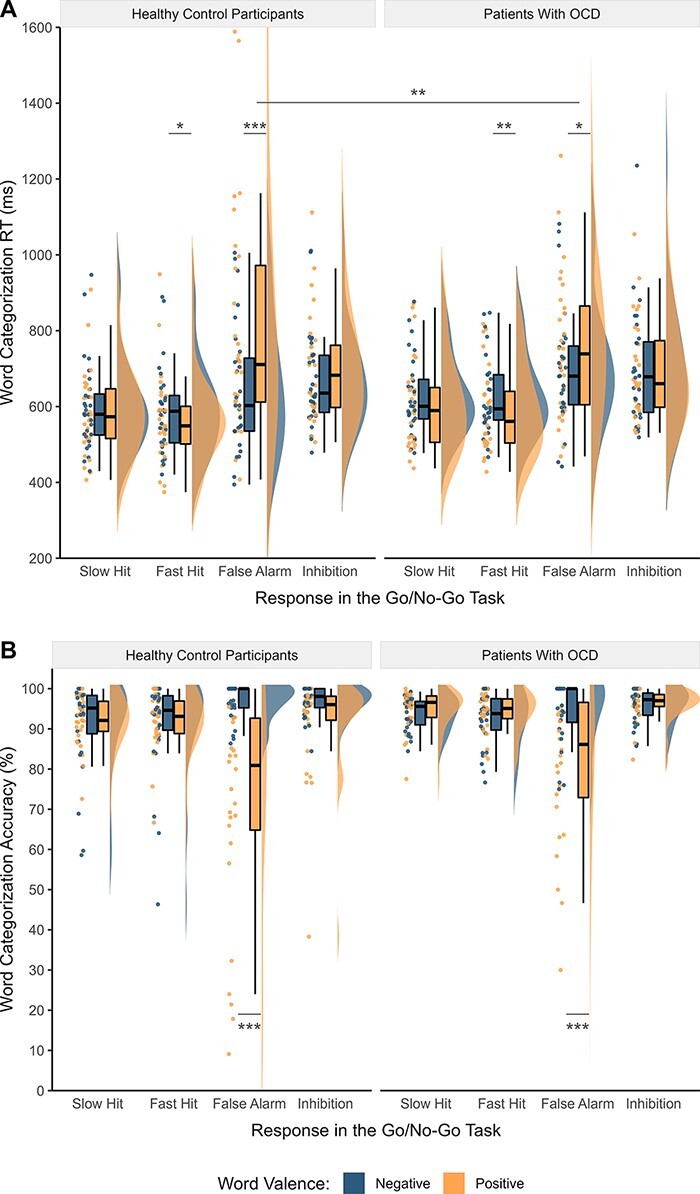
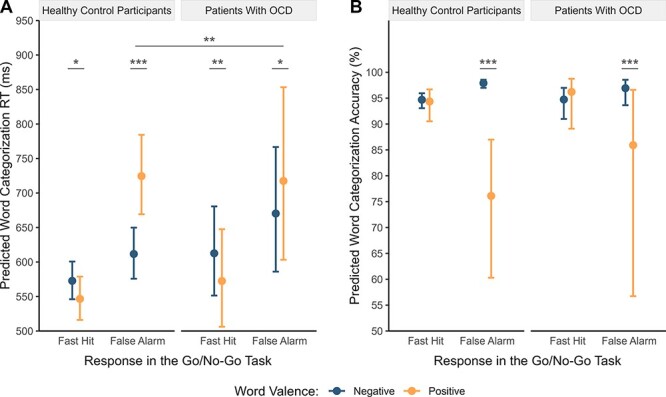
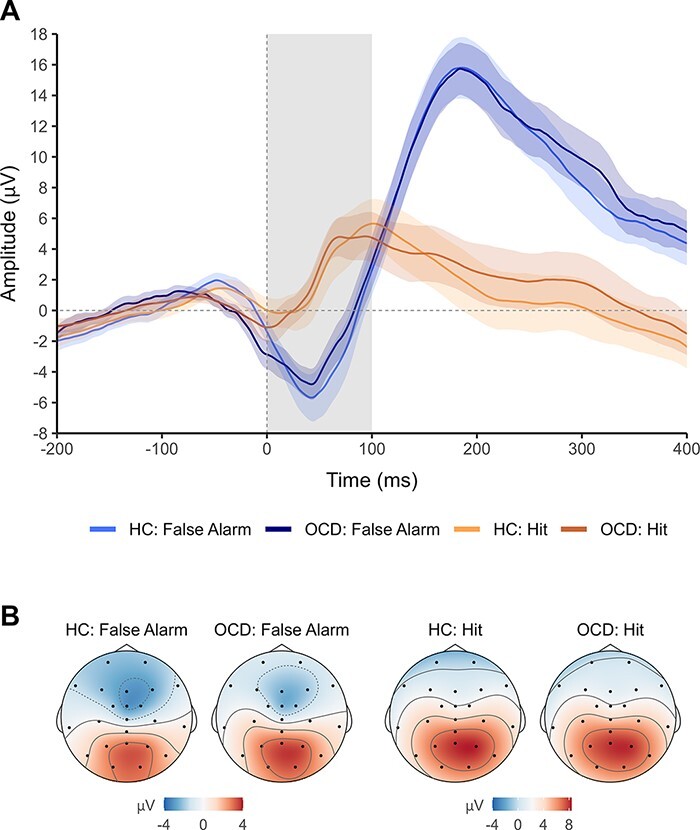
Even though overactive error monitoring, indexed by enhanced amplitudes of the error-related negativity (ERN), is a potential biomarker for obsessive-compulsive disorder (OCD), the mechanisms underlying clinical variations in ERN amplitude remain unknown. To investigate whether ERN enhancement in OCD results from altered error evaluation, we examined the trial-wise valence evaluation of errors and its relation to the ERN in 28 patients with OCD and 28 healthy individuals. Electroencephalogram was recorded during an affective priming paradigm in which responses in a go/no-go task were followed by valence-based word categorization. Results indicated that errors were followed by faster categorization of negative than positive words, confirming that negative valence is assigned to errors. This affective priming effect was reduced in patients with OCD, while go/no-go performance was comparable between groups. Notably, this reduction amplified with increasing symptom severity. These results suggest attenuated affective error evaluation in OCD, possibly resulting from interfering effects of anxiety. There was no evidence for a trial-level association between valence evaluation and ERN, implying that ERN amplitude does not reflect valence assignment to errors. Consequently, altered error monitoring in OCD may involve alterations in possibly distinct processes, with weaker assignment of negative valence to errors being one of them.
Overview
The claims and statistics of this paper haven’t been checked yet.
Free: it reads the open-access text and checks the first 5 claims that cite a source we can check. Create a free account to check every claim.
Integrity signals
Registry
Cites
Statistics
Figures


Verification
Claims the paper makes
The claims and statistics of this paper haven’t been checked yet.
Free: it reads the open-access text and checks the first 5 claims that cite a source we can check. Create a free account to check every claim.
Claims other papers make about this one
Each is checked against this paper’s own text: does it say what the citing paper says it does?
The source backs part of the claim, not all of it — or backs it for a different population, condition or comparison.
In the citing paper
“The usual increase in N2 latency with increasing inhibitory difficulty is absent (138); as is the usual differences in ERN and CRN amplitudes, and affective priming is decreased (33).”
From Neural mechanisms underlying cognitive inflexibility in obsessive-compulsive disorder: a review (2026) · cites this paper as [33]
Experimental — accuracy not yet measuredThe cited source says what the claim attributes to it.
In the citing paper
“The usual increase in N2 latency with increasing inhibitory difficulty is absent (138); as is the usual differences in ERN and CRN amplitudes, and affective priming is decreased (33).”
From Neural mechanisms underlying cognitive inflexibility in obsessive-compulsive disorder: a review (2026) · cites this paper as [33]
Self-check
Percentages, sums and reported differences re-computed from the paper’s own numbers.
The self-check needs the paper’s full text.
Citations
Cites
Fitting Linear Mixed-Effects Models Using lme4
Bates, D., Mächler, M., Bolker, B., & Walker, S. (2015) · Journal of Statistical Software · doi:10.18637/jss.v067.i01 · Cited by 86,835
The assessment and analysis of handedness: The Edinburgh inventory
Oldfield, R. C. (1971) · Neuropsychologia · doi:10.1016/0028-3932(71)90067-4 · Cited by 35,900 · cited 3×
“…range was 18–55 years (control participants: 20–54 years; patients with OCD: 18–55 years). cHandedness was assessed with the Edinburgh Handedness Inventory (Oldfield, 1971). dFor Fisher’s exact test, there is no test statistic to report. eYears of education include primary and secondary education.”
Method(1970) · Cited by 24,983
Delorme, A., & Makeig, S. (2004) · Journal of Neuroscience Methods · doi:10.1016/j.jneumeth.2003.10.009 · Cited by 24,371 · cited 1×
“Data were processed offline using MATLAB (version 2019b) and the toolboxes EEGLAB (version 2019.1; Delorme and Makeig, 2004) and ERPLAB (version 8.01; Lopez-Calderon and Luck, 2014).”
MethodInfluentiallmerTest Package: Tests in Linear Mixed Effects Models
Kuznetsova, A., Brockhoff, P. B., & Christensen, R. H. B. (2017) · Journal of Statistical Software · doi:10.18637/jss.v082.i13 · Cited by 24,346 · cited 2×
“, 2015b), and p values were obtained with the lmerTest package (version 3.1-3; Kuznetsova et al., 2017) using Satterthwaite approximation.”
MethodInfluential(2010) · Intellectum (Universidad de La Sabana) · doi:10.1111/j.1467- · Cited by 16,131
The Yale-Brown Obsessive Compulsive Scale: I. Development, Use, and Reliability
Goodman, W. K. (1989) · Archives of General Psychiatry · doi:10.1001/archpsyc.1989.01810110048007 · Cited by 7,712 · cited 2×
“WST = Wortschatztest; BDI-II = Beck Depression Inventory-II; OCI-R = Obsessive-Compulsive Inventory-Revised; PSWQ = Penn State Worry Questionnaire; STAI = State-Trait Anxiety Inventory; Y-BOCS = Yale-Brown Obsessive Compulsive Scale. aWelch’s t test was used for continuous variables. bThe age range was 18–55 years (co…”
MethodConflict monitoring and cognitive control
Botvinick, M. M., Braver, T. S., Barch, D. M., Carter, C. S., & Cohen, J. D. (2001) · Psychological Review · doi:10.1037/0033-295x.108.3.624 · Cited by 7,351 · cited 1×
“Several theories have been proposed, many interpreting the ERN as a component signaling the need for behavioral adjustment and recruitment of cognitive control to prevent future errors (Botvinick et al., 2001; Holroyd and Coles, 2002).”
BackgroundAnxiety and cognitive performance: Attentional control theory
Eysenck, M. W., Derakshan, N., Santos, R., & Calvo, M. G. (2007) · Emotion · doi:10.1037/1528-3542.7.2.336 · Cited by 5,289 · cited 1×
“This is consistent with the notion that trait anxiety and worry have detrimental effects on action monitoring (Eysenck et al., 2007).”
ResultDevelopment and validation of the Penn State Worry Questionnaire
Meyer, T. J., Miller, M. L., Metzger, R. L., & Borkovec, T. D. (1990) · Behaviour Research and Therapy · doi:10.1016/0005-7967(90)90135-6 · Cited by 5,099 · cited 5×
“Development and validation of the Penn State Worry Questionnaire.”
BackgroundInfluential
Research works printed but not linked: 4
- Beck, 1996, Manual for the Beck Depression Inventory-II
- Hautzinger, 2006, Beck Depressions-Inventar (BDI-II). Revision
- Schmidt, 1992, Wortschatztest (WST)
- Wittchen, 1997, Strukturiertes klinisches Interview für DSM-IV (SKID)
Cited by
Human Cortico‐Cerebellar Dynamics During Motor Error Processing After Stroke
Malan, N. S., Gopalakrishnan, R., Cunningham, D. A., Hogue, O., Baker, K. B., & Machado, A. G. (2025) · Human Brain Mapping · doi:10.1002/hbm.70227 · Cited by 5
“Oddball trials were categorized based on the motor behavior exhibited during the task, using overshoot as the criterion as per prior studies (Shalgi et al. 2009; Eimer 1996; Balzus et al. 2023).”
Chmiel, J., & Kładna, A. (2026) · Journal of Clinical Medicine · doi:10.3390/jcm15155994
Neural mechanisms underlying cognitive inflexibility in obsessive-compulsive disorder: a review
Guo, W., Neo, P. S.-H., & McNaughton, N. (2026) · Frontiers in Psychiatry · doi:10.3389/fpsyt.2026.1795436
“The usual increase in N2 latency with increasing inhibitory dif fi culty is absent (138); as is the usual differences in ERN and CRN amplitudes, and affective priming is decreased (33).”
Wei, X., He, J., Li, X., Gou, D., Dong, Q., Wang, X., & Yang, H. (2026) · Biological Psychiatry Cognitive Neuroscience and Neuroimaging · doi:10.1016/j.bpsc.2026.09.004
Li, J., Li, X., Zhang, J., Liu, C., Luo, Y., Zou, F., & Zhang, M. (2026) · Biological Psychology · doi:10.1016/j.biopsycho.2026.109391
Metadata
- Authors
- Balzus, L., Jüres, F., Kathmann, N., & Klawohn, J.
- Affiliations
- Humboldt-Universität zu Berlin (DE)
- Corresponding author
- Balzus, Luisa
- Venue
- Social Cognitive and Affective Neuroscience
- Publisher
- Oxford University Press (OUP)
- Published
- 2023-01-01
- Volume
- 18
- Issue
- 1
- ISSN
- 1749-5016 (ISSN-L)
- 1749-5024
- PMC
- PMC10243905
- OpenAlex
- W4366998156
- Cited by
- 4
- References
- 51
- Citations by year
- 2026: 3 · 2025: 1
- FWCI
- 1.16
- Type
- journal article
- Language
- en
- Open access
- gold
- doi.org
- Locations
- Social Cognitive and Affective Neuroscience (publishedVersion, cc-by)
- PubMed Central (publishedVersion, cc-by)
- PubMed (publishedVersion)
- edoc Publication server (Humboldt University of Berlin) (submittedVersion, cc-by)
- Social Science Open Access Repository (GESIS – Leibniz Institute for the Social Sciences) (submittedVersion)
- OSF Preprints (OSF Preprints) (submittedVersion)
- edoc Publication server (Humboldt University of Berlin) (cc-by)
- Topics
- Social Sciences › Psychology › Clinical Psychology › Obsessive-Compulsive Spectrum Disorders
- Life Sciences › Neuroscience › Cognitive Neuroscience › Neural and Behavioral Psychology Studies
- Social Sciences › Psychology › Experimental and Cognitive Psychology › Anxiety, Depression, Psychometrics, Treatment, Cognitive Processes
- Keywords
- obsessive-compulsive disorder, error-related negativity, error monitoring, affective priming, go/no-go task, anxiety, symptom severity, neural markers
- MeSH terms
- Anxiety, Anxiety Disorders, Electroencephalography, Evoked Potentials, Humans, Obsessive-Compulsive Disorder
About these checks
Registry, retraction, Cites and statistics results are computed, not judged, with one exception: a printed reference that no index lists is read once by a model before it counts as a citation error. Claims are extracted by a model and kept only when their quote appears verbatim in the text; each cited source is then checked, with a model’s help, for whether it says what the claim relies on. Those verdicts can be wrong — read the claim’s quote and the cited source before relying on one.
Statistics and arithmetic are recomputed, not judged.
Confidence bands are shown only for fields calibrated on our annotated test set. None is calibrated yet, so no band is shown.
What counts as a claim ›How we measure confidence ›How we check this ›
Are you an author, or do you see a problem with this page? Request a review
How to cite
Cite CoChat for the checks on this page, and the paper for its own findings.
- This page
- CoChat. (2026). Citation check: Affective evaluation of errors and neural error processing in obsessive-compulsive disorder. https://app.cochat.ai/papers/10.1093/scan/nsad022
- The paper
- Balzus, L., Jüres, F., Kathmann, N., & Klawohn, J. (2023). Affective evaluation of errors and neural error processing in obsessive-compulsive disorder. Social Cognitive and Affective Neuroscience. https://doi.org/10.1093/scan/nsad022
Data sources
Bibliographic data: Semantic Scholar, OpenAlex, Crossref.
Contains information from the Semantic Scholar Academic Graph Datasets, made available under the ODC Attribution License (ODC-BY 1.0).
Semantic Scholar’s data is described in: Kinney, R., et al. (2023). The Semantic Scholar Open Data Platform. arXiv:2301.10140.
