

Medial prefrontal activity differentiates self from close others
Open accessThe DOI matches its Crossref record; 33 of the 33 references it cites were found in a registry or an index.
Abstract
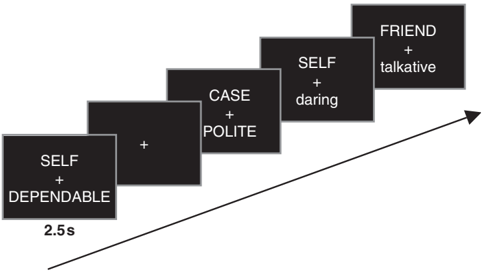
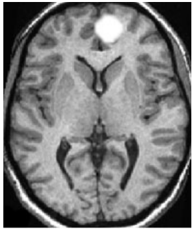
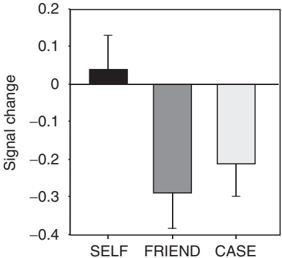
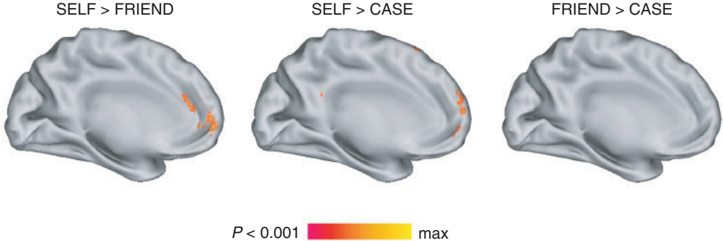
A key question in psychology and neuroscience is the extent to which the neural representation of others is incorporated with, or is distinct from, our concept of self. Recent neuroimaging research has emphasized the importance of a region in the medial prefrontal cortex [MPFC; Brodmann's area (BA) 10] when performing self-referent tasks. Specifically, previous studies have reported selective MPFC recruitment when making judgments about the self relative to a familiar but personally unknown other. The present event-related functional magnetic resonance imaging study extends these findings to judgments about personally known others. Subjects were imaged while making trait adjective judgments in one of the three conditions: (i) whether the adjective described the self; (ii) whether the adjective described an intimate other (i.e., a best friend); or (iii) whether the adjective was presented in uppercase letters. Making judgments about the self relative to an intimate other selectively activated the MPFC region previously implicated in the self-processing literature. These results suggest that while we may incorporate intimate others into our self-concept, the neural correlates of the self remain distinct from intimate and non-intimate others.
Overview
The claims and statistics of this paper haven’t been checked yet.
Free: it reads the open-access text and checks the first 5 claims that cite a source we can check. Create a free account to check every claim.
Integrity signals
Registry
Cites
Statistics
Figures
Verification
Claims the paper makes
The claims and statistics of this paper haven’t been checked yet.
Free: it reads the open-access text and checks the first 5 claims that cite a source we can check. Create a free account to check every claim.
Claims other papers make about this one
Each is checked against this paper’s own text: does it say what the citing paper says it does?
The cited source says what the claim attributes to it.
In the citing paper
“The medial PFC also plays a role in differentiating between the self and an unknown other such as George W. Bush (Kelley et al., 2002), and between the self and a personally known other such as a close friend (Heatherton et al., 2006).”
From Social cognitive development during adolescence (2006) · cites this paper as Heatherton et al., 2006
Self-check
Percentages, sums and reported differences re-computed from the paper’s own numbers.
The self-check needs the paper’s full text.
Citations
Cites
A default mode of brain function
Raichle, M. E., MacLeod, A. M., Snyder, A. Z., Powers, W. J., Gusnard, D. A., & Shulman, G. L. (2001) · Proceedings of the National Academy of Sciences · doi:10.1073/pnas.98.2.676 · Cited by 12,190
Co-Planar Stereotaxic Atlas of the Human Brain
Talairach, J., & Tournoux, P. (1988) · Medical Entomology and Zoology · Cited by 11,798
Statistical parametric maps in functional imaging: A general linear approach
Friston, K. J., Holmes, A. P., Worsley, K. J., Poline, J. ‐., Frith, C. D., & Frackowiak, R. S. J. (1994) · Human Brain Mapping · doi:10.1002/hbm.460020402 · Cited by 9,688 · cited 1×
“The fMRI data were analyzed using Statistical Parametric Mapping software (SPM99, Wellcome Department of Cognitive Neurology, London, UK) (Friston et al., 1995).”
MethodCo-planar stereotaxic atlas of the human brain
Laitinen, L. (1989) · Clinical Neurology and Neurosurgery · doi:10.1016/0303-8467(89)90128-5 · Cited by 7,565
Meeting of minds: the medial frontal cortex and social cognition
Amodio, D. M., & Frith, C. D. (2006) · Nature Reviews Neuroscience · doi:10.1038/nrn1884 · Cited by 3,782 · cited 2×
“Given the inconsistencies and ambiguities reflected in the extant literature, as well as the importance of identifying the role of MPFC in social cognition (Amodio and Frith, 2006), we elected to use event-related fMRI to examine the extent to which MPFC activity differentiates self from close others.”
MethodSearching for a baseline: Functional imaging and the resting human brain
Gusnard, D. A., & Raichle, M. E. (2001) · Nature Reviews Neuroscience · doi:10.1038/35094500 · Cited by 3,371 · cited 1×
“Given that MPFC activity is tonically active at rest (Raichle et al., 2001; Gusnard and Raichle, 2001 ), certain blocked-design paradigms may struggle to capture itemspecific differences between conditions.”
BackgroundCohen, J., MacWhinney, B., Flatt, M., & Provost, J. (1993) · Behavior Research Methods, Instruments, & Computers · doi:10.3758/bf03204507 · Cited by 2,802
Event-Related fMRI: Characterizing Differential Responses
Friston, K. J., Fletcher, P., Josephs, O., Holmes, A., Rugg, M. D., & Turner, R. (1998) · NeuroImage · doi:10.1006/nimg.1997.0306 · Cited by 2,029 · cited 1×
“For each participant, a general linear model, incorporating task effects (modelled with a canonical set of three functions: the hemodynamic response function, its temporal derivative, and its dispersion derivative) (Friston et al., 1998) and covariates of no interest (a session mean, a linear trend, and six movement p…”
MethodClose relationships as including other in the self.
Aron, A. P., Aron, E. N. A. D. T., Tudor, M., & Nelson, G. (1991) · Journal of Personality and Social Psychology · doi:10.1037//0022-3514.60.2.241 · Cited by 1,929 · cited 1×
“To the extent that intimate others are incorporated into our self-concept (e.g., Aron et al., 1991), we would expect similar MPFC activity when processing trait information about the self and intimate others.”
BackgroundSelf-reference and the encoding of personal information.
Rogers, T. B., Kuiper, N. A., & Kirker, W. S. (1977) · Journal of Personality and Social Psychology · doi:10.1037//0022-3514.35.9.677 · Cited by 1,868 · cited 2×
“others (Rogers et al., 1977), and recent imaging studies”
Background
Research works printed but not linked: 1
- Macrae, C.N., Heatherton, T.F., Kelley, W.M. (2004a). A self less ordinary: the medial prefrontal cortex and you. In: Gazzaniga, M.S., editor. Cognitive Neurosciences III. Cambridge, MA: MIT Press, pp. 1067-76.
Cited by
Functional-anatomic fractionation of the brain’s default network
Andrews-Hanna, J. R., Reidler, J. S., Sepulcre, J., Poulin, R., & Buckner, R. L. (2010) · Neuron · doi:10.1016/j.neuron.2010.02.005 · Cited by 2,767
“Additionally, the aMPFC (and often PCC) activates when participants make judgments or remember trait adjectives about themselves compared to other people (e.g., Kelley et al., 2002; Lou et al., 2004; Heatherton et al., 2006; Mitchell et al., 2006; D’Argembeau et al., 2005) and the regions correlate with self-referenti…”
The neurobiology of semantic memory
Binder, J. R., & Desai, R. H. (2011) · Trends in Cognitive Sciences · doi:10.1016/j.tics.2011.10.001 · Cited by 2,114
Social cognition and the brain: A meta-analysis
Van Overwalle, F. (2009) · Human Brain Mapping · doi:10.1002/hbm.20547 · Cited by 1,792
Fractionating theory of mind: a meta-analysis of functional brain imaging studies
Schurz, M., Radua, J., Aichhorn, M., Richlan, F., & Perner, J. (2014) · Neuroscience & Biobehavioral Reviews · doi:10.1016/j.neubiorev.2014.01.009 · Cited by 1,656
Multisensory brain mechanisms of bodily self-consciousness.
Blanke, O. (2012) · Nature Reviews Neuroscience · doi:10.1038/nrn3292 · Cited by 1,147
Metadata
- Authors
- Heatherton, T. F., Wyland, C. L., Macrae, C. N., Demos, K. E., Denny, B. T., & Kelley, W. M.
- Affiliations
- Dartmouth College (US)
- Corresponding author
- Wyland, Carrie L.
- Venue
- Social Cognitive and Affective Neuroscience
- Publisher
- Oxford University Press (OUP)
- Published
- 2006-06-01
- Volume
- 1
- Issue
- 1
- Pages
- 18-25
- ISSN
- 1749-5016 (ISSN-L)
- 1749-5024
- PMC
- PMC2555408
- OpenAlex
- W2098523016
- Cited by
- 380
- References
- 33
- Citations by year
- 2026: 4 · 2025: 12 · 2024: 12 · 2023: 32 · 2022: 15 · 2021: 11 · 2020: 13 · 2019: 10 · 2018: 19 · 2017: 20 · 2016: 23 · 2015: 24 · 2014: 24 · 2013: 30 · 2012: 24
- FWCI
- 8.74
- Type
- journal article
- Language
- en
- Open access
- hybrid
- doi.org
- Licence
- Locations
- Social Cognitive and Affective Neuroscience (publishedVersion, cc-by-nc)
- PubMed Central (publishedVersion)
- PubMed (publishedVersion)
- Funders
- Dartmouth College
- National Institutes of Health
- National Institute of Mental Health (1R21MH66720, 1R01MH59282, R01MH059282, R21MH066720)
- Topics
- Life Sciences › Neuroscience › Cognitive Neuroscience › Face Recognition and Perception
- Social Sciences › Psychology › Social Psychology › Social Representations and Identity
- Life Sciences › Neuroscience › Cognitive Neuroscience › Neural and Behavioral Psychology Studies
- Keywords
- medial prefrontal cortex, self-concept, self-other distinction, self-referential processing, event-related fMRI
- MeSH terms
- Adolescent, Female, Humans, Magnetic Resonance Imaging, Male, Self Concept, Social Perception, Prefrontal Cortex, Young Adult
About these checks
Registry, retraction, Cites and statistics results are computed, not judged, with one exception: a printed reference that no index lists is read once by a model before it counts as a citation error. Claims are extracted by a model and kept only when their quote appears verbatim in the text; each cited source is then checked, with a model’s help, for whether it says what the claim relies on. Those verdicts can be wrong — read the claim’s quote and the cited source before relying on one.
Statistics and arithmetic are recomputed, not judged.
Confidence bands are shown only for fields calibrated on our annotated test set. None is calibrated yet, so no band is shown.
What counts as a claim ›How we measure confidence ›How we check this ›
Are you an author, or do you see a problem with this page? Request a review
Data sources
Bibliographic data: Semantic Scholar, OpenAlex, Crossref.
Contains information from the Semantic Scholar Academic Graph Datasets, made available under the ODC Attribution License (ODC-BY 1.0).
Semantic Scholar’s data is described in: Kinney, R., et al. (2023). The Semantic Scholar Open Data Platform. arXiv:2301.10140.
