

Defining the Locus of Dopaminergic Dysfunction in Schizophrenia: A Meta-analysis and Test of the Mesolimbic Hypothesis
Open accessThe DOI matches its Crossref record; 74 of the 74 references it cites were found in a registry or an index.
Abstract
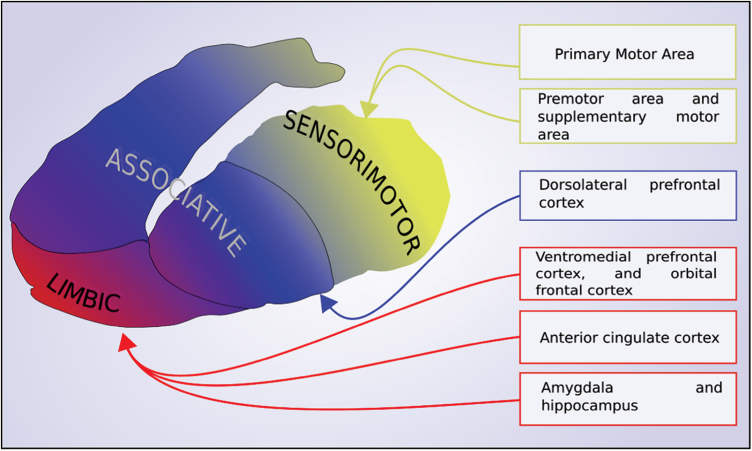
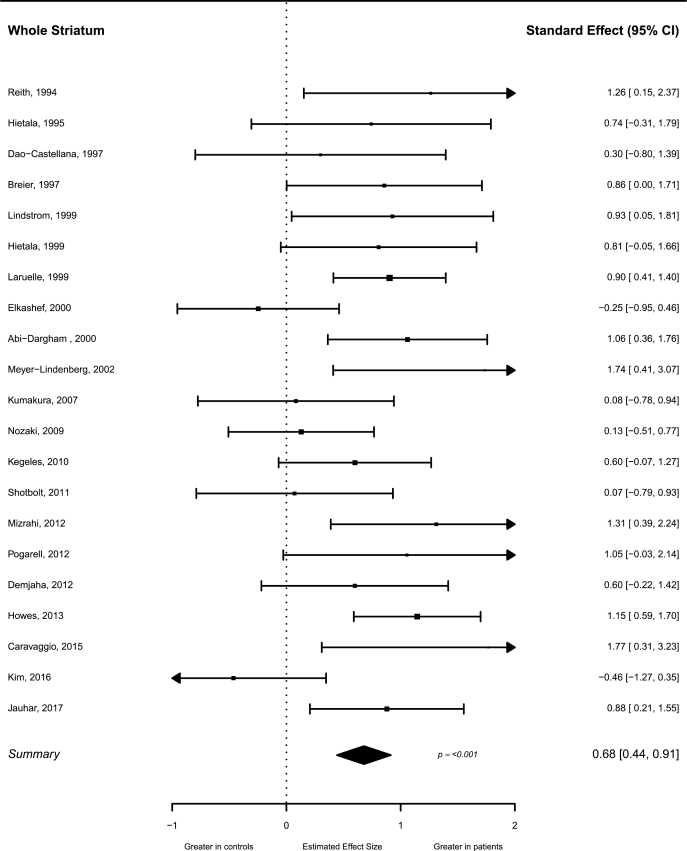
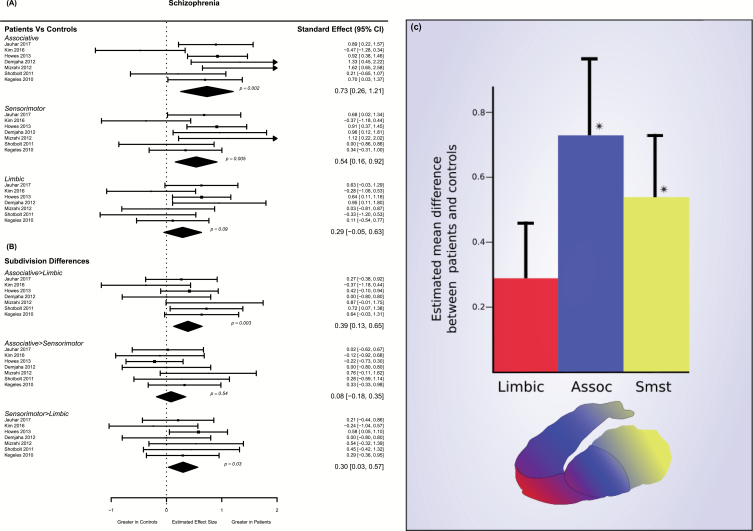
Background: Studies using positron emission tomography to image striatal dopamine function, have demonstrated that individuals with schizophrenia display increases in presynaptic function. Mesolimbic dysfunction specifically, has previously been suggested to underlie psychotic symptoms. This has not been directly tested in vivo, and the precise anatomical locus of dopamine dysfunction within the striatum remains unclear. The current article investigates the magnitude of dopaminergic abnormalities in individuals with schizophrenia, and determines how the magnitude of abnormality varies across functional subdivisions of the striatum. Methods: EMBASE, PsychINFO, and MEDLINE were searched from January 1, 1960, to December 1, 2016. Inclusion criteria were molecular imaging studies that had measured presynaptic striatal dopamine functioning. Effects sizes for whole striatum and functional subdivisions were calculated separately. The magnitude of difference between functional subdivisions in patients and controls was meta-analyzed. Results: Twenty-one eligible studies were identified, including 269 patients and 313 controls. Individuals with schizophrenia (Hedges' g = 0.68, P < .001) demonstrated elevated presynaptic dopamine functioning compared to controls. Seven studies examined functional subdivisions. These demonstrated significant increases in patients compared to controls in associative (g = 0.73, P = .002) and sensorimotor (g = 0.54, P = .005) regions, but not limbic (g = 0.29, P = .09). The magnitude of the difference between associative and limbic subdivisions was significantly greater in patients compared to controls (g = 0.39, P = .003). Conclusion: In individuals with schizophrenia dopaminergic dysfunction is greater in dorsal compared to limbic subdivisions of the striatum. This is inconsistent with the mesolimbic hypothesis and identifies the dorsal striatum as a target for novel treatment development.
Overview
The claims and statistics of this paper haven’t been checked yet.
Free: it reads the open-access text and checks the first 5 claims that cite a source we can check. Create a free account to check every claim.
Integrity signals
Registry
Cites
Statistics
Figures
Verification
Claims the paper makes
The claims and statistics of this paper haven’t been checked yet.
Free: it reads the open-access text and checks the first 5 claims that cite a source we can check. Create a free account to check every claim.
Claims other papers make about this one
Each is checked against this paper’s own text: does it say what the citing paper says it does?
The source backs part of the claim, not all of it — or backs it for a different population, condition or comparison.
In the citing paper
“Schizophrenia is attributed to increased presynaptic dopaminergic synthesizing capacity (DSC)54”
From A Method for Tapering Antipsychotic Treatment That May Minimize the Risk of Relapse (2021) · cites this paper as [54]
Experimental — accuracy not yet measuredThe cited source says what the claim attributes to it.
In the citing paper
“Meta-analysis indicates that the main changes in dopamine function occur in the associative and sensorimotor dorsal striatum (49).”
From Aberrant Salience, Information Processing, and Dopaminergic Signaling in People at Clinical High Risk for Psychosis (2020) · cites this paper as [49]
The cited source says what the claim attributes to it.
In the citing paper
“These techniques indicate that striatal dopamine synthesis, storage and release are elevated in patients with psychosis compared to healthy controls (HC) (45-48) with large effect sizes (49).”
From Aberrant Salience, Information Processing, and Dopaminergic Signaling in People at Clinical High Risk for Psychosis (2020) · cites this paper as [49]
Self-check
Percentages, sums and reported differences re-computed from the paper’s own numbers.
The self-check needs the paper’s full text.
Citations
Cites
Diagnostic and Statistical Manual of Mental Disorders
American Psychiatric Association (2013) · doi:10.1176/appi.books.9780890425596 · Cited by 116,369
Cochrane Handbook for Systematic Reviews of Interventions: Cochrane Book Series
(2008) · doi:10.1002/9780470712184 · Cited by 25,048
Borenstein, M., Hedges, L. V., Higgins, J. P. T., & Rothstein, H. R. (2009) · doi:10.1002/9780470743386 · Cited by 14,225
Diagnostic and Statistical Manual of Mental Disorders(DSM)
(2008) · Encyclopedia of Counseling · doi:10.4135/9781412963978.n182 · Cited by 10,830
Sterne, J. A. C., Sutton, A. J., Ioannidis, J. P. A., Terrin, N., Jones, D. R., Lau, J., Carpenter, J., Rucker, G., Harbord, R. M., Schmid, C. H., et al. (2011) · BMJ · doi:10.1136/bmj.d4002 · Cited by 7,709
Distribution Theory for Glass's Estimator of Effect Size and Related Estimators
Hedges, L. V. (1981) · Journal of Educational Statistics · doi:10.2307/1164588 · Cited by 5,695
Implications of Normal Brain Development for the Pathogenesis of Schizophrenia
Weinberger, D. R. (1987) · Archives of General Psychiatry · doi:10.1001/archpsyc.1987.01800190080012 · Cited by 3,724
The reward circuit: linking primate anatomy and human imaging
Haber, S. N., & Knutson, B. (2010) · Neuropsychopharmacology · doi:10.1038/npp.2009.129 · Cited by 3,718
The Dopamine Hypothesis of Schizophrenia: Version III--The Final Common Pathway
Howes, O. D., & Kapur, S. (2009) · Schizophrenia Bulletin · doi:10.1093/schbul/sbp006 · Cited by 2,693
Self-citationDopamine in schizophrenia: a review and reconceptualization
(1991) · American Journal of Psychiatry · doi:10.1176/ajp.148.11.1474 · Cited by 2,018
Research works printed but not linked: 1
- World Health Organization. International Classification of Diseases, 10th Edition (ICD-10): Classification of Mental and Behavioural Disorders. Geneva: World Health Organization; 1992.
Cited by
Items 301–347 of 347
Additional file 2 of Progressive trajectories of schizophrenia across symptoms, genes, and the brain
Jiang, S., Huang, H., Zhou, J., Li, H., Duan, M., Yao, D., & Luo, C. (2024) · Figshare · doi:10.6084/m9.figshare.26601613
Additional file 3 of Progressive trajectories of schizophrenia across symptoms, genes, and the brain
Jiang, S., Huang, H., Zhou, J., Li, H., Duan, M., Yao, D., & Luo, C. (2024) · Figshare · doi:10.6084/m9.figshare.26601616
Additional file 1 of Progressive trajectories of schizophrenia across symptoms, genes, and the brain
Jiang, S., Huang, H., Zhou, J., Li, H., Duan, M., Yao, D., & Luo, C. (2024) · Figshare · doi:10.6084/m9.figshare.26601610
Variability Is the Norm in Magnetic Resonance Imaging of Psychosis
Chopra, S. (2026) · Biological Psychiatry · doi:10.1016/j.biopsych.2026.01.015
Lu, C., Li, S., Zhang, X., Han, Y., Wang, L., Sun, W., Zhang, C., Wang, S., Li, S., Li, J., et al. (2026) · European Archives of Psychiatry and Clinical Neuroscience · doi:10.1007/s00406-026-02221-1
Mancini, V., Rogdaki, M., Jauhar, S., Moretto, M., Veronese, M., Turkheimer, F., Howes, O. D., & McCutcheon, R. A. (2026) · Molecular Psychiatry · doi:10.1038/s41380-026-03839-2
Self-citationThe Quest for a Selective Mapping Between Striatal Dopamine Subcircuits and Psychosis Symptoms
Wengler, K., & Horga, G. (2020) · Biological Psychiatry Cognitive Neuroscience and Neuroimaging · doi:10.1016/j.bpsc.2020.09.009
Brain Imaging in Schizophrenia
Lawrie, S. M. (2026) · Springer eBooks · doi:10.1007/978-3-032-09475-9_7
Petty, A. E., Cui, X., Ali, A. A., Howes, O. D., & Eyles, D. W. (2020) · European Neuropsychopharmacology · doi:10.1016/j.euroneuro.2020.09.367
Self-citationProgress in Comparison Research of Early-Onset and Late-Onset Schizophrenia
田, 宇. (2024) · International Journal of Psychiatry and Neurology · doi:10.12677/ijpn.2024.133005
Schizophrenia pathogenesis: the role of prenatal influences
Skashchenko, N. D., & Kozlova, D. I. (2026) · V M BEKHTEREV REVIEW OF PSYCHIATRY AND MEDICAL PSYCHOLOGY · doi:10.31363/2313-7053-2023-1331
Plasma dopa decarboxylase activity in treatment-resistant recent-onset psychosis patients
van der Pluijm, M., Sutterland, A. L., Kuilenburg, A. B. P., Zoetekouw, L., de Haan, L., Booij, J., & van de Giessen, E. (2019) · Therapeutic Advances in Psychopharmacology · doi:10.1177/2045125319872341
Gómez‐Revuelta, M. (2020) · UCrea (University of Cantabria)
A non-human primate model of dorsolateral prefrontal cortex dysfunction in schizophrenia
Hodgson, A. R. (2024) · Apollo (University of Cambridge) · doi:10.17863/cam.114452
Bikas, S. (2025) · Publication Server of Goethe University Frankfurt am Main (Goethe University Frankfurt) · doi:10.21248/gups.95116
Neuro-kognitive Mechanismen der Anhedonie in Depression und Schizophrenie
Frost, A. F., Zimmer, C., & München, T. U. (2023)
Jha, P., & Kumar, D. (2022) · International Journal of Pharmaceutical Sciences Review and Research · doi:10.47583/ijpsrr.2022.v77i01.027
Zhao, H., Ding, Y., Xing, H., Zhang, Y., Li, M., Ding, L., Ye, W., Geng, L., Ye, H., & Bao, T. (2026) · Neuropsychiatric Disease and Treatment · doi:10.2147/ndt.s621364
Seward, M. (2026) · DalSpace (Dalhousie University)
Scott, K. (2025) · Otago University Research Archive (University of Otago)
Striatal dopamine system in neurological and psychiatric disorders
Malén, T. (2026) · UTUPub (University of Turku)
Beyer, S. (2024) · reposiTUm (TU Wien) · doi:10.34726/hss.2024.125220
Montenegro, M. O. K. (2025) · Universidad de Chile
Allen, P., Hird, E., Orlov, N. D., Modinos, G., Bossong, M. G., Antoniades, M., Sampson, C., Azis, M., Howes, O. D., Stone, J. M., et al. (2021) · Translational Psychiatry · doi:10.1038/s41398-021-01731-x
Self-citationPolowy, R. (2025) · RCIN (Digital Repository of the Scientifics Institutes) (Institute of Archaeology and Ethnology of the Polish Academy of Sciences)
Characterization of iron-sensitive R2*-qMRI in the Substantia Nigra in Psychotic Spectrum DisordersPreprint
Wirsching, P., Fromm, S. P., Schädlich, A., Wieland, L., Buchert, R., Hetzer, S., Kaminski, J. A., & Schlagenhauf, F. (2024) · Refubium (Universitätsbibliothek der Freien Universität Berlin) · doi:10.17169/refubium-42474
Orderly chaos: social defeat as a risk factor for psychosis in autism
Schalbroeck, R. (2021) · Research Publications (Maastricht University) · doi:10.26481/dis.20211105rs
Discovery and impact of schizophrenia rare genetic variation using next generation sequencing
Fenner, E. (2023) · ORCA Online Research @Cardiff (Cardiff University)
Soler‐Vidal, J. (2024) · Dipòsit Digital de la Universitat de Barcelona (Universitat de Barcelona)
Vajda, E. A. (2026) · Carleton University's Institutional Repository (MacOdrum Library, Carleton University) · doi:10.22215/etd/2026-17025
Chandra, J. J. (2024) · UNSWorks (University of New South Wales, Sydney, Australia) · doi:10.26190/unsworks/25532
Victoriano, G. M. (2026) · UNSWorks (UNSW Sydney) · doi:10.26190/unsworks/32761
Owens, S. J. (2020) · UNSWorks (University of New South Wales, Sydney, Australia) · doi:10.26190/unsworks/22147
Estimulación cerebral profunda en esquizofrenia resistente
Roldán, A. (2021) · Tesis Doctorals en Xarxa (Consorci de Serveis Universitaris de Catalunya)
Tsartsalis, S. (2019) · Archive ouverte UNIGE (University of Geneva) · doi:10.13097/archive-ouverte/unige:125621
Neuropsychiatric symptoms and brain dopamine transporter imaging in Parkinson's disease
Jaakkola, E. (2018) · UTUPub (University of Turku)
The Importance of Dopamine In The Treatment Of Schizophrenic and Prodromal PatientsPreprint
Arslan, I. (2024) · doi:10.62439/harp-141
Freitas, I. D. S. (2024) · Digital Library of Theses and Dissertations (Universidade de São Paulo) · doi:10.11606/d.17.2024.tde-04042025-101908
Nishida, Y., Nishi, R., Fukumoto, T., Iizasa, E., Nishida, Y., & Asakawa, A. (2026) · medRxiv · doi:10.64898/2026.02.20.26346678
A Relação da Proteína Sincitina-1 com a Esquizofrenia: Uma revisão integrativa
Neto, J. R. G., Geraldo, M. T., & Candido, T. D. S. (2025) · Brazilian Journal of Health Review · doi:10.34119/bjhrv8n5-198
Lee, J., Yoon, Y. B., Cho, K. I. K., Seo, S., Lee, J. S., Jeong, J. M., Kim, E., Kim, M., Lee, T. Y., & Kwon, J. S. (2020) · Human Psychopharmacology Clinical and Experimental · doi:10.1002/hup.2766
Berg, M., Clamor, A., Rief, W., & Lincoln, T. M. (2023) · Schizophrenia Research · doi:10.1016/j.schres.2023.10.022
Metadata
- Authors
- McCutcheon, R., Beck, K., Jauhar, S., & Howes, O. D.
- Affiliations
- King's College London (GB)
- Corresponding author
- Howes, Oliver D
- Venue
- Schizophrenia Bulletin
- Publisher
- Oxford University Press (OUP)
- Published
- 2017-12-28
- Volume
- 44
- Issue
- 6
- Pages
- 1301-1311
- ISSN
- 0586-7614 (ISSN-L)
- 1745-1701
- PMC
- PMC5933516
- OpenAlex
- W2777013718
- Cited by
- 305
- References
- 74
- Citations by year
- 2026: 26 · 2025: 49 · 2024: 43 · 2023: 50 · 2022: 45 · 2021: 28 · 2020: 35 · 2019: 22 · 2018: 7
- FWCI
- 2.66
- Type
- journal article
- Language
- en
- Open access
- hybrid
- doi.org
- Licence
- Locations
- Schizophrenia Bulletin (publishedVersion, cc-by)
- Europe PMC (PubMed Central) (publishedVersion, cc-by)
- PubMed Central (publishedVersion, cc-by)
- PubMed (publishedVersion)
- Research Portal (King's College London) (submittedVersion, cc-by)
- Funders
- Brain and Behavior Research Foundation
- Wellcome Trust (094849/Z/10/Z, 200102/Z/15/Z)
- Topics
- Health Sciences › Medicine › Psychiatry and Mental health › Schizophrenia research and treatment
- Life Sciences › Neuroscience › Cellular and Molecular Neuroscience › Neurotransmitter Receptor Influence on Behavior
- Social Sciences › Arts and Humanities › Philosophy › Mental Health and Psychiatry
- Keywords
- schizophrenia, dopaminergic dysfunction
- MeSH terms
- Dopamine, Humans, Schizophrenia, Synapses, Neostriatum, Positron-Emission Tomography, Neuroimaging, Ventral Striatum
About these checks
Registry, retraction, Cites and statistics results are computed, not judged, with one exception: a printed reference that no index lists is read once by a model before it counts as a citation error. Claims are extracted by a model and kept only when their quote appears verbatim in the text; each cited source is then checked, with a model’s help, for whether it says what the claim relies on. Those verdicts can be wrong — read the claim’s quote and the cited source before relying on one.
Statistics and arithmetic are recomputed, not judged.
Confidence bands are shown only for fields calibrated on our annotated test set. None is calibrated yet, so no band is shown.
What counts as a claim ›How we measure confidence ›How we check this ›
Are you an author, or do you see a problem with this page? Request a review
Data sources
Bibliographic data: Semantic Scholar, OpenAlex, Crossref.
Contains information from the Semantic Scholar Academic Graph Datasets, made available under the ODC Attribution License (ODC-BY 1.0).
Semantic Scholar’s data is described in: Kinney, R., et al. (2023). The Semantic Scholar Open Data Platform. arXiv:2301.10140.
