

The DOI matches its Crossref record; 87 of the 87 references it cites were found in a registry or an index.
Assessing Parameter Identifiability in Phylogenetic Models Using Data Cloning
Open accessAbstract
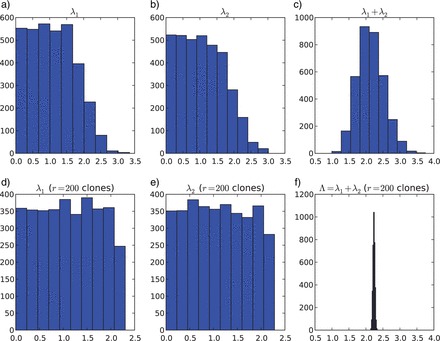
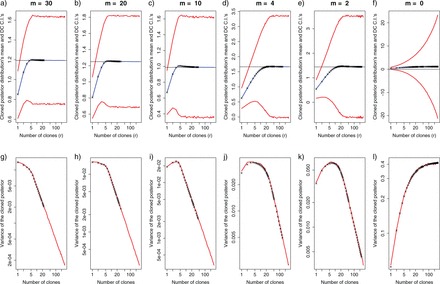
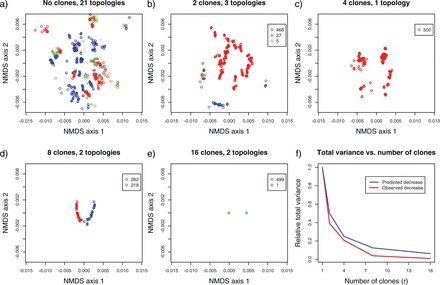
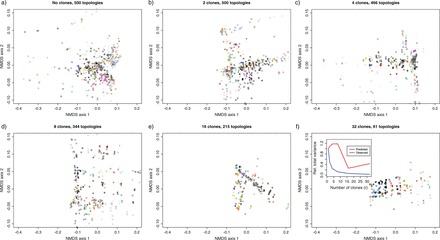
The success of model-based methods in phylogenetics has motivated much research aimed at generating new, biologically informative models. This new computer-intensive approach to phylogenetics demands validation studies and sound measures of performance. To date there has been little practical guidance available as to when and why the parameters in a particular model can be identified reliably. Here, we illustrate how Data Cloning (DC), a recently developed methodology to compute the maximum likelihood estimates along with their asymptotic variance, can be used to diagnose structural parameter nonidentifiability (NI) and distinguish it from other parameter estimability problems, including when parameters are structurally identifiable, but are not estimable in a given data set (INE), and when parameters are identifiable, and estimable, but only weakly so (WE). The application of the DC theorem uses well-known and widely used Bayesian computational techniques. With the DC approach, practitioners can use Bayesian phylogenetics software to diagnose nonidentifiability. Theoreticians and practitioners alike now have a powerful, yet simple tool to detect nonidentifiability while investigating complex modeling scenarios, where getting closed-form expressions in a probabilistic study is complicated. Furthermore, here we also show how DC can be used as a tool to examine and eliminate the influence of the priors, in particular if the process of prior elicitation is not straightforward. Finally, when applied to phylogenetic inference, DC can be used to study at least two important statistical questions: assessing identifiability of discrete parameters, like the tree topology, and developing efficient sampling methods for computationally expensive posterior densities.
Overview
The claims and statistics of this paper haven’t been checked yet.
Free: it reads the open-access text and checks the first 5 claims that cite a source we can check. Create a free account to check every claim.
Integrity signals
Registry
Cites
Statistics
Figures
Verification
Claims the paper makes
The claims and statistics of this paper haven’t been checked yet.
Free: it reads the open-access text and checks the first 5 claims that cite a source we can check. Create a free account to check every claim.
Claims other papers make about this one
Each is checked against this paper’s own text: does it say what the citing paper says it does?
The cited source doesn’t support the claim as written.
In the citing paper
“A special case of nonidentifiability occurs when the parameters are not identifiable for the estimation data set at hand, out of sheer coincidence [101].”
From Integrating Crop Growth Models with Whole Genome Prediction through Approximate Bayesian Computation (2015) · cites this paper as [101]
Checked by a reasoning model — may be wrong.
Experimental — accuracy not yet measuredThe source backs part of the claim, not all of it — or backs it for a different population, condition or comparison.
In the citing paper
“If prediction is the sole purpose, the nonidentified parameters can be viewed as nuisance variables [101], that are averaged over in the posterior predictive distribution.”
From Integrating Crop Growth Models with Whole Genome Prediction through Approximate Bayesian Computation (2015) · cites this paper as [101]
Experimental — accuracy not yet measuredThe cited source says what the claim attributes to it.
In the citing paper
“This is referred to as likelihood nonidentifiability (short ‘nonidentifiability’) and is a known problem in biological modeling with hidden variables [101].”
From Integrating Crop Growth Models with Whole Genome Prediction through Approximate Bayesian Computation (2015) · cites this paper as [101]
Self-check
Percentages, sums and reported differences re-computed from the paper’s own numbers.
The self-check needs the paper’s full text.
Citations
Cites
An Introduction to the Bootstrap
Efron, B., & Tibshirani, R. J. (1994) · doi:10.1201/9780429246593 · Cited by 40,500
An Introduction to the Bootstrap
Efron, B., & Tibshirani, R. J. (1993) · doi:10.1007/978-1-4899-4541-9 · Cited by 21,230
Relaxed Phylogenetics and Dating with Confidence
Drummond, A. J., Ho, S. Y. W., Phillips, M. J., & Rambaut, A. (2006) · PLoS Biology · doi:10.1371/journal.pbio.0040088 · Cited by 6,463 · cited 1×
“The recognition of the complexity of patterns of genomic and novel phylogenetic models that attempt to capture a number of features enhancing biological realism Drummond et al. 2006; Felsenstein 2004; Fisher 2008; Rannala 2006).”
BackgroundReversible jump Markov chain Monte Carlo computation and Bayesian model determination
GREEN, P. J. (1995) · Biometrika · doi:10.1093/biomet/82.4.711 · Cited by 5,930
Monte Carlo Statistical Methods
Kim, H. (2000) · Technometrics · doi:10.1080/00401706.2000.10485722 · Cited by 5,508
Monte Carlo Statistical Methods
Robert, C. P., & Casella, G. (2004) · Springer Texts in Statistics · doi:10.1007/978-1-4757-4145-2 · Cited by 4,271
Maddison, W. P. (1997) · Systematic Biology · doi:10.1093/sysbio/46.3.523 · Cited by 3,021
Borcard, D., Gillet, F., & Legendre, P. (2011) · doi:10.1007/978-1-4419-7976-6 · Cited by 2,997
Generalized, Linear, and Mixed Models
McCulloch, C. E., & Searle, S. R. (2000) · Wiley Series in Probability and Statistics · doi:10.1002/0471722073 · Cited by 2,994
Cases in which Parsimony or Compatibility Methods will be Positively Misleading
Felsenstein, J. (1978) · Systematic Biology · doi:10.1093/sysbio/27.4.401 · Cited by 2,896
Research works printed but not linked: 4
- Felsenstein, 2004, Inferring phytogenies.
- Robert, 1993, Prior feedback: a Bayesian approach to maximum likelihood estimation, Comput. Statist, 8, 279
- Robert, 2007, The Bayesian choice: from decision-theoretic foundations to computational implementation.
- Ronquist, 2005, MrBayes 3.1 manual.
Cited by
Ruhfel, B. R., Gitzendanner, M. A., Soltis, P. S., Soltis, D. E., & Burleigh, J. (2014) · BMC Evolutionary Biology · doi:10.1186/1471-2148-14-23 · Cited by 552
Self-citationReddy, S., Kimball, R. T., Pandey, A., Hosner, P. A., Braun, M. J., Hackett, S. J., Han, K.-L., Harshman, J., Huddleston, C. J., Kingston, S., et al. (2017) · Systematic Biology · doi:10.1093/sysbio/syx041 · Cited by 294
Self-citationIntegrating Crop Growth Models with Whole Genome Prediction through Approximate Bayesian Computation
Technow, F., Messina, C. D., Totir, L. R., & Cooper, M. (2015) · PLOS ONE · doi:10.1371/journal.pone.0130855 · Cited by 265
“If prediction is the sole purpose, the nonidentified parameters can be viewed as nuisance variables [101], that are averaged over in the posterior predictive distribution.”
BackgroundInfluentialError in Phylogenetic Estimation for Bushes in the Tree of Life
Patel, S. K. (2013) · Journal of Phylogenetics & Evolutionary Biology · doi:10.4172/2329-9002.1000110 · Cited by 120
Strong Evidence for an Intraspecific Metabolic Scaling Coefficient Near 0.89 in Fish
Jerde, C. L., Kraskura, K., Eliason, E. J., Csik, S. R., Stier, A. C., & Taper, M. L. (2019) · Frontiers in Physiology · doi:10.3389/fphys.2019.01166 · Cited by 119
Self-citation
Metadata
- Authors
- Ponciano, J. M., Burleigh, J. G., Braun, E. L., & Taper, M. L.
- Affiliations
- University of Florida (US)
- Corresponding author
- Ponciano, José Miguel
- Venue
- Systematic Biology
- Publisher
- Oxford University Press (OUP)
- Published
- 2012-07-09
- Volume
- 61
- Issue
- 6
- Pages
- 955-972
- ISSN
- 1063-5157 (ISSN-L)
- 1076-836X
- PMC
- PMC3478565
- OpenAlex
- W2098284380
- Cited by
- 39
- References
- 86
- Citations by year
- 2025: 2 · 2024: 1 · 2023: 5 · 2022: 3 · 2021: 2 · 2020: 3 · 2019: 7 · 2018: 2 · 2017: 4 · 2016: 1 · 2015: 2 · 2014: 4 · 2013: 3
- FWCI
- 2.75
- Type
- journal article
- Language
- en
- Open access
- hybrid
- doi.org
- Licence
- Locations
- Systematic Biology (publishedVersion, cc-by-nc)
- Europe PMC (PubMed Central) (publishedVersion, cc-by-nc)
- PubMed Central (publishedVersion, cc-by-nc)
- PubMed (publishedVersion)
- Funders
- University of Florida
- College of Liberal Arts and Sciences, University of Florida
- Topics
- Physical Sciences › Mathematics › Statistics and Probability › Markov Chains and Monte Carlo Methods
- Life Sciences › Biochemistry, Genetics and Molecular Biology › Molecular Biology › Genomics and Phylogenetic Studies
- Physical Sciences › Mathematics › Statistics and Probability › Statistical Methods and Bayesian Inference
- Keywords
- parameter identifiability, data cloning, phylogenetic models, estimability, maximum likelihood estimation, asymptotic variance, prior sensitivity, prior elicitation, tree topology, Bayesian phylogenetics, posterior sampling
- MeSH terms
- Chloroplasts, Classification, Data Interpretation, Statistical, Phylogeny, Plants, Models, Statistical
About these checks
Registry, retraction, Cites and statistics results are computed, not judged, with one exception: a printed reference that no index lists is read once by a model before it counts as a citation error. Claims are extracted by a model and kept only when their quote appears verbatim in the text; each cited source is then checked, with a model’s help, for whether it says what the claim relies on. Those verdicts can be wrong — read the claim’s quote and the cited source before relying on one.
Statistics and arithmetic are recomputed, not judged.
Confidence bands are shown only for fields calibrated on our annotated test set. None is calibrated yet, so no band is shown.
What counts as a claim ›How we measure confidence ›How we check this ›
Are you an author, or do you see a problem with this page? Request a review
How to cite
Cite CoChat for the checks on this page, and the paper for its own findings.
- This page
- CoChat. (2026). Citation check: Assessing Parameter Identifiability in Phylogenetic Models Using Data Cloning. https://app.cochat.ai/papers/10.1093/sysbio/sys055
- The paper
- Ponciano, J. M., Burleigh, J. G., Braun, E. L., & Taper, M. L. (2012). Assessing Parameter Identifiability in Phylogenetic Models Using Data Cloning. Systematic Biology. https://doi.org/10.1093/sysbio/sys055
Data sources
Bibliographic data: Semantic Scholar, OpenAlex, Crossref.
Contains information from the Semantic Scholar Academic Graph Datasets, made available under the ODC Attribution License (ODC-BY 1.0).
Semantic Scholar’s data is described in: Kinney, R., et al. (2023). The Semantic Scholar Open Data Platform. arXiv:2301.10140.
