

Homecare and healthcare utilization errors post-neonatal intensive care unit discharge
Open accessThe DOI matches its Crossref record; 19 of the 19 references it cites were found in a registry or an index.
Abstract
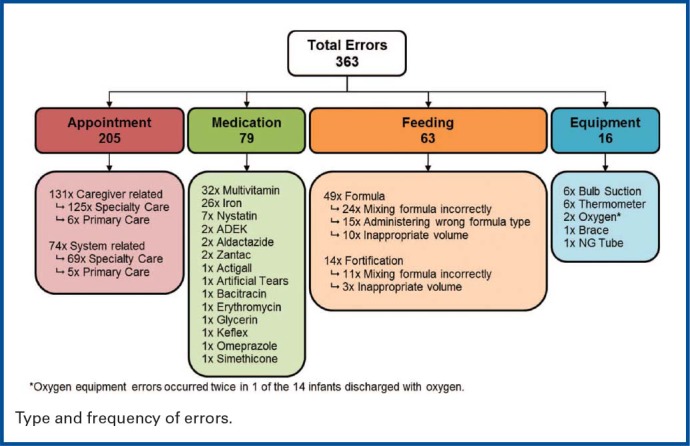
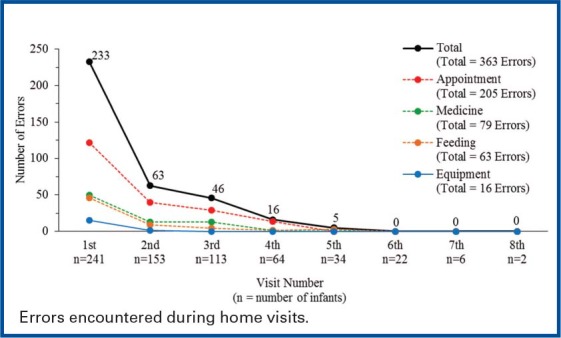
Background: High-risk infants transitioning from the neonatal intensive care unit (NICU) to home represent a vulnerable population, given their complex care requirements. Little is known about errors during this period. Purpose: Identify and describe homecare and healthcare utilization errors in high-risk infants following NICU discharge. Methods: This was a prospective observational cohort study of homecare (feeding, medication, and equipment) and healthcare utilization (appointment) errors in infants discharged from a regional NICU between 2011 and 2015. Chi-square test and Wilcoxon rank-sum test were used to compare infant and maternal demographics between infants with and without errors. Results: A total of 363 errors were identified in 241 infants during 635 home visits. The median number of visits was 2. No significance was found between infant and maternal demographics in those with or without errors. Implications of Practice: High-risk infants have complex care needs and can benefit from regular follow-up services. Home visits provide an opportunity to identify, intervene, and resolve homecare and healthcare utilization errors. Implications of Research: Further research is needed to evaluate the prevalence and cause of homecare errors in high-risk infants and how healthcare resources and infant health outcomes are affected by those errors. Preventive measures and mitigating interventions that best address homecare errors require further development and subsequent description.
Overview
The claims and statistics of this paper haven’t been checked yet.
Free: it reads the open-access text and checks the first 5 claims that cite a source we can check. Create a free account to check every claim.
Integrity signals
Registry
Cites
Statistics
Figures
Verification
Claims the paper makes
The claims and statistics of this paper haven’t been checked yet.
Free: it reads the open-access text and checks the first 5 claims that cite a source we can check. Create a free account to check every claim.
Claims other papers make about this one
Each is checked against this paper’s own text: does it say what the citing paper says it does?
The cited source says what the claim attributes to it.
In the citing paper
“Premature children may have complex needs at home, with more difficulties for caregivers and possible errors in relation to food, medication and use of health equipment or services( 22 - 23 ).”
From Care opportunities for premature infants: home visits and telephone support (2020) · cites this paper as [23]
The cited source says what the claim attributes to it.
In the citing paper
“The active presence of health professionals at the homes can anticipate the identification of errors and difficulties of caregivers, helping them to apply effective practices to enhance care for their children( 23 ).”
From Care opportunities for premature infants: home visits and telephone support (2020) · cites this paper as [23]
Self-check
Percentages, sums and reported differences re-computed from the paper’s own numbers.
The self-check needs the paper’s full text.
Citations
Cites
Hospital Discharge of the High-Risk Neonate
Committee on Fetus and Newborn (2008) · Pediatrics · doi:10.1542/peds.2008-2174 · Cited by 537
Rehospitalisation after birth hospitalisation: patterns among infants of all gestations
Escobar, G. J. (2005) · Archives of Disease in Childhood · doi:10.1136/adc.2003.039974 · Cited by 321 · cited 1×
“Length of stay, d Median (range) 43 (7-167) 43.”
BackgroundRoberts, G., Howard, K., Spittle, A. J., Brown, N. C., Anderson, P. J., & Doyle, L. W. (2008) · Journal of Paediatrics and Child Health · doi:10.1111/j.1440-1754.2007.01251.x · Cited by 268
Discharge Teaching in the NICU: Are Parents Prepared? An Integrative Review of Parents’ Perceptions
Sneath, N. (2009) · Neonatal Network · doi:10.1891/0730-0832.28.4.237 · Cited by 101
Parental English Proficiency and Children’s Health Services Access
Yu, S. M., Huang, Z. J., Schwalberg, R. H., & Nyman, R. M. (2006) · American Journal of Public Health · doi:10.2105/ajph.2005.069500 · Cited by 99
Parental Language and Dosing Errors After Discharge From the Pediatric Emergency Department
Samuels‐Kalow, M. E., Stack, A. M., & Porter, S. C. (2013) · Pediatric Emergency Care · doi:10.1097/pec.0b013e3182a269ec · Cited by 98
Preventive Interventions for Preterm Children: Effectiveness and Developmental Mechanisms
Guralnick, M. J. (2012) · Journal of Developmental & Behavioral Pediatrics · doi:10.1097/dbp.0b013e31824eaa3c · Cited by 92
Medication errors in the homes of children with chronic conditions
Walsh, K. E., Mazor, K. M., Stille, C. J., Torres, I., Wagner, J. L., Moretti, J., Chysna, K., Stine, C. D., Usmani, G. N., & Gurwitz, J. H. (2011) · Archives of Disease in Childhood · doi:10.1136/adc.2010.204479 · Cited by 87 · cited 1×
“Length of stay, d Median (range) 43 (7-167) 43.”
BackgroundTransition of premature infants from hospital to home life
Lopez, G. L., Anderson, K. H., & Feutchinger, J. (2012) · Neonatal Network · doi:10.1891/0730-0832.31.4.207 · Cited by 85
Kelly, A., Golnik, A., & CADY, R. G. (2007) · Maternal and Child Health Journal · doi:10.1007/s10995-007-0271-7 · Cited by 63 · cited 1×
“Length of stay, d Median (range) 43 (7-167) 43.”
BackgroundDischarge of Infants from NICU to Latino Families with Limited English Proficiency
Miquel‐Verges, F., Donohue, P., & Boss, R. D. (2010) · Journal of Immigrant and Minority Health · doi:10.1007/s10903-010-9355-3 · Cited by 58
Enlow, E., Herbert, S. L., Jovel, I. J., Lorch, S. A., Anderson, C., & Chamberlain, L. J. (2014) · Journal of Perinatology · doi:10.1038/jp.2014.75 · Cited by 38 · cited 1×
“Length of stay, d Median (range) 43 (7-167) 43.”
BackgroundRisk status for dropping out of developmental followup for very low birth weight infants.
Catlett, A. T., Rj, T., Da, J., & Boshkoff, M. (1993) · PubMed Central · Cited by 38
Multisite Parent-Centered Risk Assessment to Reduce Pediatric Oral Chemotherapy Errors
Walsh, K. E., Mazor, K. M., Roblin, D., Biggins, C., Wagner, J. L., Houlahan, K., Li, J. W., Keuker, C., Wasilewski-Masker, K., Donovan, J., et al. (2013) · Journal of Oncology Practice · doi:10.1200/jop.2012.000601 · Cited by 36 · cited 1×
“Length of stay, d Median (range) 43 (7-167) 43.”
BackgroundNeonates and Infants Discharged Home Dependent on Medical Technology: Characteristics and Outcomes
Toly, V. B., Musil, C. M., Bieda, A., Barnett, K. A., Dowling, D. A., & Sattar, A. (2016) · Advances in Neonatal Care · doi:10.1097/anc.0000000000000314 · Cited by 32
Improving underserved children's access to health care: practitioners' views
Ames, N. (2007) · Journal of Child Health Care · doi:10.1177/1367493507079557 · Cited by 13
Cohen, S. M., Arnold, L. D., Brown, L., & Brooten, D. A. (1991) · Clinical Nurse Specialist · doi:10.1097/00002800-199100510-00010 · Cited by 11
Predictors of caregiver satisfaction with visiting nurse home visits after NICU discharge
Awindaogo, F., Smith, V. C., & Litt, J. S. (2016) · Journal of Perinatology · doi:10.1038/jp.2015.195 · Cited by 9
NICU Parents’ Top Ten Worries at Discharge
Discenza, D. A. (2009) · Neonatal Network The Journal of Neonatal Nursing · doi:10.1891/0730-0832.28.3.202 · Cited by 9 · cited 1×
“Length of stay, d Median (range) 43 (7-167) 43.”
Background
Research works printed but not linked: 2
- Rutherford P Nielsen GA Taylor J Bradke P Coleman E How-to Guide: Improving Transitions From the Hospital to Community Settings to Reduce Avoidable Rehospitalizations. Cambridge, MA: Institute for Healthcare Improvement; 2013 http://www.ihi.org/resources/Pages/Tools/HowtoGuideImprovingTransitionstoReduceAvoidableRehospitalizations.aspx Accessed January 23, 2017.
- Kohn LT Corrigan J Donaldson MS To Err Is Human: Building a Safer Health System. Washington, DC: National Academies Press; 2000. 25077248
Cited by
Experiences of Mothers of Extremely Preterm Infants after Hospital Discharge
Granero-Molina, J., Fernández Medina, I. M., Fernández-Sola, C., Hernández-Padilla, J. M., Jiménez Lasserrotte, M. D. M., & López Rodríguez, M. D. M. (2019) · Journal of Pediatric Nursing · doi:10.1016/j.pedn.2018.12.003 · Cited by 85
Hintz, S. R., Gould, J. B., Bennett, M. V., Lu, T., Gray, E. E., Jocson, M. A. L., Fuller, M. G., & Lee, H. C. (2019) · The Journal of Pediatrics · doi:10.1016/j.jpeds.2019.03.007 · Cited by 45
Care opportunities for premature infants: home visits and telephone support
Silva, R. M. M. D., Zilly, A., Nonose, E. R. D. S., Fonseca, L. M. M., & Mello, D. F. D. (2020) · Revista Latino-Americana de Enfermagem · doi:10.1590/1518-8345.3520.3308 · Cited by 25
“The active presence of health professionals at the homes can anticipate the identification of errors and difficulties of caregivers, helping them to apply effective practices to enhance care for their children(23).”
BackgroundHome Health Care Utilization in Children With Medicaid
Sobotka, S. A., Hall, D. E., Thurm, C. W., Gay, J. C., & Berry, J. G. (2022) · PEDIATRICS · doi:10.1542/peds.2021-050534 · Cited by 20
Huth, K., Hotz, A., Emara, N., Robertson, B., Leaversuch, M., Mercer, A. N., Khan, A., Campos, M., Liss, I., Hahn, P. D., et al. (2023) · Journal of Patient Safety · doi:10.1097/pts.0000000000001155 · Cited by 16
Metadata
- Authors
- Patel, R., Nudelman, M., Olarewaju, A., Pooley, S. W., Jegatheesan, P., Song, D., & Govindaswami, B.
- Affiliations
- Santa Clara Valley Medical Center (US)
- Corresponding author
- Patel, Rupalee
- Venue
- Advances in Neonatal Care
- Published
- 2017-08
- Volume
- 17
- Issue
- 4
- Pages
- 258-264
- ISSN
- 1536-0903 (ISSN-L)
- PMC
- PMC5533584
- OpenAlex
- W2593743077
- Semantic Scholar
- e26967bfaebab2b2b334bfc40c0689c3d887026d
- Cited by
- 22
- References
- 19
- Citations by year
- 2026: 2 · 2025: 6 · 2024: 2 · 2023: 2 · 2022: 4 · 2021: 1 · 2020: 2 · 2019: 1 · 2018: 2
- FWCI
- 1.49
- Type
- journal article
- Language
- en
- Open access
- hybrid
- doi.org
- Licence
- Locations
- Advances in Neonatal Care (publishedVersion, cc-by-nc-nd)
- PubMed Central (publishedVersion, cc-by-nc-nd)
- PubMed (publishedVersion)
- Topics
- Health Sciences › Medicine › Pediatrics, Perinatology and Child Health › Infant Development and Preterm Care
- Health Sciences › Medicine › Public Health, Environmental and Occupational Health › Patient Safety and Medication Errors
- Health Sciences › Medicine › Pediatrics, Perinatology and Child Health › Maternal and Neonatal Healthcare
- Keywords
- high-risk infants, neonatal intensive care unit discharge, home visits, medication errors, follow-up care
- MeSH terms
- Female, Humans, Infant, Newborn, Infant, Premature, Male, Patient Discharge, Postnatal Care, Prospective Studies, Cohort Studies, Intensive Care, Neonatal, Home Care Services, Hospital-Based, Medical Errors
About these checks
Registry, retraction, Cites and statistics results are computed, not judged, with one exception: a printed reference that no index lists is read once by a model before it counts as a citation error. Claims are extracted by a model and kept only when their quote appears verbatim in the text; each cited source is then checked, with a model’s help, for whether it says what the claim relies on. Those verdicts can be wrong — read the claim’s quote and the cited source before relying on one.
Statistics and arithmetic are recomputed, not judged.
Confidence bands are shown only for fields calibrated on our annotated test set. None is calibrated yet, so no band is shown.
What counts as a claim ›How we measure confidence ›How we check this ›
Are you an author, or do you see a problem with this page? Request a review
Data sources
Bibliographic data: Semantic Scholar, OpenAlex, Crossref.
Contains information from the Semantic Scholar Academic Graph Datasets, made available under the ODC Attribution License (ODC-BY 1.0).
Semantic Scholar’s data is described in: Kinney, R., et al. (2023). The Semantic Scholar Open Data Platform. arXiv:2301.10140.
