

Virtual Reality to Improve Sequelae of the Postintensive Care Syndrome: A Multicenter, Randomized Controlled Feasibility Study
Open accessThe DOI matches its Crossref record; 44 of the 44 references it cites were found in a registry or an index; 5 of the 30 sources its claims cite were checked for support.
Abstract
OBJECTIVES: Psychologic sequelae after critical illness, part of the postintensive care syndrome, significantly decrease quality of life. A robustly effective treatment intervention is currently lacking. Virtual reality has beneficial effects on several non-ICU–related psychologic disorders. The aim of this study was to explore patient-related determinants of ICU-specific virtual reality, such as the timing of patients’ self-reported readiness to initiate virtual reality and the number of desired sessions and safety, and to explore the effects of ICU-specific virtual reality on mental health. DESIGN: A multicenter, randomized controlled feasibility study. SETTING: ICU at a university teaching hospital and a secondary care hospital in Rotterdam, The Netherlands. PATIENTS: Consecutive mechanically ventilated patients with sepsis or septic shock. INTERVENTIONS: Patients were randomly assigned (1:1) to receive ICU-specific virtual reality (ICU-specific virtual reality group) or exposure to a nature virtual reality environment (control virtual reality group). MEASUREMENT AND MAIN RESULTS: Explorative outcomes were feasibility, in terms of patient-related determinants, and safety. The effects of ICU-specific virtual reality on the psychologic components of postintensive care syndrome and quality of life were additionally studied. Fifty patients (median age: 61 yr; 21 [42%] female) were included. Patients in the ICU-specific virtual reality group felt ready to initiate the virtual reality intervention 10 days (median, 95% range, 5–21 d) after ICU discharge, and one session (median, 95% range, 1–6) was desired. ICU-specific virtual reality patients experienced higher immersion, cybersickness scores were low, and no changes in vital signs were observed. They also reported reduced posttraumatic stress disorder and depression scores and better mental health from 2 days until 1 month after initial exposure (Short Form-12 Mental Component Scale: ICU-specific virtual reality, 57 [36–67] vs control virtual reality, 47 [26–63]; p < 0.01). Six months after exposure, this effect was still present for posttraumatic stress disorder and depression, but not for mental quality of life. CONCLUSIONS: ICU-specific virtual reality is a feasible and acceptable novel intervention that could be used during recovery from an episode of critical illness in the ICU. A future, adequately powered study should confirm whether virtual reality is able to improve mental health and quality of life.
Overview
CoChat Summary
TL;DR
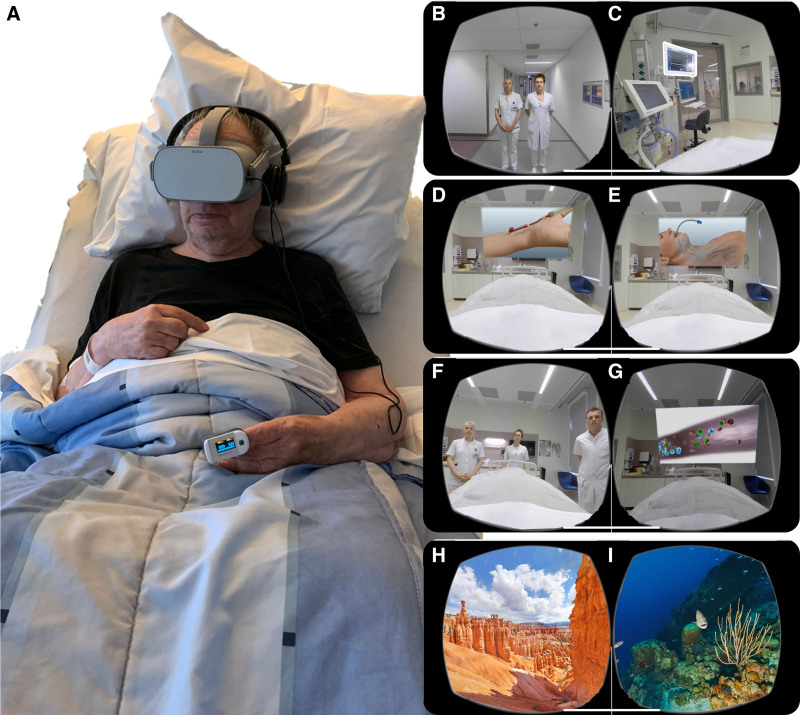
This multicenter randomized feasibility study tested an ICU-specific virtual reality intervention (ICU-VR) versus a nature VR control in 50 mechanically ventilated adults recovering from sepsis or septic shock. ICU-VR appeared feasible and safe, and it was associated with lower PTSD and depressive symptoms and better mental HRQoL during early follow-up.
Key findings
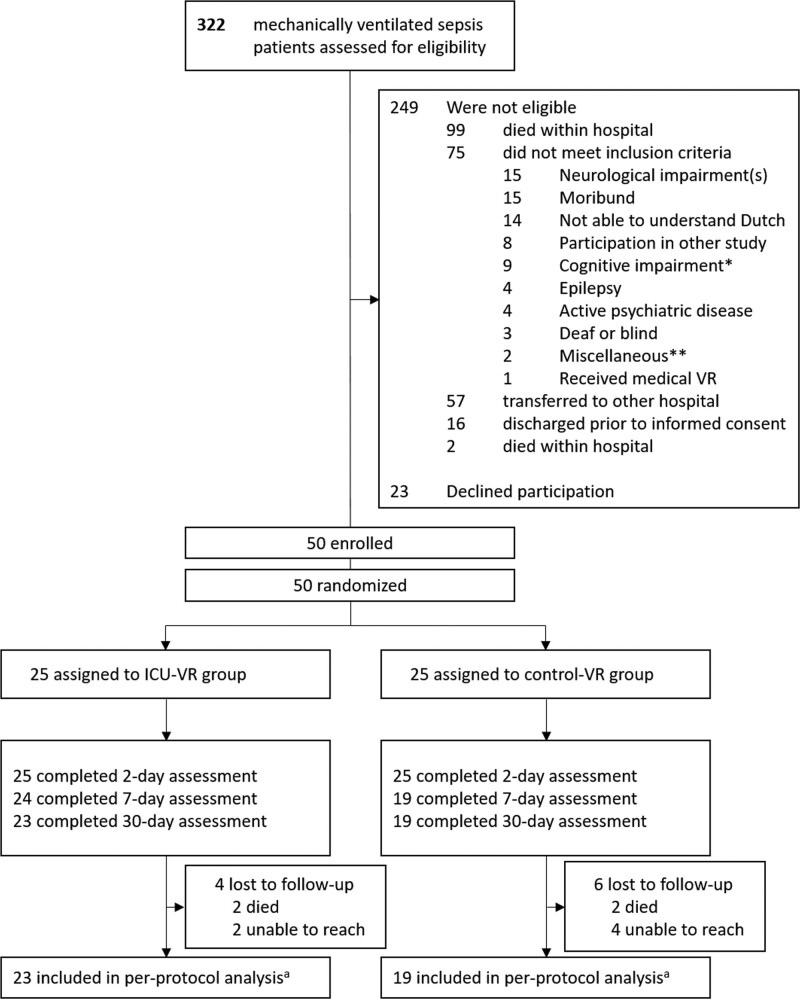
- Of 322 admitted patients, 73 met eligibility criteria and 50 were enrolled; the inclusion rate was 68%.
- Patients reported they were ready to start VR a median of 8 days after ICU discharge; all enrolled patients completed at least one VR session, and the median number of desired sessions was 1 in both groups.
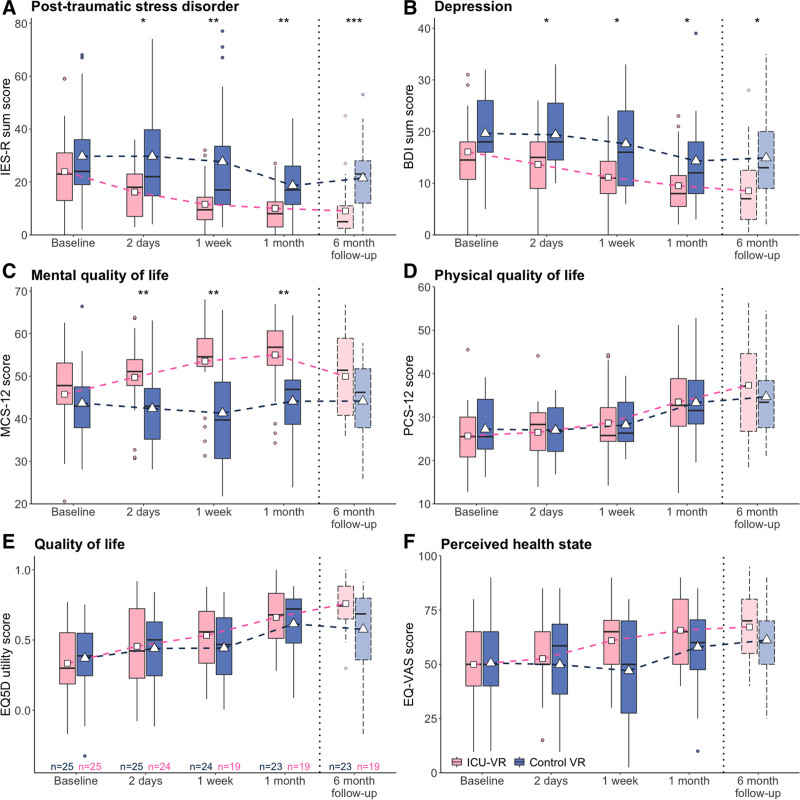
- ICU-VR improved psychologic outcomes versus control: PTSD-related symptoms were lower and the effect persisted throughout follow-up, with a reported between-group coefficient of 10.87 (95% CI, 3.73–18.01; pRandomization < 0.01), and depressive symptoms were also lower, coefficient 5.05 (95% CI, 1.31–8.79; pRandomization = 0.01).
- Mental quality of life was higher in the ICU-VR group up to 1 month after exposure, but not at 6 months; no differences were seen in physical HRQoL, overall HRQoL, or perceived health state.
Methods
- Multicenter, randomized controlled feasibility study with 1:1 assignment to ICU-VR or an active control VR nature environment; blinding of patients and investigators was not possible.
- Adults (≥18 years) admitted with sepsis or septic shock and mechanically ventilated for at least 24 hours were eligible; 50 patients were enrolled after exclusions.
- Outcomes were assessed with questionnaires before VR and at 2 days, 1 week, 1 month, and attempted 6 months after exposure; analyses included Wilcoxon Mann-Whitney U tests, Fisher exact tests, and mixed-effects linear regression, with LOCF and multiple imputation as sensitivity analyses.
Limitations
- The paper states that a larger than ideal number of patients were lost to follow-up at 6 months, which may reflect questionnaire burden and may bias results.
- The active control condition may have introduced daily contact and social support effects; the paper says this could influence findings.
- The sample was relatively small, preventing subgroup analyses, and only patients with sepsis or septic shock who were mechanically ventilated >24 hours were included, limiting generalizability.
- Evident from the text: patients and investigators were not blinded, so social desirability bias remains a possible source of bias despite attempts to minimize it.
Model-written summary. Check it against the paper before relying on it.
Integrity signals
Registry
Cites
Statistics
Figures
Verification
Claims the paper makes
3 Valid · 1 Not valid · 16 Not checked · 57 Own results and interpretations
The cited sources support only part of this claim — read each source’s verdict below.
In the paper
“Through VR, it is possible to simulate stressful and traumatic experiences in a highly engaging and realistic manner (16–19).”
§ Virtual Reality to Improve Sequelae of the Postintensive Care Syndrome: A Multicenter, Randomized Controlled Feasibility Study > Abstract
What the sources say
- Partly supportedcites [16] Gerber SM Jeitziner MM Knobel SEJ: Perception and performance on a virtual reality cognitive stimulation for use in the intensive care unit: A non-randomized trial in critically ill patients. Front Med (Lausanne). 2019; 6: 287 31921867 PMC6914846 sourceExperimental — accuracy not yet measured
Our copy supports only the engaging/realistic half of the claim: the Introduction (p. 1) states that when wearing the head-mounted display 'patients do not hear or see the ICU and they are virtually "taken out" of the ICU,' and the Discussion (Acceptance, Comfort, and Recollection) reports high immersion scores 'indicating that patients forgot about their actual surroundings.' The specific point attributed here — simulating stressful and traumatic experiences — is not in this paper; its VR content is deliberately restorative (aquatic worlds/landscapes with classical music), and the Discussion states it 'did not evoke any negative reactions, but provided patients with a confident, secure, fascinating and familiar environment,' used to distract from and reduce the stressful ICU environment (Introduction; Discussion, Primary Results). No passage credits VR with simulating trauma, and no other work is named in our copy for that point. (LLM, conf=0.70)
- Could not verifycites [17] Turon M Fernandez-Gonzalo S Jodar M: Feasibility and safety of virtual-reality-based early neurocognitive stimulation in critically ill patients. Ann Intensive Care. 2017; 7: 81 28770543 PMC5540744 sourceExperimental — accuracy not yet measured
Our copy of Turon et al. (2017) describes a VR platform (ENRIC) whose stimulation software 'immerses patients in a relaxing environment' with a guiding virtual avatar (Methods > Inpatient early neurocognitive intervention), and reports feasibility, safety, tolerability and HRV-based evidence of cognitive stimulation (Abstract > Results; Discussion). No passage states that VR can simulate stressful or traumatic experiences in a highly engaging and realistic manner; the only 'simulating' reference is healthy volunteers tested 'in a session simulating ICU patients' situation' (Methods > Procedure), which is about replicating the clinical setting for usability testing, not about VR's capacity to recreate traumatic scenarios. Searches for 'simulate stressful/traumatic experience', 'immersive/realistic/engaging' returned only the relaxing-environment description, so this paper does not support the attributed point. (LLM, conf=0.68)
- Not checked yetcites [18] Wang J Zhang C Jia Y: Development of a virtual reality system for early mobilization of critically ill patients. Stud Health Technol Inform. 2019; 264: 1805– 1806 31438353
- Not checked yetcites [19] Ong TL Ruppert MM Akbar M: Improving the intensive care patient experience with virtual reality-A feasibility study. Crit Care Explor. 2020; 2: e0122 32695991 PMC7314318
plainstates a cause- Asserted: passes — The authors put it forward as true.
- Checkable: passes — It can be checked against evidence.
- Load-bearing: passes — The paper’s conclusions depend on it.
- Based: passes — The paper gives a reason why it holds.
- Partly supported
A result the paper reports from its own data — it cites no other source for it, so there is none to check. The quote shows it is in the paper.
In the paper
“Patients reported to be ready to initiate VR 8 days (median, 95% range 4–23 d) after ICU discharge”
§ Virtual Reality to Improve Sequelae of the Postintensive Care Syndrome: A Multicenter, Randomized Controlled Feasibility Study > RESULTS > Feasibility
plain- Asserted: passes — The authors put it forward as true.
- Checkable: passes — It can be checked against evidence.
- Load-bearing: unclear — It is unclear whether the paper’s conclusions depend on it.
- Based: passes — The paper gives a reason why it holds.
A result the paper reports from its own data — it cites no other source for it, so there is none to check. The quote shows it is in the paper.
In the paper
“PTSD decreased more in the ICU-VR group than in the control VR group (β = 10.87 [3.73–18.01; pRandomization< 0.01)”
§ Virtual Reality to Improve Sequelae of the Postintensive Care Syndrome: A Multicenter, Randomized Controlled Feasibility Study > RESULTS > Psychologic PICS
plainstates a cause- Asserted: passes — The authors put it forward as true.
- Checkable: passes — It can be checked against evidence.
- Load-bearing: passes — The paper’s conclusions depend on it.
- Based: passes — The paper gives a reason why it holds.
A result the paper reports from its own data — it cites no other source for it, so there is none to check. The quote shows it is in the paper.
In the paper
“it was higher in patients in the ICU-VR group than in patients in the control VR group (7.65 [–12.10 to –3.19]; pRandomization < 0.01)”
§ Virtual Reality to Improve Sequelae of the Postintensive Care Syndrome: A Multicenter, Randomized Controlled Feasibility Study > RESULTS > Psychologic PICS
plainstates an association- Asserted: passes — The authors put it forward as true.
- Checkable: passes — It can be checked against evidence.
- Load-bearing: passes — The paper’s conclusions depend on it.
- Based: passes — The paper gives a reason why it holds.
A result the paper reports from its own data — it cites no other source for it, so there is none to check. The quote shows it is in the paper.
In the paper
“and this effect persisted throughout the follow-up period (β = 0.03 [0.00–0.07; pInteraction = 0.07).”
§ Virtual Reality to Improve Sequelae of the Postintensive Care Syndrome: A Multicenter, Randomized Controlled Feasibility Study > RESULTS > Psychologic PICS
plainstates a cause- Asserted: passes — The authors put it forward as true.
- Checkable: passes — It can be checked against evidence.
- Load-bearing: passes — The paper’s conclusions depend on it.
- Based: passes — The paper gives a reason why it holds.
25 more claims
Create a free account to see all 77 claims and to verify the 25 references still open.
- It may state two separate claims as one. 35
- Borderline: one of the tests for a substantial claim is unclear. 1
- Probably not a substantial claim. 15
Claims other papers make about this one
Each is checked against this paper’s own text: does it say what the citing paper says it does?
The cited source says what the claim attributes to it.
In the citing paper
“was previously demonstrated to be safe and feasible [18,22].”
From Intensive Care Unit–Specific Virtual Reality for Critically Ill Patients With COVID-19: Multicenter Randomized Controlled Trial (2022) · cites this paper as [22]
In the citing paper
“Recently, virtual reality (VR) was demonstrated to be a useful technique to improve post-ICU mental health in sepsis survivors and could also be safely used and implemented in post-ICU COVID-19 care [18-20].”
From Intensive Care Unit–Specific Virtual Reality for Critically Ill Patients With COVID-19: Multicenter Randomized Controlled Trial (2022) · cites this paper as [20]
Self-check
Percentages, sums and reported differences re-computed from the paper’s own numbers.
Each contradiction between two passages listed here was confirmed by an independent check.
Rated minor: it would not touch a result — a value no result rests on, a p-value that stays on the same side of the significance level, or a conflict that is clerical, resolved elsewhere in the paper, or outside its own findings.
In the paper
§ Virtual Reality to Improve Sequelae of the Postintensive Care Syndrome: A Multicenter, Randomized Controlled Feasibility Study > RESULTS > Psychologic PICS
“it was higher in patients in the ICU-VR group than in patients in the control VR group (7.65 [–12.10 to –3.19]; pRandomization < 0.01)”
§ Virtual Reality to Improve Sequelae of the Postintensive Care Syndrome: A Multicenter, Randomized Controlled Feasibility Study > RESULTS > Psychologic PICS
“Patients in the ICU-VR group experienced improved mental quality of life, already 2 days after ICU-VR exposure up to 1 month afterward, but not at 6 months, than patients in the control VR group”
Rated minor: it would not touch a result — a value no result rests on, a p-value that stays on the same side of the significance level, or a conflict that is clerical, resolved elsewhere in the paper, or outside its own findings.
In the paper
§ Virtual Reality to Improve Sequelae of the Postintensive Care Syndrome: A Multicenter, Randomized Controlled Feasibility Study > CONCLUSIONS
“Patients randomized to the ICU-VR group reported less psychologic distress and a better mental HRQoL up to 1 month after VR exposure.”
§ Virtual Reality to Improve Sequelae of the Postintensive Care Syndrome: A Multicenter, Randomized Controlled Feasibility Study > DISCUSSION
“Second, we observed that ICU-specific content improves mental health up to 6 months after ICU discharge.”
Citations
Cites
WARE, J. E., KOSINSKI, M., & KELLER, S. D. (1996) · Medical Care · doi:10.1097/00005650-199603000-00003 · Cited by 17,392 · cited 1×
“Health-related quality of life (HRQoL) was assessed using the Mental Component Scale of the ShortForm 12 (MCS-12) and the Physical Component Scale of the Short-Form 12 (PCS-12) scores and the European Quality of Life 5D (EQ-5D) questionnaire (34, 35).”
EuroQol: a new facility for the measurement of health-related quality of life
(1990) · Health Policy · doi:10.1016/0168-8510(90)90421-9 · Cited by 15,736
Bone, R. C., Balk, R. A., Cerra, F. B., Dellinger, R. P., Fein, A. M., Knaus, W. A., Schein, R. M. H., & Sibbald, W. J. (1992) · Chest · doi:10.1378/chest.101.6.1644 · Cited by 13,198
Simulator Sickness Questionnaire: An Enhanced Method for Quantifying Simulator Sickness
Kennedy, R. S., Lane, N. E., Berbaum, K. S., & Lilienthal, M. G. (1993) · The International Journal of Aviation Psychology · doi:10.1207/s15327108ijap0303_3 · Cited by 5,457 · cited 1×
“Cybersickness was measured using the Simulator Sickness Questionnaire directly after VR initiation, and changes in vital signs were assessed during the VR intervention using heart rate, respiratory rate, oxygen saturation, and mean arterial pressure (29).”
Psychometric properties of the Impact of Event Scale—Revised
Creamer, M., Bell, R., & Failla, S. (2003) · Behaviour Research and Therapy · doi:10.1016/j.brat.2003.07.010 · Cited by 1,947 · cited 1×
“Continuous outcomes rather than the cutoff values of the psychologic questionnaires were used, given that the IES-R and BDI were not designed as diagnostic tools, but rather to measure a patient’s level of stress- and depression-related symptoms (32, 33).”
A psychometric evaluation of the Beck Depression Inventory–II.
Dozois, D. J. A., Dobson, K. S., & Ahnberg, J. L. (1998) · Psychological Assessment · doi:10.1037/1040-3590.10.2.83 · Cited by 1,517 · cited 1×
“Continuous outcomes rather than the cutoff values of the psychologic questionnaires were used, given that the IES-R and BDI were not designed as diagnostic tools, but rather to measure a patient’s level of stress- and depression-related symptoms (32, 33).”
Dutch Tariff for the Five-Level Version of EQ-5D
M. Versteegh, M., M. Vermeulen, K., M. A. A. Evers, S., de Wit, G. A., Prenger, R., & A. Stolk, E. (2016) · Value in Health · doi:10.1016/j.jval.2016.01.003 · Cited by 1,113
Jones, C., Griffiths, R. D., Humphris, G., & Skirrow, P. M. (2001) · Critical Care Medicine · doi:10.1097/00003246-200103000-00019 · Cited by 786 · cited 2×
“Patients with ICU-related PTSD do not necessarily fear the “real” environment of the ICU or events during ICU treatment, but rather fear the frightening experiences they remember; in contrast, patients with non-ICU–related PTSD fear an actual event or situation (10, 37).”
Posttraumatic Stress Disorder in Critical Illness Survivors: A Metaanalysis*
Parker, A. M., Sricharoenchai, T., Raparla, S., Schneck, K. W., Bienvenu, O. J., & Needham, D. M. (2015) · Critical Care Medicine · doi:10.1097/ccm.0000000000000882 · Cited by 779
Self-citationQuality of life in the five years after intensive care: a cohort study
Cuthbertson, B. H., Roughton, S., Jenkinson, D., MacLennan, G., & Vale, L. (2010) · Critical Care · doi:10.1186/cc8848 · Cited by 475 · cited 2×
“Up to one-third of all critical illness survivors worldwide suffer from decreased quality of life (1, 3).”
Research works printed but not linked: 5
- Johns C Nunez D Daya M: The interaction between individuals’ immersive tendencies and the sensation of presence in a virtual environment. In: Eurographics Workshop on Virtual Environments. Mulder JD Van Liere R (Eds). Geneve, The Eurographics Association, 2000, pp 65– 74
- Beck AT Steer RA Brown GK: Beck Depression Inventory (BDI-II). Second Edition. London, Pearson, 1996
- Weiss DS: The impact of event scale: Revised. In: Cross-Cultural Assessment of Psychological Trauma and PTSD. International and Cultural Psychology Series. Wilson JP Tang CS (Eds). Boston, MA, Springer, 2007, pp 219– 238
- Wiederhold BK Wiederhold MD: Virtual Reality Therapy for Anxiety Disorders: Advances in Evaluation and Treatment. Second Edition. Washington, D.C., American Psychological Association, 2005
- Barrett J: Side Effects of Virtual Environments: A Review of the Literature. Edinburgh, Australian Government, Department of Defence, Defence Science and Technology Organisation Information Sciences Labarotory, 2004
Cited by
Bruno, R. R., Wolff, G., Wernly, B., Masyuk, M., Piayda, K., Leaver, S., Erkens, R., Oehler, D., Afzal, S., Heidari, H., et al. (2022) · Critical Care · doi:10.1186/s13054-022-04202-x · Cited by 242
Virtual reality in the diagnostic and therapy for mental disorders: A systematic review
Wiebe, A., Kannen, K., Selaskowski, B., Mehren, A., Thöne, A.-K., Pramme, L., Blumenthal, N., Li, M., Asché, L., Jonas, S., et al. (2022) · Clinical Psychology Review · doi:10.1016/j.cpr.2022.102213 · Cited by 223
Virtual and augmented reality in intensive care medicine: a systematic review
Kanschik, D., Bruno, R. R., Wolff, G., Kelm, M., & Jung, C. (2023) · Annals of Intensive Care · doi:10.1186/s13613-023-01176-z · Cited by 152
Vlake, J. H., van Bommel, J., Wils, E.-J., Bienvenu, J., Hellemons, M. E., Korevaar, T. I., Schut, A. F., Labout, J. A., Schreuder, L. L., van Bavel, M. P., et al. (2022) · Journal of Medical Internet Research · doi:10.2196/32368 · Cited by 84
“In short, it was developed by an interdisciplinary team that included intensivists, ICU nurses, a psychologist, a psychiatrist, an investigator, and former ICU patients and was previously demonstrated to be safe and feasible [18,22].”
Self-citationImproving the intensive care experience from the perspectives of different stakeholders
Latour, J. M., Kentish‐Barnes, N., Jacques, T. C., Wysocki, M., Azoulay, É., & Metaxa, V. (2022) · Critical Care · doi:10.1186/s13054-022-04094-x · Cited by 75
Metadata
- Authors
- Vlake, J. H., Van Bommel, J., Wils, E.-J., Korevaar, T. I. M., Bienvenu, O. J., Klijn, E., Gommers, D., & van Genderen, M. E.
- Affiliations
- Erasmus MC (NL)
- Department of Intensive Care, Erasmus Medical Centre, Rotterdam, The Netherlands.
- Sint Franciscus Gasthuis (NL)
- Johns Hopkins University (US)
- ORCID
- Venue
- Critical Care Explorations
- Published
- 2021-09
- Volume
- 3
- Issue
- 9
- Pages
- e0538
- ISSN
- 2639-8028 (ISSN-L)
- PMC
- PMC8443843
- OpenAlex
- W3200073740
- Semantic Scholar
- 16d80ef9ca242a5c6933868601c5db352d939368
- Cited by
- 41
- References
- 44
- Citations by year
- 2026: 9 · 2025: 8 · 2024: 11 · 2023: 4 · 2022: 8 · 2021: 1
- FWCI
- 4.29
- Type
- journal article
- Language
- en
- Open access
- gold
- doi.org
- Licence
- Locations
- Critical Care Explorations (publishedVersion, cc-by-nc-nd)
- Europe PMC (PubMed Central) (publishedVersion, other-oa)
- PubMed Central (publishedVersion, cc-by-nc-nd)
- PubMed (publishedVersion)
- EUR Research Repository (Erasmus University Rotterdam) (publishedVersion, cc-by-nc-nd)
- EUR Research Repository (Erasmus University Rotterdam) (submittedVersion, cc-by-nc-nd)
- DOAJ (DOAJ: Directory of Open Access Journals) (submittedVersion, cc-by-sa)
- Topics
- Health Sciences › Medicine › Critical Care and Intensive Care Medicine › Intensive Care Unit Cognitive Disorders
- Physical Sciences › Computer Science › Human-Computer Interaction › Virtual Reality Applications and Impacts
- Social Sciences › Education › Simulation-Based Education in Healthcare
- Keywords
- virtual reality, post-intensive care syndrome, critical illness, sepsis, septic shock, mechanical ventilation, post-traumatic stress disorder, depression, mental health, quality of life, cybersickness, immersion, feasibility, intensive care unit discharge
About these checks
Registry, retraction, Cites and statistics results are computed, not judged, with one exception: a printed reference that no index lists is read once by a model before it counts as a citation error. Claims are extracted by a model and kept only when their quote appears verbatim in the text; each cited source is then checked, with a model’s help, for whether it says what the claim relies on. Those verdicts can be wrong — read the claim’s quote and the cited source before relying on one.
The claim verdicts this report counts are experimental: their accuracy is not yet measured.
A language model drew the claims from the paper on 2026-10-11, under version 3 of the claim definition (model deepseek-v4.1-flash, prompt extract-v3).
A second model labelled each claim on 2026-10-11 (model jev-1.13-20260917, definition revision gold-guideline-v0.2).
Cited sources are checked with a language model’s help (qwen3.8-omni-flash).
Statistics and arithmetic are recomputed, not judged.
Confidence bands are shown only for fields calibrated on our annotated test set. None is calibrated yet, so no band is shown.
What counts as a claim ›How we measure confidence ›How we check this ›
Are you an author, or do you see a problem with this page? Request a review
Data sources
Bibliographic data: Semantic Scholar, OpenAlex, Crossref.
Contains information from the Semantic Scholar Academic Graph Datasets, made available under the ODC Attribution License (ODC-BY 1.0).
Semantic Scholar’s data is described in: Kinney, R., et al. (2023). The Semantic Scholar Open Data Platform. arXiv:2301.10140.
