

The DOI matches its Crossref record; 38 of the 38 references it cites were found in a registry or an index; none of the 52 sources its claims cite is checked for support yet.
Hallucination Rate of Peer-Reviewed Citations Generated by Large Language Models in Neurocritical Care
Open accessAbstract
IMPORTANCE: Large language models (LLMs) are increasingly used for scientific literature retrieval, yet their citation accuracy in specialized clinical domains remains poorly characterized. In neurocritical care (NCC), fabricated or inaccurate citations may be difficult to detect without deliberate verification. OBJECTIVES: To evaluate hallucination and fabrication rates of peer-reviewed citations generated by three LLMs across core NCC topics, under constrained zero-shot, memory-only conditions. DESIGN, SETTING, AND PARTICIPANTS: In this cross-sectional, blinded technology performance evaluation, Generative Pretrained Transformer (GPT)-5.3, DeepSeek-V3, and Grok-4 were queried on March 10, 2026, under identical zero-shot, retrieval-disabled web-interface conditions. Ten NCC topics were submitted to each model, and each model generated 10 references per topic, yielding 300 references. MAIN OUTCOMES AND MEASURES: Two NCC experts, blinded to model identity, independently verified each reference against PubMed, DOI, Google Scholar, and CrossRef and scored accuracy using a Hallucination Scale (0–3). The primary outcome was any hallucination, defined as any citation inaccuracy. The secondary outcome was fabrication, defined as a nonexisting complete bibliographic entity. RESULTS: Inter-rater agreement was excellent (κ = 0.91; 95% CI, 0.86–0.96). Overall, 165 of 300 references (55.0%) contained a citation inaccuracy, and 85 of 300 (28.3%) were completely fabricated. DeepSeek-V3 had the lowest hallucination rate (23%; fabrication 8%), followed by GPT-5.3 (69%; fabrication 27%) and Grok-4 (73%; fabrication 50%). Compared with DeepSeek-V3, Grok-4 was 3.17 times more likely to hallucinate (95% CI, 2.03–4.96; p < 0.001), and GPT-5.3 was 3.00 times more likely to hallucinate (95% CI, 1.94–4.63; p < 0.001). Topic-level findings were exploratory and should be interpreted cautiously. CONCLUSIONS AND RELEVANCE: Under standardized zero-shot, retrieval-disabled web-interface conditions, LLMs generated substantial numbers of inaccurate and fabricated NCC citations. Because fabricated references can appear complete and credible, artificial intelligence-generated citations should be verified across reliable databases before use in clinical, educational, or scholarly work.
Overview
CoChat Summary
TL;DR
In a cross-sectional blinded evaluation of 300 references generated by GPT-5.3, DeepSeek-V3, and Grok-4 across 10 neurocritical care topics under zero-shot, retrieval-disabled web-interface conditions, 55.0% contained citation inaccuracies and 28.3% were completely fabricated. DeepSeek-V3 had the lowest hallucination and fabrication rates, but all tested models produced citations unreliable without cross-database verification.
Key findings
- Overall, 165 of 300 references (55.0%) contained a citation inaccuracy, and 85 of 300 (28.3%) were completely fabricated; inter-rater agreement was excellent (κ = 0.91; 95% CI, 0.86–0.96).
- Model-level rates: DeepSeek-V3 had 23% hallucination and 8% fabrication; GPT-5.3 had 69% hallucination and 27% fabrication; Grok-4 had 73% hallucination and 50% fabrication. High-severity inaccuracies (score ≥ 2) occurred in 10% of DeepSeek outputs, 44% of GPT outputs, and 66% of Grok outputs.
- Compared with DeepSeek-V3, GPT-5.3 was 3.00 times more likely to hallucinate (95% CI, 1.94–4.63; p < 0.001) and Grok-4 was 3.17 times more likely (95% CI, 2.03–4.96; p < 0.001). For fabrication, GPT had RR 3.38 (95% CI, 1.52–7.49; p = 0.003) and Grok had RR 6.25 (95% CI, 3.07–12.71; p < 0.001) versus DeepSeek; Grok versus GPT for fabrication was not statistically significant (RR 1.85; 95% CI, 0.95–3.59; p = 0.069).
- Identifier omission increased with citation severity: 14.1% of accurate references had no identifier versus 54.1% of fabricated references (χ² = 79.07, p < 0.001); 3.5% of fabricated references carried a correctly resolving identifier.
Methods
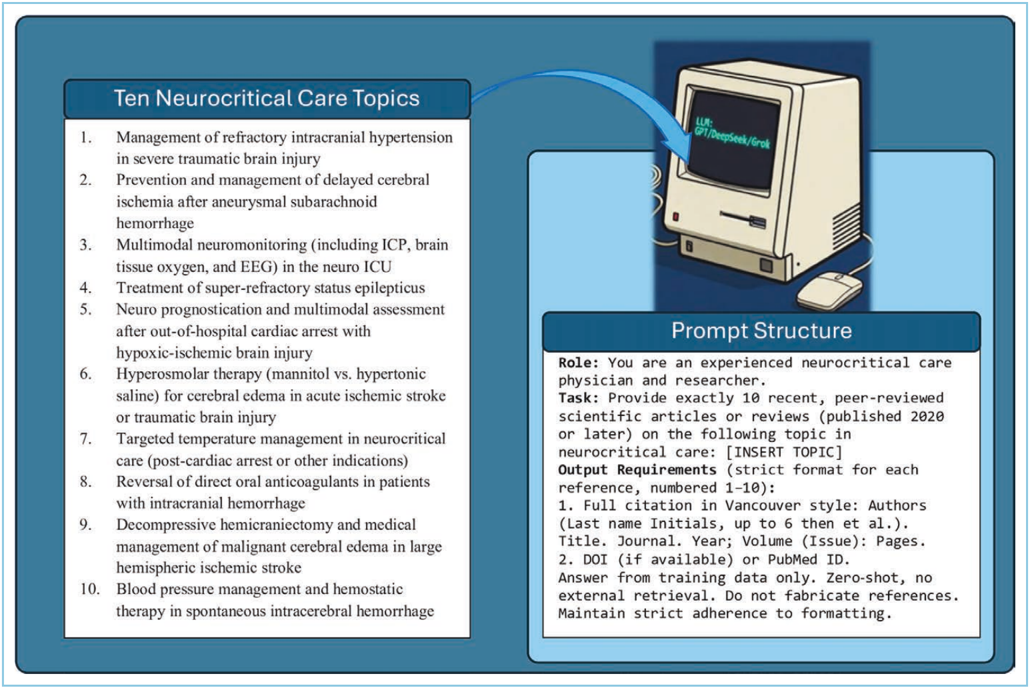
- Cross-sectional, blinded technology performance evaluation: 10 neurocritical care topics were submitted to GPT-5.3, DeepSeek-V3, and Grok-4 on March 10, 2026, using identical zero-shot prompts with retrieval/browsing disabled via official paid web interfaces; each model generated 10 recent (2020 or later) peer-reviewed references per topic, yielding 300 references.
- Two blinded neurocritical care experts independently verified each reference against PubMed, DOI resolver, Google Scholar, and CrossRef and scored it using a modified Reference Hallucination Scale (0 = fully accurate, 1 = minor error, 2 = major error, 3 = completely fabricated); discrepancies were resolved by consensus. Primary outcome was any hallucination (score ≥ 1); secondary outcome was fabrication (score = 3).
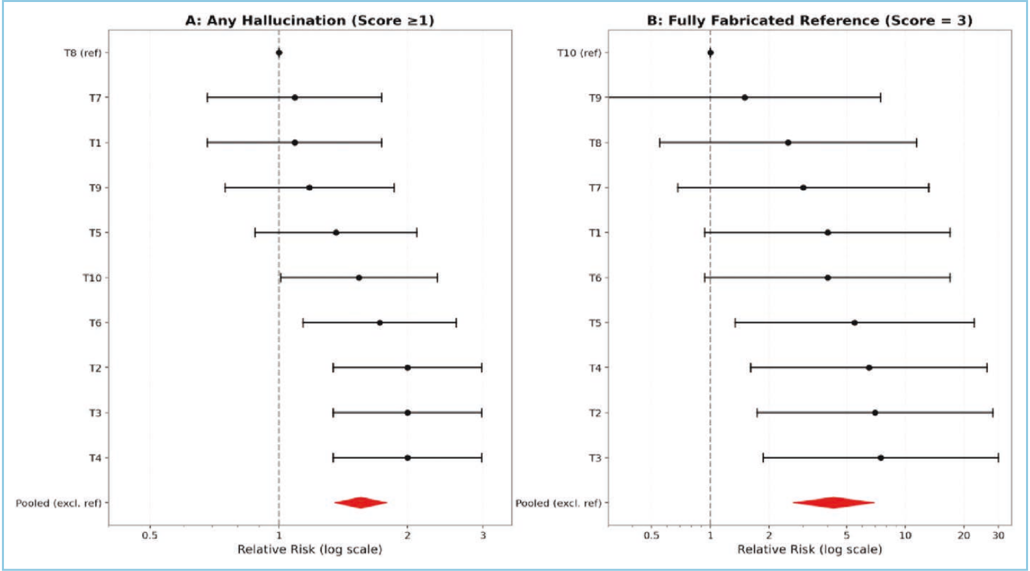
- Analyses included Cohen kappa for inter-rater reliability, Kruskal-Wallis with Dunn post hoc testing, modified Poisson regression with robust SEs clustered at the model-topic level for relative risks, and Fisher exact tests for topic-level comparisons; analyses used Python 3.12.
Limitations
- The authors state that the study used a single zero-shot prompt without chain-of-thought or retrieval-augmented generation, tested models at a single time point, selected only 10 topics by one domain expert without formal consensus or Delphi process, did not stratify topics by evidence density or guideline availability, could not exactly replicate stochastic outputs, used commercial web interfaces that limit control over temperature/system prompts/backend routing, primarily assessed bibliographic accuracy rather than topical relevance or clinical usefulness, sampled each model-topic combination once, and had underpowered topic-level analyses.
- Evident from the design: no repeated sampling per model-topic cell, no retrieval-enabled comparator arm, and no separate relevance or evidentiary-quality scoring were included, so the reported rates reflect one constrained zero-shot snapshot rather than optimized or repeated deployment conditions.
Model-written summary. Check it against the paper before relying on it.
Integrity signals
Registry
Cites
Statistics
Figures
Verification
Claims the paper makes
0 Valid · 0 Not valid · 36 Not checked · 105 Own results and interpretations
A result the paper reports from its own data — it cites no other source for it, so there is none to check. The quote shows it is in the paper.
In the paper
“Post hoc Dunn testing with Bonferroni correction identified significant differences between GPT and DeepSeek (z = 5.41, p < 0.001, r = −0.484) and between Grok and DeepSeek (z = 7.55, p < 0.001, r = −0.576).”
§ Hallucination Rate of Peer-Reviewed Citations Generated by Large Language Models in Neurocritical Care > RESULTS > Global Comparison
plain- Asserted: passes — The authors put it forward as true.
- Checkable: passes — It can be checked against evidence.
- Load-bearing: passes — The paper’s conclusions depend on it.
- Based: passes — The paper gives a reason why it holds.
A result the paper reports from its own data — it cites no other source for it, so there is none to check. The quote shows it is in the paper.
In the paper
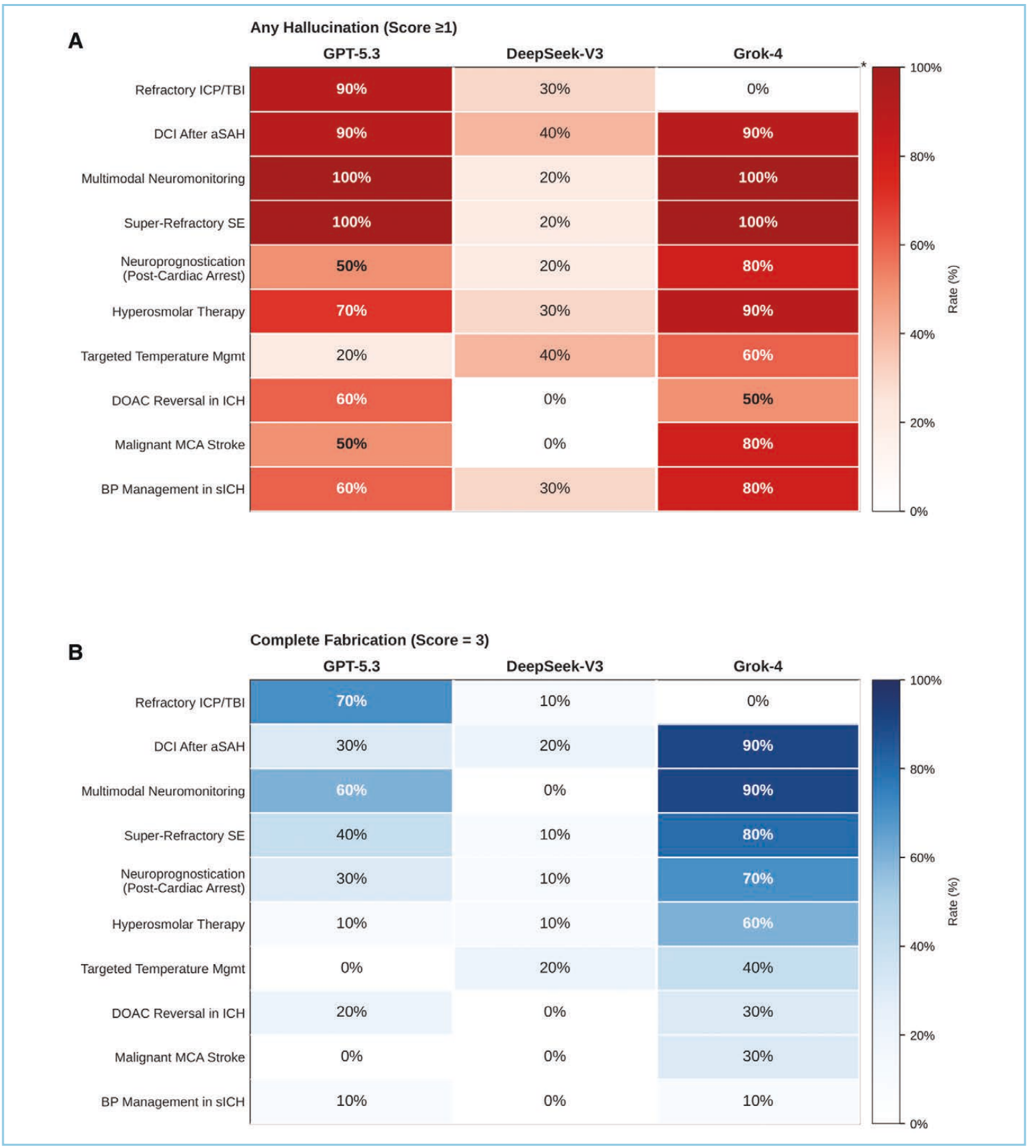
“Pooled hallucination rates across all three models ranged from 36.7% (Topic 8, DOAC reversal in ICH) to 73.3% (Topics 2, 3, and 4: cerebral vasospasm/subarachnoid hemorrhage, super refractory status epilepticus [SRSE], and delayed cerebral ischemia).”
§ Hallucination Rate of Peer-Reviewed Citations Generated by Large Language Models in Neurocritical Care > RESULTS > Topic-Level Analysis
plain- Asserted: passes — The authors put it forward as true.
- Checkable: passes — It can be checked against evidence.
- Load-bearing: passes — The paper’s conclusions depend on it.
- Based: passes — The paper gives a reason why it holds.
A result the paper reports from its own data — it cites no other source for it, so there is none to check. The quote shows it is in the paper.
In the paper
“DeepSeek demonstrated the lowest hallucination rate (23%; fabrication 8%), followed by GPT (69%; fabrication 27%) and Grok (73%; fabrication 50%).”
§ Hallucination Rate of Peer-Reviewed Citations Generated by Large Language Models in Neurocritical Care > RESULTS > Model-Level Performance
boosted- Asserted: passes — The authors put it forward as true.
- Checkable: passes — It can be checked against evidence.
- Load-bearing: passes — The paper’s conclusions depend on it.
- Based: passes — The paper gives a reason why it holds.
A result the paper reports from its own data — it cites no other source for it, so there is none to check. The quote shows it is in the paper.
In the paper
“High-severity citation inaccuracies (score ≥ 2) occurred in 10% of DeepSeek outputs, 44% of GPT outputs, and 66% of Grok outputs (Table 1).”
§ Hallucination Rate of Peer-Reviewed Citations Generated by Large Language Models in Neurocritical Care > RESULTS > Model-Level Performance
plain- Asserted: passes — The authors put it forward as true.
- Checkable: passes — It can be checked against evidence.
- Load-bearing: passes — The paper’s conclusions depend on it.
- Based: passes — The paper gives a reason why it holds.
A result the paper reports from its own data — it cites no other source for it, so there is none to check. The quote shows it is in the paper.
In the paper
“DeepSeek demonstrated the lowest hallucination rate (23%; fabrication 8%), followed by GPT (69%; fabrication 27%) and Grok (73%; fabrication 50%).”
§ Hallucination Rate of Peer-Reviewed Citations Generated by Large Language Models in Neurocritical Care > RESULTS > Model-Level Performance
boosted- Asserted: passes — The authors put it forward as true.
- Checkable: passes — It can be checked against evidence.
- Load-bearing: passes — The paper’s conclusions depend on it.
- Based: passes — The paper gives a reason why it holds.
80 more claims
Create a free account to see all 141 claims and to verify the 51 references still open.
- It may state two separate claims as one. 31
- Probably not a substantial claim. 36
- The quote only partly states this claim. 1
Statistics recomputed
Every reported test result, recomputed from its test statistic and degrees of freedom. A result shows as not adding up only once an independent check has confirmed it.
- Consistentz = 5.41reported p < .001 · recomputed p < .001
“(z = 5.41, p < .001”
- Consistentz = 7.55reported p < .001 · recomputed p < .001
“(z = 7.55, p < .001”
- Consistentz = 2.14reported p = .098 · recomputed p = .032
“(z = 2.14, p = .098”
The paper states a correction for multiple tests
Self-check
Percentages, sums and reported differences re-computed from the paper’s own numbers.
Each contradiction between two passages listed here was confirmed by an independent check.
Rated minor: it would not touch a result — a value no result rests on, a p-value that stays on the same side of the significance level, or a conflict that is clerical, resolved elsewhere in the paper, or outside its own findings.
In the paper
§ Hallucination Rate of Peer-Reviewed Citations Generated by Large Language Models in Neurocritical Care > RESULTS > Identifier Calibration Analysis
“Three fabricated references (3.5%) carried a correctly resolving identifier, representing a false reassurance scenario.”
§ Hallucination Rate of Peer-Reviewed Citations Generated by Large Language Models in Neurocritical Care > METHODS
“Citations containing bibliographic errors were classified as inaccurate, whereas “fabrication” was reserved for references that could not be verified in PubMed, CrossRef, Google Scholar, or via DOI resolution and therefore did not exist as complete bibliographic entities.”
Rated minor: it would not touch a result — a value no result rests on, a p-value that stays on the same side of the significance level, or a conflict that is clerical, resolved elsewhere in the paper, or outside its own findings.
In the paper
§ Hallucination Rate of Peer-Reviewed Citations Generated by Large Language Models in Neurocritical Care > RESULTS > Topic-Level Analysis
“Topics 2, 3, and 4: cerebral vasospasm/subarachnoid hemorrhage, super refractory status epilepticus [SRSE], and delayed cerebral ischemia”
§ Hallucination Rate of Peer-Reviewed Citations Generated by Large Language Models in Neurocritical Care > METHODS
“2) aneurysmal subarachnoid hemorrhage and delayed cerebral ischemia, 3) multimodal neuromonitoring, 4) super-refractory status epilepticus”
Citations
Cites
Survey of Hallucination in Natural Language Generation
Ji, Z., Lee, N., Frieske, R., Yu, T., Su, D., Xu, Y., Ishii, E., Bang, Y. J., Madotto, A., & Fung, P. (2023) · ACM Computing Surveys · doi:10.1145/3571730 · Cited by 5,025 · cited 4×
“When the same clinical concept appears under multiple names, an AI model encounters a fragmented and ambiguous signal, even where evidence does exist, a pattern consistent with published observations that inconsistent in specialized domains increases hallucination risk (23, 24).”
InfluentialHuang, L., Yu, W., Ma, W., Zhong, W., Feng, Z., Wang, H., Chen, Q., Peng, W., Feng, X., Qin, B., et al. (2025) · ACM Transactions on Information Systems · doi:10.1145/3703155 · Cited by 4,688
Chain-Of-Thought Prompting Elicits Reasoning in Large Language Models
Wei, J., Wang, X., Schuurmans, D., Bosma, M., Ichter, B., Xia, F., Chi, E., Le, Q. V., & Zhou, D. (2022) · Advances in Neural Information Processing Systems 35 · doi:10.52202/068431-1800 · Cited by 4,505
Chain-of-Thought Prompting Elicits Reasoning in Large Language Models
Wei, J., Wang, X., Schuurmans, D., Bosma, M., Ichter, B., Xia, F., Chi, E., Le, Q., & Zhou, D. (2022) · arXiv · doi:10.48550/arxiv.2201.11903 · Cited by 4,263
Large language models in medicine
Thirunavukarasu, A. J., Ting, D. S. J., Elangovan, K., Gutierrez, L., Tan, T. F., & Ting, D. S. W. (2023) · Nature Medicine · doi:10.1038/s41591-023-02448-8 · Cited by 3,944
Sallam, M. (2023) · Healthcare · doi:10.3390/healthcare11060887 · Cited by 3,126
Retrieval-Augmented Generation for Knowledge-Intensive NLP Tasks
Lewis, P., Perez, E., Piktus, A., Petroni, F., Karpukhin, V., Goyal, N., Küttler, H., Lewis, M., Yih, W.-T., Rocktäschel, T., et al. (2020) · arXiv · doi:10.48550/arxiv.2005.11401 · Cited by 3,101
Rapid Blood-Pressure Lowering in Patients with Acute Intracerebral Hemorrhage
Anderson, C. S., Heeley, E., Huang, Y., Wang, J., Stapf, C., Delcourt, C., Lindley, R., Robinson, T., Lavados, P., Neal, B., et al. (2013) · New England Journal of Medicine · doi:10.1056/nejmoa1214609 · Cited by 1,614
Artificial hallucinations in ChatGPT: implications in scientific writing
Alkaissi, H., & McFarlane, S. I. (2023) · Cureus · doi:10.7759/cureus.35179 · Cited by 1,540
Sharma, M., Tong, M., Korbak, T., Duperrouzel, D., Was, H., Korbak, J., Cheng, M., Askell, A., Bai, Y., Brain, C., et al. (2023) · arXiv (Cornell University) · doi:10.48550/arxiv.2310.13548 · Cited by 1,313
Cited by
Towards responsible AI-augmented evidence synthesis in Open, Distance, and Digital Education (ODDE)
Zawacki‐Richter, O., Martin, F., Bond, M., & West, R. E. (2026) · Online Learning · doi:10.24059/olj.v30isi2.6749
Metadata
- Authors
- Seifi, A., & Seyfi, A.
- Affiliations
- The University of Texas at San Antonio Health Science Center (US)
- George Washington University (US)
- Corresponding author
- Seifi, Ali
- ORCID
- Seifi, Ali
- Venue
- Critical Care Explorations
- Published
- 2026-08-25
- Volume
- 8
- Issue
- 9
- Pages
- e1474
- ISSN
- 2639-8028 (ISSN-L)
- PMC
- PMC13506236
- OpenAlex
- W7204201244
- Semantic Scholar
- 8fc580b7ee69df9a17c885e3599e120bd2742425
- Cited by
- 1
- References
- 36
- Citations by year
- 2026: 1
- FWCI
- 1.23
- Type
- journal article
- Language
- en
- Open access
- gold
- doi.org
- Locations
- Critical Care Explorations (publishedVersion, cc-by)
- PubMed Central (publishedVersion, cc-by)
- PubMed (publishedVersion)
- Topics
- Health Sciences › Medicine › Health Informatics › Artificial Intelligence in Healthcare and Education
- Physical Sciences › Computer Science › Artificial Intelligence › Topic Modeling
- Social Sciences › Library and Information Sciences › Academic Writing and Publishing
- Keywords
- large language models, citation accuracy, neurocritical care, DeepSeek-V3, Grok-4, zero-shot retrieval, bibliographic verification, AI-generated literature, interobserver agreement
- MeSH terms
- Data Accuracy, Large Language Models, Generative Artificial Intelligence, Critical Care, Humans, Neurology, Information Storage and Retrieval, Peer Review, Research
About these checks
Registry, retraction, Cites and statistics results are computed, not judged, with one exception: a printed reference that no index lists is read once by a model before it counts as a citation error. Claims are extracted by a model and kept only when their quote appears verbatim in the text; each cited source is then checked, with a model’s help, for whether it says what the claim relies on. Those verdicts can be wrong — read the claim’s quote and the cited source before relying on one.
A language model drew the claims from the paper on 2026-11-13, under version 3 of the claim definition (model deepseek-v4.1-flash, prompt extract-v3).
A second model labelled each claim on 2026-11-13 (model jev-1.13-20260917, definition revision gold-guideline-v0.2).
Statistics and arithmetic are recomputed, not judged.
Confidence bands are shown only for fields calibrated on our annotated test set. None is calibrated yet, so no band is shown.
What counts as a claim ›How we measure confidence ›How we check this ›
Are you an author, or do you see a problem with this page? Request a review
Data sources
Bibliographic data: Semantic Scholar, OpenAlex, Crossref.
Contains information from the Semantic Scholar Academic Graph Datasets, made available under the ODC Attribution License (ODC-BY 1.0).
Semantic Scholar’s data is described in: Kinney, R., et al. (2023). The Semantic Scholar Open Data Platform. arXiv:2301.10140.
