

Improving survival of critical care patients with coronavirus disease 2019 in England: a national cohort study, March to June 2020
Open accessPublished version of a preprint
The DOI matches its Crossref record; 16 of the 16 references it cites were found in a registry or an index.
Abstract
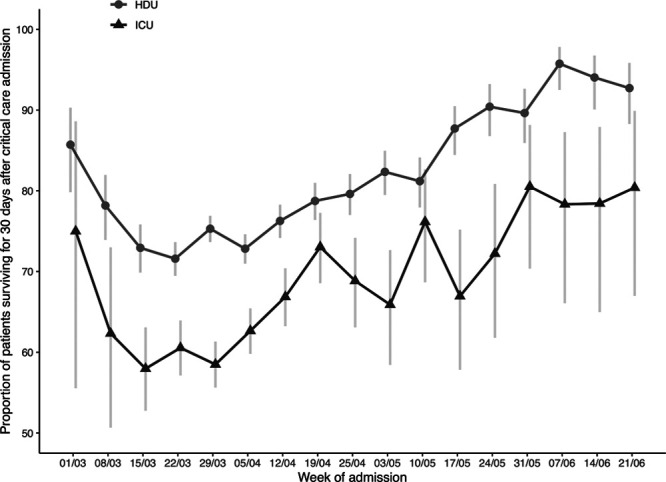
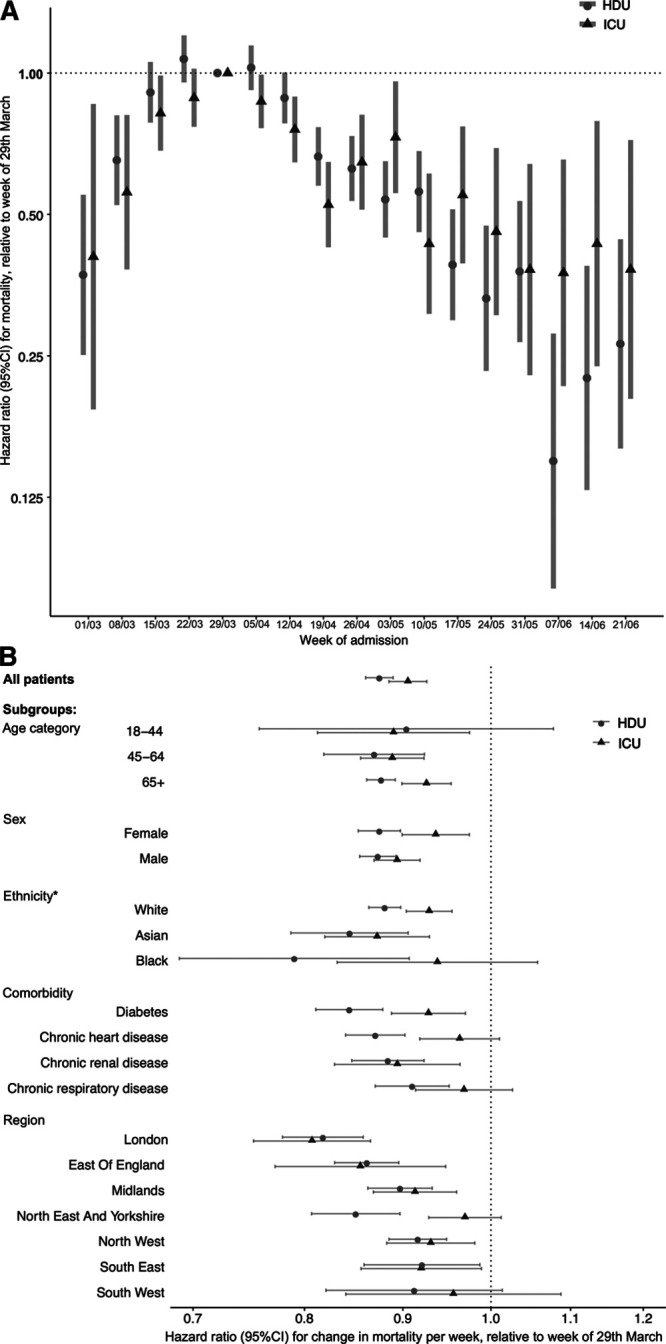
Objectives: To measure temporal trends in survival over time in people with severe coronavirus disease 2019 requiring critical care (high dependency unit or ICU) management, and to assess whether temporal variation in mortality was explained by changes in patient demographics and comorbidity burden over time. Design: Retrospective observational cohort; based on data reported to the COVID-19 Hospitalisation in England Surveillance System. The primary outcome was in-hospital 30-day all-cause mortality. Unadjusted survival was estimated by calendar week of admission, and Cox proportional hazards models were used to estimate adjusted survival, controlling for age, sex, ethnicity, major comorbidities, and geographical region. Setting: One hundred eight English critical care units. Patients: All adult (18 yr +) coronavirus disease 2019 specific critical care admissions between March 1, 2020, and June 27, 2020. Interventions: Not applicable. Measurements and Main Results: Twenty-one thousand eighty-two critical care patients (high dependency unit n = 15,367; ICU n = 5,715) were included. Unadjusted survival at 30 days was lowest for people admitted in late March in both high dependency unit (71.6% survival) and ICU (58.0% survival). By the end of June, survival had improved to 92.7% in high dependency unit and 80.4% in ICU. Improvements in survival remained after adjustment for patient characteristics (age, sex, ethnicity, and major comorbidities) and geographical region. Conclusions: There has been a substantial improvement in survival amongst people admitted to critical care with coronavirus disease 2019 in England, with markedly higher survival rates in people admitted in May and June compared with those admitted in March and April. Our analysis suggests this improvement is not due to temporal changes in the age, sex, ethnicity, or major comorbidity burden of admitted patients.
Overview
The claims and statistics of this paper haven’t been checked yet.
Free: it reads the open-access text and checks the first 5 claims that cite a source we can check. Create a free account to check every claim.
Integrity signals
Registry
Cites
Statistics
Figures
Verification
Claims the paper makes
The claims and statistics of this paper haven’t been checked yet.
Free: it reads the open-access text and checks the first 5 claims that cite a source we can check. Create a free account to check every claim.
Self-check
Percentages, sums and reported differences re-computed from the paper’s own numbers.
The self-check needs the paper’s full text.
Citations
Cites
Dexamethasone in Hospitalized Patients with Covid-19
The RECOVERY Collaborative Group (2021) · New England Journal of Medicine · doi:10.1056/nejmoa2021436 · Cited by 11,477
Effect of Dexamethasone in Hospitalized Patients with COVID-19 – Preliminary Report
Horby, P., Lim, W. S., Emberson, J., Mafham, M., Bell, J., Linsell, L., Staplin, N., Brightling, C., Ustianowski, A., Elmahi, E., et al. (2020) · doi:10.1101/2020.06.22.20137273 · Cited by 11,475 · cited 1×
“Of particular note regarding treatment, the RECOVERY trial began nationwide recruitment in early April, and included dexamethasone which was later shown to have mortality-specific, or length of intensive treatment unit admission-specific benefits, as well as azithromycin, tocilizumab, and convalescent plasma (8).”
BackgroundRemdesivir for the Treatment of Covid-19 — Final Report
Beigel, J. H., Tomashek, K. M., Dodd, L. E., Mehta, A. K., Zingman, B. S., Kalil, A. C., Hohmann, E., Chu, H. Y., Luetkemeyer, A., Kline, S., et al. (2020) · New England Journal of Medicine · doi:10.1056/nejmoa2007764 · Cited by 7,267 · cited 1×
“Randomised Evaluation of COVID-19 Therapy (RECOVERY) did not include remdesivir, also shown to have therapeutic benefit in COVID-19 patients, but did not exclude patients receiving remdesivir or other potential COVID-19 treatments from the trial itself (9).”
Docherty, A. B., Harrison, E. M., Green, C. A., Hardwick, H. E., Pius, R., Norman, L., Holden, K. A., Read, J. M., Dondelinger, F., Carson, G., et al. (2020) · BMJ · doi:10.1136/bmj.m1985 · Cited by 3,481
Ferguson, N. M., Laydon, D. J., Nedjati-Gilani, G. L., Imai, N., Ainslie, K. E. C., Baguelin, M., Bhatia, S., Boonyasiri, A., Cucunubá, Z. M., Cuomo-Dannenburg, G., et al. (2020) · Spiral (Imperial College London) · doi:10.25561/77482 · Cited by 3,281
Remdesivir for the Treatment of Covid-19 — Preliminary Report
(2020) · New England Journal of Medicine · doi:10.1056/nejmc2022236 · Cited by 1,396
Sprivulis, P. C., Da Silva, J., Jacobs, I. G., Jelinek, G. A., & Frazer, A. R. L. (2006) · Medical Journal of Australia · doi:10.5694/j.1326-5377.2006.tb00203.x · Cited by 759 · cited 1×
“Therefore, the observed time trend could be a manifestation of the well-established decline in patient-specific outcomes often observed at “unsafe” occupancy levels (11).”
BackgroundSprivulis, P. C., Da Silva, J., Jacobs, I. G., Frazer, A. R. L., & Jelinek, G. A. (2006) · Medical Journal of Australia · doi:10.5694/j.1326-5377.2006.tb00416.x · Cited by 757
Trends in Intensive Care for Patients with COVID-19 in England, Wales, and Northern Ireland
Doidge, J. C., Gould, D. W., Ferrando-Vivas, P., Mouncey, P. R., Thomas, K., Shankar-Hari, M., Harrison, D. A., & Rowan, K. M. (2021) · American Journal of Respiratory and Critical Care Medicine · doi:10.1164/rccm.202008-3212oc · Cited by 168 · cited 1×
“08] for peak vs pre-pandemic) (7); however, our analysis extends this observation to the HDU setting thereby demonstrating that this effect is likely to be robust to the selection bias implicit in identifying candidates for intensivist care.”
ResultMateen, B. A., Wilde, H., Dennis, J., Duncan, A., Thomas, N. J., McGovern, A. P., Denaxas, S., Keeling, M. J., & Vollmer, S. J. (2021) · BMJ Open · doi:10.1136/bmjopen-2020-042945 · Cited by 65
Self-citation
Cited by
Items 101–200 of 214
Castro, V. M., Hart, K. L., Sacks, C. A., Murphy, S. N., Perlis, R. H., & McCoy, T. H. (2021) · General Hospital Psychiatry · doi:10.1016/j.genhosppsych.2021.10.005 · Cited by 14
Effectiveness of low-dose radiation therapy in COVID-19 patients globally: A systematic review
Pandey, S. R., Yadav, S. A., Gautam, S., Giri, K., Devkota, A., Shrestha, S., Bhandari, S., Baniya, S., Adhikari, B., Adhikari, B., et al. (2022) · F1000Research · doi:10.12688/f1000research.74558.1 · Cited by 11
Burrell, A. J. C., Neto, A. S., Broadley, T., Trapani, T. V., Begum, H., Campbell, L. T., Cheng, A. C., Cheung, W., Cooper, D. J., Erickson, S. J., et al. (2021) · Critical Care and Resuscitation · doi:10.51893/2021.3.oa8 · Cited by 16
Kwok, S. W. H., Wang, G., Sohel, F. A., KASHANI, K. B., Zhu, Y., Wang, Z., Antpack, E., Khandelwal, K., Pagali, S. R., Nanda, S., et al. (2023) · Respiratory Research · doi:10.1186/s12931-023-02386-6 · Cited by 12
From Epidemic to Pandemic: Comparing Hospital Staff Emotional Experience Between MERS and COVID-19
Khalid, I., Imran, M., Imran, M., AKHTAR, M. A., Khan, S., Amanullah, K., & Khalid, T. J. (2021) · Clinical Medicine & Research · doi:10.3121/cmr.2021.1657 · Cited by 11
“Change in workload during the MERS outbreak, n (%) Increased 52 (51) Decreased 8 (8) Remained Unchanged 42 (41)”
BackgroundSchons, M., Pilgram, L., Reese, J., Stecher, M., Anton, G., Appel, K. S., Bahmer, T. J., Bartschke, A., Bellinghausen, C., Bernemann, I., et al. (2022) · Research Square · doi:10.21203/rs.3.rs-1249111/v1 · Cited by 11
Azarkar, Z., Salehiniya, H., Kazemi, T., & Abbaszadeh, H. (2021) · Osong Public Health and Research Perspectives · doi:10.24171/j.phrp.2021.0012 · Cited by 11
Tracking the transmission dynamics of COVID‐19 with a time‐varying coefficient state‐space model
Keller, J. P., Zhou, T., Kaplan, A., Anderson, G. B., & Zhou, W. (2022) · Statistics in Medicine · doi:10.1002/sim.9382 · Cited by 18
“Compared to the traditional additive models, the multiplicative process model (10) is more natural to introduce deviations between the nonnegative solution to differential equation models and unobservable process with nonnegative observable space.”
BackgroundMethodInfluentialVogt, K. S., Johnson, J., Coleman, R., Simms‐Ellis, R., Harrison, R., Shearman, N., Marran, J., Budworth, L., Horsfield, C., Lawton, R., et al. (2024) · BMC Health Services Research · doi:10.1186/s12913-023-10468-w · Cited by 17
Zhang, M., Hu, P., Xu, X., Ai, J., Li, Y., Bao, Y., Tangamornsuksan, W., Chan, A., Xie, S., Hu, H., et al. (2022) · PLoS ONE · doi:10.1371/journal.pone.0265117 · Cited by 9
“Consistent with the findings from a cohort study in the UK, our estimated mortality rates in severe and critical cases fell over time [73].”
BackgroundResultShah, R., Shah, J., Kunyiha, N., Ali, S. K., Sayed, S., Surani, S., & Saleh, M. N. (2022) · International Journal of General Medicine · doi:10.2147/ijgm.s361176 · Cited by 12
Changes in COVID-19-related outcomes, potential risk factors and disparities over time
Yu, Y., Gu, T., Valley, T. S., Mukherjee, B., & Fritsche, L. G. (2021) · Epidemiology and Infection · doi:10.1017/s0950268821001898 · Cited by 8
Bravata, D. M., Myers, L. J., Perkins, A. J., Keyhani, S., Zhang, Y., Zillich, A. J., Dysangco, A. T., Reese, L. J., Sharmitha, D., Myers, J. L., et al. (2021) · BMJ Open · doi:10.1136/bmjopen-2020-044646 · Cited by 8
Was Alpha deadlier than wild-type COVID? Analysis in rural England
Brainard, J. S., Sampedro, C. M. G., Sweeting, A., & Fordham, R. J. (2022) · Infection · doi:10.1007/s15010-022-01787-x · Cited by 11
Hong, C., Zhang, H. G., L’Yi, S., Weber, G. M., Avillach, P., Tan, B. W. Q., Gutiérrez‐Sacristán, A., Bonzel, C.-L., Palmer, N., Malovini, A. L., et al. (2022) · BMJ Open · doi:10.1136/bmjopen-2021-057725 · Cited by 9
COVID-19 and acute kidney injury in German hospitals 2020
Walendy, V., Girndt, M., & Greinert, D. (2022) · PLoS ONE · doi:10.1371/journal.pone.0264510 · Cited by 8
Docherty, A. B., Mulholland, R. H., Lone, N., Cheyne, C. P., Angelis, D. D., Diaz‐Ordaz, K., Donoghue, C., Drake, T. M., Dunning, J. W., Funk, S., et al. (2020) · medRxiv · doi:10.1101/2020.12.19.20248559 · Cited by 8
Sweeney, D. A., & Malhotra, A. (2021) · Current Opinion in Critical Care · doi:10.1097/mcc.0000000000000863 · Cited by 7
McPeake, J. M., Castro, P., Kentish‐Barnes, N., Cuzco, C., Azoulay, É., MacTavish, P., Quasim, T., & Puxty, K. A. (2023) · Intensive Care Medicine · doi:10.1007/s00134-023-07202-9 · Cited by 7
Survival From Severe Coronavirus Disease 2019: Is It Changing?*
Prescott, H. C., & Levy, M. M. (2020) · Critical Care Medicine · doi:10.1097/ccm.0000000000004753 · Cited by 7
Chen, H., Xu, A.-M., Qiu, H., Chao, J., & Zhao, S. (2025) · International Journal of Genomics · doi:10.1155/ijog/9902676 · Cited by 7
“Despite advances in respiratory support and treatment strategies, in-hospital mortality remains as high as 30% – 40% [3, 4] and is even higher in COVID-19 – related ARDS cases [5 – 7].”
COVID-19, a tale of two peaks: patients’ characteristics, treatments, and clinical outcomes
Banai, A., Taieb, P., Furie, N., Hochstadt, A., Merdler, I., Sapir, O. P. R., Granot, Y. N., Lupu, L., Ghantous, E., Borohovitz, A., et al. (2021) · Internal and Emergency Medicine · doi:10.1007/s11739-021-02711-1 · Cited by 6
Mac, S., Barrett, K. A., Khan, Y. A., Naimark, D. M. J., Rosella, L. C., Ximenes, R., & Sander, B. (2021) · CMAJ Open · doi:10.9778/cmajo.20200323 · Cited by 12
Khalid, I., Alshukairi, A. N., Khalid, T. J., Imran, M., Imran, M., AKHTAR, M. A., & Wali, G. Y. (2022) · Annals of Thoracic Medicine · doi:10.4103/atm.atm_178_21 · Cited by 6
“60 Annals of Thoracic Medicine ‐ Volume 17, Issue 1, January‐March 2022 the huge improvement in survival rates is driven predominantly by good outcomes in patients with none or a single comorbidity, as patients with multiple comorbidities form a smaller proportion of the general population.[3,4,7]”
BackgroundStrong second COVID-19 wave calls for a second look at ICU triage guidelines
Suter, P. M., & Pargger, H. (2020) · Swiss Medical Weekly · doi:10.4414/smw.2020.20407 · Cited by 6
Tandon, P., Leibner, E. S., Ahmed, S., Acquah, S. O., & Kohli-Seth, R. D. (2021) · Critical Care Explorations · doi:10.1097/cce.0000000000000381 · Cited by 6
Bai, J., Li, B., & Nabavi, S. (2022) · ACM International Conference on Bioinformatics, Computational Biology, and Health Informatics (ACM-BCB) · doi:10.1145/3535508.3545548 · Cited by 6
“Yet, recent national data from England illustrate an improvement in the survival rate of patients admitted into ICU due to the better distribution of resources [15].”
BackgroundSantosa, A., Oras, J., Li, H., Nwaru, C. A., Kirui, B. K., & Nyberg, F. (2024) · Critical Care Medicine · doi:10.1097/ccm.0000000000006271 · Cited by 7
“Several factors have been identified as predictors of COVID-19-related ICU admission and death, including older age, male gender (9, 10), hypertension, diabetes, cardiac disease, chronic kidney disease, liver disease (11–13), and medications (14).”
BackgroundResultBrown, C. A., Hartley, P., Forsyth, F., Boehm, L. M., Martin, G. P., Kuhn, I., Pattison, N. A., Connolly, B. A., Lone, N., Danesh, V. C., et al. (2025) · Intensive Care Medicine · doi:10.1007/s00134-025-08072-z · Cited by 5
“Specifically, the development of decision-making capacity, the role of parental support, and the impact of long-term sequelae on family functioning are unique to each group [23].”
Sutton, L., Bell, E. M., Every‐Palmer, S., Weatherall, M., & Skirrow, P. M. (2022) · JMIR Research Protocols · doi:10.2196/35936 · Cited by 7
Kröönström, L. A., Lundgren‐Nilsson, Å., Kjellby-Wendt, G., & Sunnerhagen, K. S. (2023) · PLoS ONE · doi:10.1371/journal.pone.0291548 · Cited by 4
Modeling Hospital Resource Management during the COVID-19 Pandemic: An Experimental Validation
Calabuig, J. M., Jiménez-Fernández, E., Sánchez-Pérez, E. A., & Galán, S. M. (2021) · Econometrics · doi:10.3390/econometrics9040038 · Cited by 6
“This variation could be partly due to a substantial improvement in survival among SARS-COV2 patients admitted to critical care, (Dennis et al. 2021).”
BackgroundKönig, S., Hohenstein, S., Pellissier, V., Leiner, J., Hindricks, G., Nachtigall, I., Kuhlen, R., & Bollmann, A. (2022) · Frontiers in Public Health · doi:10.3389/fpubh.2022.1028062 · Cited by 5
Engoren, M., Pancaro, C., Yeldo, N. S., Kerzabi, L. S., & Douville, N. J. (2022) · The Clinical Respiratory Journal · doi:10.1111/crj.13560 · Cited by 4
Kapur, S., Cantor, Z., Bishop, P., Benjaram, S., & Lohia, P. (2023) · Annals of Palliative Medicine · doi:10.21037/apm-22-858 · Cited by 5
Unbiased identification of clinical characteristics predictive of COVID-19 severity
Akama‐Garren, E. H., & Li, J. X. (2021) · Clinical and Experimental Medicine · doi:10.1007/s10238-021-00730-y · Cited by 5
“Over the course of the pandemic, these advances along with improvements in supportive care such as prone positioning [23–25] have led to reductions in disease mortality [26, 27].”
BackgroundMac, S., Barrett, K. A., Khan, Y. A., Naimark, D. M. J., Rosella, L. C., Ximenes, R., & Sander, B. (2020) · medRxiv · doi:10.1101/2020.11.04.20225474 · Cited by 5
Temporal and geographical variation of COVID-19 in-hospital fatality rate in BrazilPreprint
Portella, T. P., Mortara, S. R., Lopes, R., Sánchez‐Tapia, A., Donalísio, M. R., Castro, M. C., Venturieri, V. R., Estevam, C. G., Ribeiro, A. F., Coutinho, R. M., et al. (2021) · medRxiv · doi:10.1101/2021.02.19.21251949 · Cited by 6
Modeling the use of SARS-CoV-2 vaccination to safely relax non-pharmaceutical interventionsPreprint
Kraay, A. N. M., Gallagher, M., Ge, Y., Han, P., Baker, J. M., Koelle, K., Handel, A., & Lopman, B. A. (2021) · medRxiv · doi:10.1101/2021.03.12.21253481 · Cited by 6
The impact of vaccination on the length of stay of hospitalized COVID-19 patients in Brazil
dos Santos, C. V. B., Coelho, L. E., de Noronha, T. G., Goedert, G. T., Csillag, D., Luz, P. M., Werneck, G. L., Villela, D. A. M., & Struchiner, C. J. (2025) · Vaccine · doi:10.1016/j.vaccine.2025.126735 · Cited by 4
Ito, J., Kawakami, D., Seo, R., Iwata, K., Ouchi, K., Nonami, S., Miyoshi, Y., Tatebe, M., Tsuchida, T., Asaka, Y., et al. (2022) · Respiratory Investigation · doi:10.1016/j.resinv.2022.06.010 · Cited by 4
“[2] Dennis JM, McGovern AP, Vollmer SJ, Mateen BA.”
Jia, K. M., Boyer, C., Wallinga, J., & Lipsitch, M. (2025) · Epidemiology · doi:10.1097/ede.0000000000001839 · Cited by 9
“Likewise, if infection-fatality rates decline progressively due to improvements in care, 33,34 then vaccination that delays the epidemic can have amplified positive overall impact.”
Reinfection versus failure of viral clearance in a COVID-19 patient with hematologic malignancy
Ibrahim, M., Vegel, A. J., Niu, A., Panse, K. M., Chen, R., Safah, H. F., Socola, F. A., Luk, A., & Saba, N. S. (2021) · Leukemia Research · doi:10.1016/j.leukres.2021.106514 · Cited by 4
Wilde, H., Dennis, J., McGovern, A. P., Vollmer, S. J., & Mateen, B. A. (2021) · PLoS ONE · doi:10.1371/journal.pone.0255377 · Cited by 4
Self-citationModeling the change in European and US COVID-19 death rates
Khan, Z. S., Bussel, F. V., & Hussain, F. (2022) · PLoS ONE · doi:10.1371/journal.pone.0268332 · Cited by 4
de Sandes‐Freitas, T. V., Cristelli, M. P., Requião‐Moura, L., de Andrade, L. G. M., Viana, L. A., Garcı́a, V. D., de Oliveira, C. M. C., Esmeraldo, R. D. M., de Lima, P. R., Charpiot, I. M. M. F., et al. (2022) · Transplant International · doi:10.3389/ti.2022.10205 · Cited by 3
Gupta, A. A., Kachur, S. M., Soto, J. T., Patel, H. K., Timme, D. O., Shariati, F., Rogers, K. D., Morin, D. P., & Lavie, C. J. (2021) · Mayo Clinic Proceedings · doi:10.1016/j.mayocp.2021.09.002 · Cited by 3
“The difference in mortality between derivation and validation cohort reflected the national and international trends in decreasing mortality with COVID-19 illness.(16,17) This was likely due to a combination of factors including younger patient population, lower community prevalence, and use of corticosteroids.”
ResultDuncan, N. A., L’Her, G., Osborne, A., Sawyer, S. L., & Deinert, M. (2022) · Royal Society Open Science · doi:10.1098/rsos.210875 · Cited by 2
Huang, C. X., Okin, D. A., Moin, E. E., Jesudasen, S. J., Dandawate, N. A., Gavralidis, A., Chang, L. L., Witkin, A. S., Schulson, L., Hibbert, K. A., et al. (2024) · CHEST Critical Care · doi:10.1016/j.chstcc.2024.100061 · Cited by 4
Ferraro, D., Arias, A. P., Pérez, G., Gómez, S., Deschutter, V., Highton, E., Taicz, M., Trugman, F., Picollo, M., Bologna, R., et al. (2021) · Revista chilena de infectología · doi:10.4067/s0716-10182021000400506 · Cited by 3
Guzmán, M. J. M., Castillo-Gonzalez, A., Gonzalez, J. L. B., Gámez, M. G., Enciso, E. A. M., Robles, I. O., Díaz, A. L. G., Peña, C. M. G., Medina, L. M., Colín, V. A. M., et al. (2021) · medRxiv · doi:10.1101/2021.03.04.21252084 · Cited by 3
Wang, D. X., Wang, M. K., Rochwerg, B. N., & Burns, K. E. A. (2021) · The American Journal of Emergency Medicine · doi:10.1016/j.ajem.2021.03.009 · Cited by 3
“predictors of mortality may be different today as new treatments have been shown to reduce mortality in patients with COVID-19 infection since this study was performed [4].”
Jung, C., Fjølner, J., Bruno, R. R., Wernly, B., Artigas, A., Pinto, B. B., Schefold, J. C., Wolff, G., Kelm, M., Beil, M., et al. (2021) · SSRN Electronic Journal · doi:10.2139/ssrn.3800079 · Cited by 3
Roelens, M., Martin, A., Friker, B., Sousa, F. M., Thiabaud, A., Vidondo, B., Buchter, V., Gardiol, C., Vonlanthen, J., Balmelli, C., et al. (2021) · medRxiv · doi:10.1101/2021.09.14.21263153 · Cited by 3
Thazhathedath, H., & Surendran, A. T. (2023) · Indian journal of clinical medicine · doi:10.1177/26339447231158202 · Cited by 4
Knowledge mobilization in critical care and the evolving communication role of nurses
Kelly, S., Garner, J., Treadway, V., & Sadera, G. (2022) · Nursing in Critical Care · doi:10.1111/nicc.12821 · Cited by 3
Anderegg, N., Panczak, R., Egger, M., Low, N. N., & Riou, J. (2021) · OSF Preprints (OSF Preprints) · doi:10.31219/osf.io/37gaz · Cited by 2
COVID-19 severe conditions: EMS, pharmacists, and health informatics strategies and community impact
Alzahrani, A. M., Altayawi, F. J. F., Alrasheedi, B. B., Alanzi, A. A. N., Alanazi, A. A., Almutairi, S. H., & Alsulami, A. H. (2022) · International Journal of Health Sciences · doi:10.53730/ijhs.v6ns10.15172 · Cited by 2
“Early in the pandemic, hospitalization and mortality rates were high, but advancements in treatment and vaccination have since reduced these risks [1, 2, 20, 52, 53, 54, 55, 56, 57, 58, 59, 60, 61, 62, 63, 64, 65, 66, 67].”
Masoodi, W. T. M. A., Radhi, S. W., Abdalsada, H. K., & Al‐Hakeim, H. K. (2025) · Biochemistry and Biophysics Reports · doi:10.1016/j.bbrep.2025.102068 · Cited by 4
“Research has indicated that individuals with pre-existing medical conditions such as diabetes or obesity are more prone to experiencing persistent symptoms of COVID-19, including fatigue, difficulty breathing, and muscle pain [21].”
Lupu, C. D., Cotuţiu, V.-D., & Bîrluțiu, V. (2026) · Journal of Clinical Medicine · doi:10.3390/jcm15083030 · Cited by 1
Wellenreiten – 12 Monate COVID-19 im Maximalversorger
Fistera, D., Pabst, D., Falk, M., Anastasiou, O. E., Goer, S., Dolff, S., Konik, M., Herbstreit, F., Taube, C., Kill, C., et al. (2021) · DMW - Deutsche Medizinische Wochenschrift · doi:10.1055/a-1522-1502 · Cited by 3
Lambert, B. C., Stopard, I. J., Boroujeni, A. M., Mendoza, R., & Zuretti, A. R. (2022) · PLoS ONE · doi:10.1371/journal.pone.0272442 · Cited by 2
Pagnucci, N. (2022) · Journal of preventive medicine and hygiene · doi:10.15167/2421-4248/jpmh2022.63.3.2557 · Cited by 1
Ros, M. L., Artigas, A., & Lorente, J. A. (2022) · Lessons from the ICU · doi:10.1007/978-3-030-94133-8_18 · Cited by 1
Hazlett, C. J., Wulf, D. A., Paşaniuc, B., Arah, O. A., Erlandson, K. M., & Montague, B. T. (2020) · medRxiv · doi:10.1101/2020.12.06.20244798 · Cited by 2
Commentary: Special care considerations in older adults hospitalized with COVID-19
Zietlow, K. E., Wiggins, J. E., Jenq, G. Y., Patel, P., Mody, L., & Dewar, S. (2021) · Aging and Health Research · doi:10.1016/j.ahr.2021.100023 · Cited by 2
Temporal Trends in ICU Survival for Coronavirus Disease 2019: A Bumpy Road*
Prescott, H. C., & Levy, M. M. (2021) · Critical Care Medicine · doi:10.1097/ccm.0000000000005244 · Cited by 1
“The findings of the study by Dennis et al (5) are consistent with the possibility that the alpha (B.1.1.7) variant of SARS-CoV-2 is more deadly than other strains.”
BackgroundInfluentialWinters, J. M. (2020) · medRxiv · doi:10.1101/2020.12.01.20242263 · Cited by 1
Rapid shortening of survival duration in early fatal cases of COVID-19, Wuhan, China
Zhang, Y., Bambrick, H., Tong, S., Lambert, S. B., & Hu, W. (2021) · Experimental Results · doi:10.1017/exp.2020.73
“A similar finding was found in the UK, which indicated that the unadjusted survival at 30 days was lowest for people admitted in both high dependency unit and ICU in late March, the early stage of the epidemic in the country (Dennis et al., 2020).”
ResultHow Philosophers of Science Violated Their Epistemic Duties During the SARS-CoV-2 CrisisPreprint
van Basshuysen, P., & White, L. (2021) · PhilSci-Archive (University of Pittsburgh)
Ahmed, Y. C., Cao, A., Thal, A. G., Shah, S., Mehta, V., Ow, T. J., Smith, R. V., & Schiff, B. A. (2021) · The Laryngoscope · doi:10.1002/lary.29520
The Impact of Surges on Hospital COVID-19 Mortality RatesPreprint
Wright, B. J., Robicsek, A. A., & Wang, M. (2021) · SSRN Electronic Journal · doi:10.2139/ssrn.3860327
Oud, L. (2021) · Journal of Clinical Medicine Research · doi:10.14740/jocmr4531
Schwere COVID 19: Überlebensraten steigen bis Juni 2020 im Vergleich zum März
(2021) · AINS - Anästhesiologie · Intensivmedizin · Notfallmedizin · Schmerztherapie · doi:10.1055/a-1506-2181
Subramaniam, A., Anstey, C., Curtis, J. R., Ashwin, S., Reddy, M. P., Aliberti, M. J. R., Avelino‐Silva, T. J., Welch, C., Koduri, G., Prowle, J. R., et al. (2021) · Research Square · doi:10.21203/rs.3.rs-910468/v1
Bariatric and metabolic surgery during the COVID-19 crisis: strategies facing two pandemics
Martínez, B. L., Dziaková, J., & Torres, A. (2021) · ANALES RANM · doi:10.32440/ar.2021.138.02.rev05
Powell, L. H., Kaufmann, P. G., & Freedland, K. E. (2021) · Springer eBooks · doi:10.1007/978-3-030-39330-4_4
PARTICULARIDADES SOBRE A COVID-19: UMA REVISÃO INTEGRATIVA
Gottardo, P. C., Camboim, I. L. L., Maehler, A. D. L., Pereira, M. A. D. F., Wanderley, E. A., & Cainelli, A. C. F. (2021) · Revista de Ciências da Saúde Nova Esperança · doi:10.17695/rcsnevol19n2p117-133
Covid-19 (Pandemic): A Review Article
Ishrath, A., Ahmed, M. M., Pal, N., & Muppidi, S. (2021) · Journal of Research in Medical and Dental Science
Belhassen‐García, M., Sánchez-Puente, A., Dorado-Díaz, P. I., López‐Bernús, A., Sampedro-Gómez, J., Azibeiro-Melchor, R., Marcano-Millán, E., Rodríguez-Alonso, B., Sánchez-Barrado, M. E., Hernández-García, I., et al. (2021) · Journal of Clinical Medicine · doi:10.3390/jcm11010198
Schwere COVID 19: Überlebensraten steigen bis Juni 2020 im Vergleich zum März
(2021) · Journal Club AINS · doi:10.1055/a-1470-1446
Likelihood of COVID-19 reinfection in an urban community cohort in Massachusetts
Casey, S. M., Legler, A., Hanchate, A. D., & Perkins, R. B. (2022) · Dialogues in Health · doi:10.1016/j.dialog.2022.100057 · Cited by 1
COVID‐19: ICU and Critical Care Management
Crouch, D. J. M., Rose, A., McGuire, C., Yang, J. Z., Odish, M. F., & Bellinghausen, A. L. (2022) · Wiley eBooks · doi:10.1002/9781119789741.ch11
Sepsis: Past, Present, and Future—Lessons Learned from COVID-19
Paiva, J.-A., & Rello, J. (2023) · Elsevier eBooks · doi:10.1016/b978-0-323-88271-2.00006-7
Makris, G., Tzanaki, E., Bachlitzanaki, M., Pasparaki, E., Amargianitakis, V., Naska, A., Sypsa, V.-A., & Paraskevis, D. N. (2023) · Health & Research Journal · doi:10.12681/healthresj.31249
Sadeghi, S., Mansourian, M., Ebrahimi, S. H., Basiri, B. K., Nikgoftar, N., Jalali, S., & Sami, R. (2023) · Journal of Nephropharmacology · doi:10.34172/npj.2023.10577
Nguyễn, T. H., Nguyễn, T. T. N., Nguyễn, T. A. Đ., Lê, T. N. D., & Nguyễn, T. C. (2023) · Tạp chí Khoa học Điều dưỡng · doi:10.54436/jns.2023.04.625
Viability of COVID‐19 in Different Environmental Surfaces
Saadat, S., Rao, P. K., Khatri, N., & Rawtani, D. (2023) · Wiley eBooks · doi:10.1002/9781119777403.ch2 · Cited by 1
de Oliveira, M. C., Bernardelli, R. S., Kozesinski-Nakatani, A. C., Turnes, J. D. M., Reese, F. B., Pozzo, L. C., Deucher, R. A. D. O., Rossi, C. U., Tannous, L. A., & Réa-Neto, Á. (2023) · Critical Care Science · doi:10.5935/2965-2774.20230015-en
Jung, C., Fjølner, J., Bruno, R. R., Wernly, B., Artigas, A., Pinto, B. B., Schefold, J. C., Wolff, G., Kelm, M., Beil, M., et al. (2021) · Figshare · doi:10.6084/m9.figshare.16674744
Jung, C., Fjølner, J., Bruno, R. R., Wernly, B., Artigas, A., Pinto, B. B., Schefold, J. C., Wolff, G., Kelm, M., Beil, M., et al. (2021) · Figshare · doi:10.6084/m9.figshare.16674750
Fong, R. (2025) · Oxford University Press eBooks · doi:10.1093/med/9780190902001.003.0020
Caterson, H. J., Troy, L. K., Ahmed, M. U., Torzillo, P. J., Davis, R. A., Duffin, S. C., Forrest, P., Southwood, T. J., Totaro, R. J., Jo, H. E., et al. (2025) · Respiratory Medicine · doi:10.1016/j.rmed.2025.108311
Anderegg, N., Panczak, R., Egger, M., Low, N., & Riou, J. (2022) · Figshare · doi:10.6084/m9.figshare.19654485
Jung, C., Fjølner, J., Bruno, R. R., Wernly, B., Artigas, A., Pinto, B. B., Schefold, J. C., Wolff, G., Kelm, M., Beil, M., et al. (2021) · Figshare · doi:10.6084/m9.figshare.16674729
Jung, C., Fjølner, J., Bruno, R. R., Wernly, B., Artigas, A., Pinto, B. B., Schefold, J. C., Wolff, G., Kelm, M., Beil, M., et al. (2021) · Figshare · doi:10.6084/m9.figshare.16674747
Jung, C., Fjølner, J., Bruno, R. R., Wernly, B., Artigas, A., Pinto, B. B., Schefold, J. C., Wolff, G., Kelm, M., Beil, M., et al. (2021) · Figshare · doi:10.6084/m9.figshare.16674735
Dres, M., Hajage, D., Lebbah, S., Kimmoun, A., Pham, T. O., Béduneau, G., Combes, A., Mercat, A., Guidet, B., Demoule, A., et al. (2021) · Figshare · doi:10.6084/m9.figshare.14600622
Metadata
- Authors
- Dennis, J. M., McGovern, A. P., Vollmer, S. J., & Mateen, B. A.
- Affiliations
- University of Exeter (GB)
- University of Warwick (GB)
- Corresponding author
- Mateen, Bilal A.
- Venue
- Critical Care Medicine
- Published
- 2020-10-26
- Volume
- 49
- Issue
- 2
- Pages
- 209-214
- ISSN
- 0090-3493 (ISSN-L)
- PMC
- PMC7803441
- OpenAlex
- W3093584488
- Semantic Scholar
- 7f834cffd578938c5dfc79ce714209c52cff70a3
- Cited by
- 214
- References
- 15
- Citations by year
- 2026: 3 · 2025: 7 · 2024: 6 · 2023: 22 · 2022: 51 · 2021: 112 · 2020: 13
- FWCI
- 6.55
- Type
- journal article
- Language
- en
- Open access
- hybrid
- doi.org
- Locations
- Critical Care Medicine (publishedVersion, cc-by)
- medRxiv (acceptedVersion, cc-by)
- Europe PMC (PubMed Central) (publishedVersion, other-oa)
- PubMed Central (publishedVersion, cc-by)
- PubMed (publishedVersion)
- Open Research Exeter (University of Exeter) (publishedVersion, cc-by)
- Warwick Research Archive Portal (University of Warwick) (acceptedVersion)
- Figshare (submittedVersion, cc-by)
- Royal Devon and Exeter Research Repository (Royal Devon and Exeter) (submittedVersion, cc-by)
- Funders
- Alan Turing Institute (N510129)
- National Institute for Health and Care Research (ACF-2017-23-003)
- University of Warwick
- Rosetrees Trust
- Engineering and Physical Sciences Research Council (N510129)
- Research England
- Topics
- Health Sciences › Medicine › Infectious Diseases › COVID-19 Clinical Research Studies
- Health Sciences › Medicine › Oncology › COVID-19 and healthcare impacts
- Health Sciences › Medicine › Critical Care and Intensive Care Medicine › Sepsis Diagnosis and Treatment
- Keywords
- COVID-19 pandemic, SARS-CoV-2, intensive care, in-hospital mortality, 30-day survival, temporal trends, high dependency unit, intensive care unit, comorbidities, patient demographics
- MeSH terms
- COVID-19, Adult, Aged, Critical Care, England, Female, Humans, Intensive Care Units, Male, Middle Aged, Retrospective Studies, Risk Factors, Cohort Studies, Survival Rate, Critical Illness, Survivors, Risk Assessment
About these checks
Registry, retraction, Cites and statistics results are computed, not judged, with one exception: a printed reference that no index lists is read once by a model before it counts as a citation error. Claims are extracted by a model and kept only when their quote appears verbatim in the text; each cited source is then checked, with a model’s help, for whether it says what the claim relies on. Those verdicts can be wrong — read the claim’s quote and the cited source before relying on one.
Statistics and arithmetic are recomputed, not judged.
Confidence bands are shown only for fields calibrated on our annotated test set. None is calibrated yet, so no band is shown.
What counts as a claim ›How we measure confidence ›How we check this ›
Are you an author, or do you see a problem with this page? Request a review
Data sources
Bibliographic data: Semantic Scholar, OpenAlex, Crossref.
Contains information from the Semantic Scholar Academic Graph Datasets, made available under the ODC Attribution License (ODC-BY 1.0).
Semantic Scholar’s data is described in: Kinney, R., et al. (2023). The Semantic Scholar Open Data Platform. arXiv:2301.10140.
