

The DOI matches its Crossref record; 1 of the 1 references it cites were found in a registry or an index.
Identification of a Promiscuous Epitope Peptide Derived From HSP70
Abstract
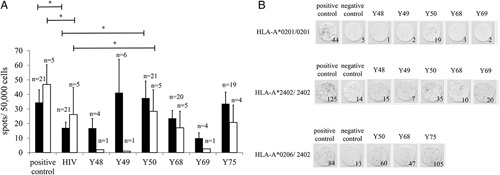
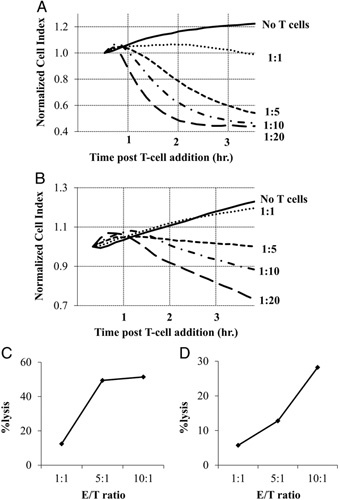
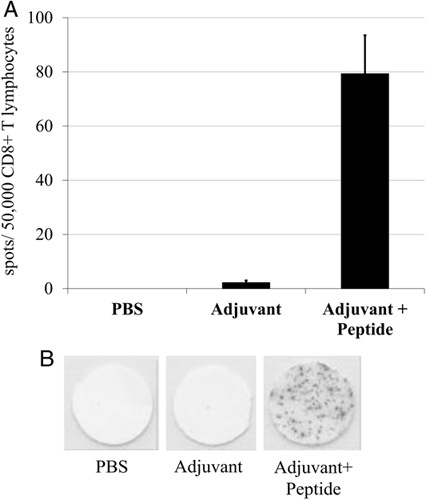
We previously found that heat-shock protein 70 (HSP70) is expressed on hepatocellular carcinoma cells and developed an HSP70 mRNA-transfected dendritic cell therapy for treating unresectable or recurrent hepatocellular carcinoma. The phase I trial was completed successfully. The purpose of this study is to identify a promiscuous epitope peptide derived from HSP70 for the purpose of developing a novel cancer peptide vaccine. Using a computational algorithm to analyze the specificity of previously reported major histocompatibility complex class I–binding peptides, we selected candidates that bound to >2 of the 3 HLA types. Twenty-nine HSP70-derived peptides (9-mers) that bound to HLA-class I was selected. The peptides were prioritized based on the results of peptide binding experiments. Using dendritic cells stimulated with the candidate peptide described previously as stimulators and CD8+ T cells as effectors, an ELISPOT assay was performed. Cytotoxicity of CD8 lymphocytes stimulated with the candidate peptides toward HSP70-expressing cancer cells was analyzed using an xCELLigence System. Peptides were administered to HLA-A 24 transgenic mice as vaccines, and peptide-specific T-cell induction was measured in vivo. We identified a multi-HLA-class I–binding epitope peptide that bound to HLA-A*02:01, *02:06, and *24:02 in vitro using an interferon-γ ELISPOT immune response induction assay. Cytotoxicity was confirmed in vitro, and safety and immune response induction were confirmed in vivo using HLA-A 24 transgenic mice. Our study demonstrated that the promiscuous HSP70-derived peptide is applicable to cancer immunotherapy in patients with HLA-A*24:02-positive, *02:01-positive, and *02:06-positive HSP70-expressing cancers.
Overview
The claims and statistics of this paper haven’t been checked yet.
Run the check — free, no account needed. It reads the open-access text and checks the sources it cites.
Integrity signals
Registry
Cites
Statistics
Figures
Verification
Claims the paper makes
The claims and statistics of this paper haven’t been checked yet.
Run the check — free, no account needed. It reads the open-access text and checks the sources it cites.
Claims other papers make about this one
Each is checked against this paper’s own text: does it say what the citing paper says it does?
In the citing paper
“Because these domains are evolutionarily conserved, they may contain epitopes that are recognized by antibodies across species boundaries”
From Parasites and allergies: a complex bidirectional relationship from evolutionary origins to modern therapeutics (2026) · cites this paper as Matsui et al. 2019
In the citing paper
“HSP70 homologs from Schistosoma mansoni and Aspergillus fumigatus share conserved structural and functional domains, including regions involved in ATP binding and substrate interaction.”
From Parasites and allergies: a complex bidirectional relationship from evolutionary origins to modern therapeutics (2026) · cites this paper as Matsui et al. 2019
In the citing paper
“Heat shock protein 70 (HSP70) is one example of a highly conserved protein family with potential relevance for cross-recognition between parasite and environmental allergens.”
From Parasites and allergies: a complex bidirectional relationship from evolutionary origins to modern therapeutics (2026) · cites this paper as Matsui et al. 2019
Self-check
Percentages, sums and reported differences re-computed from the paper’s own numbers.
The self-check needs the paper’s full text.
Citations
Cites
In vitro immunotherapy potency assays using real-time cell analysis
Cerignoli, F., Abassi, Y. A., Lamarche, B. J., Guenther, G., Santa Ana, D., Guimet, D., Zhang, W., Zhang, J., & Xi, B. (2018) · PLOS ONE · doi:10.1371/journal.pone.0193498 · Cited by 105
Research works printed but not linked: 24
- Nishida, 2018, Immune checkpoint blockade for the treatment of human hepatocellular carcinoma, Hepatol Res, 48, 622, 10.1111/hepr.13191 · DOI
- Hazama, 2018, Current status of immunotherapy against gastrointestinal cancers and its biomarkers: perspective for precision immunotherapy, Ann Gastroenterol Surg, 2, 289, 10.1002/ags3.12180 · DOI
- Ban, 2018, Current topics in the surgical treatments for hepatocellular carcinoma, Ann Gastroenterol Surg, 2, 137, 10.1002/ags3.12065 · DOI
- Takashima, 2003, Proteomic profiling of heat shock protein 70 family members as biomarkers for hepatitis C virus-related hepatocellular carcinoma, Proteomics, 3, 2487, 10.1002/pmic.200300621 · DOI
- Yoshida, 2009, Concomitant overexpression of heat-shock protein 70 and HLA class-I in hepatitis C virus-related hepatocellular carcinoma, Anticancer Res, 29, 539
- Maeda, 2015, Dendritic cells transfected with heat-shock protein 70 messenger RNA for patients with hepatitis C virus-related hepatocellular carcinoma: a phase 1 dose escalation clinical trial, Cancer Immunol Immunother, 64, 1047, 10.1007/s00262-015-1709-1 · DOI
- Udaka, 2002, Empirical evaluation of a dynamic experiment design method for prediction of MHC class I-binding peptides, J Immunol, 169, 5744, 10.4049/jimmunol.169.10.5744 · DOI
- Imanishi, 1991, Allele and haplotype frequencies for HLA and complement loci in various ethnic groups, HLA, 1, 1065
- Browning, 1996, Genetic diversity of HLA-A2: evolutionary and functional significance, Immunol Today, 17, 165, 10.1016/0167-5699(96)80614-1 · DOI
- Ikeda-Moore, 1997, Identification and characterization of multiple HLA-A24-restricted HIV-1 CTL epitopes: strong epitopes are derived from V regions of HIV-1, J Immunol, 159, 6242, 10.4049/jimmunol.159.12.6242 · DOI
- Tsomides, 1994, Naturally processed viral peptides recognized by cytotoxic T lymphocytes on cells chronically infected by human immunodeficiency virus type 1, J Exp Med, 180, 1283, 10.1084/jem.180.4.1283 · DOI
- Kantakamalakul, 2006, Identification of a novel HIV type 1 CRF01_AE cytotoxic T lymphocyte (CTL) epitope restricted by an HLA-Cw0602 allele and a novel HLA-A0206/peptide restriction, AIDS Res Hum Retroviruses, 22, 1271, 10.1089/aid.2006.22.1271 · DOI
- Zeh, 1994, Flow-cytometric determination of peptide-class I complex formation. Identification of p53 peptides that bind to HLA-A2, Hum Immunol, 39, 79, 10.1016/0198-8859(94)90105-8 · DOI
- Tahara, 1990, HLA antibody responses in HLA class I transgenic mice, Immunogenetics, 32, 351, 10.1007/BF00211650 · DOI
- Udaka, 2000, An automated prediction of MHC class I-binding peptides based on positional scanning with peptide libraries, Immunogenetics, 51, 816, 10.1007/s002510000217 · DOI
- Erskine, 2012, Determining optimal cytotoxic activity of human Her2neu specific CD8 T cells by comparing the Cr51 release assay to the xCELLigence System, J Vis Exp, 66, e3683
- Kano, 2016, Combined adjuvants of poly(I:C) plus LAG-3-Ig improve antitumor effects of tumor-specific T cells, preventing their exhaustion, Cancer Sci, 107, 398, 10.1111/cas.12861 · DOI
- Tokunaga, 1997, Sequence-based association analysis of HLA class I and II alleles in Japanese supports conservation of common haplotypes, Immunogenetics, 46, 199, 10.1007/s002510050262 · DOI
- Menez-Jamet, 2016, Optimized tumor cryptic peptides: the basis for universal neo-antigen-like tumor vaccines, Ann Transl Med, 4, 266, 10.21037/atm.2016.05.15 · DOI
- Sidney, 2001, Majority of peptides binding HLA-A∗ 0201 with high affinity crossreact with other A2-supertype molecules, Hum Immunol, 62, 1200, 10.1016/S0198-8859(01)00319-6 · DOI
- Zhang, 2003, Functional supertype of HLA-A2 in the presentation of Flu matrix p58–66 to induce CD8+ T-cell response in a Northern Chinese population, Tissue Antigens, 62, 285, 10.1034/j.1399-0039.2003.00102.x · DOI
- Banday, 2015, Cancer vaccine adjuvants—recent clinical progress and future perspectives, Immunopharmacol Immunotoxicol, 37, 1, 10.3109/08923973.2014.971963 · DOI
- Kissick, 2015, The role of active vaccination in cancer immunotherapy: lessons from clinical trials, Curr Opin Immunol, 35, 15, 10.1016/j.coi.2015.05.004 · DOI
- Rosenberg, 2004, Cancer immunotherapy: moving beyond current vaccines, Nat Med, 10, 909, 10.1038/nm1100 · DOI
Cited by
Sorted by citations
Packi, K., Świerczewski, D., Klimczak, S., Ochab, D., Gałęziewska, J., Gromek, P., Kruczkowska, W., Płuciennik, E., Kałuzińska-Kołat, Ż., & Kołat, D. (2026) · Antonie van Leeuwenhoek · doi:10.1007/s10482-026-02425-4
Metadata
- Authors
- Matsui, H., Hazama, S., Tamada, K., Udaka, K., Irie, A., Nishimura, Y., Miyakawa, T., Doi, S., Nakajima, M., Kanekiyo, S., Tokumitsu, Y., Shindo, Y., Tomochika, S., Yoshida, S., Iida, M., Suzuki, N., Takeda, S., Yamamoto, S., Yoshino, S., Ueno, T., & Nagano, H.
- Venue
- Journal of Immunotherapy
- Published
- 2019-09
- Volume
- 42
- Issue
- 7
- Pages
- 244-250
- ISSN
- 1524-9557
- PMC
- PMC6727952
- Cited by
- 11
- References
- 1
- Language
- en
About these checks
Registry, retraction, Cites and statistics results are computed, not judged, with one exception: a printed reference that no index lists is read once by a model before it counts as a citation error. Claims are extracted by a model and kept only when their quote appears verbatim in the text; each cited source is then checked, with a model’s help, for whether it says what the claim relies on. Those verdicts can be wrong — read the claim’s quote and the cited source before relying on one.
Statistics and arithmetic are recomputed, not judged.
Confidence bands are shown only for fields calibrated on our annotated test set. None is calibrated yet, so no band is shown.
What counts as a claim ›How we measure confidence ›How we check this ›
Are you an author, or do you see a problem with this page? Request a review
How to cite
Cite CoChat for the checks on this page, and the paper for its own findings.
- This page
- CoChat. (2026). Citation check: Identification of a Promiscuous Epitope Peptide Derived From HSP70. https://app.cochat.ai/papers/10.1097/cji.0000000000000274
- The paper
- Matsui, H., Hazama, S., Tamada, K., Udaka, K., Irie, A., Nishimura, Y., Miyakawa, T., Doi, S., Nakajima, M., Kanekiyo, S., Tokumitsu, Y., Shindo, Y., Tomochika, S., Yoshida, S., Iida, M., Suzuki, N., Takeda, S., Yamamoto, S., Yoshino, S., . . . Nagano, H. (2019). Identification of a Promiscuous Epitope Peptide Derived From HSP70. Journal of Immunotherapy. https://doi.org/10.1097/cji.0000000000000274
