

Effects of visual impairment and its restoration on electroencephalogram during walking in aged females
Open accessThe DOI matches its Crossref record; 32 of the 32 references it cites were found in a registry or an index.
Abstract
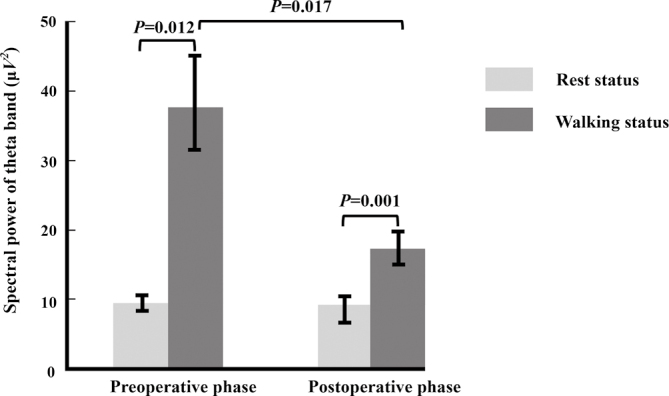
Background: Visual input significantly influences cerebral activity related to locomotor navigation, although the underlying mechanism remains unclear. This study aimed to analyze the effects of chronic visual impairment and its rehabilitation on sensorimotor integration during level walking in patients with age-related cataract. Methods: This prospective case series enrolled 14 female patients (68.4 ± 4.7 years) with age-related cataract, scheduled for consecutive cataract surgeries at the Department of Ophthalmology in Peking University Third Hospital from June 2019 to June 2020. Electroencephalogram (EEG) signals during level walking were recorded using a portable EEG system before and 4 weeks after visual restoration. Walking speed was assessed using the Footscan system. Spectral power of the theta and alpha bands was analyzed with repeated-measures analysis of variance, with Assignment (rest and walking), Phase (preoperative and postoperative), and Electrode sites (F3, Fz, F4, O1, and O2) as within-subject factors. Results: Compared to the visual impairment state, theta band power significantly decreased after visual restoration (13.16 ± 1.58 μV 2 vs. 23.65 ± 3.48 μV 2, P = 0.018). Theta activity was notably reduced during walking (17.24 ± 2.43 μV 2 vs. 37.86 ± 6.62 μV 2, P = 0.017), while theta power at rest was not significantly different between the two phases (9.44 ± 1.24 μV 2 vs. 9.08 ± 1.74 μV 2, P = 0.864). Changes in walking speed were correlated with alterations in theta power at electrode sites of O1 (r = −0.574, P = 0.032) and O2 (r = −0.648, P = 0.012). Alpha band power remained stable during walking and was unaffected by visual status. Conclusions: Chronic visual impairment from age-related cataract triggers enhanced cerebral activation of sensorimotor integration to compensate for visual decline during locomotion. This cerebral over-activation is effectively alleviated by visual restoration.
Overview
The claims and statistics of this paper haven’t been checked yet.
Free: it reads the open-access text and checks the first 5 claims that cite a source we can check. Create a free account to check every claim.
Integrity signals
Registry
Cites
Statistics
Figures
Verification
Claims the paper makes
The claims and statistics of this paper haven’t been checked yet.
Free: it reads the open-access text and checks the first 5 claims that cite a source we can check. Create a free account to check every claim.
Claims other papers make about this one
Each is checked against this paper’s own text: does it say what the citing paper says it does?
The source backs part of the claim, not all of it — or backs it for a different population, condition or comparison.
In the citing paper
“This compensatory activation was associated with reduced gait speed and increased theta band activity during walking.”
From Brain Rewires to Stabilize Walking During Visual Impairment · cites this paper as [7]
Experimental — accuracy not yet measuredThe source backs part of the claim, not all of it — or backs it for a different population, condition or comparison.
In the citing paper
“Collectively, these findings suggest that the brain upregulates activity within cognition- and motor control-related cortices to preserve sensorimotor integration when adapting to visual degradation.”
From Brain Rewires to Stabilize Walking During Visual Impairment · cites this paper as [7]
Experimental — accuracy not yet measuredThe cited source says what the claim attributes to it.
In the citing paper
“This compensatory activation was associated with reduced gait speed and increased theta band activity during walking.”
From Brain Rewires to Stabilize Walking During Visual Impairment · cites this paper as [7]
The cited source says what the claim attributes to it.
In the citing paper
“In our prior research on gait patterns and electrocortical activity in patients with age-related cataracts, we observed that chronic visual impairment triggers an enhanced cerebral activation of sensorimotor integration.[6,7]”
From Brain Rewires to Stabilize Walking During Visual Impairment · cites this paper as [7]
Self-check
Percentages, sums and reported differences re-computed from the paper’s own numbers.
The self-check needs the paper’s full text.
Citations
Cites
Neuroplasticity in adult human visual cortex
Castaldi, E., Lunghi, C., & Morrone, M. C. (2020) · Neuroscience & Biobehavioral Reviews · doi:10.1016/j.neubiorev.2020.02.028 · Cited by 191
Peterson, S. M., & Ferris, D. P. (2018) · eNeuro · doi:10.1523/eneuro.0207-18.2018 · Cited by 171
Winter, C., Kern, F., Gall, D., Latoschik, M. E., Pauli, P., & Käthner, I. (2021) · Journal of NeuroEngineering and Rehabilitation · doi:10.1186/s12984-021-00848-w · Cited by 167 · cited 1×
“[3,4] Investigating the impacts of visual impairment and its rehabilitation on cerebral function during walking could provide valuable insights for developing strategies to protect motor ability in the elderly through brain-level interventions.”
Nóbrega‐Sousa, P., Gobbi, L. T. B., Orcioli‐Silva, D., da Conceição, N. R., Beretta, V. S., & Vitório, R. (2020) · Neurorehabilitation and neural repair · doi:10.1177/1545968320953824 · Cited by 135 · cited 1×
“[32] The results of that study indicated that this compensatory over-activation reached its resource limit in the 70s, contributing to gait impairments.”
Tsang, J. Y., Wright, A. K., Carr, M., Dickinson, C., Harper, R. A., Kontopantelis, E., van Staa, T. P., Munford, L. A., Blakeman, T., & Ashcroft, D. M. (2023) · JAMA Ophthalmology · doi:10.1001/jamaophthalmol.2023.5858 · Cited by 87 · cited 1×
“[5] The satisfactory clinical outcomes of cataract surgery offer an ideal model for studying the effects of visual restoration on locomotion.”
George, R. J. S., Hinder, M. R., Puri, R., Walker, E., & Callisaya, M. L. (2020) · Neuroscience · doi:10.1016/j.neuroscience.2020.10.027 · Cited by 86 · cited 1×
“[10,11] Thus, visual impairment could exacerbate the functional load on sensorimotor integration.”
Neuroplasticity of the visual cortex: in sickness and in health
Baroncelli, L., & Lunghi, C. (2020) · Experimental Neurology · doi:10.1016/j.expneurol.2020.113515 · Cited by 83 · cited 1×
“[28,29] Age-related cataracts, which cause visual impairment, can be effectively treated, making it an ideal model to observe the impact of visual restoration on cerebral activity related to motor control in the elderly.”
Restricted vision increases sensorimotor cortex involvement in human walking
Oliveira, A. S., Schlink, B. R., Hairston, W. D., König, P., & Ferris, D. P. (2017) · Journal of Neurophysiology · doi:10.1152/jn.00926.2016 · Cited by 79 · cited 1×
“[21] In addition, studies have reported that subjects training in virtual reality with rotating visual views during treadmill walking exhibited increased theta power compared to those with unaltered visual input.”
Richer, N., Bradford, J. C., & Ferris, D. P. (2024) · Neuroscience & Biobehavioral Reviews · doi:10.1016/j.neubiorev.2024.105718 · Cited by 58 · cited 2×
“[20] Consequently, in this study, we specifically analyzed the power spectrum of the theta and alpha bands recorded from the frontal and occipital regions.”
Visual Restoration after Cataract Surgery Promotes Functional and Structural Brain Recovery
Lin, H., Zhang, L., Lin, D., Chen, W., Zhu, Y., Chen, C., Chan, K. C., Liu, Y., & Chen, W. (2018) · eBioMedicine · doi:10.1016/j.ebiom.2018.03.002 · Cited by 57 · cited 2×
“[12,13] By using a mobile brain/ body imaging system, the study of electrocortical activity synchronous with walking provides further insight into the role of visual rehabilitation in protecting cerebral function related to sensorimotor integration in the elderly.”
Fotteler, M. L., Mühlbauer, V., Brefka, S., Mayer, S., Kohn, B., Holl, F., Swoboda, W., Gaugisch, P., Risch, B., Denkinger, M., et al. (2022) · JMIR Aging · doi:10.2196/31916 · Cited by 52 · cited 1×
“[1,2] Through sensorimotor integration, the brain processes visual inputs and makes decisions for locomotor navigation.”
Ma, L., Marshall, P. J., & Wright, W. G. (2022) · Journal of NeuroEngineering and Rehabilitation · doi:10.1186/s12984-022-01059-7 · Cited by 50 · cited 1×
“[18] During treadmill walking on a balance beam, a prolonged increase in alpha power was detected across the occipital, temporal, sensorimotor, and posterior parietal cortices after intermittent visual occlusion.”
Peterson, S. M., Rios, E., & Ferris, D. P. (2018) · Journal of Neurophysiology · doi:10.1152/jn.00292.2018 · Cited by 49 · cited 1×
“[22,23] We previously demonstrated that blurred visual inputs, simulating cortical cataract with foggy goggles targeted at a Snellen visual acuity of 20/60, elicited a generalization of theta activity from the occipital to the frontal regions in healthy young volunteers.”
Chen, Y., Cao, Z., Mao, M., Sun, W., Song, Q., & Mao, D. (2022) · Brain and Cognition · doi:10.1016/j.bandc.2022.105904 · Cited by 45
Electrocortical activity correlated with locomotor adaptation during split‐belt treadmill walking
Jacobsen, N. A., & Ferris, D. P. (2023) · The Journal of Physiology · doi:10.1113/jp284505 · Cited by 41 · cited 1×
“19] In addition, alterations in cerebral activity synchronous with locomotion resulting from visual manipulations have been found to be more prominent in the frontal and occipital regions.”
Yokoyama, H., Kaneko, N., Masugi, Y., Ogawa, T., Watanabe, K., & Nakazawa, K. (2020) · European Journal of Neuroscience · doi:10.1111/ejn.14867 · Cited by 40 · cited 1×
“[17] In response to visual inputs that conflict with somatosensory and vestibular inputs, alpha band power increases over the occipital cortex during postural control on a balance board, indicating an adjustment in visual weighting within sensorimotor integration.”
Stojan, R., Mack, M., Bock, O. L., & Voelcker‐Rehage, C. (2023) · NeuroImage · doi:10.1016/j.neuroimage.2023.120070 · Cited by 33 · cited 1×
“9] To maintain normal motor performance, older adults recruit additional cortical or subcortical areas during motor control to compensate for the deterioration of cerebral function.”
Lin, M., Liran, O., Bauer, N., & Baker, T. E. (2022) · Scientific Reports · doi:10.1038/s41598-022-05955-9 · Cited by 33 · cited 1×
“[25] In immersive virtual hallway locomotor tasks, with or without conflicts between self-motion and landmarks, theta activity in frontal-midline regions was considered a crucial index for the early processing of spatial representations during navigation.”
Lee, S., Hsu, Y., Andrew, L., Davis, T., & Johnson, C. (2020) · Physiotherapy Theory and Practice · doi:10.1080/09593985.2020.1780656 · Cited by 32 · cited 1×
“[1,2] Through sensorimotor integration, the brain processes visual inputs and makes decisions for locomotor navigation.”
The effects of optic flow on postural stability: Influence of age and fall risk
Phu, S., Persiani, M., Tan, B., Brodie, M. A. D., Gandevia, S. C., Sturnieks, D. L., & Lord, S. R. (2023) · Experimental Gerontology · doi:10.1016/j.exger.2023.112146 · Cited by 27 · cited 1×
“[10,11] Thus, visual impairment could exacerbate the functional load on sensorimotor integration.”
Du, Y. K., Liang, M., McAvan, A. S., Wilson, R. C., & Ekstrom, A. D. (2023) · Cortex · doi:10.1016/j.cortex.2023.09.005 · Cited by 18
Jacobsen, N. A., & Ferris, D. P. (2024) · eNeuro · doi:10.1523/eneuro.0515-23.2024 · Cited by 18
Ramanoël, S., Durteste, M., Delaux, A., Aubert, J. D. S., & Arleo, A. (2022) · Aging Brain · doi:10.1016/j.nbas.2022.100034 · Cited by 17
Shirazi, S. Y., & Huang, H. J. (2021) · IEEE Transactions on Neural Systems and Rehabilitation Engineering · doi:10.1109/tnsre.2021.3057054 · Cited by 15 · cited 1×
“[26] Theta band activity is known to be associated with sensorimotor integration in challenging locomotor tasks, such as responses to abrupt balance perturbations during treadmill walking, [15] adaptation on perturbed stepping tasks, [14] or mobility in indoor real-world environments.”
Self-citationNeural signature of everyday function in older adults at-risk of cognitive impairment
Sanctis, P. D., Wagner, J., Molholm, S., Foxe, J. J., Blumen, H. M., & Horsthuis, D. J. (2021) · Neurobiology of Aging · doi:10.1016/j.neurobiolaging.2022.11.005 · Cited by 14 · cited 1×
“[31] The authors attributed the increase in theta activity to compensatory responses for age-related declines in sensorimotor integration.”
Jacobsen, N. A., & Ferris, D. P. (2024) · PeerJ · doi:10.7717/peerj.17451 · Cited by 10 · cited 1×
“[26] Theta band activity is known to be associated with sensorimotor integration in challenging locomotor tasks, such as responses to abrupt balance perturbations during treadmill walking, [15] adaptation on perturbed stepping tasks, [14] or mobility in indoor real-world environments.”
Symeonidou, E.-R., & Ferris, D. P. (2023) · IEEE Transactions on Neural Systems and Rehabilitation Engineering · doi:10.1109/tnsre.2023.3317055 · Cited by 9 · cited 2×
“[4] In our study, the lack of significant changes in alpha band power during walking can likely be attributed to the simplicity of the level walking task, which may not have been demanding enough to trigger alpha activity fluctuations.”
Association between gait speed deterioration and EEG abnormalities
García-Agustin, D., Morgade-Fonte, R. M., Bobes, M. A., Galán‐Garcia, L., & Rodríguez, V. (2024) · PLoS ONE · doi:10.1371/journal.pone.0305074 · Cited by 5 · cited 1×
“[30] A recent study also identified theta band activation during tread-mill walking as a neural signature of mobility-related brain function in elderly individuals at risk for cognitive impairment.”
Marshall, S. D., Jeyarajan, G., Hayhow, N., Gabiazon, R., Seleem, T., Hammerstrom, M. R., Krigolson, O. E., & Nagamatsu, L. S. (2024) · Neuropsychologia · doi:10.1016/j.neuropsychologia.2024.108971 · Cited by 5 · cited 1×
“[27] As a model of chronic progressive visual impairment, age-related cataracts affect cerebral functions related to walking navigation.”
Ao, M., Shi, H., Li, X., Huang, H., Ao, Y., & Wang, W. (2023) · Chinese Medical Journal · doi:10.1097/cm9.0000000000002509 · Cited by 4 · cited 1×
“[6] However, the changes in cerebral activity during walking associated with optical restoration require further analysis to better understand the cerebral mechanisms underlying the effects of visual restoration on mobility.”
Self-citationAo, M., Ren, S., Yu, Y., Huang, H., Miao, X., Ao, Y., & Wang, W. (2023) · Frontiers in Neuroscience · doi:10.3389/fnins.2023.1151799 · Cited by 4 · cited 1×
“[24] Increased theta activity has also been observed during the decision-making phase of visual navigation when walking toward specific targets.”
Self-citationSobczak, A. M., Bohaterewicz, B., Fąfrowicz, M., Domagalik, A., Beldzik, E., Ogińska, H., Golonka, N., Rękas, M., Bronicki, D., Romanowska-Dixon, B., et al. (2021) · Brain Sciences · doi:10.3390/brainsci11111400 · Cited by 4 · cited 2×
“[13] In accordance with these findings, the postoperative decrease in theta band spectral power in our study provides direct electrocortical evidence of the alleviation of sensorimotor integration recruitment during walking, following visual restoration.”
Cited by
(n.d.) · Chinese Medical Journal / Neuroscience News · doi:10.1097/cm9.0000000000004040
“[6,7] This compensatory activation was associated with reduced gait speed and increased theta band activity during walking.”
Self-citation
Metadata
- Authors
- Ao, M., Huang, H., Li, X., & Ao, Y.
- Affiliations
- Peking University Third Hospital (CN)
- Peking University (CN)
- Corresponding author
- Ao, Mingxin
- Ao, Yingfang
- Venue
- Chinese Medical Journal
- Published
- 2025-02-21
- Volume
- 138
- Issue
- 6
- Pages
- 738-744
- ISSN
- 0366-6999 (ISSN-L)
- 2542-5641
- PMC
- PMC11925416
- OpenAlex
- W4407813997
- Semantic Scholar
- 39a4c74c24ede036fbfafce4410d274c0d7fabc8
- Cited by
- 1
- References
- 32
- Citations by year
- 2026: 1
- FWCI
- 2.16
- Type
- journal article
- Language
- en
- Open access
- gold
- doi.org
- Licence
- Locations
- Chinese Medical Journal (publishedVersion, cc-by-nc-nd)
- PubMed Central (publishedVersion, cc-by-nc-nd)
- PubMed (publishedVersion)
- DOAJ (DOAJ: Directory of Open Access Journals) (submittedVersion, cc-by-sa)
- Topics
- Health Sciences › Health Professions › Physical Therapy, Sports Therapy and Rehabilitation › Balance, Gait, and Falls Prevention
- Life Sciences › Neuroscience › Cognitive Neuroscience › Motor Control and Adaptation
- Life Sciences › Neuroscience › Cognitive Neuroscience › EEG and Brain-Computer Interfaces
- Keywords
- senile cataract, visual impairment, vision restoration, cataract surgery, walking, locomotion, sensorimotor integration, theta power, alpha power, EEG, brain activation, walking speed, older women
- MeSH terms
- Aged, Cataract, Electroencephalography, Female, Humans, Middle Aged, Prospective Studies, Vision Disorders, Walking
About these checks
Registry, retraction, Cites and statistics results are computed, not judged, with one exception: a printed reference that no index lists is read once by a model before it counts as a citation error. Claims are extracted by a model and kept only when their quote appears verbatim in the text; each cited source is then checked, with a model’s help, for whether it says what the claim relies on. Those verdicts can be wrong — read the claim’s quote and the cited source before relying on one.
Statistics and arithmetic are recomputed, not judged.
Confidence bands are shown only for fields calibrated on our annotated test set. None is calibrated yet, so no band is shown.
What counts as a claim ›How we measure confidence ›How we check this ›
Are you an author, or do you see a problem with this page? Request a review
Data sources
Bibliographic data: Semantic Scholar, OpenAlex, Crossref.
Contains information from the Semantic Scholar Academic Graph Datasets, made available under the ODC Attribution License (ODC-BY 1.0).
Semantic Scholar’s data is described in: Kinney, R., et al. (2023). The Semantic Scholar Open Data Platform. arXiv:2301.10140.
