

The DOI matches its Crossref record; the references it cites are not checked yet.
Formulation and pharmacology of long-acting cabotegravir
Open accessAbstract
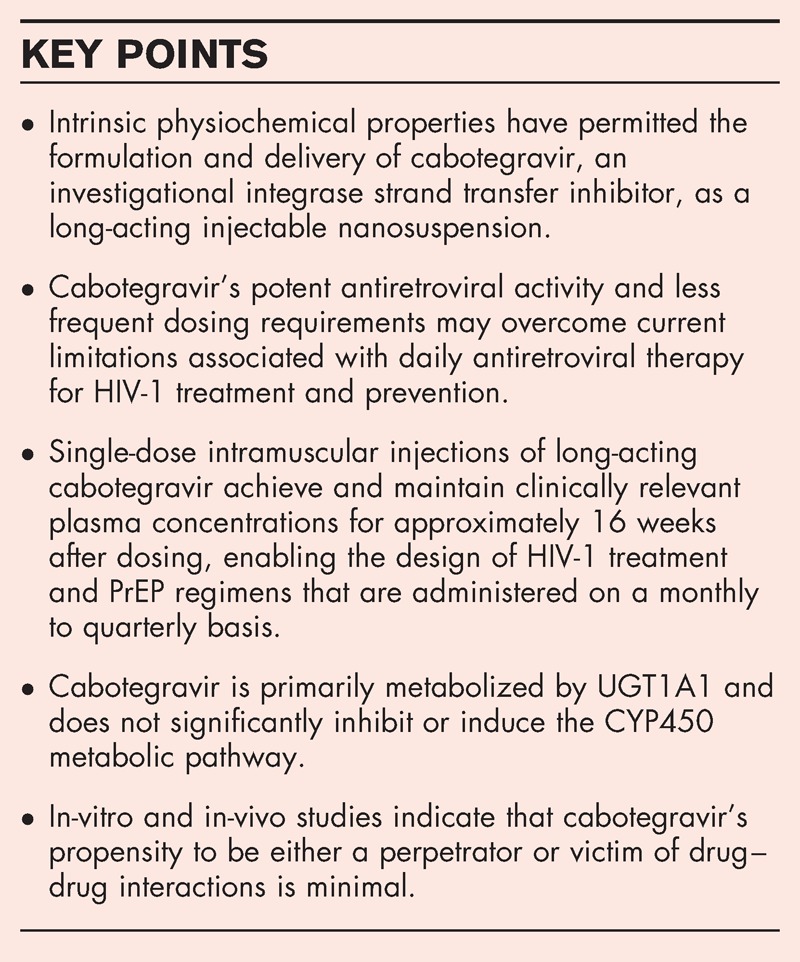
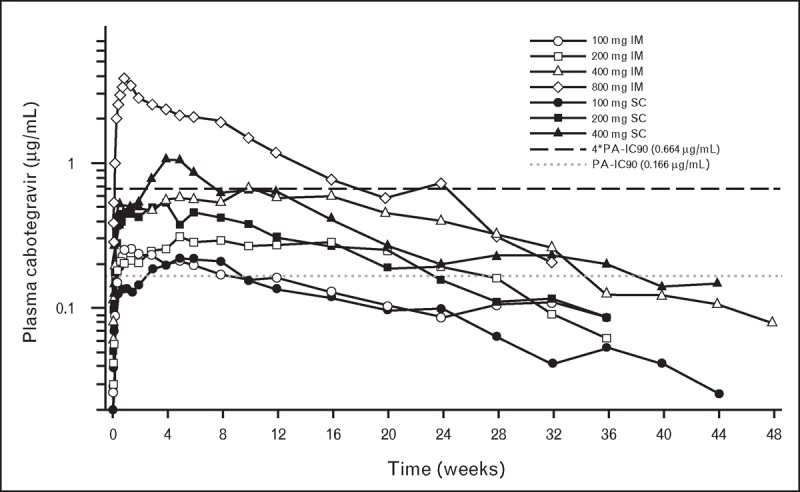
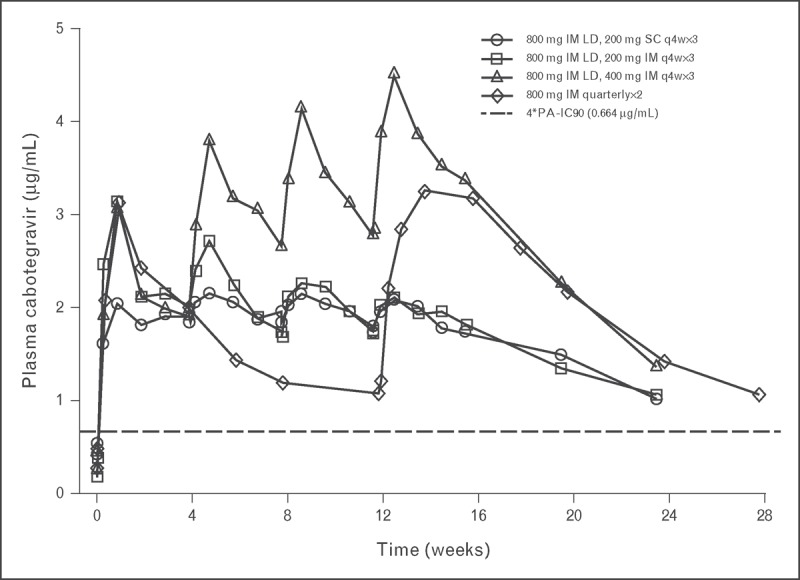
PURPOSE OF REVIEW: Long-acting cabotegravir may provide a novel therapeutic option for both the treatment and prevention of HIV-1 infection that does not necessitate adherence to a daily regimen. The present review will highlight the unique formulation properties and pharmacologic attributes of long-acting cabotegravir nanosuspension. RECENT FINDINGS: Cabotegravir is a potent integrase strand transfer inhibitor that has been formulated as an oral tablet for daily administration and as a long-acting injectable nanosuspension. Long-acting cabotegravir is readily absorbed following intramuscular and subcutaneous administration and has an elimination half-life of approximately 40 days, allowing for administration on a monthly or less frequent schedule. Repeat-dose pharmacokinetic studies and population pharmacokinetic modeling indicate monthly and bi-monthly dosing achieves clinically relevant plasma concentrations considered effective for HIV maintenance therapy and that quarterly injections are appropriate for investigation as preexposure prophylaxis. Cabotegravir is primarily metabolized by uridine diphosphate glucuronosyltransferase 1A1 and is unlikely to be impacted by the cytochrome P450 metabolic pathway. In vitro and in vivo data suggest cabotegravir has a low propensity to cause, or be subject to, significant drug interactions. SUMMARY: The pharmacologic profile of long-acting cabotegravir supports its continued development for both treatment and prevention of HIV-1 infection.
Overview
The claims and statistics of this paper haven’t been checked yet.
Run the check — free, no account needed. It reads the open-access text and checks the sources it cites.
Integrity signals
Registry
Cites
Statistics
Figures
Verification
Claims the paper makes
The claims and statistics of this paper haven’t been checked yet.
Run the check — free, no account needed. It reads the open-access text and checks the sources it cites.
Claims other papers make about this one
Each is checked against this paper’s own text: does it say what the citing paper says it does?
In the citing paper
“Following subcutaneous or intramuscular injection, drug absorption into systemic circulation is dictated by the rate of dissolution of the drug crystals in the interstitial fluid 16 .”
From Nanotechnology approaches for global infectious diseases (2021) · cites this paper as [16]
In the citing paper
“Specifically, nanoparticles of two antiretrovirals, cabotegravir and rilpivirine, are being actively pursued in the clinic.”
From Nanotechnology approaches for global infectious diseases (2021) · cites this paper as [16]
In the citing paper
“Cabotegravir 16 and rilpivirine 17 were chosen owing to their efficacy at low oral doses and low water solubility.”
From Nanotechnology approaches for global infectious diseases (2021) · cites this paper as [16]
Self-check
Percentages, sums and reported differences re-computed from the paper’s own numbers.
The self-check needs the paper’s full text.
Citations
The citation lists haven’t been fetched yet
References 13 · Cited by 179
Research works printed but not linked: 1
- Bari, 2010, Int J Pharm Sci Rev Res, 3, 1
Metadata
- Authors
- Trezza, C., Ford, S. L., Spreen, W., Pan, R., & Piscitelli, S.
- Affiliations
- GlaxoSmithKline (United States) (US)
- Corresponding author
- Spreen, William
- Venue
- Current Opinion in HIV and AIDS
- Published
- 2015-07
- Volume
- 10
- Issue
- 4
- Pages
- 239-245
- ISSN
- 1746-630X (ISSN-L)
- PMC
- PMC5638427
- OpenAlex
- W2394662221
- Cited by
- 179
- References
- 13
- Citations by year
- 2026: 10 · 2025: 13 · 2024: 22 · 2023: 19 · 2022: 21 · 2021: 25 · 2020: 14 · 2019: 19 · 2018: 19 · 2017: 8 · 2016: 9
- FWCI
- 9.28
- Type
- journal article
- Language
- en
- Open access
- hybrid
- doi.org
- Licence
- cc-by-nc-nd
- Locations
- Current Opinion in HIV and AIDS (publishedVersion, cc-by-nc-nd)
- PubMed Central (publishedVersion, cc-by-nc-nd)
- PubMed (publishedVersion)
- Topics
- Health Sciences › Medicine › Infectious Diseases › HIV/AIDS drug development and treatment
- Health Sciences › Medicine › Infectious Diseases › HIV/AIDS Research and Interventions
- Life Sciences › Immunology and Microbiology › Virology › HIV Research and Treatment
- Keywords
- cabotegravir, long-acting injectable antiretrovirals, HIV-1 prevention, pharmacokinetics, pre-exposure prophylaxis, drug interactions
- MeSH terms
- Humans, Pyridones, HIV Infections, Anti-HIV Agents, Diketopiperazines
About these checks
Registry, retraction, Cites and statistics results are computed, not judged, with one exception: a printed reference that no index lists is read once by a model before it counts as a citation error. Claims are extracted by a model and kept only when their quote appears verbatim in the text; each cited source is then checked, with a model’s help, for whether it says what the claim relies on. Those verdicts can be wrong — read the claim’s quote and the cited source before relying on one.
Statistics and arithmetic are recomputed, not judged.
Confidence bands are shown only for fields calibrated on our annotated test set. None is calibrated yet, so no band is shown.
What counts as a claim ›How we measure confidence ›How we check this ›
Are you an author, or do you see a problem with this page? Request a review
How to cite
Cite CoChat for the checks on this page, and the paper for its own findings.
- This page
- CoChat. (2026). Citation check: Formulation and pharmacology of long-acting cabotegravir. https://app.cochat.ai/papers/10.1097/coh.0000000000000168
- The paper
- Trezza, C., Ford, S. L., Spreen, W., Pan, R., & Piscitelli, S. (2015). Formulation and pharmacology of long-acting cabotegravir. Current Opinion in HIV and AIDS. https://doi.org/10.1097/coh.0000000000000168
