

The DOI matches its Crossref record; 22 of the 22 references it cites were found in a registry or an index.
The Use of Temporoparietal Fascia Flap for Surgical Treatment of Traumatic Auricle Defects
Open accessAbstract
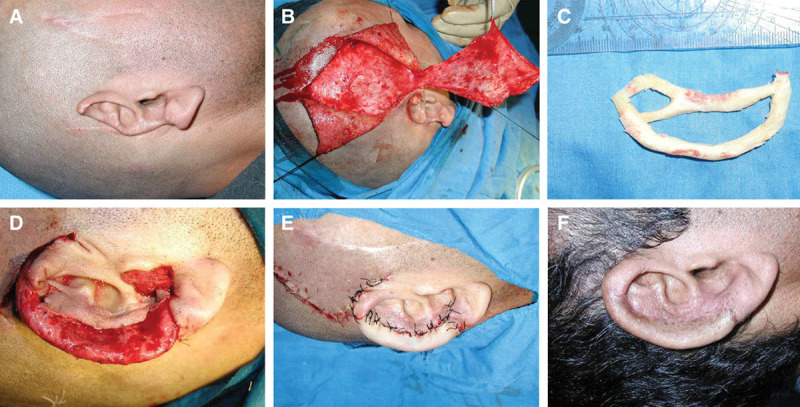
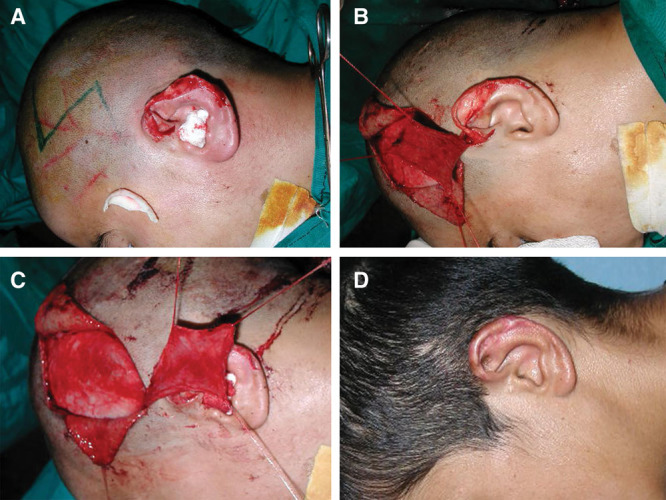
BACKGROUND: Auricular reconstruction is 1 of the biggest challenges of facial plastic surgery. The aim of this study was to evaluate the efficacy of 1-stage reconstruction of an auricle using a temporoparietal fascia flap (TPFF). METHODS: In this nonrandomized study, autologous auricle bodies with emergency condition and cartilaginous graft from projection of a costal arch from the VI-VII ribs were used. Temporal fascia sample with vascular pedicle (a temporal artery with the accompanying veins) by the Z-shaped incision of skin in temporal area for auricular reconstruction was extracted. Skin grafts were taken from the supraclavicular area or from the left or right flank. Grafts of partial auricle bodies (n = 8) along with cartilaginous framework from a costal arch (n = 21) were used for auricle reconstruction. The follow-up period studied after 6 months in 29 operated patients. RESULTS: The graft of partial auricle bodies or the graft of a cartilaginous framework from a costal arch presented a perfect auricular reconstruction. By avoiding a difficult microsurgery and its possible complications, the use of TPFF led to beneficial results in 75% and 90.4% of cases, respectively. Overall, no major complication (alopecia, hematoma, or necrosis) occurred, and further surgery was not required. CONCLUSION: TPFF is a technique of choice for surgical treatment of traumatic auricle defects.
Overview
The claims and statistics of this paper haven’t been checked yet.
Run the check — free, no account needed. It reads the open-access text and checks the sources it cites.
Integrity signals
Registry
Cites
Statistics
Figures
Verification
Claims the paper makes
The claims and statistics of this paper haven’t been checked yet.
Run the check — free, no account needed. It reads the open-access text and checks the sources it cites.
Self-check
Percentages, sums and reported differences re-computed from the paper’s own numbers.
The self-check needs the paper’s full text.
Citations
Cites
Modification of the Stages in Total Reconstruction of the Auricle
Nagata, S. (1994) · Plastic & Reconstructive Surgery · doi:10.1097/00006534-199402000-00001 · Cited by 360
Brent, B., & Byrd, H. S. (1983) · Plastic & Reconstructive Surgery · doi:10.1097/00006534-198308000-00003 · Cited by 275
The Correction of Microtia with Autogenous Cartilage Grafts
Brent, B. (1980) · Plastic & Reconstructive Surgery · doi:10.1097/00006534-198007000-00001 · Cited by 273
Firmin, F. (1998) · Scandinavian Journal of Plastic and Reconstructive Surgery and Hand Surgery · doi:10.1080/02844319850158930 · Cited by 259
Modification of the Stages in Total Reconstruction of the Auricle
Nagata, S. (1994) · Plastic & Reconstructive Surgery · doi:10.1097/00006534-199402000-00002 · Cited by 241
TOTAL RECONSTRUCTION OF THE AURICLE
Tanzer, R. C. (1971) · Plastic & Reconstructive Surgery · doi:10.1097/00006534-197106000-00001 · Cited by 220
Modification of the Stages in Total Reconstruction of the Auricle
Nagata, S. (1994) · Plastic & Reconstructive Surgery · doi:10.1097/00006534-199402000-00003 · Cited by 199
Nagata, S. (1994) · PubMed · Cited by 158
Modification of the Stages in Total Reconstruction of the Auricle
Nagata, S. (1994) · Plastic & Reconstructive Surgery · doi:10.1097/00006534-199402000-00004 · Cited by 156
The Restoration of a Lower Eyelid by a New Method
MONKS, G. H. (1898) · New England Journal of Medicine · doi:10.1056/nejm189810201391602 · Cited by 105
Research works printed but not linked: 1
- Mathes, 1997, Regional flaps: anatomy and basic techniques head and neck section., Reconstr Surg Princ Anat Tech, 1, 367
Cited by
Kepekçi, A. H. (2025) · Healthcare · doi:10.3390/healthcare13111325 · Cited by 5
“The hematoma rate observed in our study was 1.3%, notably lower than the 3–8% range reported in the literature [27–29], and occurred only in the flap group.”
Influential
Metadata
- Authors
- Kurbonov, U., Davlatov, A., Janobilova, S., Kurbanov, Z., & Mirshahi, M.
- Affiliations
- Tajik State Medical University (TJ)
- Republican Scientific Center of Cardiovascular Surgery;
- Inserm (FR)
- Corresponding author
- Kurbonov, Ubaidullo
- Davlatov, Abdumalik
- Janobilova, Sitora
- Venue
- Plastic and Reconstructive Surgery - Global Open
- Published
- 2018-05
- Volume
- 6
- Issue
- 5
- Pages
- e1741
- ISSN
- 2169-7574 (ISSN-L)
- PMC
- PMC5999426
- OpenAlex
- W2802411525
- Cited by
- 13
- References
- 22
- Citations by year
- 2025: 3 · 2024: 2 · 2023: 2 · 2022: 2 · 2021: 3 · 2020: 1
- FWCI
- 1.04
- Type
- journal article
- Language
- en
- Open access
- gold
- doi.org
- Licence
- Locations
- Plastic & Reconstructive Surgery Global Open (publishedVersion, cc-by-nc-nd)
- Europe PMC (PubMed Central) (publishedVersion, other-oa)
- PubMed Central (publishedVersion, cc-by-nc-nd)
- PubMed (publishedVersion)
- DOAJ (DOAJ: Directory of Open Access Journals) (submittedVersion, cc-by-sa)
- Topics
- Health Sciences › Medicine › Surgery › Reconstructive Facial Surgery Techniques
- Health Sciences › Medicine › Surgery › Reconstructive Surgery and Microvascular Techniques
- Health Sciences › Medicine › Clinical Neurology › Facial Nerve Paralysis Treatment and Research
- Keywords
- temporoparietal fascia flap, ear reconstruction, costal cartilage graft, one-stage reconstruction, flap complications
About these checks
Registry, retraction, Cites and statistics results are computed, not judged, with one exception: a printed reference that no index lists is read once by a model before it counts as a citation error. Claims are extracted by a model and kept only when their quote appears verbatim in the text; each cited source is then checked, with a model’s help, for whether it says what the claim relies on. Those verdicts can be wrong — read the claim’s quote and the cited source before relying on one.
Statistics and arithmetic are recomputed, not judged.
Confidence bands are shown only for fields calibrated on our annotated test set. None is calibrated yet, so no band is shown.
What counts as a claim ›How we measure confidence ›How we check this ›
Are you an author, or do you see a problem with this page? Request a review
