

The global epidemiology of nonalcoholic fatty liver disease (NAFLD) and nonalcoholic steatohepatitis (NASH): a systematic review
Open accessThe DOI matches its Crossref record; 38 of the 38 references it cites were found in a registry or an index.
Abstract
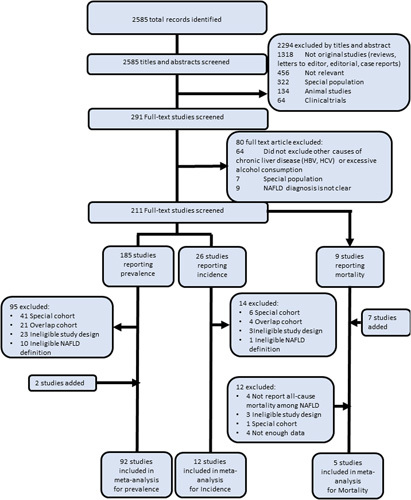
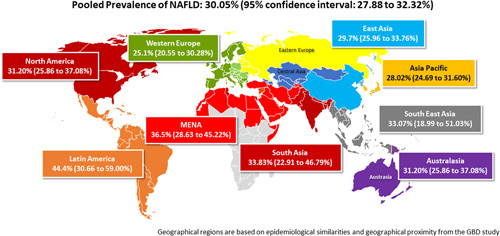
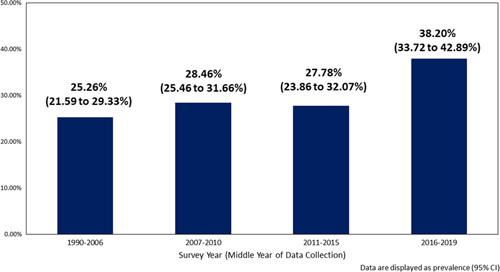
Background and Aims: NAFLD is a leading cause of liver-related morbidity and mortality. We assessed the global and regional prevalence, incidence, and mortality of NAFLD using an in-depth meta-analytic approach. Approach and Results: PubMed and Ovid MEDLINE were searched for NAFLD population-based studies from 1990 to 2019 survey year (last published 2022) per Preferred Reporting Items for Systematic Reviews and Meta-Analyses (PRISMA). Meta-analysis was conducted using random-effects models. Bias risk assessment was per Joanna Briggs Institute. Of 2585 studies reviewed, 92 studies (N=9,361,716) met eligibility criteria. Across the study period (1990–2019), meta-analytic pooling of NAFLD prevalence estimates and ultrasound-defined NAFLD yielded an overall global prevalence of 30.05% (95% CI: 27.88%–32.32%) and 30.69% (28.4–33.09), respectively. Global NAFLD prevalence increased by +50.4% from 25.26% (21.59–29.33) in 1990–2006 to 38.00% (33.71–42.49) in 2016–2019 ( p <0.001); ultrasound-defined NAFLD prevalence increased by +38.7% from 25.16% (19.46–31.87) in 1990–2006 to 34.59% (29.05–40.57) ( p =0.029). The highest NAFLD prevalence was in Latin America 44.37% (30.66%–59.00%), then Middle East and North Africa (MENA) (36.53%, 28.63%–45.22%), South Asia (33.83%, 22.91%–46.79%), South-East Asia (33.07%, 18.99%–51.03%), North America (31.20%, 25.86%–37.08%), East Asia (29.71%, 25.96%–33.76%), Asia Pacific 28.02% (24.69%–31.60%), Western Europe 25.10% (20.55%–30.28%). Among the NAFLD cohort diagnosed without a liver biopsy, pooled mortality rate per 1000 PY was 12.60 (6.68–23.67) for all-cause mortality; 4.20 (1.34–7.05) for cardiac-specific mortality; 2.83 (0.78–4.88) for extrahepatic cancer-specific mortality; and 0.92 (0.00–2.21) for liver-specific mortality. Conclusions: NAFLD global prevalence is 30% and increasing which requires urgent and comprehensive strategies to raise awareness and address all aspects of NAFLD on local, regional, and global levels.
Overview
The claims and statistics of this paper haven’t been checked yet.
Free: it reads the open-access text and checks the first 5 claims that cite a source we can check. Create a free account to check every claim.
Integrity signals
Registry
Cites
Statistics
Figures
Verification
Claims the paper makes
The claims and statistics of this paper haven’t been checked yet.
Free: it reads the open-access text and checks the first 5 claims that cite a source we can check. Create a free account to check every claim.
Claims other papers make about this one
Each is checked against this paper’s own text: does it say what the citing paper says it does?
The source backs part of the claim, not all of it — or backs it for a different population, condition or comparison.
In the citing paper
“Thus, MASLD is now the leading cause of chronic liver disease and hence liver fibrosis (47–49).”
From Targeting macrophages in liver fibrosis (2026) · cites this paper as [49]
Experimental — accuracy not yet measuredThe source backs part of the claim, not all of it — or backs it for a different population, condition or comparison.
In the citing paper
“The estimated global prevalence of MASLD in the general population has risen from 25% in 2016 12 to currently more than 30%, and the incidence is continually increasing. 12 -14”
From EASL-EASD-EASO Clinical Practice Guidelines on the management of metabolic dysfunction-associated steatotic liver disease (MASLD). (2024) · cites this paper as [12]
Experimental — accuracy not yet measuredThe source backs part of the claim, not all of it — or backs it for a different population, condition or comparison.
In the citing paper
“Compared to matched control populations, individuals with MASLD have increased all-cause mortality of 17.05/1,000 PY (range 10.31 -28.05). 12”
From EASL-EASD-EASO Clinical Practice Guidelines on the management of metabolic dysfunction-associated steatotic liver disease (MASLD). (2024) · cites this paper as [12]
Experimental — accuracy not yet measuredThe check wasn’t confident either way, so it gives no verdict — never disputed.
In the citing paper
“the “non-viral” subgroups probably consist of different proportions of HCCs due to each etiology across different trials, as the above example has shown [63–65]”
From Etiology-Based Treatment for Unresectable/Advanced Hepatocellular Carcinoma: Focus on Viral Hepatitis and Metabolic Dysfunction-Associated Steatohepatitis (2025) · cites this paper as [64]
Experimental — accuracy not yet measured
Self-check
Percentages, sums and reported differences re-computed from the paper’s own numbers.
The self-check needs the paper’s full text.
Citations
Cites
Bias in meta-analysis detected by a simple, graphical test
Egger, M., Smith, G. D., Schneider, M., & Minder, C. (1997) · BMJ · doi:10.1136/bmj.315.7109.629 · Cited by 56,722 · cited 1×
“[22] A funnel plot was used to investigate publication bias with the Egger regression test[23] and visual inspection to assess plot asymmetry.”
MethodMeta-analysis in clinical trials
DerSimonian, R., & Laird, N. (1986) · Controlled Clinical Trials · doi:10.1016/0197-2456(86)90046-2 · Cited by 39,552 · cited 1×
“Meta-analysis was performed on the adjusted NAFLD prevalence via random-effects models using the DerSimonian and Laird method[17] to estimate the pooled prevalence.”
MethodConducting Meta-Analyses in R with the metafor Package
Viechtbauer, W. (2010) · Journal of Statistical Software · doi:10.18637/jss.v036.i03 · Cited by 20,464 · cited 1×
“Analysis was conducted using the “metafor” package[24] in RStudio version 1.”
MethodYounossi, Z. M., Koenig, A. B., Abdelatif, D., Fazel, Y., Henry, L., & Wymer, M. (2016) · Hepatology · doi:10.1002/hep.28431 · Cited by 10,781 · cited 3×
“In 2016, a meta-analysis of studies published between 1990 and 2015 provided evidence that the global prevalence of NAFLD was about 25%, making it the most common cause of chronic liver disease (CLD).[1] The subsequent data from the Global Burden of Disease (GBD) study have supplemented this data and provided evidence…”
BackgroundResultSelf-citationMunn, Z., Moola, S., Lisy, K., Riitano, D., & Tufanaru, C. (2015) · International Journal of Evidence-Based Healthcare · doi:10.1097/xeb.0000000000000054 · Cited by 3,131 · cited 1×
“Quality assessment of the included studies was conducted using the Joanna Briggs Institute (JBI) critical appraisal instrument for prevalence studies against the following matrices: sample frame suitability, sampling strategy, sample size adequacy, study subjects and setting description, appropriate data analysis perf…”
MethodNon-alcoholic fatty liver disease
Powell, E. E., Wong, V. W.-S., & Rinella, M. (2021) · The Lancet · doi:10.1016/s0140-6736(20)32511-3 · Cited by 2,789 · cited 1×
“[6,7] In this context, the number of metabolic conditions that one carries not only increases the risk of having NAFLD but also the risk of progression to advanced liver disease and mortality.[8,9] Besides adverse clinical outcomes such as increased mortality, NAFLD is also associated with significant economic burden…”
BackgroundEstes, C., Razavi, H., Loomba, R., Younossi, Z., & Sanyal, A. J. (2018) · Hepatology · doi:10.1002/hep.29466 · Cited by 2,399 · cited 1×
“Nonetheless, these reported NAFLD incidence rates are in line with other incidence reports and is important information especially when forecasting the future burden of disease.[29,30,33] Our data showed that pooled mortality rate for NAFLD was 12.”
ResultSelf-citationThe prevalence and incidence of NAFLD worldwide: a systematic review and meta-analysis
Riazi, K., Azhari, H., Charette, J. H., Underwood, F. E., King, J. A., Afshar, E. E., Swain, M. G., Congly, S. E., Kaplan, G. G., & Shaheen, A.-A. (2022) · The Lancet Gastroenterology & Hepatology · doi:10.1016/s2468-1253(22)00165-0 · Cited by 2,246 · cited 3×
“Nonetheless, these reported NAFLD incidence rates are in line with other incidence reports and is important information especially when forecasting the future burden of disease.[29,30,33] Our data showed that pooled mortality rate for NAFLD was 12.”
BackgroundResultWilliams, C. D., Stengel, J., Asike, M. I., Torres, D. M., Shaw, J., Contreras, M., Landt, C. L., & Harrison, S. A. (2011) · Gastroenterology · doi:10.1053/j.gastro.2010.09.038 · Cited by 2,148 · cited 1×
“To reduce overestimation associated with a referral for liver biopsy, we only included studies with subjects who were not specifically referred for liver biopsy based on a clinical indication such as elevated liver enzymes.[26,27] Subsequently, the NASH prevalence in the general population was estimated by multiplying…”
MethodImproved tests for a random effects meta‐regression with a single covariate
Knapp, G., & Hartung, J. (2003) · Statistics in Medicine · doi:10.1002/sim.1482 · Cited by 2,075 · cited 1×
“Model coefficients were tested using the Knapp and Hartung adjustment.[21] Pairwise comparisons for categorical moderators were calculated using the Hommel method.”
MethodLin, X., Xu, Y., Pan, X., Xu, J., Ding, Y., Sun, X., Song, X., Ren, Y., & Shan, P.-F. (2020) · Scientific Reports · doi:10.1038/s41598-020-71908-9 · Cited by 1,819 · cited 1×
“[6,7] In this context, the number of metabolic conditions that one carries not only increases the risk of having NAFLD but also the risk of progression to advanced liver disease and mortality.”
BackgroundA stagewise rejective multiple test procedure based on a modified Bonferroni test
HOMMEL, G. (1988) · Biometrika · doi:10.1093/biomet/75.2.383 · Cited by 1,367 · cited 1×
“[21] Pairwise comparisons for categorical moderators were calculated using the Hommel method.[22] A funnel plot was used to investigate publication bias with the Egger regression test[23] and visual inspection to assess plot asymmetry.”
MethodKarlas, T., Petroff, D., Sasso, M., Fan, J.-G., Mi, Y.-Q., de Lédinghen, V., Kumar, M., Lupsor-Platon, M., Han, K.-H., Cardoso, A. C., et al. (2017) · Journal of Hepatology · doi:10.1016/j.jhep.2016.12.022 · Cited by 1,275 · cited 2×
“Additionally, we provided the prevalence rate of NAFLD according to different CAP cutoff scores since currently there is no consensus of the appropriate CAP cutoff score for NAFLD.[41] In this context, the higher the CAP score to establish diagnosis of NAFLD, the lower the NAFLD prevalence rate.”
BackgroundMethodYe, Q., Zou, B., Yeo, Y. H., Li, J., Huang, D. Q., Wu, Y., Yang, H., Liu, C., Kam, L. Y., Tan, X. X. E., et al. (2020) · The Lancet Gastroenterology & Hepatology · doi:10.1016/s2468-1253(20)30077-7 · Cited by 925 · cited 1×
“Nonetheless, these reported NAFLD incidence rates are in line with other incidence reports and is important information especially when forecasting the future burden of disease.[29,30,33] Our data showed that pooled mortality rate for NAFLD was 12.”
ResultSelf-citationCusi, K. (2012) · Gastroenterology · doi:10.1053/j.gastro.2012.02.003 · Cited by 911 · cited 1×
“Also, it is important to remember that age and obesity are highly associated with NAFLD prevalence[31] and these factors may differ according to the region of the world.”
BackgroundA random‐effects regression model for meta‐analysis
Berkey, C. S., Hoaglin, D. C., Mosteller, F., & Colditz, G. A. (1995) · Statistics in Medicine · doi:10.1002/sim.4780140406 · Cited by 879 · cited 2×
“Heterogeneity among studies was assessed using Q statistics and I2.”
MethodPaik, J. M., Golabi, P., Younossi, Y., Mishra, A., & Younossi, Z. M. (2020) · Hepatology · doi:10.1002/hep.31173 · Cited by 788 · cited 1×
“[11] Recent data from the GBD related to mortality and disability adjusted years suggest that the burden of NAFLD is experienced across the globe and this burden is rapidly increasing.[12,13] To estimate the epidemiologic burden of NAFLD across the world, we used the most current data to determine the global as well a…”
MethodSelf-citationAdvancing the global public health agenda for NAFLD: a consensus statement
Lazarus, J. V., Mark, H. E., Anstee, Q. M., Arab, J. P., Batterham, R. L., Castera, L., Cortez-Pinto, H., Crespo, J., Cusi, K., Dirac, M. A., et al. (2022) · Nature Reviews Gastroenterology & Hepatology · doi:10.1038/s41575-021-00523-4 · Cited by 757
Self-citation2019 Global NAFLD Prevalence: A Systematic Review and Meta-analysis
Le, M. H., Yeo, Y. H., Li, X., Li, J., Zou, B., Wu, Y., Ye, Q., Huang, D. Q., Zhao, C., Zhang, J., et al. (2022) · Clinical Gastroenterology and Hepatology · doi:10.1016/j.cgh.2021.12.002 · Cited by 711
Siddiqui, M. S., Vuppalanchi, R., Van Natta, M. L., Hallinan, E., Kowdley, K. V., Abdelmalek, M., Neuschwander-Tetri, B. A., Loomba, R., Dasarathy, S., Brandman, D., et al. (2019) · Clinical Gastroenterology and Hepatology · doi:10.1016/j.cgh.2018.04.043 · Cited by 614 · cited 1×
“However, since there is a lack of universal agreement about which CAP cutoff scores should be used to establish fatty liver,[15] we included all published studies using different values of CAP and then categorized these studies into 3 groups (CAP: 248–259, CAP: 260–273, and CAP ≥274 dB/m).”
MethodYounossi, Z. M., Stepanova, M., Ong, J., Trimble, G., AlQahtani, S., Younossi, I., Ahmed, A., Racila, A., & Henry, L. (2021) · Clinical Gastroenterology and Hepatology · doi:10.1016/j.cgh.2020.05.064 · Cited by 576 · cited 1×
“[2,3] Furthermore, the most recent data from the United States’ United Network of Organ Sharing (UNOS) indicates that currently NAFLD is the second indication for all liver transplants and is rapidly becoming the top indication for liver transplant among those who are listed for hepatocellular carcinoma.[4,5] This rap…”
BackgroundSelf-citationYounossi, Z. M., Corey, K. E., & Lim, J. K. (2021) · Gastroenterology · doi:10.1053/j.gastro.2020.11.051 · Cited by 490 · cited 3×
“In this context, it is important to remember although the disease burden of NAFLD is increasing across most of the regions, interventions to deal with this growing burden (Mediterranean based diet, weight loss, exercise, raising awareness) may differ by region and may require region-specific policies and strategies.[2…”
BackgroundSelf-citationAn Update on the Epidemiology of Type 2 Diabetes
Tinajero, M. G., & Malik, V. S. (2021) · Endocrinology and Metabolism Clinics of North America · doi:10.1016/j.ecl.2021.05.013 · Cited by 471 · cited 1×
“[6,7] In this context, the number of metabolic conditions that one carries not only increases the risk of having NAFLD but also the risk of progression to advanced liver disease and mortality.”
BackgroundNon-Alcoholic Fatty Liver Disease: Metabolic, Genetic, Epigenetic and Environmental Risk Factors
Juanola, O., Martínez-López, S., Francés, R., & Gómez-Hurtado, I. (2021) · International Journal of Environmental Research and Public Health · doi:10.3390/ijerph18105227 · Cited by 302 · cited 1×
“[10] In addition to obesity and T2DM, other environmental and genetic factors may predispose these patients to progressive liver disease.[11] Recent data from the GBD related to mortality and disability adjusted years suggest that the burden of NAFLD is experienced across the globe and this burden is rapidly increasin…”
BackgroundModelling publication bias in meta-analysis: a review
Sutton, A. J., Song, F., Gilbody, S. M., & Abrams, K. R. (2000) · Statistical Methods in Medical Research · doi:10.1177/096228020000900503 · Cited by 288 · cited 1×
“Estimates were transformed to logits to keep the prevalence estimates bounded between 0 and 1 (0% and 100%).[18] As a sensitivity analysis, the regional population size-adjusted estimate was also calculated by weighing regional pooled prevalence estimates by the total regional population.”
MethodLazarus, J. V., Mark, H. E., Villota-Rivas, M., Palayew, A., Carrieri, P., Colombo, M., Ekstedt, M., Esmat, G., George, J., Marchesini, G., et al. (2022) · Journal of Hepatology · doi:10.1016/j.jhep.2021.10.025 · Cited by 267 · cited 1×
“In fact, only 32 countries have national NAFLD guidelines, and no country has a comprehensive NAFLD public health response.[38] The inclusion of NAFLD as an important noncommunicable disease by the WHO will be critical to appropriately develop country, regional, and global-specific policies to deal with the burden of…”
BackgroundSelf-citationGolabi, P., Paik, J. M., AlQahtani, S., Younossi, Y., Tuncer, G., & Younossi, Z. M. (2021) · Journal of Hepatology · doi:10.1016/j.jhep.2021.05.022 · Cited by 259 · cited 4×
“In this context, it is important to remember although the disease burden of NAFLD is increasing across most of the regions, interventions to deal with this growing burden (Mediterranean based diet, weight loss, exercise, raising awareness) may differ by region and may require region-specific policies and strategies.[2…”
BackgroundMethodSelf-citationZou, B., Yeo, Y. H., Nguyen, V. H., Cheung, R., Ingelsson, E., & Nguyen, M. H. (2020) · Journal of Internal Medicine · doi:10.1111/joim.13069 · Cited by 250
Mortality Related to Nonalcoholic Fatty Liver Disease Is Increasing in the United States
Paik, J. M., Henry, L., De Avila, L., Younossi, E., Racila, A., & Younossi, Z. M. (2019) · Hepatology Communications · doi:10.1002/hep4.1419 · Cited by 225 · cited 2×
“In this context, it is important to remember although the disease burden of NAFLD is increasing across most of the regions, interventions to deal with this growing burden (Mediterranean based diet, weight loss, exercise, raising awareness) may differ by region and may require region-specific policies and strategies.[2…”
BackgroundSelf-citationGolabi, P., Otgonsuren, M., de Avila, L., Sayiner, M., Rafiq, N., & Younossi, Z. M. (2018) · Medicine · doi:10.1097/md.0000000000010214 · Cited by 221 · cited 1×
“[6,7] In this context, the number of metabolic conditions that one carries not only increases the risk of having NAFLD but also the risk of progression to advanced liver disease and mortality.[8,9] Besides adverse clinical outcomes such as increased mortality, NAFLD is also associated with significant economic burden…”
BackgroundSelf-citationGe, X., Zheng, L., Wang, M., Du, Y., & Jiang, J. (2020) · BMJ Open · doi:10.1136/bmjopen-2019-036663 · Cited by 188 · cited 1×
“[11] Recent data from the GBD related to mortality and disability adjusted years suggest that the burden of NAFLD is experienced across the globe and this burden is rapidly increasing.[12,13] To estimate the epidemiologic burden of NAFLD across the world, we used the most current data to determine the global as well a…”
MethodConfidence Intervals for the Product of Two Binomial Parameters
Buehler, R. J. (1957) · Journal of the American Statistical Association · doi:10.1080/01621459.1957.10501404 · Cited by 157 · cited 1×
“The confidence intervals were estimated by the Delta method.[25]”
MethodDoycheva, I., Issa, D., Watt, K. D., Lopez, R., Rifai, G., & Alkhouri, N. (2018) · Journal of Clinical Gastroenterology · doi:10.1097/mcg.0000000000000925 · Cited by 138 · cited 1×
“[2,3] Furthermore, the most recent data from the United States’ United Network of Organ Sharing (UNOS) indicates that currently NAFLD is the second indication for all liver transplants and is rapidly becoming the top indication for liver transplant among those who are listed for hepatocellular carcinoma.[4,5] This rap…”
BackgroundClinical and Economic Burden of Nonalcoholic Fatty Liver Disease and Nonalcoholic Steatohepatitis
Younossi, Z. M., Henry, L. L., Bush, H., & Mishra, A. (2017) · Clinics in Liver Disease · doi:10.1016/j.cld.2017.08.001 · Cited by 120 · cited 1×
“[8,9] Besides adverse clinical outcomes such as increased mortality, NAFLD is also associated with significant economic burden and impairment of patients’ health-related quality of life.[10] In addition to obesity and T2DM, other environmental and genetic factors may predispose these patients to progressive liver dise…”
BackgroundSelf-citationPaik, J. M., Golabi, P., Younossi, Y., Srishord, M., Mishra, A., & Younossi, Z. M. (2020) · Hepatology Communications · doi:10.1002/hep4.1599 · Cited by 103 · cited 1×
“[1] The subsequent data from the Global Burden of Disease (GBD) study have supplemented this data and provided evidence that NAFLD is the most rapidly increasing global contributor to the disease burden related to the complications of CLD, including cirrhosis and liver cancer.[2,3] Furthermore, the most recent data fr…”
MethodSelf-citationGolabi, P., Paik, J. M., Harring, M., Younossi, E., Kabbara, K., & Younossi, Z. M. (2022) · Clinical Gastroenterology and Hepatology · doi:10.1016/j.cgh.2021.12.015 · Cited by 73 · cited 1×
“Specifically, we used NHANES 2-year cycle data starting in 1999 since significant detailed information was available in previously published data.[14] In addition, in the 2017–2018 NHANES cycles, transient elastography became available which allowed the use of the controlled attenuation parameter (CAP) to define NAFLD.”
MethodSelf-citationKim, H., Lee, K., Lee, K., Yi, N., Lee, H. W., Hong, G. S., Choi, Y., You, T. S., Suh, S., Jang, J. J., et al. (2014) · Clinical Transplantation · doi:10.1111/ctr.12343 · Cited by 57 · cited 1×
“To reduce overestimation associated with a referral for liver biopsy, we only included studies with subjects who were not specifically referred for liver biopsy based on a clinical indication such as elevated liver enzymes.[26,27] Subsequently, the NASH prevalence in the general population was estimated by multiplying…”
MethodLiu, J. J., DeCuir, N., Kia, L., Peterson, J., Miller, C. H., & Issaka, R. B. (2022) · Clinical Gastroenterology and Hepatology · doi:10.1016/j.cgh.2022.12.002 · Cited by 14
Cited by
Tacke, F., Horn, P., Wai-Sun Wong, V., Ratziu, V., Bugianesi, E., Francque, S., Zelber-Sagi, S., Valenti, L., Roden, M., Schick, F., et al. (2024) · Journal of Hepatology · doi:10.1016/j.jhep.2024.04.031 · Cited by 2,210
Epidemiology of metabolic dysfunction-associated steatotic liver disease
Younossi, Z. M., Kalligeros, M., & Henry, L. (2025) · Clinical and Molecular Hepatology · doi:10.3350/cmh.2024.0431 · Cited by 960
“[17, 18] However, although the burden of MASLD is increasing around the world, in many countries where viral hepatitis remains endemic, resources and efforts for viral hepatitis must continue to be prioritized.”
BackgroundResultInfluentialSelf-citationMASLD: a systemic metabolic disorder with cardiovascular and malignant complications
Targher, G., Byrne, C. D., & Tilg, H. (2024) · Gut · doi:10.1136/gutjnl-2023-330595 · Cited by 897
“11 13 In a nationwide cohort study of 10 422 Swedish middle-aged individuals with histologically confirmed MASLD and ~50 000 population controls matched by age, sex, calendar year and county, Simon et al 14 showed that MASLD was associated with an increased risk of developing”
BackgroundHepatic inflammatory responses in liver fibrosis
Hammerich, L., & Tacke, F. (2023) · Nature Reviews Gastroenterology & Hepatology · doi:10.1038/s41575-023-00807-x · Cited by 803
Current status and future trends of the global burden of MASLD
Miao, L., Targher, G., Byrne, C. D., Cao, Y.-Y., & Zheng, M.-H. (2024) · Trends in Endocrinology & Metabolism · doi:10.1016/j.tem.2024.02.007 · Cited by 781
Metadata
- Authors
- Younossi, Z. M., Golabi, P., Paik, J. M., Henry, A., Van Dongen, C., & Henry, L.
- Affiliations
- Inova Health System (US)
- Betty and Guy Beatty Center for Integrated Research, Inova Health System, Falls Church, Virginia, USA
- Corresponding author
- Younossi, Zobair M.
- Venue
- Hepatology
- Published
- 2023-01-03
- Volume
- 77
- Issue
- 4
- Pages
- 1335-1347
- ISSN
- 0270-9139 (ISSN-L)
- PMC
- PMC10026948
- OpenAlex
- W4315619045
- Semantic Scholar
- e0a044235c08e95a83a81d9d88106233ad769e33
- Cited by
- 3,383
- References
- 38
- Citations by year
- 2026: 1056 · 2025: 1214 · 2024: 850 · 2023: 262
- FWCI
- 131.94
- Type
- journal article
- Language
- en
- Open access
- hybrid
- doi.org
- Licence
- Locations
- Hepatology (publishedVersion, cc-by-nc-nd)
- PubMed Central (publishedVersion, cc-by-nc-nd)
- PubMed (publishedVersion)
- Topics
- Health Sciences › Medicine › Hepatology › Liver Disease Diagnosis and Treatment
- Health Sciences › Medicine › Pathology and Forensic Medicine › Alcohol Consumption and Health Effects
- Health Sciences › Medicine › Hepatology › Liver Diseases and Immunity
- Keywords
- non-alcoholic fatty liver disease, nonalcoholic steatohepatitis, global prevalence, incidence, mortality, prevalence trends, regional variation, liver-related mortality, NAFLD risk factors
- MeSH terms
- Humans, North America, Prevalence, Risk Assessment, Non-alcoholic Fatty Liver Disease
About these checks
Registry, retraction, Cites and statistics results are computed, not judged, with one exception: a printed reference that no index lists is read once by a model before it counts as a citation error. Claims are extracted by a model and kept only when their quote appears verbatim in the text; each cited source is then checked, with a model’s help, for whether it says what the claim relies on. Those verdicts can be wrong — read the claim’s quote and the cited source before relying on one.
Statistics and arithmetic are recomputed, not judged.
Confidence bands are shown only for fields calibrated on our annotated test set. None is calibrated yet, so no band is shown.
What counts as a claim ›How we measure confidence ›How we check this ›
Are you an author, or do you see a problem with this page? Request a review
Data sources
Bibliographic data: Semantic Scholar, OpenAlex, Crossref.
Contains information from the Semantic Scholar Academic Graph Datasets, made available under the ODC Attribution License (ODC-BY 1.0).
Semantic Scholar’s data is described in: Kinney, R., et al. (2023). The Semantic Scholar Open Data Platform. arXiv:2301.10140.
