

Pharmacological Treatment of Hallucinogen Persisting Perception Disorder (HPPD): A Systematic Review
Open accessThe DOI matches its Crossref record; 50 of the 50 references it cites were found in a registry or an index; 13 of the 19 sources its claims cite were checked for support.
Abstract
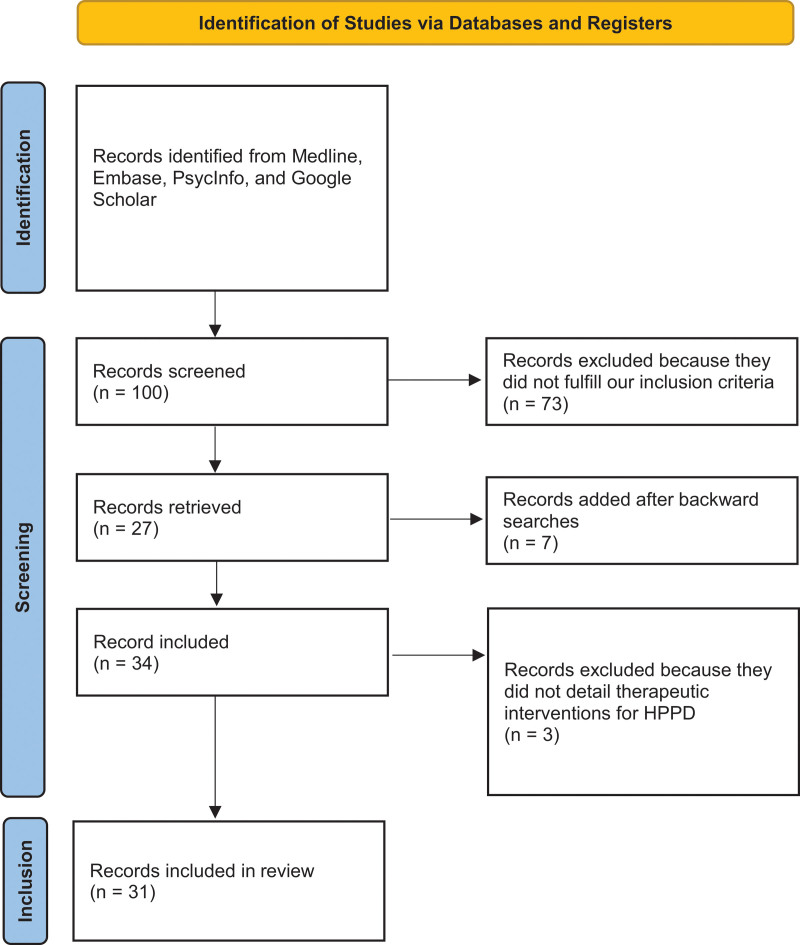
Hallucinogen persisting perception disorder (HPPD) is characterized by perceptual phenomena that either linger after substance-use cessation or recur as reperceptions or flashbacks. These symptoms may be either mild and transient or long-lasting and severely burdening. Since evidence for pharmacological treatment of HPPD is unclear, we seek to provide treatment advice based on a systematic review of existing medication studies. Our search yielded 31 studies with 87 participants treated for HPPD with different types of medication. Three observational studies reported substantial symptom reduction for regimens with clonidine, clonazepam, and levetiracetam. The other 28 studies, which consist of case reports and small case series, found largely similar results for benzodiazepines, antiepileptics, antidepressants, and alpha agonists. Of those who received these pharmacological treatments, 28% showed full recovery and 61% partial recovery within a year. When HPPD was triggered by lysergic acid diethylamide, benzodiazepines were ineffective. Notably, several studies described HPPD symptom aggravation upon treatment with the antipsychotic agent risperidone. A list of practice-based treatment methods is provided and suggestions for further research are made.
Overview
CoChat Summary
TL;DR
This systematic review of pharmacological HPPD treatment found no single effective therapy, but benzodiazepines, antiepileptics, antidepressants, and alpha agonists showed favorable effects in mostly small, uncontrolled studies. Across 31 articles and 87 treated individuals, 28% achieved full recovery and 61% partial recovery within a year.
Key findings
- The search yielded 31 articles describing 87 unique individuals: 51 in observational studies and 36 in case series/case reports. Three observational studies reported substantial symptom reduction with clonidine, clonazepam, and levetiracetam.
- In the 28 case series/case reports (36 people; 5 female, 14%; mean age 26 years), 10 (28%) showed full recovery, 22 (61%) partial recovery, 2 (6%) no effect, and 2 (6%) symptom aggravation. Full recovery was reported with clonazepam (n=3), valproic acid or lamotrigine (n=2), sertraline or reboxetine (n=2), clonidine (n=1), or risperidone (n=1).
- Five other papers reported symptom aggravation with risperidone, and when HPPD was triggered by LSD, benzodiazepines were ineffective. Comorbid anxiety or mood disorders were associated with worse outcomes.
- The authors conclude that no single effective therapeutic can be singled out; further research is needed on the natural course of HPPD and on medication effects in HPPD subtypes.
Methods
- Systematic search in Medline, Embase, PsycInfo, and Google Scholar for pharmacological HPPD treatments diagnosed by DSM-IV or DSM-5 criteria, including papers published until November 13, 2024; English and Dutch papers were included, with backward searches.
- Articles were excluded if they contained no original reports on pharmacological HPPD treatment. Data extracted included publication year, participant number, sex, age, illicit substance used, comorbid diagnosis, intervention, results, and follow-up duration.
- The authors did not consider statistical analysis informative given the relatively small number of publications. The PRISMA-style flow ended with 31 articles for review.
Limitations
- The paper states there was a lack of randomized, placebo-controlled studies, a relatively small number of evaluated treatment options, breadth of pharmacological agents prescribed, and heterogeneity in design, diagnostic instruments/criteria, study duration, effect evaluation, and follow-up; ranking efficacy was unattainable.
- The authors note the lack of studies on the natural course of HPPD, no control groups, and that case series/case reports rarely used questionnaires or other assessment tools.
- They also state possible placebo effect, primary effect on comorbid disorders, underappreciated psychoeducation/psychosocial interventions, underappreciation of natural course, and publication bias; phenomenological overlap with Alice in Wonderland syndrome was rarely assessed.
Model-written summary. Check it against the paper before relying on it.
Integrity signals
Registry
Cites
Statistics
Figures
Verification
Claims the paper makes
8 Valid · 3 Not valid · 4 Not checked · 34 Own results and interpretations
The cited sources support only part of this claim — read each source’s verdict below.
In the paper
“In light of the substantial phenomenological overlap between HPPD and Alice in Wonderland syndrome, a comparison may teach us something about HPPD and, in particular, its treatment.”
§ Pharmacological Treatment of Hallucinogen Persisting Perception Disorder (HPPD): A Systematic Review > DISCUSSION > Historical Aspects
What the sources say
- Partly supportedcites [7] Vis PJ Goudriaan AE ter Meulen BC Blom JD. On perception and consciousness in HPPD: a systematic review. Front Neurosci. 2021; 15: 675768. 34456666 PMC8385145 sourceExperimental — accuracy not yet measured
The Etiology section identifies substance-induced AIWS with HPPD, supporting a close relationship between the syndromes. The Limitations section also refers to their overlap, but says its extent needs to be assessed; it does not establish that the phenomenological overlap is substantial. (LLM, conf=0.85)
plainstates an association- Asserted: passes — The authors put it forward as true.
- Checkable: passes — It can be checked against evidence.
- Load-bearing: passes — The paper’s conclusions depend on it.
- Based: passes — The paper gives a reason why it holds.
- Partly supported
The sources with a verdict support this claim; the rest weren’t checked yet, have no full text we could read, or their verdicts aren’t rated yet.
In the paper
“The efficacy of these medications, however, remains unclear.3–5”
§ Pharmacological Treatment of Hallucinogen Persisting Perception Disorder (HPPD): A Systematic Review > INTRODUCTION > Diagnosis and Treatment
What the sources say
- Supportedcites [3] Martinotti G Santacroce R Pettorruso M. Hallucinogen persisting perception disorder: etiology, clinical features, and therapeutic perspectives. Brain Sci. 2018; 8: 47. 29547576 PMC5870365 source
The Discussion (page not provided) says the literature on HPPD treatment is limited and calls for controlled investigations of pharmacological options. The Results, §3.5 (page not provided), also describe conflicting or questionable findings for some medications. Together, these support uncertainty about their efficacy, although the paper reports promising results for some treatments. (LLM, conf=0.88)
- Not checked yetcites [4] Doyle MA Ling S Lui LMW. Hallucinogen persisting perception disorder: a scoping review covering frequency, risk factors, prevention, and treatment. Expert Opin Drug Saf. 2022; 21: 733– 43. 35426769 source
- Supportedcites [5] Ford H Fraser CL Solly E. Hallucinogenic persisting perception disorder: a case series and review of the literature. Front Neurol. 2022; 13: 878609. 35599738 PMC9120359 source
The Discussion says HPPD management relies on case studies because controlled trials are lacking, and that the overall evidence for treatment is scarce. This supports the claim that the efficacy of the medications discussed remains unclear. (LLM, conf=0.92)
plain- Asserted: passes — The authors put it forward as true.
- Checkable: passes — It can be checked against evidence.
- Load-bearing: passes — The paper’s conclusions depend on it.
- Based: passes — The paper gives a reason why it holds.
- Supported
The sources with a verdict support this claim; the rest weren’t checked yet, have no full text we could read, or their verdicts aren’t rated yet.
In the paper
“Pharmacological interventions are all experimental and practice-based.”
§ Pharmacological Treatment of Hallucinogen Persisting Perception Disorder (HPPD): A Systematic Review > INTRODUCTION > Diagnosis and Treatment
What the sources say
- Supportedcites [3] Martinotti G Santacroce R Pettorruso M. Hallucinogen persisting perception disorder: etiology, clinical features, and therapeutic perspectives. Brain Sci. 2018; 8: 47. 29547576 PMC5870365 source
The Discussion (section 4; page unavailable) describes the HPPD treatment literature as limited, says clinical experience is vital to treatment, and calls for controlled investigations of pharmacological options. This supports the characterization of current pharmacological interventions as experimental and practice-based. (LLM, conf=0.88)
- Not checked yetcites [4] Doyle MA Ling S Lui LMW. Hallucinogen persisting perception disorder: a scoping review covering frequency, risk factors, prevention, and treatment. Expert Opin Drug Saf. 2022; 21: 733– 43. 35426769 source
- Not checked — no full text of the sourcecites [5] Ford H Fraser CL Solly E. Hallucinogenic persisting perception disorder: a case series and review of the literature. Front Neurol. 2022; 13: 878609. 35599738 PMC9120359
plain- Asserted: passes — The authors put it forward as true.
- Checkable: passes — It can be checked against evidence.
- Load-bearing: passes — The paper’s conclusions depend on it.
- Based: passes — The paper gives a reason why it holds.
- Supported
The cited sources support only part of this claim — read each source’s verdict below.
In the paper
“Case reports and small-scale pharmacological studies show promising results with antipsychotics, antidepressants, antiepileptics, and benzodiazepines.”
§ Pharmacological Treatment of Hallucinogen Persisting Perception Disorder (HPPD): A Systematic Review > INTRODUCTION > Diagnosis and Treatment
What the sources say
- Supportedcites [3] Martinotti G Santacroce R Pettorruso M. Hallucinogen persisting perception disorder: etiology, clinical features, and therapeutic perspectives. Brain Sci. 2018; 8: 47. 29547576 PMC5870365 source
The Results (§3.5, First-Line Medications) report helpful outcomes with some antipsychotics, some success with an antidepressant, improvement with antiepileptics, and symptom improvement in case reports and a 16-patient open-label trial of clonazepam. The review also describes mixed or adverse results for particular drugs, but the claim says these treatments show promising results, not that they work consistently. (LLM, conf=0.86)
- Not checked yetcites [4] Doyle MA Ling S Lui LMW. Hallucinogen persisting perception disorder: a scoping review covering frequency, risk factors, prevention, and treatment. Expert Opin Drug Saf. 2022; 21: 733– 43. 35426769 source
- Partly supportedcites [5] Ford H Fraser CL Solly E. Hallucinogenic persisting perception disorder: a case series and review of the literature. Front Neurol. 2022; 13: 878609. 35599738 PMC9120359 sourceExperimental — accuracy not yet measured
The Discussion (page unavailable) reports improvement associated with benzodiazepines and some efficacy for antiepileptics. The Results also record partial recovery in a patient treated with antidepressants. But the paper does not establish promising results for antipsychotics, and it says HPPD management rests on case studies because controlled trials are lacking; listing a drug as a treatment does not establish its benefit. (LLM, conf=0.86)
plainstates a possible cause- Asserted: passes — The authors put it forward as true.
- Checkable: passes — It can be checked against evidence.
- Load-bearing: passes — The paper’s conclusions depend on it.
- Based: passes — The paper gives a reason why it holds.
- Supported
The cited sources that could be checked couldn’t confirm or dispute this claim.
In the paper
“What is relevant is that people with (either type of) HPPD who suffer from comorbid anxiety or depressive disorder tend to have less favorable prognoses.7”
§ Pharmacological Treatment of Hallucinogen Persisting Perception Disorder (HPPD): A Systematic Review > INTRODUCTION > Typology
What the sources say
- Could not verifycites [7] Vis PJ Goudriaan AE ter Meulen BC Blom JD. On perception and consciousness in HPPD: a systematic review. Front Neurosci. 2021; 15: 675768. 34456666 PMC8385145 sourceExperimental — accuracy not yet measured
The Discussion sections on etiology and limitations identify HPPD as related to Alice in Wonderland syndrome. The Treatment and prognosis section discusses outcomes for AIWS, including cases associated with migraine or epilepsy, but does not link anxiety or depression to prognosis in either type of HPPD. Searches for comorbid anxiety, depression, and HPPD prognosis found no such passage in our copy. (LLM, conf=0.76)
plainstates an association- Asserted: passes — The authors put it forward as true.
- Checkable: passes — It can be checked against evidence.
- Load-bearing: unclear — It is unclear whether the paper’s conclusions depend on it.
- Based: passes — The paper gives a reason why it holds.
- Could not verify
18 more claims
Create a free account to see all 49 claims and to verify the 5 references still open.
- Probably not a substantial claim. 15
- It may state two separate claims as one. 18
Self-check
Percentages, sums and reported differences re-computed from the paper’s own numbers.
Rated minor: it would not touch a result — a value no result rests on, a p-value that stays on the same side of the significance level, or a conflict that is clerical, resolved elsewhere in the paper, or outside its own findings.
In the paper
“Of the 36 people described, 10 (28%) showed full recovery and 22 (61%) partial recovery.”
§ Pharmacological Treatment of Hallucinogen Persisting Perception Disorder (HPPD): A Systematic Review > RESULTS > Case Series and Case Descriptions
Reported 10 · recomputed 9
Citations
Cites
The PRISMA 2020 statement: An updated guideline for reporting systematic reviews
Page, M. J., McKenzie, J. E., Bossuyt, P. M., Boutron, I., Hoffmann, T. C., Mulrow, C. D., Shamseer, L., Tetzlaff, J. M., Akl, E. A., Brennan, S. E., et al. (2021) · BMJ · doi:10.1136/bmj.n71 · Cited by 108,283
The assessment of anxiety states by rating
HAMILTON, M. (1959) · British Journal of Medical Psychology · doi:10.1111/j.2044-8341.1959.tb00467.x · Cited by 11,455
Nichols, D. E. (2004) · Pharmacology & Therapeutics · doi:10.1016/j.pharmthera.2003.11.002 · Cited by 1,211
Hallucinogen persisting perception disorder: what do we know after 50 years?
Halpern, J. (2003) · Drug and Alcohol Dependence · doi:10.1016/s0376-8716(02)00306-x · Cited by 219 · cited 1×
“53,54 It may indeed be true that by chronicling the prolonged sensitization to the color blue and the lingering sense of derealization Ellis described HPPD avant la lettre .”
The Therapeutic Value of Lysergic Acid Diethylamide in Mental Illness
Sandison, R. A., Spencer, A. M., & Whitelaw, J. D. A. (1954) · Journal of Mental Science · doi:10.1192/bjp.100.419.491 · Cited by 196
Martinotti, G., Santacroce, R., Pettorruso, M., Montemitro, C., Spano, M., Lorusso, M., Di Giannantonio, M., & Lerner, A. (2018) · Brain Sciences · doi:10.3390/brainsci8030047 · Cited by 171
Visual Phenomenology of the LSD Flashback
Abraham, H. D. (1983) · Archives of General Psychiatry · doi:10.1001/archpsyc.1983.01790070074009 · Cited by 168
Alice in Wonderland syndrome: A systematic review
Blom, J. D. (2016) · Neurology Clinical Practice · doi:10.1212/cpj.0000000000000251 · Cited by 143
Self-citationHalpern, J. H., Lerner, A. G., & Passie, T. (2016) · Current Topics in Behavioral Neurosciences · doi:10.1007/7854_2016_457 · Cited by 133 · cited 2×
“12,13 Type 1 is characterized by reperceptions or flashbacks that arise weeks to months after the intoxication phase and have a duration of seconds to minutes.”
Flashbacks: Recurrent Intrusive Images After the Use of LSD
HOROWITZ, M. J. (1969) · American Journal of Psychiatry · doi:10.1176/ajp.126.4.565 · Cited by 124
Orsolini, L., Papanti, G. D., De Berardis, D., Guirguis, A., Corkery, J. M., & Schifano, F. (2017) · Frontiers in Psychiatry · doi:10.3389/fpsyt.2017.00240 · Cited by 99
Unfavourable reactions to LSD: a review and analysis of the available case reports.
Smart, R. G., & Bateman, K. (1967) · PubMed Central · Cited by 98
Persistent hallucinosis following repeated administration of hallucinogenic drugs.
ROSENTHAL, S. H. (1964) · American Journal of Psychiatry · doi:10.1176/ajp.121.3.238 · Cited by 82 · cited 1×
“52,55 During those early years, adverse hallucinogen effects were primarily : (1 ) unsupervised use, ( 2”
A Classification of LSD Complications
Cohen, S. (1966) · Psychosomatics · doi:10.1016/s0033-3182(66)72149-5 · Cited by 74
Hallucinogen-persisting perception disorder
Hermle, L., Simon, M., Ruchsow, M., & Geppert, M. (2012) · Therapeutic Advances in Psychopharmacology · doi:10.1177/2045125312451270 · Cited by 72
Hallucinogen persisting perception disorder after psilocybin consumption: a case study
Espiard, M.-L., Lecardeur, L., Abadie, P., Halbecq, I., & Dollfus, S. (2005) · European Psychiatry · doi:10.1016/j.eurpsy.2005.04.008 · Cited by 61
Lerner, A. G., Gelkopf, M., Skladman, I., Rudinski, D., Nachshon, H., & Bleich, A. (2003) · International Clinical Psychopharmacology · doi:10.1097/00004850-200303000-00007 · Cited by 51
On Perception and Consciousness in HPPD: A Systematic Review
Vis, P. J., Goudriaan, A. E., ter Meulen, B. C., & Blom, J. D. (2021) · Frontiers in Neuroscience · doi:10.3389/fnins.2021.675768 · Cited by 51 · cited 2×
“7”
Self-citationLSD-Like Panic From Risperidone in Post-LSD Visual Disorder
Abraham, H. D., & Mamen, A. (1996) · Journal of Clinical Psychopharmacology · doi:10.1097/00004714-199606000-00008 · Cited by 50
Lerner, A. G., Gelkopf, M., Oyffe, I., Finkel, B., Katz, S., Sigal, M., & Weizman, A. (2000) · International Clinical Psychopharmacology · doi:10.1097/00004850-200015010-00005 · Cited by 39
(2014) · PubMed · Cited by 39
Exacerbation of hallucinogen-persisting perception disorder with risperidone.
Morehead, D. B. (1997) · Journal of Clinical Psychopharmacology · doi:10.1097/00004714-199708000-00020 · Cited by 33
Persisting Visual Hallucinations and Illusions in Previously Drug-Addicted Patients
Gaillard, M.-C., & Borruat, F.-X. (2003) · Klinische Monatsblätter für Augenheilkunde · doi:10.1055/s-2003-38173 · Cited by 30
Sertraline Treatment of Hallucinogen Persisting Perception Disorder
Young, C. R. (1997) · The Journal of Clinical Psychiatry · doi:10.4088/jcp.v58n0206a · Cited by 29
Hallucinogenic persisting perception disorder: a case series and review of the literature.
Ford, H., Fraser, C. L., Solly, E., Clough, M., Fielding, J., White, O., & Van Der Walt, A. (2022) · Frontiers in Neurology · doi:10.3389/fneur.2022.878609 · Cited by 28 · cited 1×
“Based on their case series, as well as 24 previously published articles, Ford and colleagues 5 found that full HPPD recovery was only obtained with benzodiazepines and partial recovery with antiepileptics in combination with benzodiazepines.”
Doyle, M. A., Ling, S., Lui, L. M. W., Fragnelli, P., Teopiz, K. M., Ho, R., Di Vincenzo, J. D., Rosenblat, J. D., Gillissie, E. S., Nogo, D., et al. (2022) · Expert Opinion on Drug Safety · doi:10.1080/14740338.2022.2063273 · Cited by 27
Effects of a Hallucinogenic Agent in Totally Blind Subjects
Krill, A. E., ALPERT, H. J., & OSTFELD, A. M. (1963) · Archives of Ophthalmology · doi:10.1001/archopht.1963.00960040186009 · Cited by 25
Naltrexone treatment of hallucinogen persisting perception disorder
Lerner, A. G., Oyefe, I., Isaacs, G., & Sigal, M. (1997) · American Journal of Psychiatry · doi:10.1176/ajp.154.3.437a · Cited by 25
Hallucinogen persisting perception disorder: A literature review and three case reports
Skryabin, V. Y., Vinnikova, M., Nenastieva, A., & Alekseyuk, V. (2018) · Journal of Addictive Diseases · doi:10.1080/10550887.2019.1673655 · Cited by 25
Cooper, H. A. (1955) · The Lancet · doi:10.1016/s0140-6736(55)91156-9 · Cited by 24
Hallucinogen Persisting Perception Disorder and Risk of Suicide
Brodrick, J., & Mitchell, B. G. (2016) · Journal of Pharmacy Practice · doi:10.1177/0897190014566314 · Cited by 23
Aldurra, G., & Crayton, J. W. (2001) · Journal of Clinical Psychopharmacology · doi:10.1097/00004714-200106000-00016 · Cited by 23
Hallucinogen-persisting Perception Disorder in a 21-year-old Man
Kurtom, M., Henning, A., & Espiridion, E. D. (2019) · Cureus · doi:10.7759/cureus.4077 · Cited by 23
LSD-induced Hallucinogen Persisting Perception Disorder treated with clonazepam: two case reports.
Lerner, A., Skladman, I., Kodesh, A., Sigal, M., & Shufman, E. (2001) · PubMed · Cited by 21
Clonidine treatment for hallucinogen persisting perception disorder.
LERNER, A. G., FINKEL, B., OYFFE, I., MERENZON, I., & SIGAL, M. (1998) · American Journal of Psychiatry · doi:10.1176/ajp.155.10.1460 · Cited by 21
Lerner, A. G., Goodman, C., Bor, O., & Lev‐Ran, S. (2014) · PubMed · Cited by 19
Coppola, M., & Mondola, R. (2017) · Journal of Psychoactive Drugs · doi:10.1080/02791072.2017.1316431 · Cited by 18
Friedrich, M. U., Baughan, E. C., Kletenik, I., Younger, E. F. P., Zhao, C. W., Howard, C., Ferguson, M. A., Schaper, F. L. W. V. J., Chen, A., Zeller, D., et al. (2024) · Annals of Neurology · doi:10.1002/ana.27015 · Cited by 17
(2014) · PubMed · Cited by 13
The trip of a lifetime: hallucinogen persisting perceptual disorder
Anderson, L., Lake, H., & Walterfang, M. (2018) · Australasian Psychiatry · doi:10.1177/1039856217726694 · Cited by 13
Elkes, C., Elkes, J., & Mayer-Groß, W. (1955) · The Lancet · doi:10.1016/s0140-6736(55)91086-2 · Cited by 12
Improvement of hallucinogen persisting perception disorder (HPPD) with oral risperidone: case report
Subramanian, N., & Doran, M. (2014) · Irish Journal of Psychological Medicine · doi:10.1017/ipm.2013.59 · Cited by 11
1589 Levetiracetam efficacy in hallucinogen persisting perception disorders: a prospective study
(2005) · Journal of the Neurological Sciences · doi:10.1016/s0022-510x(05)81946-x · Cited by 5
[Hallucinogen persisting perception disorder after ecstasy use].
Hanck, L., & Schellekens, A. (2013) · PubMed · Cited by 4
Christensen, J. A., Fipps, D. C., & Bostwick, J. M. (2022) · Experimental and Clinical Psychopharmacology · doi:10.1037/pha0000597 · Cited by 4
Neven, A., & Blom, J. D. (2014) · PubMed · Cited by 3
Self-citationStanciu, C. N., & Penders, T. M. (2016) · Current Psychiatry Reviews · doi:10.2174/1573400512999160803102947 · Cited by 3
Ryan, E., & Kulkarni, J. (2023) · Australasian Psychiatry · doi:10.1177/10398562231154107 · Cited by 3
Hallucinogen Persisting Perception Disorder Following Recreational Dextromethorphan Use
Rymowicz, R., & Tsuang, T. (2021) · Addictive Disorders & Their Treatment · doi:10.1097/adt.0000000000000287 · Cited by 2
Hallucinogen-Induced Persisting Perception Disorder: A Case Report
Ayyub, J., Nandennagari, S., Edelbaum, D., Agbo, J., Nagendran, D., & Tamayo, L. (2023) · Cureus · doi:10.7759/cureus.46262 · Cited by 2
Research works printed but not linked: 5
- Blom JD. Alice in Wonderland syndrome. London: Springer Nature, 2020.
- Blom JD. A dictionary of hallucinations, 2nd ed. London: Springer Nature, 2023.
- Hermle L Simon M Ruchsow M Batra A Geppert M. Hallucinogen persisting perception disorder (HPPD) and flashback-are they identical? J Alcohol Drug Dependence. 2013; 1: 1– 6.
- Sullivan JF. Case report: hallucinogen persisting perception disorder after exposure to ayahuasca. J Neuropsychiatry Clin Neurosci. 2013; 25: 161.
- Ellis H. Mescal: a new artificial paradise. Contemporary Rev. 1898; 73: 130– 41.
Cited by
Psychedelics as a Therapeutic Opportunity or Threat: A Narrative Review
Liszka, P., Ogorek, A., Olejnik-Chlewicka, K. M., Puchalski, K. R., Zasiadła, M., Patrzykąt, K. M., Perediatkiewicz, J., Urbański, W., Łuczak, P. M., & Brodowski, J. (2025) · Cureus · doi:10.7759/cureus.99942
Hashimoto, K. (2026) · Psychiatry Research · doi:10.1016/j.psychres.2026.117024
Dourron, H. M., Bradley, M. K., Copes, H., Nicholas, C. R. N., Turner, J. A., Allen-Clark, G., & Hendricks, P. S. (2026) · International Journal of Mental Health and Addiction · doi:10.1007/s11469-026-01649-9 · Cited by 2
Metadata
- Authors
- Neven, A., & Blom, J. D.
- Affiliations
- Parnassia Groep (NL)
- Leiden University (NL)
- Corresponding author
- Blom, Jan Dirk
- ORCID
- Blom, Jan Dirk
- Venue
- Harvard Review of Psychiatry
- Published
- 2025-09
- Volume
- 33
- Issue
- 5
- Pages
- 264-275
- ISSN
- 1067-3229 (ISSN-L)
- 1465-7309
- PMC
- PMC12424536
- OpenAlex
- W4414162243
- Semantic Scholar
- 62dfbb08b5f9b67c0be4e35e236ab576cff9ece5
- Cited by
- 4
- References
- 47
- Citations by year
- 2026: 3 · 2025: 1
- FWCI
- 0.87
- Type
- journal article
- Language
- en
- Open access
- hybrid
- doi.org
- Licence
- Locations
- Harvard Review of Psychiatry (publishedVersion, cc-by-nc-nd)
- PubMed (publishedVersion)
- PubMed Central (publishedVersion, cc-by-nc-nd)
- University of Groningen research database (University of Groningen / Centre for Information Technology) (publishedVersion, cc-by-nc-nd)
- Leiden Repository (Leiden University) (submittedVersion, cc-by-nc-nd)
- Leiden Repository (Leiden University) (submittedVersion)
- Topics
- Social Sciences › Psychology › Clinical Psychology › Psychedelics and Drug Studies
- Life Sciences › Neuroscience › Cognitive Neuroscience › Hallucinations in medical conditions
- Health Sciences › Medicine › Psychiatry and Mental health › Schizophrenia research and treatment
- Keywords
- hallucinogen persisting perception disorder, pharmacotherapy, clonidine, clonazepam, levetiracetam, benzodiazepines, antiepileptic drugs, antidepressants, alpha-adrenergic agonists, lysergic acid diethylamide, risperidone, drug-induced hallucinations, symptom recovery
About these checks
Registry, retraction, Cites and statistics results are computed, not judged, with one exception: a printed reference that no index lists is read once by a model before it counts as a citation error. Claims are extracted by a model and kept only when their quote appears verbatim in the text; each cited source is then checked, with a model’s help, for whether it says what the claim relies on. Those verdicts can be wrong — read the claim’s quote and the cited source before relying on one.
The claim verdicts this report counts are experimental: their accuracy is not yet measured.
A language model drew the claims from the paper on 2026-10-09, under version 3 of the claim definition (model deepseek-v4.1-flash, prompt extract-v3).
A second model labelled each claim on 2026-10-09 (model jev-1.13-20260917, definition revision gold-guideline-v0.2).
Cited sources are checked with a language model’s help (gpt-6-sol).
Statistics and arithmetic are recomputed, not judged.
Confidence bands are shown only for fields calibrated on our annotated test set. None is calibrated yet, so no band is shown.
What counts as a claim ›How we measure confidence ›How we check this ›
Are you an author, or do you see a problem with this page? Request a review
Data sources
Bibliographic data: Semantic Scholar, OpenAlex, Crossref.
Contains information from the Semantic Scholar Academic Graph Datasets, made available under the ODC Attribution License (ODC-BY 1.0).
Semantic Scholar’s data is described in: Kinney, R., et al. (2023). The Semantic Scholar Open Data Platform. arXiv:2301.10140.
