

AI-driven evidence synthesis: data extraction of randomized controlled trials with large language models
Open accessThe DOI matches its Crossref record; 28 of the 29 references it cites were found in a registry or an index.
Abstract
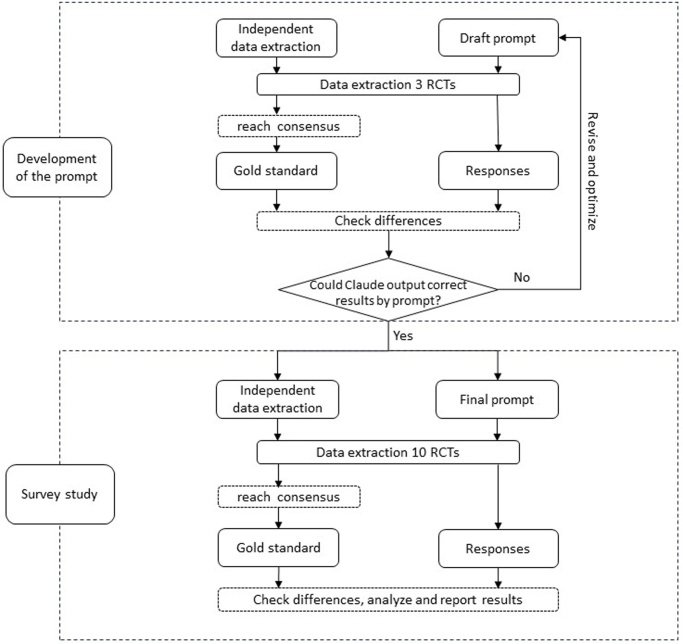
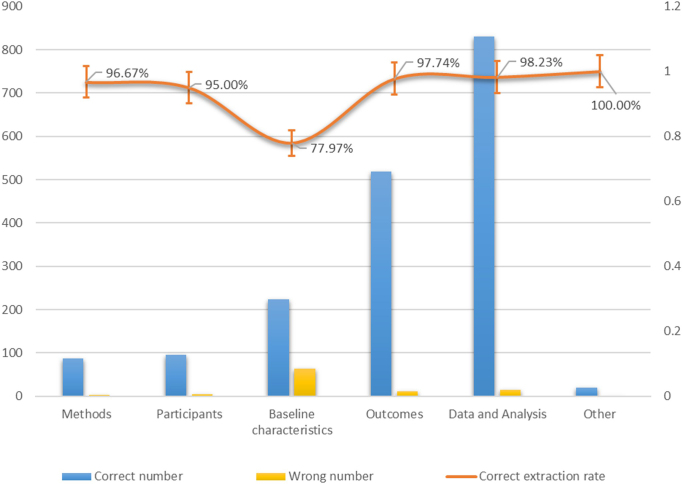
The advancement of large language models (LLMs) presents promising opportunities to enhance evidence synthesis efficiency, particularly in data extraction processes, yet existing prompts for data extraction remain limited, focusing primarily on commonly used items without accommodating diverse extraction needs. This research letter developed structured prompts for LLMs and evaluated their feasibility in extracting data from randomized controlled trials (RCTs). Using Claude (Claude-2) as the platform, we designed comprehensive structured prompts comprising 58 items across six Cochrane Handbook domains and tested them on 10 randomly selected RCTs from published Cochrane reviews. The results demonstrated high accuracy with an overall correct rate of 94.77% (95% CI: 93.66% to 95.73%), with domain-specific performance ranging from 77.97% to 100%. The extraction process proved efficient, requiring only 88 seconds per RCT. These findings substantiate the feasibility and potential value of LLMs in evidence synthesis when guided by structured prompts, marking a significant advancement in systematic review methodology.
Overview
The claims and statistics of this paper haven’t been checked yet.
Free: it reads the open-access text and checks the first 5 claims that cite a source we can check. Create a free account to check every claim.
Integrity signals
Registry
Cites
Statistics
Figures
Verification
Claims the paper makes
The claims and statistics of this paper haven’t been checked yet.
Free: it reads the open-access text and checks the first 5 claims that cite a source we can check. Create a free account to check every claim.
Claims other papers make about this one
Each is checked against this paper’s own text: does it say what the citing paper says it does?
The cited source says what the claim attributes to it.
In the citing paper
“Although these proof-of-concept studies have reported encouraging results and the potential to substantially reduce manual workload and human error, most evaluations have been limited to single models, small or restricted datasets, or single extraction runs (15–20).”
From Performance of large language models and prompt engineering strategies for data extraction in systematic reviews (2026) · cites this paper as [19]
Self-check
Percentages, sums and reported differences re-computed from the paper’s own numbers.
The self-check needs the paper’s full text.
Citations
Cites
O’Mara-Eves, A., Thomas, J., McNaught, J., Miwa, M., & Ananiadou, S. (2015) · Systematic Reviews · doi:10.1186/2046-4053-4-5 · Cited by 681
Automating data extraction in systematic reviews: a systematic review
Jonnalagadda, S. R., Goyal, P., & Huffman, M. D. (2015) · Systematic Reviews · doi:10.1186/s13643-015-0066-7 · Cited by 287 · cited 1×
“While semi-automated tools have been developed to assist this process, they exhibit constraints in efficacy and application [ 3 , 4 ] .”
Jabbour, S., Fouhey, D., Shepard, S., Valley, T. S., Kazerooni, E. A., Banovic, N., Wiens, J., & Sjoding, M. W. (2023) · JAMA · doi:10.1001/jama.2023.22295 · Cited by 236 · cited 1×
“While semi-automated tools have been developed to assist this process, they exhibit constraints in efficacy and application [ 3 , 4 ] .”
Manchikanti, L. (2008) · Pain Physician · doi:10.36076/ppj.2008/11/161 · Cited by 157
Initial Management of Acute Primary Angle Closure
Husain, R., Gazzard, G., Aung, T., Chen, Y., Padmanabhan, V., Oen, F. T. S., Seah, S. K. L., & Hoh, S. (2012) · Ophthalmology · doi:10.1016/j.ophtha.2012.06.015 · Cited by 142
Self-citationCombining classifiers for robust PICO element detection.
Boudin, F., Nie, J.-Y., Bartlett, J. C., Grad, R., Pluye, P., & Dawes, M. (2010) · BMC Medical Informatics and Decision Making · doi:10.1186/1472-6947-10-29 · Cited by 131
Assessing the Risk of Bias in Randomized Clinical Trials With Large Language Models
Lai, H., Ge, L., Sun, M., Pan, B., Huang, J., Hou, L., Yang, Q., Liu, J., Liu, J., Ye, Z., et al. (2024) · JAMA Network Open · doi:10.1001/jamanetworkopen.2024.12687 · Cited by 103
Self-citationUsage of automation tools in systematic reviews
van Altena, A. J., Spijker, R., & Olabarriaga, S. D. (2019) · Research Synthesis Methods · doi:10.1002/jrsm.1335 · Cited by 79
Introduction to and Techniques of Evidence-Based Medicine
Fisher, C. G., & Wood, K. B. (2007) · Spine · doi:10.1097/brs.0b013e318145308d · Cited by 62
Abelson, M. B., Heller, W. H., Shapiro, A., Si, E., Hsu, P., & Bowman, L. M. (2008) · American Journal of Ophthalmology · doi:10.1016/j.ajo.2008.01.019 · Cited by 54
Cited by
Data extraction methods for systematic review (semi)automation: Update of a living systematic review
Schmidt, L., Finnerty Mutlu, A. N., Elmore, R., Olorisade, B. K., Thomas, J., & Higgins, J. P. T. (2025) · F1000Research · doi:10.12688/f1000research.51117.3 · Cited by 27
Wen, P., Ai, Q., Fan, X., Gu, Z., 陈波, & Qian, H. (2026) · Cancer Letters · doi:10.1016/j.canlet.2026.218257 · Cited by 21
Artificial Intelligence Tools for Automating Evidence Synthesis: Scoping Review
Harasgama, S., Pearce, H., Appel, C., Loftus, L., Painter, H., Kuhn, I. L., Karpusheff, J., Ceesay, A., & Ford, J. A. (2026) · Journal of Medical Internet Research · doi:10.2196/81597 · Cited by 14
Young, R., Matthews, A. M., & Poston, B. (2025) · Algorithms · doi:10.3390/a18050296 · Cited by 11
Fleurence, R., Qureshi, R., Aggarwal, R., Bian, J., Cheyne, S., Dawoud, D., Faden, R., & Chhatwal, J. (2026) · Value in Health · doi:10.1016/j.jval.2026.06.012 · Cited by 8
Performance of large language models in data extraction for evidence synthesis: A systematic review
Shankar, R., Lim, A., & Qian, X. (2026) · Journal of Biomedical Informatics · doi:10.1016/j.jbi.2026.105086 · Cited by 7
Lai, H., Sousa‐Pinto, B., Cao, C., Moher, D., Estill, J., Liu, J., Zhao, W., Wang, Y., Ye, Z., Tong, B., et al. (2026) · Journal of Clinical Epidemiology · doi:10.1016/j.jclinepi.2026.112383 · Cited by 5
Self-citationOami, T., Okada, Y., Maeda, K., & Nakada, T.-A. (2026) · Frontiers in Digital Health · doi:10.3389/fdgth.2026.1799623 · Cited by 4
“Our findings further indicated that not only model selection but also prompt engineering strategies influence performance, emphasizing prompt optimization as a primary means of improving LLM outputs (18, 19).”
Large language models for automated PRISMA 2020 adherence checking
Kataoka, Y., So, R., Banno, M., Tsujimoto, Y., Takayama, T., Yamagishi, Y., Tsuge, T., Yamamoto, N., Suda, C., & Furukawa, T. A. (2026) · International Journal of Medical Informatics · doi:10.1016/j.ijmedinf.2026.106561 · Cited by 4
O’Keefe, H., Eastaugh, C., Wallace, S. A., & Beyer, F. R. (2026) · Campbell Systematic Reviews · doi:10.1177/18911803261449731 · Cited by 3
Lai, H., Ma, N., Zhao, W., Liu, J., Pan, B., Tian, J., Chen, Y., Ma, B., Shang, H., Liu, J., et al. (2025) · Chinese Science Bulletin (Chinese Version) · doi:10.1360/csb-2025-5395 · Cited by 2
Self-citationLai, H., Ma, N., Liu, J., Weilong, Z. H. A. O., Pan, B., & Ge, L. (2025) · World Journal of Integrated traditional and western Medicine(WJIM) · doi:10.70976/j.2096-0964.wjim-2025-0022 · Cited by 2
Self-citationLee, D. C. W., O’Brien, K. M., Presseau, J., Yoong, S., Lecathelinais, C., Wolfenden, L., Thomas, J., Arno, A., Hutton, B., & Hodder, R. K. (2026) · medRxiv · doi:10.64898/2026.02.25.26347053 · Cited by 1
Yisha, Z., Sun, J., Yang, K., Liu, Z., Zeng, B., 刘凤琪, Yang, S., Deng, H., Ma, Z., Yan, C., et al. (2026) · AI Evidence-Based Medicine · doi:10.1097/ai9.0000000000000016 · Cited by 1
Jay, M., Abi‐Jaoude, J., Straus, S. E., Eskander, A., Lipscombe, L. L., Dharma, C., & Yu, C. (2026) · Global Epidemiology · doi:10.1016/j.gloepi.2026.100282
Liu, J., Lai, H., Zhao, W., Tong, B., Ma, N., Pan, B., Wu, D., & Ge, L. (2026) · Complementary Medicine Research · doi:10.1159/000552717
Self-citationYoung, R., Cacho, J. R. F., & Poston, B. (2026) · Bioengineering · doi:10.3390/bioengineering13070773
McClure, Z., Messer, M., Jarman, H. K., & Linardon, J. (2026) · Behavior Therapy · doi:10.1016/j.beth.2026.07.001
Adam, G. P., Davies, M. C., Caputo, E. L., Mai, H. J., Coppola, E. L., Holmer, H. K., Kuhn, E., Balk, E. M., Trikalinos, T. A., Ivlev, I., et al. (2026) · Research Synthesis Methods · doi:10.1017/rsm.2026.10118
Merchán-Cruz, E. A., Gabelaia, I., Soe, S. P., Yatskiv, I., & Dmitry, P. (2026) · Informatics · doi:10.3390/informatics13100160
Başer, O. (2026) · Journal of health economics and outcomes research · doi:10.36469/001c.171937
Başer, O. (2026) · Journal of health economics and outcomes research · doi:10.36469/jheor.2026.171937
Jay, M., ESTTAIFO, M., Samani, A., Wilson, E., Esttaifo, S., Morgan, M., Abi‐Jaoude, J., Reszetnik, G., Chopra, M., Alrashidi, A., et al. (2026) · medRxiv · doi:10.64898/2026.11.06.26367388
Jeong, I., Park, S., Jhon, M., Kim, D.-K., Park, J.-H., Kim, Y. H., Jang, M., Kim, J., Kim, J., & Lee�, H. (2026) · Journal of Medical Internet Research · doi:10.2196/102768
Zhou, H., Zhou, X., Zhou, S., Song, M., Chen, X., Wu, Y., Chen, Y., Yu, K., Xiao, Y., Hou, Y., et al. (2026) · Authorea · doi:10.22541/au.176789264.41926181/v1
Self-citationZhou, H., Zhou, X., Zhou, S., Song, M., Chen, X., Wu, Y., Chen, Y., Yu, K., Xiao, Y., Hou, Y., et al. (2026) · Research Square · doi:10.21203/rs.3.rs-11343754/v1
Self-citationMehdizadkhani, M., Liu, L., Zheng, R., & Yang, M. (2026) · International Journal of Qualitative Methods · doi:10.1177/16094069261504392
Kravchuk, A. P., Garzaro, J. R. R., Donabauer, G., Ateia, S., Kruschwitz, U., Egert, V., Eckl, C., Rinderknecht, E., Herrmann, S., Siepmann, S., et al. (2026) · Research Square · doi:10.21203/rs.3.rs-9260490/v1
Smart Extraction of Structured Data from Unstructured Documents
Friberg, E. (2024) · AMS Degree Thesis (University of Bologna)
Bhatt, N., Warner, F., Miao, J., Thakker, R. A., Joodi, G., Cantero-Schaffer, P., Mortazavi, B. J., Huang, C., Krumholz, H. M., & Murugiah, K. (2026) · medRxiv · doi:10.64898/2026.08.05.26359802
FIRE-EVIDENCE: enabling LLM-driven, machine-readable evidence synthesis for women’s health
Shahid, M. A., Afzal, M., Lokker, C., Wu, W., & Şeker, H. (2026) · npj Digital Medicine · doi:10.1038/s41746-026-03411-w
Metadata
- Authors
- Liu, J., Lai, H., Zhao, W., Huang, J., Xia, D., Liu, H., Luo, X., Wang, B., Pan, B., Hou, L., Chen, Y., & Ge, L.
- Affiliations
- Lanzhou University (CN)
- Gansu University of Traditional Chinese Medicine (CN)
- Chinese Academy of Medical Sciences & Peking Union Medical College (CN)
- Corresponding author
- Ge, Long
- ORCID
- Venue
- International Journal of Surgery
- Published
- 2025-02-04
- Volume
- 111
- Issue
- 3
- Pages
- 2722-2726
- ISSN
- 1743-9159 (ISSN-L)
- PMC
- PMC12372713
- OpenAlex
- W4407119832
- Semantic Scholar
- 35e2a6a4ce8a877689db1a702aaf1f879ec4ae2d
- Cited by
- 19
- References
- 29
- Citations by year
- 2026: 16 · 2025: 3
- FWCI
- 12.02
- Type
- journal article
- Language
- en
- Open access
- hybrid
- doi.org
- Licence
- Locations
- International Journal of Surgery (publishedVersion, cc-by-sa)
- SSRN Electronic Journal (acceptedVersion)
- Europe PMC (PubMed Central) (publishedVersion, cc-by-sa)
- PubMed Central (publishedVersion, cc-by-sa)
- PubMed (publishedVersion)
- Funders
- National Natural Science Foundation of China
- China Academy of Chinese Medical Sciences
- Fundamental Research Funds for the Central Universities
- Topics
- Social Sciences › Decision Sciences › Statistics, Probability and Uncertainty › Meta-analysis and systematic reviews
- Health Sciences › Medicine › Health Informatics › Artificial Intelligence in Healthcare and Education
- Social Sciences › General Social Sciences › Computational and Text Analysis Methods
- Keywords
- large language models, data extraction, evidence synthesis, randomized controlled trials, prompt engineering, structured prompting, Claude 2, Cochrane Handbook, systematic reviews
- MeSH terms
- Large Language Models, Artificial Intelligence, Humans, Randomized Controlled Trials as Topic, Information Storage and Retrieval
About these checks
Registry, retraction, Cites and statistics results are computed, not judged, with one exception: a printed reference that no index lists is read once by a model before it counts as a citation error. Claims are extracted by a model and kept only when their quote appears verbatim in the text; each cited source is then checked, with a model’s help, for whether it says what the claim relies on. Those verdicts can be wrong — read the claim’s quote and the cited source before relying on one.
Statistics and arithmetic are recomputed, not judged.
Confidence bands are shown only for fields calibrated on our annotated test set. None is calibrated yet, so no band is shown.
What counts as a claim ›How we measure confidence ›How we check this ›
Are you an author, or do you see a problem with this page? Request a review
Data sources
Bibliographic data: Semantic Scholar, OpenAlex, Crossref.
Contains information from the Semantic Scholar Academic Graph Datasets, made available under the ODC Attribution License (ODC-BY 1.0).
Semantic Scholar’s data is described in: Kinney, R., et al. (2023). The Semantic Scholar Open Data Platform. arXiv:2301.10140.
