

The DOI matches its Crossref record.
Risk Factors Influencing Complications of Cardiac Implantable Electronic Device Implantation: Infection, Pneumothorax and Heart Perforation A Nationwide Population-Based Cohort Study
Open accessAbstract
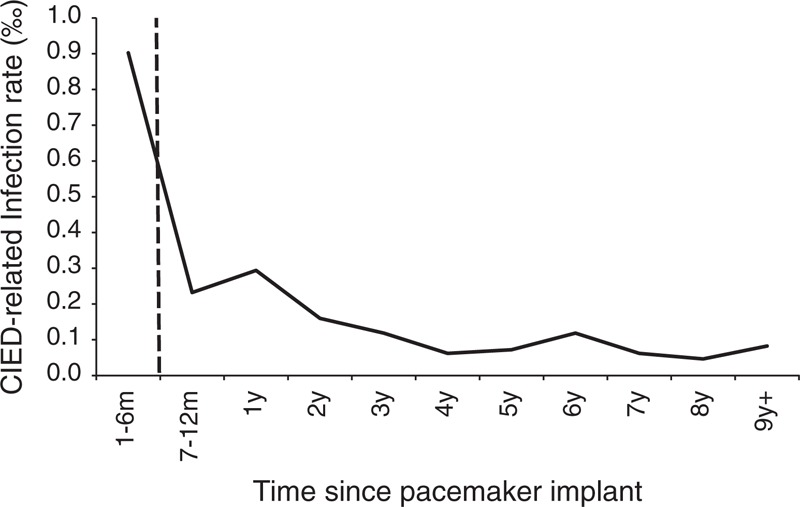
As the number of cardiac implantable electronic devices (CIEDs) is increasing annually, CIED-related complications are becoming increasingly important. The aim of the study was to assess the risks associated with CIEDs by a nationwide database. Patients were selected from the Taiwan National Health Insurance Database. Admissions for CIED implantation, replacement, and revision were evaluated and the evaluation period was 14 years. Endpoints included CIED-related infection, pneumothorax, and heart perforation. The study included 40,608 patients with a mean age of 71.8 ± 13.3 years. Regarding infection, the incidence rate was 2.45 per 1000 CIED-years. Male gender, younger age, device replacement, and previous infection were risks for infection while old age and high-volume centers (>200 per year) were protectors. The incidence of pneumothorax was 0.6%, with an increased risk in individuals who had chronic obstructive lung disease (COPD) and cardiac resynchronized therapy (CRT). The incidence of heart perforation was 0.09%, with an increased risk in individuals who had pre-operation temporal pacing and steroid use. High-volume center was found to decrease infection rate while male gender, young people, and individuals who underwent replacements were associated with an increased risk of infection. Additionally, pre-operation temporal pacing and steroid use should be avoided if possible. Furthermore, COPD patients or those who accept CRTs should be monitored closely.
Overview
The claims and statistics of this paper haven’t been checked yet.
Run the check — free, no account needed. It reads the open-access text and checks the sources it cites.
Integrity signals
Registry
Cites
Statistics
Figures
Verification
Claims the paper makes
The claims and statistics of this paper haven’t been checked yet.
Run the check — free, no account needed. It reads the open-access text and checks the sources it cites.
Claims other papers make about this one
Each is checked against this paper’s own text: does it say what the citing paper says it does?
The source backs part of the claim, not all of it — or backs it for a different population, condition or comparison.
In the citing paper
“Other complications include tissue puncture during the implant procedure, causing perforation and rupture of the heart or air entrapment in the lungs known as pneumothorax6.”
From Inductively powered wireless pacing via a miniature pacemaker and remote stimulation control system (2017) · cites this paper as [6]
Experimental — accuracy not yet measured
Self-check
Percentages, sums and reported differences re-computed from the paper’s own numbers.
The self-check needs the paper’s full text.
Citations
Cites
No references could be resolved yet.
Research works printed but not linked: 33
- Vardas, 2007, Guidelines for cardiac pacing and cardiac resynchronization therapy: The Task Force for Cardiac Pacing and Cardiac Resynchronization Therapy of the European Society of Cardiology. Developed in collaboration with the European Heart Rhythm Association, Eur Heart J, 28, 2256, 10.1093/eurheartj/ehm305 · DOI
- Abikhzer, 2010, Infected pacemaker causing septic lung emboli detected on FDG PET/CT, J Nucl Cardiol, 17, 514, 10.1007/s12350-009-9160-3 · DOI
- Dickstein, 2010, 2010 Focused Update of ESC Guidelines on device therapy in heart failure: an update of the 2008 ESC Guidelines for the diagnosis and treatment of acute and chronic heart failure and the 2007 ESC guidelines for cardiac and resynchronization therapy. Developed with the special contribution of the Heart Failure Association and the European Heart Rhythm Association, Eur Heart J, 31, 2677, 10.1093/eurheartj/ehq337 · DOI
- Mond, 2008, The world survey of cardiac pacing and cardioverter-defribrillators: calendar Year 2005 an International Cardiac Pacing and Electrophysiology Society (ICPES) project, PACE, 31, 1202, 10.1111/j.1540-8159.2008.01164.x · DOI
- Mond, 2011, The 11th world survey of cardiac pacing and implantable cardioverter-defibrillators: calendar year 2009: a World Society of Arrhythmia's project, PACE, 34, 1013, 10.1111/j.1540-8159.2011.03150.x · DOI
- Cabell, 2004, Increasing rates of cardiac device infections among Medicare beneficiaries: 1990–1999, Am Heart J, 147, 582, 10.1016/j.ahj.2003.06.005 · DOI
- Voigt, 2010, Continued rise in rates of cardiovascular implantable electronic device infections in the United States: temporal trends and causative insights, PACE, 33, 414, 10.1111/j.1540-8159.2009.02569.x · DOI
- Sohail, 2011, Mortality and cost associated with cardiovascular implantable electronic device infections, Arch Intern Med, 171, 1821, 10.1001/archinternmed.2011.441 · DOI
- Tompkins, 2011, End-stage renal disease predicts complications in pacemaker and ICD implants, J Cardiovasc Electrophysiol, 22, 1099, 10.1111/j.1540-8167.2011.02066.x · DOI
- Nery, 2010, Device-related infection among patients with pacemakers and implantable defibrillators: incidence, risk factors, and consequences, J Cardiovasc Electrophysiol, 21, 786, 10.1111/j.1540-8167.2009.01690.x · DOI
- Johansen, 2011, Infection after pacemaker implantation: infection rates and risk factors associated with infection in a population-based cohort study of 46299 consecutive patients, Eur Heart J, 32, 991, 10.1093/eurheartj/ehq497 · DOI
- Romeyer-Bouchard, 2010, Prevalence and risk factors related to infections of cardiac resynchronization therapy devices, Eur Heart J, 31, 203, 10.1093/eurheartj/ehp421 · DOI
- Sohail, 2007, Risk factor analysis of permanent pacemaker infection, Clin Infect Dis, 45, 166, 10.1086/518889 · DOI
- Klug, 2007, Risk factors related to infections of implanted pacemakers and cardioverter-defibrillators: results of a large prospective study, Circulation, 116, 1349, 10.1161/CIRCULATIONAHA.106.678664 · DOI
- Raad, 2012, Implantable electrophysiologic cardiac device infections: a risk factor analysis, Eur J Clin Microbiol Infect Dis, 31, 3015, 10.1007/s10096-012-1655-1 · DOI
- Baddour, 2010, Update on cardiovascular implantable electronic device infections and their management: a scientific statement from the American Heart Association, Circulation, 121, 458, 10.1161/CIRCULATIONAHA.109.192665 · DOI · Paper page
- Kirkfeldt, 2012, Pneumothorax in cardiac pacing: a population-based cohort study of 28,860 Danish patients, Europace, 14, 1132, 10.1093/europace/eus054 · DOI
- Tobin, 2000, Acute complications of permanent pacemaker implantation: their financial implication and relation to volume and operator experience, Am J Cardiol, 85, 774, 10.1016/S0002-9149(99)00861-9 · DOI
- Piekarz, 2012, Heart perforation in patients with permanent cardiac pacing—pilot personal observations, Arch Med Sci, 8, 70, 10.5114/aoms.2012.27284 · DOI
- Mahapatra, 2005, Incidence and predictors of cardiac perforation after permanent pacemaker placement, Heart Rhythm, 2, 907, 10.1016/j.hrthm.2005.06.011 · DOI
- Wu, 2012, Association between nucleoside analogues and risk of hepatitis B virus-related hepatocellular carcinoma recurrence following liver resection HBV nucleoside analogues, and HCC recurrence, JAMA, 308, 1906, 10.1001/2012.jama.11975 · DOI
- Cheng, 2011, Validation of the National Health Insurance Research Database with ischemic stroke cases in Taiwan, Pharmacoepidemiol Drug Safety, 20, 236, 10.1002/pds.2087 · DOI
- Gould, 2011, Cardiovascular implantable electrophysiological device-related infections: a review, Curr Opin Cardiol, 26, 6, 10.1097/HCO.0b013e328341384e · DOI
- Al-Khatib, 2005, The relation between patients’ outcomes and the volume of cardioverter-defibrillator implantation procedures performed by physicians treating Medicare beneficiaries, J Am Coll Cardiol, 46, 1536, 10.1016/j.jacc.2005.04.063 · DOI
- Freeman, 2010, The relation between hospital procedure volume and complications of cardioverter-defibrillator implantation from the implantable cardioverter-defibrillator registry, J Am Coll Cardiol, 56, 1133, 10.1016/j.jacc.2010.07.007 · DOI
- Darouiche, 2012, Antibiotics and antiseptics to prevent infection in cardiac rhythm management device implantation surgery, PACE, 35, 1348, 10.1111/j.1540-8159.2012.03506.x · DOI
- Bloom, 2006, Renal insufficiency and the risk of infection from pacemaker or defibrillator surgery, PACE, 29, 142, 10.1111/j.1540-8159.2006.00307.x · DOI
- Dasgupta, 2007, Increased complication rates of cardiac rhythm management devices in ESRD patients, Am J Kidney Dis, 49, 656, 10.1053/j.ajkd.2007.02.272 · DOI
- Lekkerkerker, 2009, Risk factors and time delay associated with cardiac device infections: Leiden device registry, Heart, 95, 715, 10.1136/hrt.2008.151985 · DOI
- Pakarinen, 2010, Short-term implantation-related complications of cardiac rhythm management device therapy: a retrospective single-centre 1-year survey, Europace, 12, 103, 10.1093/europace/eup361 · DOI
- Khan, 2005, Delayed lead perforation: a disturbing trend, PACE, 28, 251, 10.1111/j.1540-8159.2005.40003.x · DOI
- Hirschl, 2007, Prevalence and characterization of asymptomatic pacemaker and ICD lead perforation on CT, PACE, 30, 28, 10.1111/j.1540-8159.2007.00575.x · DOI
- Twycross, 1994, The risks and benefits of corticosteroids in advanced cancer, Drug Saf, 11, 163, 10.2165/00002018-199411030-00003 · DOI
Cited by
Sorted by citations
Inductively powered wireless pacing via a miniature pacemaker and remote stimulation control system
Abiri, P., Abiri, A., Packard, R. R. S., Ding, Y., Yousefi, A., Ma, J., Bersohn, M., Nguyen, K.-L., Markovic, D., Moloudi, S., et al. (2017) · Scientific Reports · doi:10.1038/s41598-017-06493-5 · Cited by 68
Metadata
- Authors
- Lin, Y.-S., Hung, S.-P., Chen, P.-R., Yang, C.-H., Wo, H.-T., Chang, P.-C., Wang, C.-C., Chou, C.-C., Wen, M.-S., Chung, C.-M., & Chen, T.-H.
- Affiliations
- Chang Gung University (TW)
- Corresponding author
- Chen, Pei-Rung
- Chang, Po-Cheng
- Chen, Tien-Hsing
- ORCID
- Venue
- Medicine
- Published
- 2014-12
- Volume
- 93
- Issue
- 27
- Pages
- e213
- ISSN
- 0025-7974 (ISSN-L)
- PMC
- PMC4602772
- OpenAlex
- W2230393603
- Cited by
- 58
- References
- 0
- Citations by year
- 2026: 3 · 2025: 2 · 2024: 6 · 2023: 9 · 2022: 2 · 2021: 1 · 2020: 10 · 2019: 6 · 2018: 4 · 2017: 5 · 2016: 5 · 2015: 5
- FWCI
- 3.44
- Type
- journal article
- Language
- en
- Open access
- gold
- doi.org
- Licence
- cc-by-nc-nd
- Locations
- Medicine (publishedVersion, cc-by-nc-nd)
- Europe PMC (PubMed Central) (publishedVersion, cc-by-nc-nd)
- PubMed Central (publishedVersion, cc-by-nc-nd)
- PubMed (publishedVersion)
- Topics
- Health Sciences › Medicine › Cardiology and Cardiovascular Medicine › Cardiac pacing and defibrillation studies
- Health Sciences › Medicine › Cardiology and Cardiovascular Medicine › Infective Endocarditis Diagnosis and Management
- Health Sciences › Medicine › Cardiology and Cardiovascular Medicine › Coronary Interventions and Diagnostics
- Keywords
- cardiac implantable electronic devices, device-related infection, pneumothorax, risk factors, equipment replacement, chronic obstructive pulmonary disease, steroid use, high-volume centers
- MeSH terms
- Adult, Aged, Aged, 80 and over, Female, Heart Injuries, Humans, Infections, Male, Middle Aged, Pacemaker, Artificial, Pneumothorax, Retrospective Studies, Risk Factors, Taiwan, Incidence, Defibrillators, Implantable, Young Adult
About these checks
Registry, retraction, Cites and statistics results are computed, not judged, with one exception: a printed reference that no index lists is read once by a model before it counts as a citation error. Claims are extracted by a model and kept only when their quote appears verbatim in the text; each cited source is then checked, with a model’s help, for whether it says what the claim relies on. Those verdicts can be wrong — read the claim’s quote and the cited source before relying on one.
Statistics and arithmetic are recomputed, not judged.
Confidence bands are shown only for fields calibrated on our annotated test set. None is calibrated yet, so no band is shown.
What counts as a claim ›How we measure confidence ›How we check this ›
Are you an author, or do you see a problem with this page? Request a review
