

Comparison of effective teaching methods to achieve skill acquisition using a robotic virtual reality simulator: Expert proctoring versus an educational video versus independent training
Open accessThe DOI matches its Crossref record; 18 of the 18 references it cites were found in a registry or an index.
Abstract
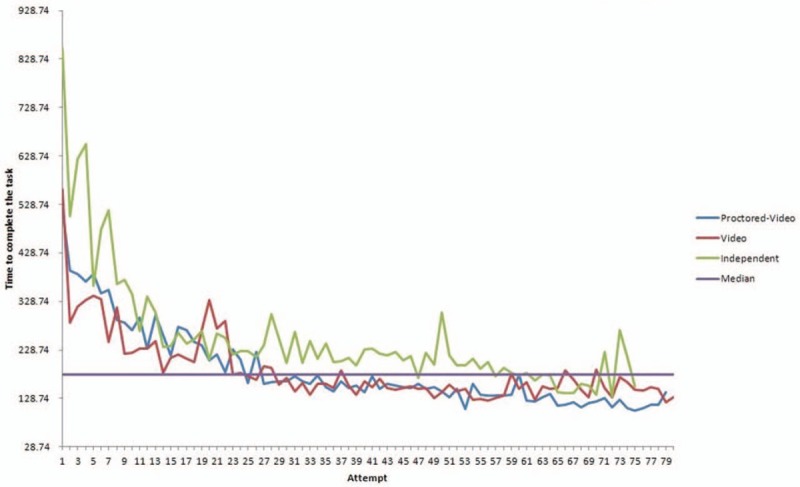
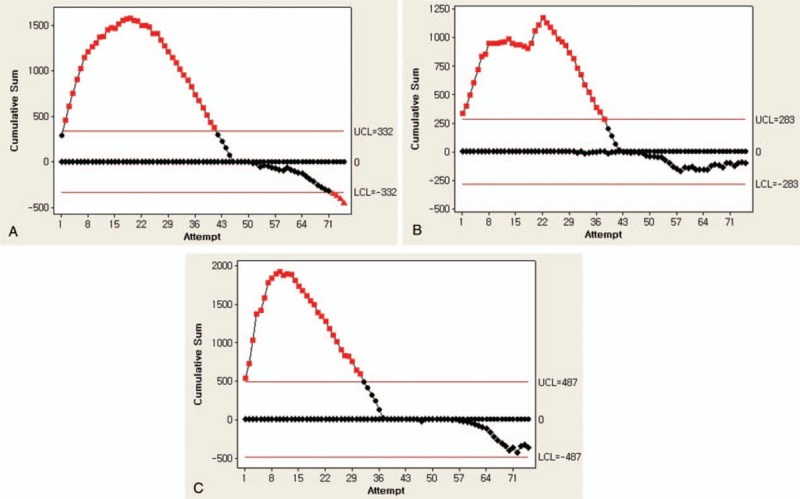
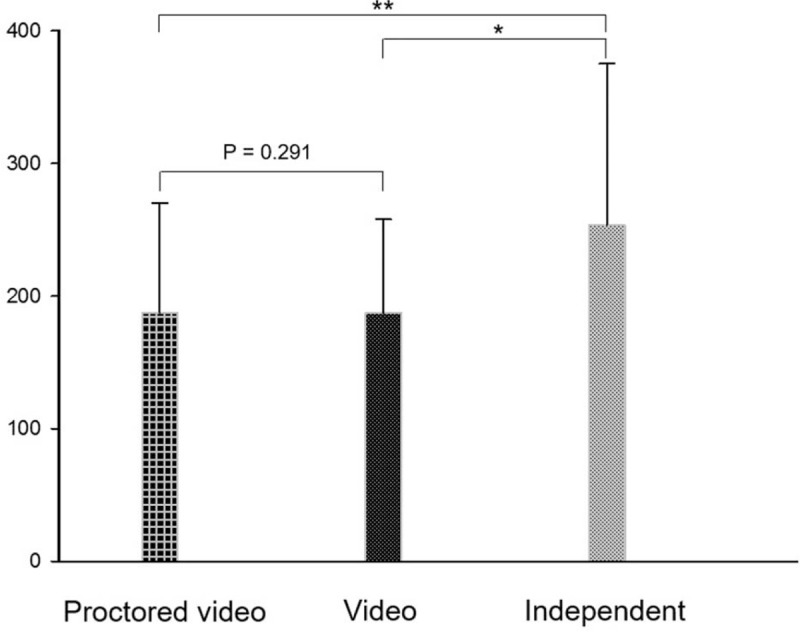
BACKGROUND: To compare the superiority of teaching methods for acquiring a proficient level of surgical skill in a robotic surgery-naïve individual using a robotic virtual reality simulator. METHODS: This study employed a prospective, randomized study design to assess student's learning curve. We divided 45 subjects into 3 groups: those with expert proctoring (group I), those who watched only an educational video (group II), and those with independent training (group III; n = 15 per group). The task used in this study was the Tube 2 and it imitates a vesicourethral anastomosis in robotic prostatectomy. The effects were analyzed by the time to end the task after overcoming the learning curve which is determined by several performance parameters. RESULTS: The number of task repetitions required to reach the learning curve plateau was 45, 42, and 37 repetitions in groups I, II, and III, which means that there was continuous improvement in performing the task after 40 repetitions only in groups I and II. The mean time for completing the task during the stabilization period was significantly different between group I and group III and group II and group III, which means that the independent training method was inferior to the other methods (group I vs. group II vs. group III: 187.38 vs. 187.07 vs. 253.47 seconds, P < .001). CONCLUSIONS: This study's findings showed that an educational video can be as beneficial as expert proctoring, which implies that the development of a standardized educational video would be worthwhile.
Overview
The claims and statistics of this paper haven’t been checked yet.
Free: it reads the open-access text and checks the first 5 claims that cite a source we can check. Create a free account to check every claim.
Integrity signals
Registry
Cites
Statistics
Figures
Verification
Claims the paper makes
The claims and statistics of this paper haven’t been checked yet.
Free: it reads the open-access text and checks the first 5 claims that cite a source we can check. Create a free account to check every claim.
Claims other papers make about this one
Each is checked against this paper’s own text: does it say what the citing paper says it does?
The cited source says what the claim attributes to it.
In the citing paper
“Studies exploring AI-assisted desktop and interactive screen-based simulations, and VR simulations have reported positive student learning outcomes ( Liaw et al., 2023 ;Shim et al., 2018 ;Simsek-Cetinkaya & Cakir, 2023 ;Winkler-Schwartz et al., 2019 ).”
From Feasibility and acceptability of incorporating artificial intelligence into simulation education (2025) · cites this paper as Shim et al., 2018
Self-check
Percentages, sums and reported differences re-computed from the paper’s own numbers.
The self-check needs the paper’s full text.
Citations
Cites
Training and learning robotic surgery, time for a more structured approach: a systematic review
Schreuder, H., Wolswijk, R., Zweemer, R., Schijven, M., & Verheijen, R. (2012) · BJOG: An International Journal of Obstetrics & Gynaecology · doi:10.1111/j.1471-0528.2011.03139.x · Cited by 227
Kenney, P. A., Wszolek, M. F., Gould, J. J., Libertino, J. A., & Moinzadeh, A. (2009) · Urology · doi:10.1016/j.urology.2008.12.044 · Cited by 218
Best Practices for Robotic Surgery Training and Credentialing
Lee, J. Y., Mucksavage, P., Sundaram, C. P., & McDougall, E. M. (2011) · The Journal of Urology · doi:10.1016/j.juro.2010.11.067 · Cited by 153
Validation of a Novel Virtual Reality Robotic Simulator
Sethi, A. S., Peine, W. J., Mohammadi, Y., & Sundaram, C. P. (2009) · Journal of Endourology · doi:10.1089/end.2008.0250 · Cited by 151
Laparoscopic Radical Prostatectomy: Decreasing the Learning Curve Using A Mentor Initiated Approach
Fabrizio, M. D., Tuerk, I., & Schellhammer, P. F. (2003) · The Journal of Urology · doi:10.1097/01.ju.0000059701.01781.e4 · Cited by 135
Hung, A. J., Patil, M. B., Zehnder, P., Cai, J., Ng, C. K., Aron, M., Gill, I. S., & Desai, M. M. (2011) · The Journal of Urology · doi:10.1016/j.juro.2011.09.154 · Cited by 134
Rashid, H. H., Leung, Y.-Y. M., Rashid, M., Oleyourryk, G., Valvo, J. R., & Eichel, L. (2006) · Urology · doi:10.1016/j.urology.2006.01.057 · Cited by 131
COMPLICATIONS OF LAPAROSCOPIC PROCEDURES AFTER CONCENTRATED TRAINING IN UROLOGICAL LAPAROSCOPY
Cadeddu, J. A., WOLFE, J. S., Nakada, S. Y., Chen, R. K., Shalhav, A. L., Bishoff, J. T., Hamilton, B. D., Schulam, P. G., Dunn, M. D., Hoenig, D. M., et al. (2001) · The Journal of Urology · doi:10.1016/s0022-5347(05)65515-2 · Cited by 122
Comparative assessment of three standardized robotic surgery training methods
Hung, A. J., Jayaratna, I. S., Teruya, K. K., Desai, M. M., Gill, I. S., & Goh, A. C. (2013) · British Journal of Urology · doi:10.1111/bju.12045 · Cited by 114
Virtual Reality-Assisted Robotic Surgery Simulation
Albani, J. M., & Lee, D. I. (2007) · Journal of Endourology · doi:10.1089/end.2007.9978 · Cited by 97
Cited by
Virtual Reality in Medical Students’ Education: Scoping Review
Jiang, H., Vimalesvaran, S., Wang, J. K., Lim, K. B., Mogali, S. R., & Car, L. T. (2022) · JMIR Medical Education · doi:10.2196/34860 · Cited by 259
Applications of Artificial Intelligence (AI) in Medical Education: A Scoping Review
Nagi, F., Salih, R., Alzubaidi, M., Shah, H., Alam, T., Shah, Z., & Househ, M. (2023) · Studies in Health Technology and Informatics · doi:10.3233/shti230581 · Cited by 135
Learning Surgical Skills Through Video-Based Education: A Systematic Review
Youssef, S. C., Aydın, A., Canning, A., Khan, N. S., Ahmed, K., & Dasgupta, P. (2022) · Surgical Innovation · doi:10.1177/15533506221120146 · Cited by 121
Khanna, A., Antolin, A., Bar, O., Ben-Ayoun, D., Zohar, M., Boorjian, S. A., Frank, I., Shah, P. H., Sharma, V., Thompson, R. H., et al. (2024) · The Journal of Urology · doi:10.1097/ju.0000000000003845 · Cited by 45
Systematic review of academic robotic surgery curricula
Khan, M. T. A., Patnaik, R., Lee, C. S., Willson, C. M., DeMario, V. K., Krell, R. W., & Laverty, R. B. (2022) · Journal of Robotic Surgery · doi:10.1007/s11701-022-01500-y · Cited by 38
“[45] 2018 Medical students (n = 45) Korea University—Department Urology, Seoul, South Korea Prospective”
BackgroundHaslam, R. E., & Seideman, C. A. (2020) · Journal of Endourology · doi:10.1089/end.2020.0102 · Cited by 36
Rodler, S., Kidess, M. A., Westhofen, T., Kowalewski, K., BELENCHON, I. R., Taratkin, M. S., Puliatti, S., Rivas, J. G., Veccia, A., Piazza, P., et al. (2023) · Journal of Clinical Medicine · doi:10.3390/jcm12165425 · Cited by 26
“demonstrate in a study with 45 participants that educational videos are comparable to expert-guided training but are superior to unguided training to fulfil robotic surgical tasks [42].”
BackgroundA scoping review on the relationship between robotics in educational contexts and e-health
Sannicandro, K., Santis, A. D., Bellini, C., & Minerva, T. (2022) · Frontiers in Education · doi:10.3389/feduc.2022.955572 · Cited by 21
“Shim et al. (2018) show no significant difference between subjects with expert proctoring and those who viewed an educational video only in achieving skill acquisition, but both groups yielded significant improvement compared to those with independent training.”
BackgroundResultA systematic review of video-based educational interventions in robotic surgical training
Larkins, K. M., Khan, M., Mohan, H. M., Warrier, S. K., & Heriot, A. G. (2023) · Journal of Robotic Surgery · doi:10.1007/s11701-023-01605-y · Cited by 16
“When compared to expert proctoring, expert video was also shown to be an effective educational tool with benefits beyond independent practice alone [10].”
BackgroundSöderlund, A., Blaževičienė, A., Elvén, M., Vaškelytė, A., Strods, R., Blese, I., Paakkonen, H. J., Fernandes, A. M., Cardoso, D., Kav, S., et al. (2023) · Discover Education · doi:10.1007/s44217-022-00022-x · Cited by 33
Training novice robot surgeons: Proctoring provides same results as simulator-generated guidance
Beulens, A. J. W., Hashish, Y. A. F., Brinkman, W. M., Umari, P., Puliatti, S., Koldewijn, E. L., Hendrikx, A. J. M., van Basten, J. P., van Merriënboer, J. J. G., van der Poel, H. G., et al. (2020) · Journal of Robotic Surgery · doi:10.1007/s11701-020-01118-y · Cited by 11
Larkins, K. M., Mansour, K., Costello, D., Gray, M., Warrier, S. K., Heriot, A. G., & Mohan, H. M. (2022) · Journal of Robotic Surgery · doi:10.1007/s11701-022-01513-7 · Cited by 16
Assessment of the Educational Value of Distal Hypospadias Repair Videos on YouTube
Jones, P., Rajasegaran, A., Brassale, S., Chen, Y., Haslam, R. E., Austin, C., & Seideman, C. A. (2021) · Urology · doi:10.1016/j.urology.2021.08.020 · Cited by 10
Impact of artificial intelligence on academic performance in medical education: A systematic review
Kalantarion, M., Heidari, M., Khajeali, N., Khorrami, Z., & Amini, M. (2025) · Journal of Education and Health Promotion · doi:10.4103/jehp.jehp_2071_23 · Cited by 17
“[20] Achieve skill acquisition using a robotic VR simulator in radical prostatectomy.”
Improving Robotic Skills by Video Review
van der Leun, J. A., Siem, G., Meijer, R. P., & Brinkman, W. M. (2022) · Journal of Endourology · doi:10.1089/end.2021.0740 · Cited by 9
“7,8 Video-based learning has been adopted across various sectors such as sports, aviation, and business management.”
Robotic surgical curriculum for medical students: a scoping review
Mohamed, J. E., Ahmadipour, M., Warrier, S. K., Costello, T., Hii, M. W., & Mohan, H. M. (2025) · Journal of Robotic Surgery · doi:10.1007/s11701-025-02667-w · Cited by 8
“…et al. [33] 2015 Educational Strategies Laca et al. [37] 2022 Educational Strategies Melnyk et al. [36] 2021 Educational Strategies Shim et al. [34] 2018 Educational Strategies Suh et al. [32] 2011 Educational Strategies Van der Leun et al. [38] 2022 Educational Strategies Kalinov et al. [40]…”
Feasibility and acceptability of incorporating artificial intelligence into simulation education
Swan, B. A., Febres-Cordero, S., Steiger, L., Lisenby, A., Getz, T., Hudson, J., Cole, K., Branch, R., McDermott, C., Fugate, K., et al. (2025) · Clinical Simulation in Nursing · doi:10.1016/j.ecns.2025.101739 · Cited by 5
Educational Quality of YouTube TM Videos on Laparoscopic Radical Prostatectomy
Akdemir, E., Çiçek, M., Çakmak, B. S., Akbulut, M. L., & Buğday, M. S. (2025) · Journal of Laparoendoscopic & Advanced Surgical Techniques · doi:10.1089/lap.2025.0002 · Cited by 7
The Influence of Intraoperative Technology on Neurosurgery Training
Ho, A., Khan, Y. R., Whitney, E., Alastra, A. J. G., & Siddiqi, J. (2019) · Cureus · doi:10.7759/cureus.5769 · Cited by 5
“systematic stepwise training curriculum beginning with online video didactics, then hands-on tutorial simulation, culminating in real-time performance are necessary for residents to be proficient at roboticassisted intraoperative procedures as well as decreased trainee frustration [15-18].”
BackgroundMalhotra, M., & Chhabra, I. (2026) · Discover Education · doi:10.1007/s44217-026-01275-6 · Cited by 2
Arain, Z., Fadel, M. G., Arif, A., Robb, H., Das, B., Poynter, L., Kontovounisios, C., Ashrafian, H., Lawes, D., & Fehervari, M. (2025) · International Journal of Colorectal Disease · doi:10.1007/s00384-025-04914-w · Cited by 1
“There was no significant difference in video length between YouTube videos (9.5 [7–16] min) and videos from surgical educational platforms (10 [6–10] min) (Fig.”
InfluentialSapeni, M. A.-A. R., Erika, K. A., & Saleh, A. (2020) · Indonesian Contemporary Nursing Journal (ICON Journal) · doi:10.20956/icon.v5i1.9795 · Cited by 1
“Oleh karena itu, penerapan metode pembelajaran yang tepat dengan pendekatan terstruktur dan standar, seperti pembelajaran yang melibatkan praktik dan pelatihan akan meningkakan kemampuan mahasiswa dalam keterampilan (Shim et al., 2018).”
BackgroundPractical training of AI tools in medical education
Khan, S. M. (2025) · Elsevier eBooks · doi:10.1016/b978-0-443-33584-6.00021-9
Shinohara, K., Saito, T., Yasui, K., Ueda, S., Matsumura, T., Osawa, T., Ando, M., Fukami, Y., Kaneko, K., & Sano, T. (2025) · Surgery Today · doi:10.1007/s00595-025-03139-2
Tracheostomy Care Curricula for Pediatric Residents: A Pilot Randomized Trial
Yang, C. J., Campisi, C., Li, D., Goto, L., Tank, A., Schiff, E., Tawfik, M., Shen, A., Kelly, Z., Cai, R., et al. (2024) · Tracheostomy Official Journal of the Global Tracheostomy Collaborative · doi:10.62905/001c.120181
Applications of artificial intelligence in medical education
Pedro, L. (2025) · International Journal of Clinical Medical Research · doi:10.61466/ijcmr4010003
Human Learning of Soft Robot Motion and Control: The Impact of Teaching Method and Task Order
Zouzas, W., Scholnik, L., Zang, J., Torre, A. D. L., Blumenschein, L. H., & Yu, D. (2026) · IEEE International Conference on Soft Robotics (RoboSoft) · doi:10.1109/robosoft67810.2026.11522937
“Shim et al. [2] compared different teaching methods for robotic surgical training in a robotic VR simulator.”
Metadata
- Authors
- Shim, J. S., Kim, J. Y., Pyun, J. H., Cho, S., Oh, M. M., Kang, S. H., Lee, J. G., Kim, J. J., Cheon, J., & Kang, S. G.
- Affiliations
- Korea University Medical Center (KR)
- Korea University (KR)
- Corresponding author
- Kang, Seok Ho
- Kang, Sung Gu
- ORCID
- Venue
- Medicine
- Published
- 2018-12
- Volume
- 97
- Issue
- 51
- Pages
- e13569
- ISSN
- 0025-7974 (ISSN-L)
- 1536-5964
- PMC
- PMC6320110
- OpenAlex
- W2906598984
- Cited by
- 27
- References
- 18
- Citations by year
- 2026: 2 · 2025: 8 · 2024: 2 · 2023: 4 · 2022: 5 · 2021: 2 · 2020: 3 · 2019: 1
- FWCI
- 1.56
- Type
- journal article
- Language
- en
- Open access
- gold
- doi.org
- Licence
- Locations
- Medicine (publishedVersion, cc-by-nc-nd)
- Europe PMC (PubMed Central) (publishedVersion, cc-by-nc-nd)
- PubMed Central (publishedVersion, cc-by-nc-nd)
- PubMed (publishedVersion)
- Topics
- Health Sciences › Medicine › Surgery › Surgical Simulation and Training
- Social Sciences › Education › Innovations in Medical Education
- Physical Sciences › Engineering › Biomedical Engineering › Anatomy and Medical Technology
- Keywords
- robotic surgery training, virtual reality simulator, surgical skill acquisition, learning curve, educational videos, independent training, robotic prostatectomy, vesicourethral anastomosis, surgical training
- MeSH terms
- Simulation Training, Virtual Reality, Adult, Clinical Competence, Education, Medical, Graduate, Faculty, Medical, Female, Humans, Male, Motion Pictures, Prostatectomy, Robotics, Students, Medical, Learning Curve, Robotic Surgical Procedures, Surgeons
About these checks
Registry, retraction, Cites and statistics results are computed, not judged, with one exception: a printed reference that no index lists is read once by a model before it counts as a citation error. Claims are extracted by a model and kept only when their quote appears verbatim in the text; each cited source is then checked, with a model’s help, for whether it says what the claim relies on. Those verdicts can be wrong — read the claim’s quote and the cited source before relying on one.
Statistics and arithmetic are recomputed, not judged.
Confidence bands are shown only for fields calibrated on our annotated test set. None is calibrated yet, so no band is shown.
What counts as a claim ›How we measure confidence ›How we check this ›
Are you an author, or do you see a problem with this page? Request a review
Data sources
Bibliographic data: Semantic Scholar, OpenAlex, Crossref.
Contains information from the Semantic Scholar Academic Graph Datasets, made available under the ODC Attribution License (ODC-BY 1.0).
Semantic Scholar’s data is described in: Kinney, R., et al. (2023). The Semantic Scholar Open Data Platform. arXiv:2301.10140.
