

Acupuncture and sleep disorders in Parkinson’s disease: A systematic evaluation with meta-analysis
Open accessThe DOI matches its Crossref record; 21 of the 21 references it cites were found in a registry or an index.
Abstract
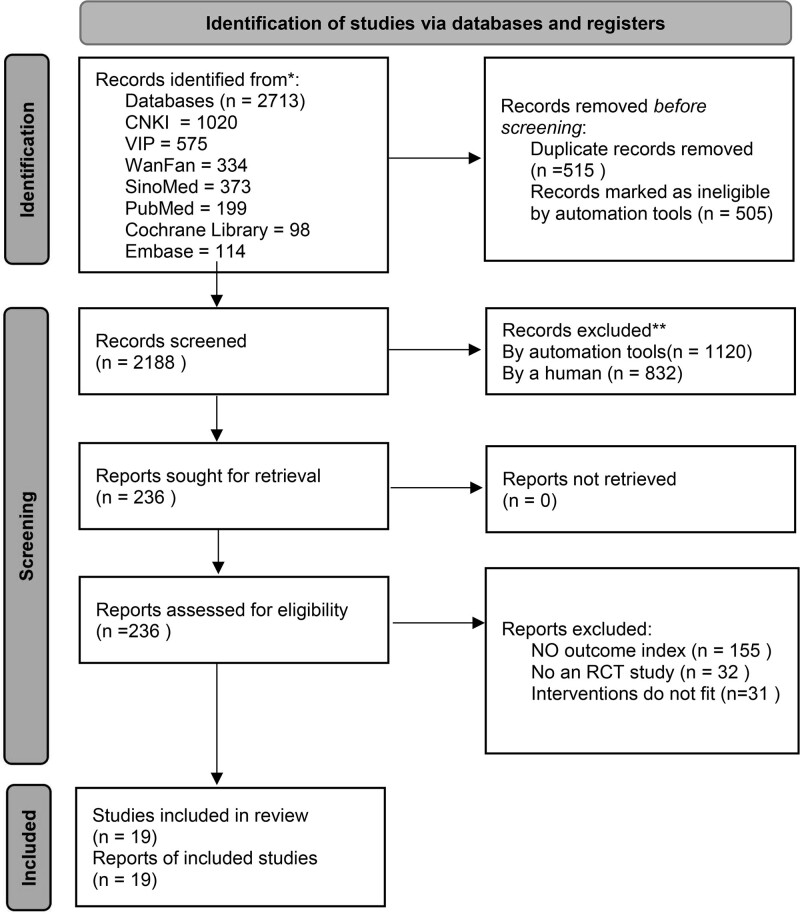
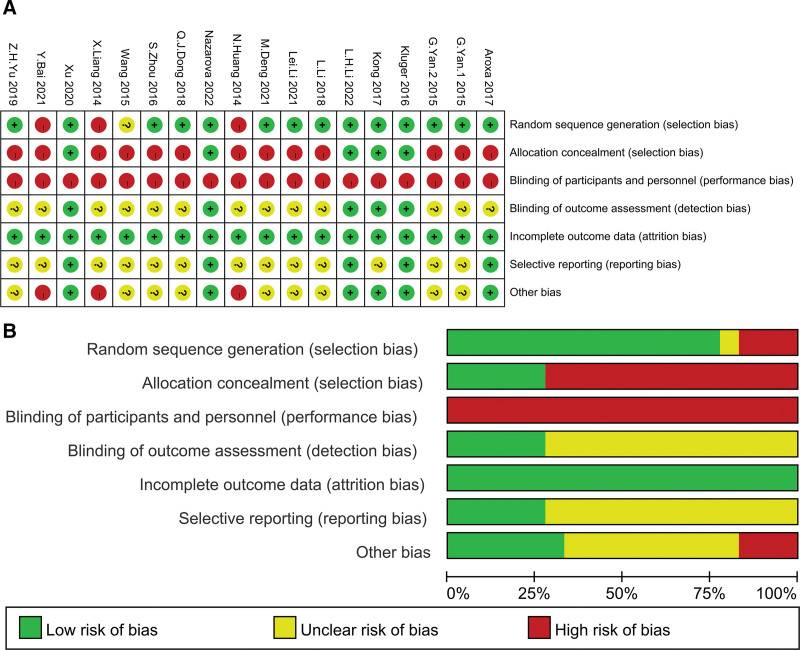
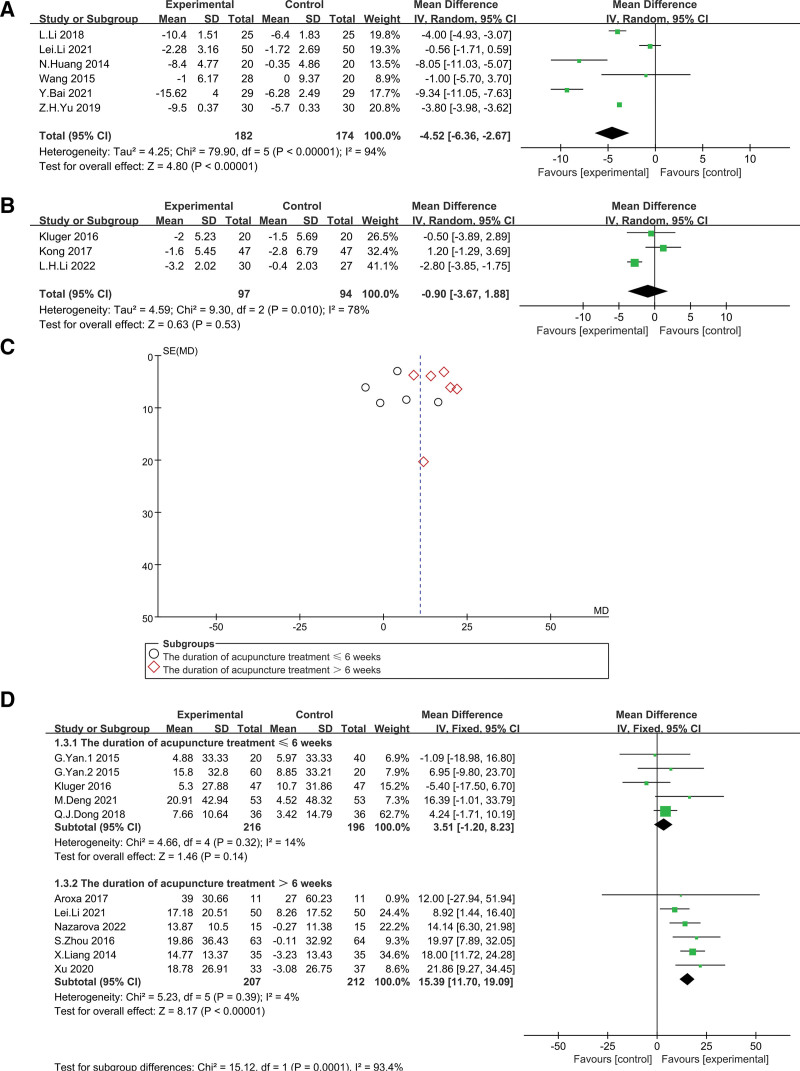
Background: Parkinson’s disease (PD) patients commonly suffer from sleep disorders, significantly impacting their quality of life. Western treatments often entail adverse effects, while acupuncture (ACU) presents a safe, nonaddictive alternative. Methods: A thorough literature search was performed across PubMed, Cochrane Library, and Embase databases. Eligible studies underwent statistical analysis via RevMan 5.4 software. Results: This study synthesized data from 19 randomized controlled trials involving 1300 patients. The ACU cohort showed notable improvement in Parkinson’s disease sleep scale (PDSS) scores (mean difference [MD] = 10.81, 95% confidence interval [CI]: 5.64, 15.98) relative to controls. Subgroup analysis revealed significance for ACU treatments beyond 6 weeks (MD = 15.39, 95% CI: 11.70, 19.09) but not for those 6 weeks or shorter (MD = 3.51, 95% CI: −1.20, 8.23). Notably, electroacupuncture resulted in significant PDSS score enhancements (MD = 12.39, 95% CI: 6.06, 18.71), with sensitivity analysis verifying result stability. However, without electroacupuncture, PDSS score differences were insignificant (MD = 7.83, 95% CI: −2.33, 17.99) and had lower result stability. Additionally, increased ACU session frequency may yield better improvements in PDSS scores. The ACU group also observed Improved Pittsburgh Sleep Quality Index scores (MD = −4.52, 95% CI: −6.36, −2.67). However, no significant variation was identified in Epworth Sleepiness Scale score improvement between groups (MD = −0.90, 95% CI: −3.67, 1.88). Conclusion: ACU therapy effectively improves nighttime sleep quality in PD patients. A treatment duration extending beyond 6 weeks is highly recommended. Additionally, increasing the frequency of ACU sessions and incorporating electroacupuncture in the treatment regimen may be essential for optimal results.
Overview
The claims and statistics of this paper haven’t been checked yet.
Free: it reads the open-access text and checks the first 5 claims that cite a source we can check. Create a free account to check every claim.
Integrity signals
Registry
Cites
Statistics
Figures
Verification
Claims the paper makes
The claims and statistics of this paper haven’t been checked yet.
Free: it reads the open-access text and checks the first 5 claims that cite a source we can check. Create a free account to check every claim.
Claims other papers make about this one
Each is checked against this paper’s own text: does it say what the citing paper says it does?
The source backs part of the claim, not all of it — or backs it for a different population, condition or comparison.
In the citing paper
“According to different studies, acupuncture can be considered a safe and beneficial complementary approach in treating stroke [66], Parkinson’s disease, and various neurological disorders [65], [66], [67].”
From Analysis of patellar reflex in Parkinson disease patients after an acupuncture treatment protocol – Case series study (2025) · cites this paper as [66]
Experimental — accuracy not yet measured
Self-check
Percentages, sums and reported differences re-computed from the paper’s own numbers.
The self-check needs the paper’s full text.
Citations
Cites
1 retracted
Li, L., Jin, X., Cong, W., Du, T., & Zhang, W. (2022) · BioMed Research International · doi:10.1155/2022/7403627 · Cited by 14 · cited 3×
“Out of the 19 trials included, L.H. Li [14] utilized the PDSS-2 for descriptive analysis.”
BackgroundMethodRetractedTest–retest reliability and validity of the Pittsburgh Sleep Quality Index in primary insomnia
Backhaus, J., Junghanns, K., Broocks, A., Riemann, D., & Hohagen, F. (2002) · Journal of Psychosomatic Research · doi:10.1016/s0022-3999(02)00330-6 · Cited by 1,756 · cited 1×
“[40] Although certain PSQI items resemble those of the PDSS, such as vivid dreams, pain, and frequency of nocturia, the scoring methods diverge.”
BackgroundChaudhuri, K. R. (2002) · Journal of Neurology, Neurosurgery & Psychiatry · doi:10.1136/jnnp.73.6.629 · Cited by 676 · cited 1×
“[9] The ESS is an eight-item self-report measure wherein respondents rate their sleepiness on a scale of 0 (no sleepiness) to 3 (high degree of sleepiness) for each item.”
BackgroundAccuracy of clinical diagnosis of idiopathic Parkinson's disease.
Rajput, R. P. S. (1993) · Journal of Neurology Neurosurgery & Psychiatry · doi:10.1136/jnnp.56.8.938 · Cited by 145 · cited 1×
“[8] No restrictions were imposed regarding gender, age, ethnicity, or disease stage; 3.”
BackgroundEffects of Sleep Disorders on the Non-Motor Symptoms of Parkinson Disease
Neikrug, A. B., Maglione, J. E., Liu, L., Natarajan, L., Avanzino, J. A., Corey‐Bloom, J., Palmer, B. W., Loredo, J. S., & Ancoli‐Israel, S. (2013) · Journal of Clinical Sleep Medicine · doi:10.5664/jcsm.3148 · Cited by 131 · cited 1×
“[2] The quality of nighttime sleep directly influences motor symptoms, attention, and over-all functioning.”
BackgroundAcupuncture for the Treatment of Insomnia
Zhao, K. (2013) · International review of neurobiology · doi:10.1016/b978-0-12-411545-3.00011-0 · Cited by 106 · cited 1×
“[6,7] The benefits of ACU for sleep disorders in PD patients are evident as it poses no adverse events and addiction risks.”
BackgroundThe Impact of Sleep Quality on Cognitive Functioning in Parkinson's Disease
Stavitsky, K., Neargarder, S., Bogdanova, Y., McNamara, P., & Cronin-Golomb, A. (2012) · Journal of the International Neuropsychological Society · doi:10.1017/s1355617711001482 · Cited by 89
Randomized, Controlled Trial of Acupuncture for Fatigue in Parkinson's Disease
Kluger, B. M., Rakowski, D., Christian, M., Cedar, D., Wong, B., Crawford, J., Uveges, K., Berk, J., Abaca, E., Corbin, L., et al. (2016) · Movement Disorders · doi:10.1002/mds.26597 · Cited by 85 · cited 3×
“Nonetheless, upon a comprehensive review of all included studies in our meta-analysis, it was found that the heterogeneity caused by Kluger study [12] cannot be explained by the PICOS principle (participants, intervention, comparison, outcome, and study design).”
BackgroundResultZhao, F.-Y., Fu, Q.-Q., Kennedy, G. A., Conduit, R., Zhang, W., Wu, W., & Zheng, Z. (2021) · Sleep Medicine · doi:10.1016/j.sleep.2021.01.053 · Cited by 83 · cited 2×
“Previous studies on non-PD insom-niacs have confirmed that ACU can effectively improve PSQI scores, [32,41] aligning with our research results.”
BackgroundResultWang, F., Sun, L. Z., Zhang, X.-Z., Jia, J., Liu, Z., Huang, X., Yu, S., Zuo, L.-J., Cao, C.-J., Wang, X., et al. (2015) · Evidence-based Complementary and Alternative Medicine · doi:10.1155/2015/692795 · Cited by 54
Research works printed but not linked: 20
- 1. Zhang H, Jiang L. Research status of non-motor symptoms in Parkinson’s disease. Chin J Pract Neurol Dis. 2021;24:72–6.
- 6. Wei K, Wang H, Wang Z. Research progress on the mechanism of acupuncture in treating insomnia. Liaoning J Tradit Chin Med. 2021;48:218–20.
- 16. Deng M. Effects of dingzuo anshen prescription combined with acupuncture on cognitive function and neurotransmitter level of Parkinson’s disease. Chin Foreign Med Res. 2021;19:128–31.
- 17. Bai Y, Wang M. Clinical observation of 56 patients with Parkinson’s disease and insomnia treated by acupuncture. Chin Tradit Med Sci Technol. 2021;28:506–7.
- 18. Li L, Tian Z, Zhang X. Clinical study of electroacupuncture combined with medoba in the treatment of sleep disorders in Parkinson’s disease. New J Tradit Chin Med. 2021;53:113–6.
- 19. Zhu Y, Ling W. Clinical observation on the treatment of Insomnia with deficiency of heart and spleen in Parkinson disease by guipi decoction combined with acupuncture. Guangming Tradit Chin Med. 2020;35:3253–5.
- 20. Dong Q, Li X, Tang M, et al. A randomized controlled study of scalp electroacupuncture in the treatment of sleep disorders in Parkinson’s disease. Pract J Clin Med. 2018;15:214–6.
- 21. Li L. Clinical observation of guipi decoction combined with acupuncture and moxibustion in treatment of Parkinson’s insomnia. Guangming J Chin Med. 2018;33:2043–4.
- 22. Zhou C, Pang W, Wu L. Clinical efficacy and safety analysis of acupuncture combined with medoba in the treatment of Parkinson’s disease. China Med Pharm. 2016;6:11–3 + 8.
- 23. Yan G, Cui Q, Kong M. Clinical study of hyperbaric oxygen, acupuncture and moxibustion combined with low dose medopa to improve the quality of life of patients with Parkinson’s disease. Chin J Navigation Medi Hyperbaric Med. 2015;22:187–91.
- 24. Liang X, Chen F. A randomized controlled study on the intervention of quality of life in patients with Parkinson’s disease by acupuncture at seven cranial base points. Int J Tradit Chin Med. 2014;36:613–6.
- 25. Huang N, Huang L, An J. Clinical effect of Fang’s head needle on insomnia of Parkinson’s disease. Shaanxi J Tradit Chin Med. 2014;35:348–9.
- 26. Chen H. Clinical observation on the treatment of Insomnia with deficiency of heart and spleen in PARKINSON disease by guipi decoction combined with acupuncture. Word Lasted Med Inform. 2021;21:469–70.
- 28. Yu Z. Clinical observation of Rehmannia Yinzi combined with acupuncture treatment of Parkinson’s disease. Chin Med Guide. 2019;17:7–8.
- 34. Gong J, Li W, Xiong X, et al. Observation and analysis of time effect and dose effect of acupuncture in the treatment of chronic insomnia. Chin Community Doct. 2020;36:78–9.
- 37. Xue X, Yue Z, Xiao S, et al. Observation of therapeutic effect of different courses of acupuncture on primary dysmenorrhea. Shanghai J Acupuncture. 2013;32:738–9.
- 38. He E, Chen Y, Tian H, et al. Therapeutic effect of electroacupuncture on female stress urinary incontinence in different acupuncture courses. Chin Acupuncture Moxibustion. 2016;36:351–4.
- 39. Gao L, Kong D, Wang S, et al. Mesh meta-analysis of external treatment of traditional Chinese medicine to improve sleep quality of insomnia. World Tradit Chin Med. 2022;17:2753–8.
- 44. Zeng H. Effects of zhitanshen decoction on the levels of family neurotrophic factor-3, interleukin-1 β and sleep quality in patients with Parkinson’s sleep disorder. Liaoning J Tradit Chin Med. 2020;47:4.
- 45. Wang L, Huang M, Fu R. Correlation between serum CysC, Hcy levels and sleep disorders in early Parkinson’s disease patients. Chin J Gerontol. 2020;40:571–4.
Cited by
Yu, P.-H., Wang, G.-Q., Tan, S., Zhan, M., Zheng, Y.-W., Zhou, W. Z., Li, H., & Ma, J. (2025) · Neurological Sciences · doi:10.1007/s10072-025-08333-1 · Cited by 8
“Moreover, current research has largely focused on improvements in motor function, with less emphasis on non-motor symptoms and broader clinical outcomes that impact patient quality of life [14, 15, 17–19].”
Li, X., Chen, P., Wang, S., Wang, C., Ли, Б., & Liu, H. (2025) · Neuropsychiatric Disease and Treatment · doi:10.2147/ndt.s541627 · Cited by 3
“110 Our results found that scalp_electroacupuncture was significantly effective in enhancing PDSS scores.”
An overview of systematic reviews of acupuncture for Parkinson’s disease
Xue, H., He, H., Wu, D., Fan, W.-H., & Li, Y. (2024) · Frontiers in Neuroscience · doi:10.3389/fnins.2024.1415008 · Cited by 2
“…24 SRs were rated as having a low risk of bias (Hsu et al., 2023; Lee and Lim, 2017; Lei et al., 2023; Li et al., 2022; Lin et al., 2024; Noh et al., 2017; Ou and Xu, 2017; Tan et al., 2023; Wen et al., 2021; Wu et al., 2023; Yan et al., 2024; Yang et al., 2010; Zhang et al., 2024; Zhou al., 2020).”
BackgroundInfluentialPereira, C. R., Machado, J., Criado, B., Santos, R., Reis, A. M., Ramos, B., Santos, M. J., & Greten, H. J. (2025) · Clinical Parkinsonism & Related Disorders · doi:10.1016/j.prdoa.2025.100324 · Cited by 1
“According to different studies, acupuncture can be considered a safe and beneficial complementary approach in treating stroke [66], Parkinson ’ s disease, and various neurological disorders [65 – 69].”
Gu, Y., Liang, Y., Han, H., Yin, H., & Zheng, Z. (2025) · Frontiers in Neurology · doi:10.3389/fneur.2025.1697481 · Cited by 1
Metadata
- Authors
- Yan, F., Chen, C., Feng, Q., Huang, Z., Chen, Y., & Chen, H.
- Affiliations
- Department of Acupuncture, Chongqing Jiangbei Hospital of Traditional Chinese Medicine, Chongqing, China
- Heilongjiang University of Chinese Medicine (CN)
- Chongqing Zhongxian Hospital of Traditional Chinese Medicine Hospital Office, Chongqing, China.
- Corresponding author
- Chen, Huan
- Venue
- Medicine
- Published
- 2024-01-05
- Volume
- 103
- Issue
- 1
- Pages
- e36286
- ISSN
- 0025-7974 (ISSN-L)
- 1536-5964
- PMC
- PMC10766232
- OpenAlex
- W4390645933
- Cited by
- 7
- References
- 21
- Citations by year
- 2025: 5 · 2024: 2
- FWCI
- 0.72
- Type
- journal article
- Language
- en
- Open access
- gold
- doi.org
- Licence
- Locations
- Medicine (publishedVersion, cc-by-nc)
- PubMed Central (publishedVersion, cc-by-nc)
- PubMed (publishedVersion)
- Topics
- Health Sciences › Medicine › Complementary and alternative medicine › Acupuncture Treatment Research Studies
- Social Sciences › Psychology › Experimental and Cognitive Psychology › Sleep and related disorders
- Health Sciences › Medicine › Complementary and alternative medicine › Traditional Chinese Medicine Studies
- Keywords
- acupuncture, Parkinson's disease, sleep disorders, electroacupuncture, sleep quality, Parkinson's Disease Sleep Scale, Pittsburgh Sleep Quality Index, Epworth Sleepiness Scale, treatment duration, session frequency
- MeSH terms
- Humans, Parkinson Disease, Quality of Life, Sleep Wake Disorders, Acupuncture Therapy, Electroacupuncture, Randomized Controlled Trials as Topic
About these checks
Registry, retraction, Cites and statistics results are computed, not judged, with one exception: a printed reference that no index lists is read once by a model before it counts as a citation error. Claims are extracted by a model and kept only when their quote appears verbatim in the text; each cited source is then checked, with a model’s help, for whether it says what the claim relies on. Those verdicts can be wrong — read the claim’s quote and the cited source before relying on one.
Statistics and arithmetic are recomputed, not judged.
Confidence bands are shown only for fields calibrated on our annotated test set. None is calibrated yet, so no band is shown.
What counts as a claim ›How we measure confidence ›How we check this ›
Are you an author, or do you see a problem with this page? Request a review
How to cite
Cite CoChat for the checks on this page, and the paper for its own findings.
- This page
- CoChat. (2026). Citation check: Acupuncture and sleep disorders in Parkinson’s disease: A systematic evaluation with meta-analysis. https://app.cochat.ai/papers/10.1097/md.0000000000036286
- The paper
- Yan, F., Chen, C., Feng, Q., Huang, Z., Chen, Y., & Chen, H. (2024). Acupuncture and sleep disorders in Parkinson’s disease: A systematic evaluation with meta-analysis. Medicine. https://doi.org/10.1097/md.0000000000036286
Data sources
Bibliographic data: Semantic Scholar, OpenAlex, Crossref.
Contains information from the Semantic Scholar Academic Graph Datasets, made available under the ODC Attribution License (ODC-BY 1.0).
Semantic Scholar’s data is described in: Kinney, R., et al. (2023). The Semantic Scholar Open Data Platform. arXiv:2301.10140.
