

Setmelanotide: a promising advancement for pediatric patients with rare forms of genetic obesity
Open accessThe DOI matches its Crossref record; 23 of the 23 references it cites were found in a registry or an index.
Abstract
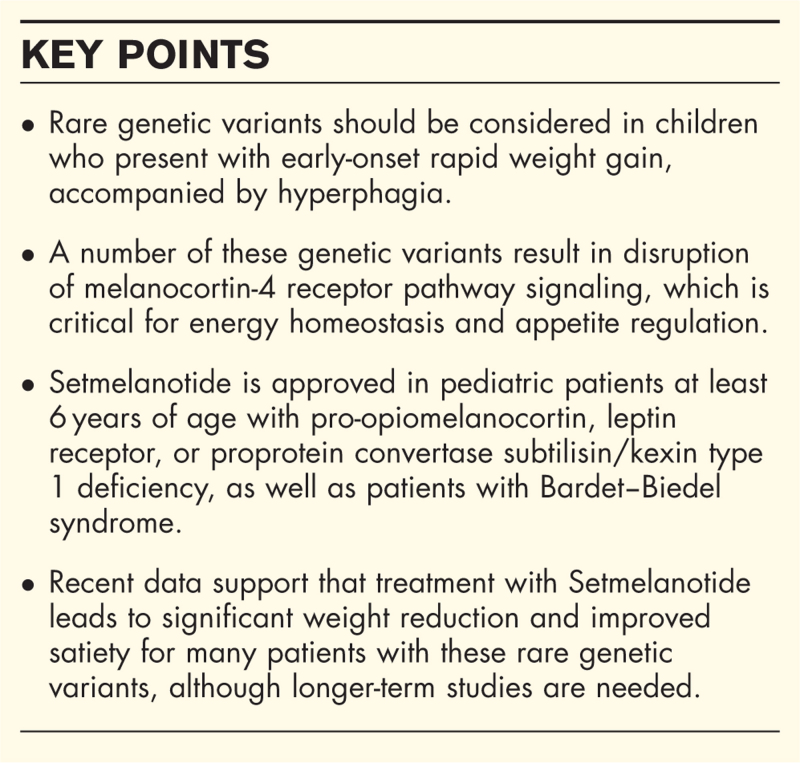
Purpose of review: Examine Setmelanotide use in patients with rare genetic variants that disrupt the melanocortin pathway. Recent findings: Between February 2017 and September 2018, 10 participants with pro-opiomelanocortin (POMC)/ proprotein convertase subtilisin/kexin type 1 (PCSK1) deficiency and 11 participants with leptin receptor (LEPR) deficiency were enrolled in open-label, phase 3 trials at 10 centers in the United States and internationally to assess the efficacy and safety of the melanocortin-4 receptor (MC4R) agonist Setmelanotide. 80% of POMC participants and 45% of LEPR participants achieved at least 10% weight loss at 1 year. Significant changes in hunger scores were seen for both cohorts as well. Setmelanotide was well tolerated with injection site reactions and hyperpigmentation being the most common adverse events reported. As a result, Setmelanotide was approved by the U.S. FDA in 2020 for chronic weight management in adult and pediatric patients ≥6 years of age with POMC, LEPR, or PCSK1 deficiency. In 2022, its approval was extended to include patients with Bardet–Biedel syndrome (BBS) after phase 3 trial data showed that, on average, Setmelanotide treatment resulted in a BMI loss of 7.9% for the 44 BBS participants. Summary: Rare genetic variants such as POMC, LEPR, and PCSK1 deficiency disrupt MC4R pathway signaling, resulting in severe early-onset obesity, hyperphagia, and increased risk for metabolic co-morbidities. Patients with BBS also demonstrate severe early-onset obesity and hyperphagia, due in part to defective MC4R signaling. Setmelanotide has shown promising benefits in improving satiety scores and weight-related outcomes in patients with these early-life genetic obesity conditions, although longer-term studies are needed.
Overview
The claims and statistics of this paper haven’t been checked yet.
Free: it reads the open-access text and checks the first 5 claims that cite a source we can check. Create a free account to check every claim.
Integrity signals
Registry
Cites
Statistics
Figures
Verification
Claims the paper makes
The claims and statistics of this paper haven’t been checked yet.
Free: it reads the open-access text and checks the first 5 claims that cite a source we can check. Create a free account to check every claim.
Claims other papers make about this one
Each is checked against this paper’s own text: does it say what the citing paper says it does?
The source backs part of the claim, not all of it — or backs it for a different population, condition or comparison.
In the citing paper
“Targeted hormone replacement therapy with the melanocortin-4 receptor agonist, setmelanotide, has been shown to be very effective in children with monogenetic obesity such as Bardet-Biedl syndrome (123).”
From Management of Acquired Hypothalamic Dysfunction and the Hypothalamic Syndrome; It Is More Than Obesity (2025) · cites this paper as [123]
Experimental — accuracy not yet measuredThe cited source says what the claim attributes to it.
In the citing paper
“Direct activation of the hypothalamic melanocortin-4 (MC4) satiety signalling pathway with the MC4R agonist setmelanotide has produced marked weight loss during small clinical studies of severely obese individuals with pro-opiomelanocortin (POMC) deficiency and other rare congenital conditions that disrupt the MC4 signalling pathway [47].”
From Recent advances in peptide-based therapies for obesity and type 2 diabetes (2024) · cites this paper as [47]
The cited source says what the claim attributes to it.
In the citing paper
“Direct activation of the melanocortin-4 receptor in the hypothalamus with melanocortin-4 receptor agonist setmelanotide resulted in significant weight loss in small clinical studies conducted in severely obese individuals with pro-opiomelanocortin deficiency or other rare congenital conditions affecting the melanocortin-4 signaling pathway [123].”
From New Developments in Pharmacological Treatment of Obesity and Type 2 Diabetes—Beyond and within GLP-1 Receptor Agonists (2024) · cites this paper as [123]
Self-check
Percentages, sums and reported differences re-computed from the paper’s own numbers.
The self-check needs the paper’s full text.
Citations
Cites
Targeted disruption of the melanocortin-4 receptor results in obesity in mice
Huszar, D., Lynch, C. A., Fairchild-Huntress, V., Dunmore, J. H., Fang, Q., Berkemeier, L. R., Gu, W., Kesterson, R. A., Boston, B. A., Cone, R. D., et al. (1997) · Cell · doi:10.1016/s0092-8674(00)81865-6 · Cited by 3,030 · cited 1×
“co-morbidities such as type 2 diabetes, dyslipidemia, and cardiovascular disease [5,6].”
BackgroundJackson, R. S., Creemers, J. W. M., Ohagi, S., Raffin-Sanson, M.-L., Sanders, L., Montague, C. T., Hutton, J. C., & O'Rahilly, S. (1997) · Nature Genetics · doi:10.1038/ng0797-303 · Cited by 1,153
Clément, K., van den Akker, E., Argente, J., Bahm, A., Chung, W. K., Connors, H., De Waele, K., Farooqi, I. S., Gonneau-Lejeune, J., Gordon, G., et al. (2020) · The Lancet Diabetes & Endocrinology · doi:10.1016/s2213-8587(20)30364-8 · Cited by 492
Evaluation of a melanocortin-4 receptor (MC4R) agonist (Setmelanotide) in MC4R deficiency
Collet, T.-H., Dubern, B., Mokrosinski, J., Connors, H., Keogh, J. M., Mendes de Oliveira, E., Henning, E., Poitou-Bernert, C., Oppert, J.-M., Tounian, P., et al. (2017) · Molecular Metabolism · doi:10.1016/j.molmet.2017.06.015 · Cited by 302 · cited 1×
“[16] examined the use of Setmelanotide in individuals with MC4R deficiency in a 28-day randomized, double blind placebo-controlled phase 1b clinical trial.”
MethodRare Genetic Forms of Obesity: Clinical Approach and Current Treatments in 2016
Huvenne, H., Dubern, B., Clément, K., & Poitou, C. (2016) · Obesity Facts · doi:10.1159/000445061 · Cited by 279 · cited 1×
“Although obesity is a complex condition that is multifactorial in its origins, severe early-onset obesity may be due to rare genetic variants that result in disruption of the melanocortin pathway, which is critical for energy homeostasis and appetite regulation [4,5].”
BackgroundHu, K., & Staiano, A. E. (2022) · JAMA Pediatrics · doi:10.1001/jamapediatrics.2022.2052 · Cited by 266
The melanocortin pathway and energy homeostasis: From discovery to obesity therapy
Yeo, G. S. H., Chao, D. H. M., Siegert, A.-M., Koerperich, Z. M., Ericson, M. D., Simonds, S. E., Larson, C. M., Luquet, S., Clarke, I., Sharma, S., et al. (2021) · Molecular Metabolism · doi:10.1016/j.molmet.2021.101206 · Cited by 242 · cited 1×
“Published by Wolters Kluwe show clinical efficacy and/or had undesirable adverse effect profiles [7,8].”
BackgroundKievit, P., Halem, H., Marks, D. L., Dong, J. Z., Glavas, M. M., Sinnayah, P., Pranger, L., Cowley, M. A., Grove, K. L., & Culler, M. D. (2013) · Diabetes · doi:10.2337/db12-0598 · Cited by 231 · cited 1×
“Unlike earlier generation MC4R agonists, individuals taking Setmelanotide have not exhibited concerning elevations in heart rate or blood pressure that led to the termination of firstgeneration MC4R agonist development [14,15].”
BackgroundHaqq, A. M., Chung, W. K., Dollfus, H., Haws, R. M., Martos-Moreno, G. Á., Poitou, C., Yanovski, J. A., Mittleman, R. S., Yuan, G., Forsythe, E., et al. (2022) · The Lancet Diabetes & Endocrinology · doi:10.1016/s2213-8587(22)00277-7 · Cited by 206
Obesity genetics in mouse and human: back and forth, and back again
Yazdi, F. T., Clee, S. M., & Meyre, D. (2015) · PeerJ · doi:10.7717/peerj.856 · Cited by 196
Research works printed but not linked: 1
- Farooqi IS, O’Rahilly S. The Genetics of Obesity in Humans. [Updated 2017 Dec 23]. In: Feingold KR, Anawalt B, Boyce A, et al., editors. Endotext [Internet]. South Dartmouth (MA): MDText.com, Inc.; 2000. Available from: https://www.ncbi.nlm.nih.gov/books/NBK279064/UMFCXA
Cited by
A comprehensive spatio-cellular map of the human hypothalamus
Tadross, J. A., Steuernagel, L., Dowsett, G. K. C., Kentistou, K. A., Lundh, S., Porniece, M., Klemm, P., Rainbow, K., Hvid, H., Kania, K., et al. (2025) · Nature · doi:10.1038/s41586-024-08504-8 · Cited by 112
“In addition, we extracted the expression matrix for 121,405 nuclei (20,331 ± 55.9 [mean ± s.e.m.] counts detected and 5097 ± 7.1 genes per nucleus) from the hypothalamic regions of three separate donors from a publicly available whole-brain dataset 12 (Supplementary Tables 1 and 2).”
InfluentialBays, H. E., Fitch, A., Cuda, S., Gonsahn-Bollie, S., Rickey, E., Hablutzel, J., Coy, R., & Censani, M. (2023) · Obesity Pillars · doi:10.1016/j.obpill.2023.100065 · Cited by 105
Self-citationChildhood Obesity, Diabetes, and Cardiovascular Disease Risk
Salama, M., Balagopal, B., Fennoy, I., & Kumar, S. (2023) · The Journal of Clinical Endocrinology & Metabolism · doi:10.1210/clinem/dgad361 · Cited by 114
Sztanek, F., Tóth, L. I., Pető, A., Hernyák, M., Diószegi, Á., & Harangi, M. (2024) · Biomedicines · doi:10.3390/biomedicines12061320 · Cited by 47
“…in the hypothalamus with melanocortin-4 receptor agonist setmelanotide resulted in significant weight loss in small clinical studies conducted in severely obese individuals with pro-opiomelanocortin deficiency or other rare congenital conditions affecting the melanocortin-4 signaling pathway [123].”
BackgroundAcquired hypothalamic obesity: A clinical overview and update
Roth, C. L., & McCormack, S. E. (2024) · Diabetes, Obesity and Metabolism · doi:10.1111/dom.15530 · Cited by 42
Añazco, D., & Acosta, A. J. (2024) · International Journal of Obesity · doi:10.1038/s41366-024-01599-z · Cited by 43
“…has been the only MC4R agonist approved by the FDA for chronic weight management in adults and pediatric patients with monogenic or syndromic obesity due to Bardet Biedl Syndrome (BBS) or POMC, proprotein convertase subtilisin/kexin type 1 (PCSK1) or leptin receptor (LEPR) de fi ciency [85].”
360-Degree Perspectives on Obesity
Cuciureanu, M. D., Caratașu, C.-C., Gabrielian, L., Frăsinariu, O. E., Checheriță, L. E., Trandafir, L. M., Stanciu, G. D., Szilagyi, A., Pogonea, I., Bordeianu, G., et al. (2023) · Medicina · doi:10.3390/medicina59061119 · Cited by 37
Non-canonical G protein signaling
Nürnberg, B., Beer‐Hammer, S., Reisinger, E., & Leiss, V. (2024) · Pharmacology & Therapeutics · doi:10.1016/j.pharmthera.2024.108589 · Cited by 30
Recent advances in peptide-based therapies for obesity and type 2 diabetes
Bailey, C. J., Flatt, P. R., & Conlon, J. M. (2024) · Peptides · doi:10.1016/j.peptides.2024.171149 · Cited by 25
“…(MC4) satiety signalling pathway with the MC4R agonist setmelanotide has produced marked weight loss during small clinical studies of severely obese individuals with pro-opiomelanocortin (POMC) deficiency and other rare congenital conditions that disrupt the MC4 signalling pathway [47].”
BackgroundBouSaba, J., Vosoughi, K., Dilmaghani, S., Prokop, L. J., & Camilleri, M. (2023) · Pharmacogenomics · doi:10.2217/pgs-2022-0192 · Cited by 26
van Santen, H. M., & Müller, H. L. (2025) · Endocrine Reviews · doi:10.1210/endrev/bnaf025 · Cited by 21
The melanocortin‐4 receptor pathway and the emergence of precision medicine in obesity management
Fansa, S., & Acosta, A. J. (2024) · Diabetes Obesity and Metabolism · doi:10.1111/dom.15555 · Cited by 19
Jolin, J. R., Kwon, M.-S., Brock, E. M., CHEN, J., KOKAN, A., Murdock, R., & Stanford, F. C. (2024) · Milbank Quarterly · doi:10.1111/1468-0009.12693 · Cited by 20
Qamar, S., Mallik, R., & Makaronidis, J. (2024) · touchREVIEWS in Endocrinology · doi:10.17925/ee.2024.20.2.9 · Cited by 17
Cuda, S. E., Censani, M., O’Hara, V. M., Paisley, J., Kharofa, R. Y., Conroy, R., Sweeney, B. R., Fernández, C., Gillette, M. L. D., & Browne, N. T. (2024) · Obesity Pillars · doi:10.1016/j.obpill.2024.100113 · Cited by 13
“Research data remains limited for children younger than 12 years of age [51,55,56], therefore children 12 with obesity have only 1 medication FDA approved medication, Setmelanotide, for the indication of obesity [57], use of which is limited to specific rare genetic forms of obesity [53,57,58].”
Self-citationFinkelberg, I., Polichronidou, I. M., Hühne, T., Brensing, P., Karaterzi, S., Jaegers, J., Gäckler, A., Pape, L., & Cetiner, M. (2025) · Orphanet Journal of Rare Diseases · doi:10.1186/s13023-025-03835-9 · Cited by 11
“Setmelanotide acts on MC4Rs down-stream of the locus for the ciliopathy-related impaired melanocortin signaling seen in BBS [15].”
Melanocortin 4 receptor mutation in obesity
Sridhar, G. R., & Gumpeny, L. (2024) · World Journal of Experimental Medicine · doi:10.5493/wjem.v14.i4.99239 · Cited by 20
Updates on Rare Genetic Variants, Genetic Testing, and Gene Therapy in Individuals With Obesity
Zuccaro, M. V., LeDuc, C. A., & Thaker, V. (2024) · Current Obesity Reports · doi:10.1007/s13679-024-00567-y · Cited by 13
Human HYPOMAP: A comprehensive spatio-cellular map of the human hypothalamusPreprint
Tadross, J. A., Steuernagel, L., Dowsett, G. K. C., Kentistou, K. A., Lundh, S. H., Porniece, M., Klemm, P., Rainbow, K., Hvid, H., Kania, K., et al. (2023) · bioRxiv (Cold Spring Harbor Laboratory) · doi:10.1101/2023.09.15.557967 · Cited by 8
Updates on Anti-Obesity Medications in Children and Adolescents
Salama, M., Hassan, D., & Kumar, S. (2025) · Children · doi:10.3390/children12101390 · Cited by 12
The need to personalise approaches for the prevention and management of obesity
Flint, S. W., & Batterham, R. L. (2023) · EClinicalMedicine · doi:10.1016/j.eclinm.2023.101944 · Cited by 8
Clinician’s Guide for Pediatric Anti-obesity Medications
Dutton, W. P., Paddu, N. U., Braddock, A. S., & Sweeney, B. R. (2024) · Pediatric Clinics of North America · doi:10.1016/j.pcl.2024.07.006 · Cited by 5
Setmelanotide-mediated MC4R activation improves hypothalamic obesity via CaMKK2/AMPK pathways
Peng, J., Ou, Y., Zhou, M., Wang, X., Zhang, X., Long, H., Wu, G., Che, M., Li, K., Yang, L., et al. (2026) · Frontiers in Pharmacology · doi:10.3389/fphar.2025.1730786 · Cited by 5
“At present, a multicenter phase 3 study of MC4R neuron agonists has been carried out in clinical trials (Argente et al., 2025b; Trapp and Censani, 2023).”
MASLD In Children - A Distinct Phenotype?
Barbhuiya, P. A., & Pathak, M. P. (2026) · Current Obesity Reports · doi:10.1007/s13679-026-00698-4 · Cited by 4
Pediatric Pharmacology for the Primary Care Provider: Advances and Limitations
Thompson, E. J., Wood, C. T., & Hornik, C. P. V. (2024) · PEDIATRICS · doi:10.1542/peds.2023-064158 · Cited by 4
Prindle, C. R., Bennett, T. L., Rajewski, B. H., Kelley, K. J., Impastato, A. C., Potterfield, R., Marks, D. L., & Delev, J. Y. (2026) · Frontiers in Endocrinology · doi:10.3389/fendo.2026.1797586 · Cited by 3
Liu, H., Liu, Z., Wong, H.-X. K., Xu, N., Liu, Q., Li, Y., Liu, Y., Wong, H., Burt, M. E., Jossy, S. V., et al. (2024) · Endocrinology · doi:10.1210/endocr/bqae063 · Cited by 2
Patil, P. P., Rajagara, S., Dhamankar, S., Yalamgonde, M., & Thakare, P. (2023) · Journal of Pediatric Endocrinology and Diabetes · doi:10.25259/jped_5_2023 · Cited by 2
Obesity-Related Ciliopathies: Focus on Advances of Biomarkers
Zhang, Q., Huang, Y., Gao, S., Ding, Y., Zhang, H., Chang, G., & Wang, X. (2024) · International Journal of Molecular Sciences · doi:10.3390/ijms25158484 · Cited by 2
“In June 2022, the indication for setmelanotide was expanded to include patients with BBS [51].”
BackgroundManagement of Obesity-Related Genetic Disorders
Esbati, R., Yazdani, O., & SIMONETTI, J. S. (2024) · Endocrinology and Metabolism Clinics of North America · doi:10.1016/j.ecl.2024.11.001 · Cited by 2
Carbocyclic setmelanotide analogs maintain biochemical potency at melanocortin 4 receptors
Gary, S., Roy, A., & Bloom, S. H. (2024) · Journal of Peptide Science · doi:10.1002/psc.3656 · Cited by 1
Nonga, D., Chaves, E. A., Pandurangi, S., Hartjes, K. T., Chu, C., & Flores, A. (2025) · Current Treatment Options in Pediatrics · doi:10.1007/s40746-025-00356-2 · Cited by 1
“Side effects include hyperpigmentation, gastrointestinal symp - toms, depression, dizziness, fatigue, headache, insomnia, vertigo, and prolonged penile erections [71, 72].”
Pharmacotherapeutic options for the management of obesity in children
Aldhafiri, A. J. (2023) · Journal of advanced Biomedical and Pharmaceutical Sciences · doi:10.21608/jabps.2023.225432.1194 · Cited by 2
Saleev, N., Getselter, D., Bartman, J., Gutman, R., Marco, A., & Elliott, E. (2024) · bioRxiv (Cold Spring Harbor Laboratory) · doi:10.1101/2024.04.07.588459 · Cited by 1
Henry, B. A., Cowley, M. A., Andrews, Z. B., & Clarke, I. J. (2024) · Endocrinology · doi:10.1210/endocr/bqae156
“In humans, mutations in MC4R are the most common cause of genetic obesity (2, 4) and the use of setmelanotide, an MC4R agonist, is an effective pharmacotherapy for the treatment of monogenetic and syndromic obesity phenotypes (5, 6).”
Setmelanotide nel trattamento dell’obesità ipotalamica acquisita
Bondanelli, M., Ambrosio, M. R., & Zatelli, M. C. (2025) · L Endocrinologo · doi:10.1007/s40619-025-01629-6
“I pazienti studiati presentavano tuttavia varianti omozigoti o eterozigoti composte del deficit di POMC, PCSK1 o LEPR e, nonostante l’effetto di alcune varianti eterozigoti sull’o-besità resti ancora da definire, setmelanotide sembra essere una valida opzione per tali pazienti [6, 11–13].”
Head, K. C., & Giovanni, C. B. S. (2025) · Elsevier eBooks · doi:10.1016/b978-0-443-11760-2.00014-8
Intestinal Enteroendocrine Disorders in the Fetus and Neonate
Rubenstein, A., & León, D. D. D. (2025) · Elsevier eBooks · doi:10.1016/b978-0-443-23940-3.00028-4
Szelka, H., Czyżykowski, K., Gęsińska, A. M., Golis, B., Edyko, P., Babula, A., Golus, W., Andrzejewska, K., Przybyła, Z., & Woźniak, H. (2025) · International Journal of Innovative Technologies in Social Science · doi:10.31435/ijitss.4(48).2025.4323
Anti-obesity drugs: comprehensive review and emerging therapies
Marne, P., Patil, S. D., Vora, A., MohdSiddique, M. U., Gadkari, Y. U., & Kurkute, P. (2026) · Endocrine · doi:10.1007/s12020-025-04528-w · Cited by 1
“Setmelanotide primarily binds to and activates the MC4R in the lateral hypothalamic area and the para - ventricular nucleus of the hypothalamus, two regions impli - cated in appetite regulation [121].”
Current updates and anesthetic considerations for adolescent metabolic and bariatric surgery
Doyle, N. M., Weisberg, E. L., Glenski, T. A., & Taylor, C. M. (2026) · Seminars in Pediatric Surgery · doi:10.1016/j.sempedsurg.2026.151610
Metadata
- Authors
- Trapp, C. M., & Censani, M.
- Affiliations
- University of Connecticut (US)
- NewYork–Presbyterian Hospital (US)
- Corresponding author
- Censani, Marisa
- ORCID
- Censani, Marisa
- Venue
- Current Opinion in Endocrinology, Diabetes & Obesity
- Published
- 2023-02-01
- Volume
- 30
- Issue
- 2
- Pages
- 136-140
- ISSN
- 1752-296X (ISSN-L)
- 1752-2978
- PMC
- PMC9973437
- OpenAlex
- W4318754718
- Semantic Scholar
- 558fb8788b36b8b16eb10595b4d330d68e104a7b
- Cited by
- 41
- References
- 23
- Citations by year
- 2026: 5 · 2025: 9 · 2024: 19 · 2023: 8
- FWCI
- 6.10
- Type
- journal article
- Language
- en
- Open access
- hybrid
- doi.org
- Licence
- Locations
- Current Opinion in Endocrinology Diabetes and Obesity (publishedVersion, cc-by-nc-nd)
- PubMed Central (publishedVersion, cc-by-nc-nd)
- PubMed (publishedVersion)
- Topics
- Life Sciences › Neuroscience › Endocrine and Autonomic Systems › Regulation of Appetite and Obesity
- Health Sciences › Medicine › Pharmacology (medical) › Pharmacology and Obesity Treatment
- Health Sciences › Medicine › Surgery › Bariatric Surgery and Outcomes
- Keywords
- setmelanotide, melanocortin-4 receptor agonist, genetic obesity, leptin receptor deficiency, Bardet-Biedl syndrome, childhood obesity, weight loss, hyperphagia, satiety, melanocortin pathway, drug approval
- MeSH terms
- Adrenal Insufficiency, alpha-MSH, Child, Humans, Hyperphagia, Obesity, Pro-Opiomelanocortin, Clinical Trials, Phase III as Topic, Pediatric Obesity
About these checks
Registry, retraction, Cites and statistics results are computed, not judged, with one exception: a printed reference that no index lists is read once by a model before it counts as a citation error. Claims are extracted by a model and kept only when their quote appears verbatim in the text; each cited source is then checked, with a model’s help, for whether it says what the claim relies on. Those verdicts can be wrong — read the claim’s quote and the cited source before relying on one.
Statistics and arithmetic are recomputed, not judged.
Confidence bands are shown only for fields calibrated on our annotated test set. None is calibrated yet, so no band is shown.
What counts as a claim ›How we measure confidence ›How we check this ›
Are you an author, or do you see a problem with this page? Request a review
Data sources
Bibliographic data: Semantic Scholar, OpenAlex, Crossref.
Contains information from the Semantic Scholar Academic Graph Datasets, made available under the ODC Attribution License (ODC-BY 1.0).
Semantic Scholar’s data is described in: Kinney, R., et al. (2023). The Semantic Scholar Open Data Platform. arXiv:2301.10140.
