

Regulation of intestinal lipid and lipoprotein metabolism by the proglucagon-derived peptides glucagon like peptide 1 and glucagon like peptide 2
Open accessThe DOI matches its Crossref record; 89 of the 93 references it cites were found in a registry or an index.
Abstract
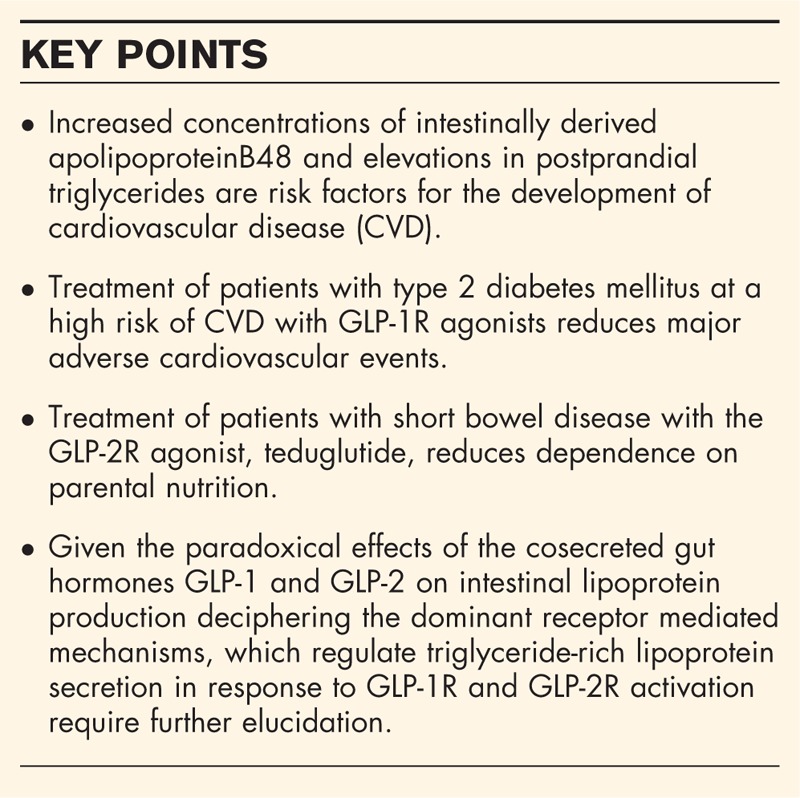
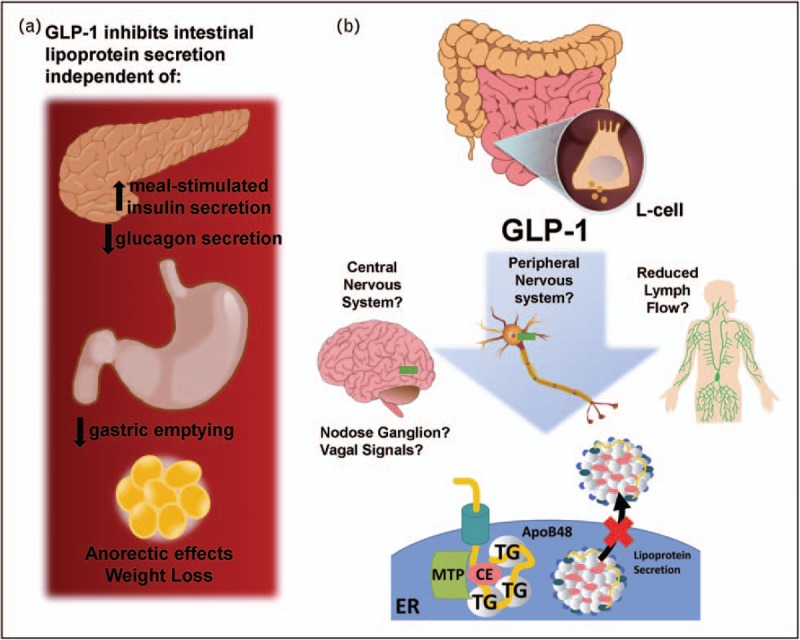
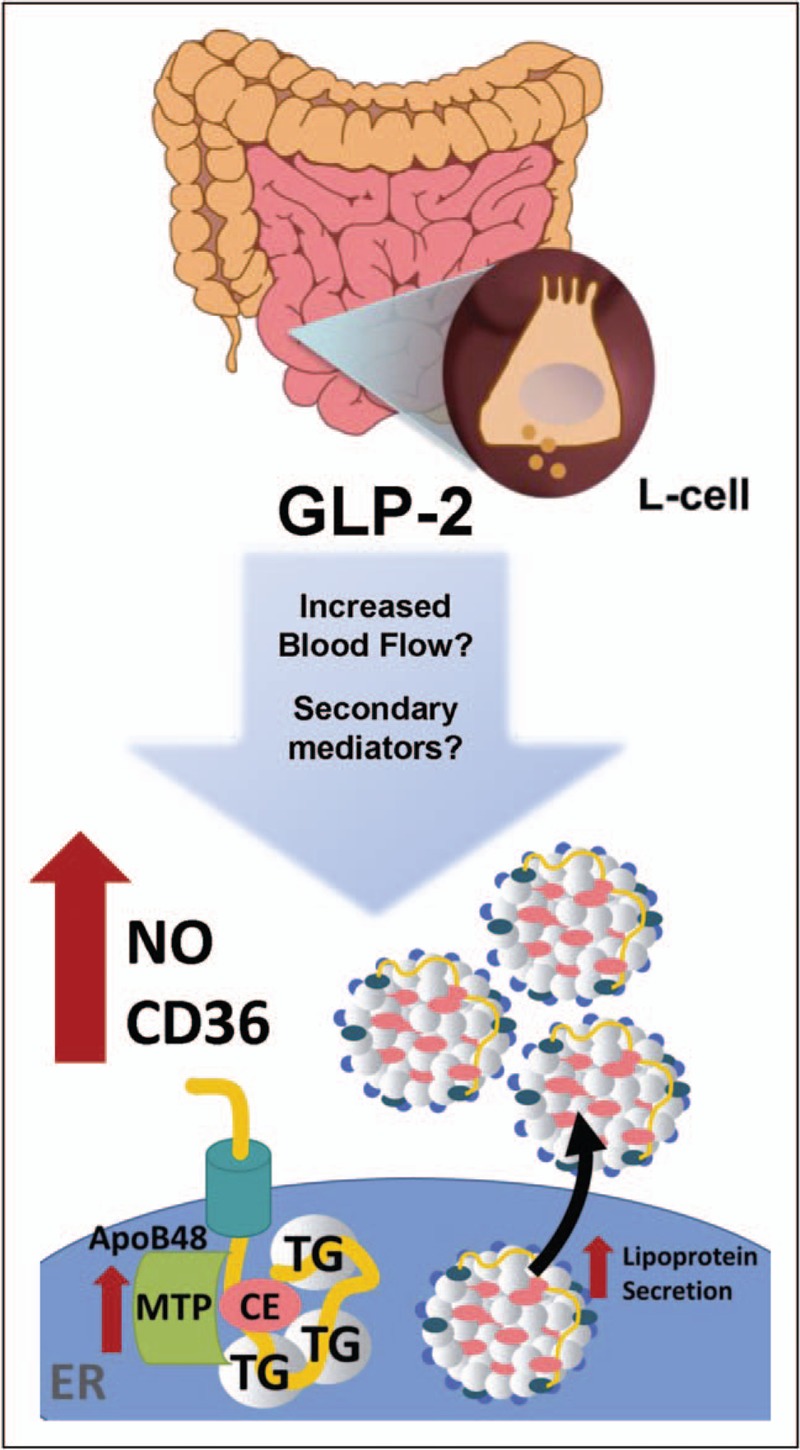
Purpose of review: The intestine is highly efficient at absorbing and packaging dietary lipids onto the structural protein apoB48 for distribution throughout the body. Here, we summarize recent advances into understanding the physiological and pharmacological actions of the proglucagon-derived peptides: glucagon like peptide 1 (GLP-1) and glucagon like peptide 2 (GLP-2) on intestinal lipoprotein secretion. Recent findings: Several recent studies have elucidated mechanisms underlying the paradoxical effects of GLP-1 and GLP-2 on intestinal production of triglyceride-rich lipoproteins (TRLs). Both gut-derived peptides are secreted on an equimolar basis in response to the same nutrient stimulus. Despite neither receptor demonstrating clear localization to enterocytes, a single injection of a GLP-1R agonist rapidly decreases delivery of intestinally packaged fatty acids into the plasma, while conversely GLP-2 receptor (GLP-2R) activation acutely increases TRL concentrations in plasma. Summary: The regulation of TRL secretion is dependent on the coordination of many processes: fatty acid availability uptake, assembly onto the apoB48 polypeptide backbone, secretion and reuptake, which the hormonal, neural, inflammatory and metabolic milieu can all strongly influence. Understanding of how GLP-1 and GLP-2 receptor agonists control TRL production has clinical importance given that GLP1R agonists were recently demonstrated not only to provide glycemic control but also to prevent major adverse cardiovascular events in patients with T2DM and the success of GLP-2R agonists in treating short bowel disease.
Overview
The claims and statistics of this paper haven’t been checked yet.
Free: it reads the open-access text and checks the first 5 claims that cite a source we can check. Create a free account to check every claim.
Integrity signals
Registry
Cites
Statistics
Figures
Verification
Claims the paper makes
The claims and statistics of this paper haven’t been checked yet.
Free: it reads the open-access text and checks the first 5 claims that cite a source we can check. Create a free account to check every claim.
Claims other papers make about this one
Each is checked against this paper’s own text: does it say what the citing paper says it does?
In the citing paper
“Increased numbers of small chylomicrons are secreted by individuals with insulin resistance.49,50”
Self-check
Percentages, sums and reported differences re-computed from the paper’s own numbers.
The self-check needs the paper’s full text.
Citations
Cites
Empagliflozin, Cardiovascular Outcomes, and Mortality in Type 2 Diabetes
Zinman, B., Wanner, C., Lachin, J. M., Fitchett, D., Bluhmki, E., Hantel, S., Mattheus, M., Devins, T., Johansen, O. E., Woerle, H. J., et al. (2015) · New England Journal of Medicine · doi:10.1056/nejmoa1504720 · Cited by 12,315
Turner, R. C., Fox, C., Matthews, McElroy, H. H., Cull, C. A., Holman, R. R., Neil, P., Hadden, D. R., Wright, D., Manley, E., et al. (1998) · The Lancet · Cited by 8,419
Liraglutide and Cardiovascular Outcomes in Type 2 Diabetes
Marso, S. P., Daniels, G. H., Brown-Frandsen, K., Kristensen, P., Mann, J. F. E., Nauck, M. A., Nissen, S. E., Pocock, S., Poulter, N. R., Ravn, L. S., et al. (2016) · New England Journal of Medicine · doi:10.1056/nejmoa1603827 · Cited by 7,629
Semaglutide and Cardiovascular Outcomes in Patients with Type 2 Diabetes
Marso, S. P., Bain, S. C., Consoli, A., Eliaschewitz, F. G., Jódar, E., Leiter, L. A., Lingvay, I., Rosenstock, J., Seufert, J., Warren, M. L., et al. (2016) · New England Journal of Medicine · doi:10.1056/nejmoa1607141 · Cited by 6,900
Nitric Oxide and Peroxynitrite in Health and Disease
Pacher, P., Beckman, J. S., & Liaudet, L. (2007) · Physiological Reviews · doi:10.1152/physrev.00029.2006 · Cited by 6,390
Ezetimibe Added to Statin Therapy after Acute Coronary Syndromes
Cannon, C. P., Blazing, M. A., Giugliano, R. P., McCagg, A., White, J. A., Theroux, P., Darius, H., Lewis, B. S., Ophuis, T. O., Jukema, J. W., et al. (2015) · New England Journal of Medicine · doi:10.1056/nejmoa1410489 · Cited by 4,487
Gupta, A., & Uribarri, J. (2016) · Hormone Research in Paediatrics · doi:10.1159/000444053 · Cited by 4,006
Cited by
Ginsberg, H. N., Packard, C. J., Chapman, M. J., Borén, J., Aguilar-Salinas, C. A., Averna, M., Ference, B. A., Gaudet, D., Hegele, R. A., Kersten, S., et al. (2021) · European Heart Journal · doi:10.1093/eurheartj/ehab551 · Cited by 979
“49,50 Intestinal lipid droplets appear to act as temporary lipid stores, modulating the release and size of chylomicrons following meals.”
BackgroundMolecular mechanisms by which GLP-1 RA and DPP-4i induce insulin sensitivity
Yaribeygi, H., Sathyapalan, T., & Sahebkar, A. (2019) · Life Sciences · doi:10.1016/j.lfs.2019.116776 · Cited by 102
Dyslipidemia Management in Adults With Diabetes
Lazarte, J., & Hegele, R. A. (2019) · Canadian Journal of Diabetes · doi:10.1016/j.jcjd.2019.07.003 · Cited by 99
D‐Peptide and D‐Protein Technology: Recent Advances, Challenges, and Opportunities**
Lander, A. J., Jin, Y., & Luk, L. Y. P. (2022) · ChemBioChem · doi:10.1002/cbic.202200537 · Cited by 91
Wang, W., Wang, J., Zhang, H., Wu, S., & Qi, G. (2020) · Frontiers in Microbiology · doi:10.3389/fmicb.2020.00600 · Cited by 79
Resveratrol Modulates the Gut-Brain Axis: Focus on Glucagon-Like Peptide-1, 5-HT, and Gut Microbiota
Chung, J. Y., Jeong, J., & Song, J. (2020) · Frontiers in Aging Neuroscience · doi:10.3389/fnagi.2020.588044 · Cited by 60
“It enhances impaired glucose and lipid metabolism and also inhibits inflammation (Liu et al., 2013; Shah et al., 2013; Mulvihill, 2018).”
BackgroundTriglyceride lowering by omega-3 fatty acids: a mechanism mediated by N-acyl taurines
Bornfeldt, K. E. (2021) · Journal of Clinical Investigation · doi:10.1172/jci147558 · Cited by 58
Enteroendocrine Regulation of Nutrient Absorption
McCauley, H. A. (2019) · Journal of Nutrition · doi:10.1093/jn/nxz191 · Cited by 50
Insights into incretin-based therapies for treatment of diabetic dyslipidemia
Stemmer, K., Finan, B., DiMarchi, R. D., Tschöp, M. H., & Müller, T. D. (2020) · Advanced Drug Delivery Reviews · doi:10.1016/j.addr.2020.05.008 · Cited by 43
“apeutics in the treatment of diabetic dyslipidemia [24,25].”
BackgroundRole of the Gut in Diabetic Dyslipidemia
Stahel, P., Xiao, C., Nahmias, A., & Lewis, G. F. (2020) · Frontiers in Endocrinology · doi:10.3389/fendo.2020.00116 · Cited by 37
“Enterocytes do not express receptors to either GLP-1 or GLP-2, therefore their modulation of CM secretion is through indirect mechanisms that remain to be fully elucidated (20).”
BackgroundMorrow, N. M., Trzaskalski, N. A., Hanson, A. A., Fadzeyeva, E., Telford, D. E., Chhoker, S. S., Sutherland, B. G., Edwards, J. Y., Huff, M. W., & Mulvihill, E. E. (2021) · Arteriosclerosis Thrombosis and Vascular Biology · doi:10.1161/atvbaha.121.316896 · Cited by 42
“GLP-2(3-33) did not affect body weight (Figure S2A and S2B).”
BackgroundMethodSelf-citationEffects of liraglutide on the metabolism of triglyceride-rich lipoproteins in type 2 diabetes
Taskinen, M., Björnson, E., Matikainen, N., Söderlund, S., Pietiläinen, K. H., Ainola, M., Hakkarainen, A., Lundbom, N., Fuchs, J., Thorsell, A., et al. (2021) · Diabetes, Obesity and Metabolism · doi:10.1111/dom.14328 · Cited by 40
Moon, S., Lee, J., Chung, H. S., Kim, Y. J., Yu, J. M., Yu, S. H., & Oh, C.-M. (2021) · Endocrinology and Metabolism · doi:10.3803/enm.2020.934 · Cited by 38
Lipid effects of glucagon-like peptide 1 receptor analogs
Berberich, A. J., & Hegele, R. A. (2021) · Current Opinion in Lipidology · doi:10.1097/mol.0000000000000750 · Cited by 32
Taskinen, M., Matikainen, N., Björnson, E., Söderlund, S., Inkeri, J., Hakkarainen, A., Parviainen, H., Sihlbom, C., Thorsell, A., Andersson, L. K., et al. (2023) · Diabetologia · doi:10.1007/s00125-023-06008-0 · Cited by 25
“Better understanding of the causes and consequences of dysregulation of TRL metabolism in the fasted and postprandial states, especially in individuals with type 2 diabetes, is essential in order to uncover the basis of residual risk [17, 29, 30] and how best to inter-vene [9, 17, 26, 31–35].”
BackgroundConformational Dynamics of Glucagon-like Peptide-2 with Different Electric Field
Su, J.-J., Sun, T., Wang, Y., & Shen, Y. (2022) · Polymers · doi:10.3390/polym14132722 · Cited by 17
“Many advantages of GLP-2 indicate that GLP-2 has a good clinical application prospect [9].”
BackgroundThe Association of Peptide Hormones with Glycemia, Dyslipidemia, and Obesity in Lebanese Individuals
Abou-Samra, M., Venema, K., Moubareck, C. A., & Karavetian, M. (2022) · Metabolites · doi:10.3390/metabo12111051 · Cited by 14
“It is known that GLP-1 and GLP-2 are co-secreted in response to the ingestion of the same nutrients [35].”
BackgroundKrysa, J. A., Ball, G. D. C., Vine, D. F., Jetha, M. M., & Proctor, S. D. (2020) · Pediatric Obesity · doi:10.1111/ijpo.12745 · Cited by 9
Morrow, N. M., Locatelli, C. A. A., Trzaskalski, N. A., Klein, C. T., Hanson, A. A., Al-Hadi, H., Tripathi, I., Clément, A. C., Imran, S., Lorenzen‐Schmidt, I., et al. (2022) · Biochimica et Biophysica Acta (BBA) - Molecular and Cell Biology of Lipids · doi:10.1016/j.bbalip.2022.159208 · Cited by 9
Self-citationLipid regulation of the glucagon receptor family
Oqua, A. I., Manchanda, Y., McGlone, E. R., Jones, B. J., Rouse, S. L., & Tomás, A. (2024) · Journal of Endocrinology · doi:10.1530/joe-23-0335 · Cited by 8
Zhang, Q., Liu, J., Li, S., Huang, Z. J., Pang, L., Guo, L., Yang, X., & Qu, B. (2025) · International Journal of Biological Macromolecules · doi:10.1016/j.ijbiomac.2025.149118 · Cited by 4
Molecular Mechanisms of Intestinal Adaptation in Short Bowel Syndrome: A Comprehensive Review
Radojević, D., Bezmarević, M., Pešić, M., Stojanović, B., Stankovic, M., Pavlović, M., Marković, N., Stanojević-Pirković, M., Živković, J., Anđelković, B., et al. (2026) · International Journal of Molecular Sciences · doi:10.3390/ijms27052105 · Cited by 4
“This reflects their shared biosynthetic pathway and co-secretion mechanism; however, circulating levels may differ due to different post-secretory fates of the two peptides [163,164].”
Role of endogenous incretins in the regulation of postprandial lipoprotein metabolism
Taskinen, M., Matikainen, N., Björnson, E., Söderlund, S., Ainola, M., Hakkarainen, A., Lundbom, N. M. I., Sihlbom, C., Thorsell, A., Andersson, L., et al. (2022) · European Journal of Endocrinology · doi:10.1530/eje-21-1187 · Cited by 4
“Clinical interest in the actions of incretins 68 arises from the observation that GLP-1 agonists in humans diminish postprandial TG responses 69 (although they have only modest effects on fasting TG levels) (3, 11, 13, 18-20).”
BackgroundHuang, Y., Lin, X., Deng, M., Tang, Y., Li, S., Xu, B., Zeng, W., Chen, Z., Hou, X., Lin, Z., et al. (2026) · EBioMedicine · doi:10.1016/j.ebiom.2026.106141 · Cited by 3
“35 GLP-1 analogues like liraglutide and exenatide improved lipid metabolism in several animal models and in human diseases.”
Winkler, G., Folyovich, A., Kis, J. T., Dancs, T., & Schandl, L. (2024) · Orvosi Hetilap · doi:10.1556/650.2024.33012 · Cited by 2
Incretins and the metabolic syndrome
Karásek, D. (2024) · Vnitřní lékařství · doi:10.36290/vnl.2024.020 · Cited by 1
Waris, N., Bano, S., Fawwad, A., & Basit, A. (2022) · International Journal of Diabetes in Developing Countries · doi:10.1007/s13410-021-01028-1
“Also, dipeptidyl peptidase 4 inhibitors that raise the endogenous bioactive levels of GLP-1 and GLP-1 receptor agonists that directly stimulate GLP-1 receptors have been assessed in both preclinical and clinical trials for their ability to modulate plasma lipid parameters [13].”
BackgroundInfluentialDual GIP and GLP-1 agonists and changes in the lipid spectrum
Karásek, D. (2024) · Vnitřní lékařství · doi:10.36290/vnl.2024.006
Hanson, A. A. (2022) · uO Research (University of Ottawa) · doi:10.20381/ruor-27367
Fauste, E., Pérez-Armas, M., Donis, C., Otero, P., Panadero, M. I., & Bocos, C. (2025) · Molecular Medicine · doi:10.1186/s10020-025-01402-3
“In addition, GLP2, which is also produced from proglucagon and whose high levels would be more in line with the greater lipid absorption and packaging found in the descendants of fructose-fed mothers consuming tagatose, was not affected by the different treatments (Mulvihill 2018).”
InfluentialGLP-1R/GIPR DUAL AGONISM REDUCES INTESTINAL LIPID SECRETION
Tabatabaeian, F. (2026) · HARVEST (University of Saskatchewan)
Lipska, D., Suvitaival, T., Kienle, S. M., von Scholten, B. J., Ripa, R. S., Zobel, E. H., Størling, J., Blond, M. B., Ahluwalia, T. S., Hansen, T. W., et al. (2026) · medRxiv · doi:10.64898/2026.07.22.26358565
Metadata
- Authors
- Mulvihill, E. E.
- Affiliations
- University of Ottawa (CA)
- Corresponding author
- Mulvihill, Erin E.
- ORCID
- Mulvihill, Erin E.
- Venue
- Current Opinion in Lipidology
- Published
- 2018-04
- Volume
- 29
- Issue
- 2
- Pages
- 95-103
- ISSN
- 0957-9672 (ISSN-L)
- 1473-6535
- PMC
- PMC5882252
- OpenAlex
- W2792260658
- Cited by
- 29
- References
- 93
- Citations by year
- 2026: 2 · 2025: 2 · 2024: 4 · 2023: 1 · 2022: 6 · 2021: 6 · 2020: 5 · 2019: 3
- FWCI
- 0.65
- Type
- journal article
- Language
- en
- Open access
- hybrid
- doi.org
- Licence
- Locations
- Current Opinion in Lipidology (publishedVersion, cc-by-nc-nd)
- Europe PMC (PubMed Central) (publishedVersion, cc-by-nc-nd)
- PubMed Central (publishedVersion, cc-by-nc-nd)
- PubMed (publishedVersion)
- Topics
- Health Sciences › Medicine › Cardiology and Cardiovascular Medicine › Lipid metabolism and disorders
- Health Sciences › Medicine › Endocrinology, Diabetes and Metabolism › Diabetes Treatment and Management
- Life Sciences › Biochemistry, Genetics and Molecular Biology › Biochemistry › Cholesterol and Lipid Metabolism
- Keywords
- glucagon-like peptide-1, glucagon-like peptide-2, proglucagon-derived peptides, intestinal lipid metabolism, lipoprotein secretion, triglyceride-rich lipoproteins, apoB-48, GLP-1 receptor agonists, short bowel syndrome, type 2 diabetes, fatty acid uptake, enterocytes
- MeSH terms
- Animals, Humans, Intestinal Mucosa, Lipoproteins, Glucagon-Like Peptide 1, Glucagon-Like Peptide 2
About these checks
Registry, retraction, Cites and statistics results are computed, not judged, with one exception: a printed reference that no index lists is read once by a model before it counts as a citation error. Claims are extracted by a model and kept only when their quote appears verbatim in the text; each cited source is then checked, with a model’s help, for whether it says what the claim relies on. Those verdicts can be wrong — read the claim’s quote and the cited source before relying on one.
Statistics and arithmetic are recomputed, not judged.
Confidence bands are shown only for fields calibrated on our annotated test set. None is calibrated yet, so no band is shown.
What counts as a claim ›How we measure confidence ›How we check this ›
Are you an author, or do you see a problem with this page? Request a review
Data sources
Bibliographic data: Semantic Scholar, OpenAlex, Crossref.
Contains information from the Semantic Scholar Academic Graph Datasets, made available under the ODC Attribution License (ODC-BY 1.0).
Semantic Scholar’s data is described in: Kinney, R., et al. (2023). The Semantic Scholar Open Data Platform. arXiv:2301.10140.
