

Intensive Multidisciplinary Treatment of Severe Somatoform Disorder: A Prospective Evaluation
Open accessThe DOI matches its Crossref record; 28 of the 28 references it cites were found in a registry or an index; none of the 13 sources its claims cite is checked for support yet.
Abstract
Chronic severe somatoform disorder (SFD) is resistant to treatment. In a prospective observational study, we evaluated an intensive multidisciplinary treatment focusing on body-related mentalization and acceptance. Patients included in the study were 183 (146 women, 37 men) of 311 eligible patients with chronic severe SFD, referred consecutively to a specialized tertiary care center between 2002 and 2009. Primary outcome measures were somatic symptoms (SCL-90) and health-related quality of life (EuroQol 5-Dimensional [EQ-5D]). These measures were assessed four times before treatment (on intake, twice during an observation period, at start of treatment) and four times after treatment (during follow-up for 2 years). Multilevel analysis was used to separate effects of time (maturation) and treatment. Results revealed significant improvements in SCL-90 somatic symptoms (d = 0.51), EQ-5D index (d = 0.27), and EQ visual analogue scale (d = 0.56). Significant reductions were also observed in SCL-90 anxiety, depression, and overall psychopathology as well as in medical consumption associated with psychiatric illness (Trimbos/iMTA Questionnaire for Costs Associated With Psychiatric Illness). Large interindividual differences were found in treatment outcome. The long-term improvement seen in many patients suggests that intensive multidisciplinary tertiary care treatment is a useful approach to chronic severe SFD. © 2015 Wolters Kluwer Health, Inc. All rights reserved.
Overview
CoChat Summary
TL;DR
In a prospective observational study of 183 patients with chronic severe somatoform disorder, intensive multidisciplinary tertiary care focusing on body-related mentalization and acceptance was associated with significant improvements in somatic symptoms and health-related quality of life. Improvements were maintained over 2-year follow-up, with large interindividual differences.
Key findings
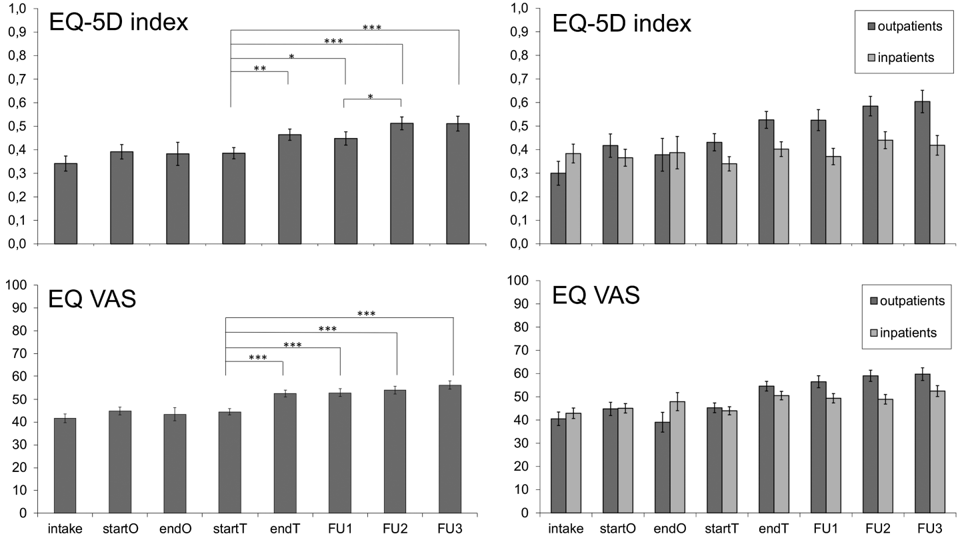
- Primary outcomes improved from pretreatment to posttreatment: SCL-90 somatization \(d = 0.51\), EQ-5D index \(d = 0.27\), and EQ VAS \(d = 0.56\); all mean posttreatment scores were significantly better than start-of-treatment values.
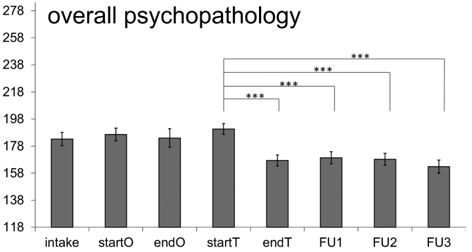
- Secondary outcomes also improved: SCL-90 anxiety \(d = -0.36\), depression \(d = -0.51\), and overall psychopathology \(d = -0.52\). Medical consumption decreased overall (median pretreatment 400 euro vs posttreatment 350 euro; Wilcoxon \(Z = -2.17\), \(p < 0.05\)), significant only for inpatients (median 650 to 400, \(p < 0.05\)) and not outpatients (median 300 to 275, \(p = 0.21\)).
- Large interindividual differences were found: random slopes significantly improved model fit; among patients dysfunctional at start, 28.0% improved more than 1 SD on somatization, 34.8% on EQ-5D index, and 46.8% on EQ VAS. Outpatients improved more on health-related quality of life than inpatients; no overall group difference was found for SCL-90.
Methods
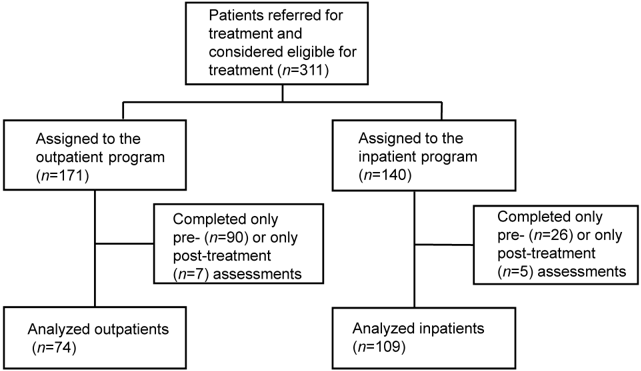
- Prospective observational interrupted time-series evaluation of 183 patients (146 women, 37 men) of 311 consecutively referred eligible patients with chronic severe SFD at a Dutch tertiary care center, 2002–2009; 74 received a 3-day/week outpatient program and 109 received a 5-day/week inpatient program lasting about 6 months.
- Treatment focused on body-related mentalization, acceptance/ACT, cognitive-behavioral modulation, and the family system, delivered through group and individual psychotherapy, psychosomatic physiotherapy, psychomotor therapy, art therapy, and related components. Assessments occurred eight times: four before treatment (intake, twice during observation, start of treatment) and four after (end of treatment, 6-month, 1-year, and 2-year follow-up).
- Primary outcomes were SCL-90 somatization and EQ-5D index/VAS; secondary outcomes were SCL-90 anxiety, depression, overall psychopathology, and TiC-P medical consumption. Linear mixed-model multilevel analyses separated assessment time/maturation from a pretreatment-to-posttreatment contrast; Cohen’s \(d\) effect sizes were computed, and Wilcoxon signed-rank tests were used for skewed TiC-P costs.
Limitations
- Stated: the observational study evaluated only one treatment without a comparison group; missing values and unbalanced data were present; some patients aborted treatment prematurely or did not complete sufficient questionnaires; medical costs were based on retrospective self-report (TiC-P), and future studies should use real health care costs; confounding by indication prevents strong conclusions on cost-effectiveness.
- Stated/evident: TiC-P scores were severely skewed and did not meet multilevel assumptions; two medical-consumption measurement occasions were excluded because no reliable estimates existed just after observation and just after treatment; posttreatment TiC-P observations were available for only 136 of 183 patients.
- Evident: there was no randomization and the inpatient/outpatient groups were nonequivalent, so group differences may reflect baseline severity or impairment rather than treatment setting.
Model-written summary. Check it against the paper before relying on it.
Integrity signals
Registry
Cites
Statistics
Figures
Verification
Claims the paper makes
0 Valid · 1 Not valid · 8 Not checked · 93 Own results and interpretations
A result the paper reports from its own data — it cites no other source for it, so there is none to check. The quote shows it is in the paper.
In the paper
“We did not find an overall difference between the inpatient and outpatient groups”
plain- Asserted: passes — The authors put it forward as true.
- Checkable: passes — It can be checked against evidence.
- Load-bearing: unclear — It is unclear whether the paper’s conclusions depend on it.
- Based: passes — The paper gives a reason why it holds.
A result the paper reports from its own data — it cites no other source for it, so there is none to check. The quote shows it is in the paper.
In the paper
“Interindividual differences in the effects of the treatment were clearly present.”
boosted- Asserted: passes — The authors put it forward as true.
- Checkable: passes — It can be checked against evidence.
- Load-bearing: passes — The paper’s conclusions depend on it.
- Based: passes — The paper gives a reason why it holds.
A result the paper states — it cites no source for it, so there is none to check. The quote shows it is in the paper.
In the paper
“However, the outpatient group improved most on health-related quality of life.”
plainstates an association- Asserted: passes — The authors put it forward as true.
- Checkable: passes — It can be checked against evidence.
- Load-bearing: passes — The paper’s conclusions depend on it.
- Based: passes — The paper gives a reason why it holds.
A result the paper reports from its own data — it cites no other source for it, so there is none to check. The quote shows it is in the paper.
In the paper
“The models including only a fixed effect of the treatment contrast explained relatively little (8.7% -13.4%) variance on the time level (see Table 3, % I).”
plainstates an association- Asserted: passes — The authors put it forward as true.
- Checkable: passes — It can be checked against evidence.
- Load-bearing: unclear — It is unclear whether the paper’s conclusions depend on it.
- Based: passes — The paper gives a reason why it holds.
A result the paper states — it cites no source for it, so there is none to check. The quote shows it is in the paper.
In the paper
“Finally, costs varied greatly during the remaining six measurement occasions per subject.”
plain- Asserted: passes — The authors put it forward as true.
- Checkable: passes — It can be checked against evidence.
- Load-bearing: passes — The paper’s conclusions depend on it.
- Based: passes — The paper gives a reason why it holds.
51 more claims
Create a free account to see all 102 claims and to verify the 10 references still open.
- Probably not a substantial claim. 27
- It may state two separate claims as one. 25
Statistics recomputed
Every reported test result, recomputed from its test statistic and degrees of freedom. A result shows as not adding up only once an independent check has confirmed it.
- Consistentz = -2.17reported p < .05 · recomputed p = .030
“Z = -2.17, p < .05”
Self-check
Percentages, sums and reported differences re-computed from the paper’s own numbers.
Self-check results appear here once an independent check has confirmed them.
Citations
Cites
Diagnostic and Statistical Manual of Mental Disorders, Fourth Edition, Text Revision (DSM-IV-TR)
American Psychiatric Association (2000) · doi:10.1176/appi.books.9780890423349 · Cited by 11,069
Jacobson, N. S., & Truax, P. (1991) · Journal of Consulting and Clinical Psychology · doi:10.1037/0022-006x.59.1.12 · Cited by 7,770
EuroQol: the current state of play
Brooks, R. (1996) · Health Policy · doi:10.1016/0168-8510(96)00822-6 · Cited by 5,815 · cited 2×
“Health-related quality of life was measured with the EuroQol 5- Dimensional (EQ-5D) (Brooks, 1996).”
MethodThe size and burden of mental disorders and other disorders of the brain in Europe 2010
Wittchen, H. U., Jacobi, F., Rehm, J., Gustavsson, A., Svensson, M., Jönsson, B., Olesen, J., Allgulander, C., Alonso, J., Faravelli, C., et al. (2011) · European Neuropsychopharmacology · doi:10.1016/j.euroneuro.2011.07.018 · Cited by 3,754
Morris, S. B., & DeShon, R. P. (2002) · Psychological Methods · doi:10.1037/1082-989x.7.1.105 · Cited by 2,502
Veehof, M. M., Oskam, M.-J., Schreurs, K. M. G., & Bohlmeijer, E. T. (2011) · PAIN · doi:10.1016/j.pain.2010.11.002 · Cited by 792 · cited 1×
“Acceptance-based interventions are known to be effective for chronic pain (Veehof et al., 2011), but these have not yet been evaluated for SFD.”
Background[Measuring the quality of life in economic evaluations: the Dutch EQ-5D tariff].
Lamers, L. M., Stalmeier, P. F. M., McDonnell, J., Krabbe, P. F. M., & Busschbach, J. J. V. (2005) · PubMed · Cited by 697
Efficacy of treatment for somatoform disorders: a review of randomized controlled trials
Kroenke, K. (2007) · Psychosomatic Medicine · doi:10.1097/psy.0b013e31815b00c4 · Cited by 450 · cited 9×
“Once these skills have improved, the treatment focus shifts to acceptance (acceptance and commitment therapy [ACT]), cognitive-behavioral modulation (CBT), and involvement of the family system (systemic therapy).”
BackgroundResultInfluentialJacobson, N. S., & Truax, P. (1992) · Methodological issues & strategies in clinical research. · doi:10.1037/10109-042 · Cited by 384
Short-Term Psychodynamic Psychotherapy for Somatic Disorders
Abbass, A., Kisely, S., & Kroenke, K. (2009) · Psychotherapy and Psychosomatics · doi:10.1159/000228247 · Cited by 280 · cited 1×
“Psychological interventions shown to be effective for SFD are cognitive behavioral therapy (CBT) (Kroenke, 2007), short-term insight-focused psychotherapy (Abbass et al., 2009), andmindfulness-based cognitive therapy (Lakhan and Schofield, 2013).”
BackgroundThe difficult doctor-patient relationship: Somatization, personality and psychopathology
Hahn, S. R., Thompson, K. S., Wills, T. A., Stern, V., & Budner, N. S. (1994) · Journal of Clinical Epidemiology · doi:10.1016/0895-4356(94)90212-7 · Cited by 270
The Prevalence of Medically Unexplained Symptoms in Primary Care
Steinbrecher, N., Koerber, S., Frieser, D., & Hiller, W. (2011) · Psychosomatics · doi:10.1016/j.psym.2011.01.007 · Cited by 235
Lakhan, S. E., & Schofield, K. L. (2013) · PLoS ONE · doi:10.1371/journal.pone.0071834 · Cited by 233
Economics of Medically Unexplained Symptoms: A Systematic Review of the Literature
Konnopka, A., Schaefert, R., Heinrich, S., Kaufmann, C., Luppa, M., Herzog, W., & König, H.-H. (2012) · Psychotherapy and Psychosomatics · doi:10.1159/000337349 · Cited by 207
Prevalence of mental disorders based on general population surveys
Baumeister, H., & Härter, M. (2007) · Social Psychiatry and Psychiatric Epidemiology · doi:10.1007/s00127-007-0204-1 · Cited by 198
Somatoform and personality disorders: Syndromal comorbidity and overlapping developmental pathways
Bass, C., & Murphy, M. (1995) · Journal of Psychosomatic Research · doi:10.1016/0022-3999(94)00157-z · Cited by 184
Theory of Mind and Emotional Awareness Deficits in Patients With Somatoform Disorders
Subic-Wrana, C., Beutel, M. E., Knebel, A., & Lane, R. D. (2010) · Psychosomatic Medicine · doi:10.1097/psy.0b013e3181d35e83 · Cited by 165
The prevalence of somatoform disorders among internal medical inpatients
Fink, P., Hansen, M. S., & Oxhoj, M.-L. (2004) · Journal of Psychosomatic Research · doi:10.1016/s0022-3999(03)00624-x · Cited by 160
A mentalization-based approach to the understanding and treatment of functional somatic disorders
Luyten, P., van Houdenhove, B., Lemma, A., Target, M., & Fonagy, P. (2012) · Psychoanalytic Psychotherapy · doi:10.1080/02668734.2012.678061 · Cited by 134
Association of costs with somatic symptom severity in patients with medically unexplained symptoms
Konnopka, A., Kaufmann, C., König, H.-H., Heider, D., Wild, B., Szecsenyi, J., Herzog, W., Heinrich, S., & Schaefert, R. (2013) · Journal of Psychosomatic Research · doi:10.1016/j.jpsychores.2013.08.011 · Cited by 109 · cited 1×
“Furthermore, severity of symptoms has been related to increased cost (Konnopka et al., 2013).”
BackgroundAttachment Representation and Illness Behavior in Somatoform Disorders
Waller, E., Scheidt, C. E., & Hartmann, A. (2004) · Journal of Nervous & Mental Disease · doi:10.1097/01.nmd.0000116463.17588.07 · Cited by 105
Effectiveness of psychotherapy for severe somatoform disorder: meta-analysis
Koelen, J. A., Houtveen, J. H., Abbass, A., Luyten, P., Eurelings-Bontekoe, E. H. M., Van Broeckhuysen-Kloth, S. A. M., Bühring, M. E. F., & Geenen, R. (2014) · British Journal of Psychiatry · doi:10.1192/bjp.bp.112.121830 · Cited by 104
Self-citationFeltz-Cornelis, C. M. V. D., Hoedeman, R., Keuter, E., & Swinkels, J. A. (2011) · Journal of Psychosomatic Research · doi:10.1016/j.jpsychores.2011.11.007 · Cited by 95
Medically unexplained symptoms: perceptions of physicians in primary health care
Woivalin, T. (2004) · Family Practice · doi:10.1093/fampra/cmh217 · Cited by 86
Distinctive Patterns of Medical Care Utilization in Patients Who Somatize
Barsky, A. J., Orav, E. J., & Bates, D. W. (2006) · Medical Care · doi:10.1097/01.mlr.0000228028.07069.59 · Cited by 74
Was folgt der Diagnose einer somatoformen Störung?
Sammet, I., Bohn, T., Schrauth, M., & Leibing, E. (2007) · PPmP - Psychotherapie · Psychosomatik · Medizinische Psychologie · doi:10.1055/s-2007-970892 · Cited by 7
Brooks, R. (1996) · PsycTESTS Dataset · doi:10.1037/t23278-000
Mentaliseren bij ernstige onverklaarde lichamelijke klachten
Spaans, J. A., Koelen, J. A., & Bühring, M. E. F. (2010) · Tijdschrift voor Psychotherapie · doi:10.1007/s12485-010-0002-1
Self-citation
Research works printed but not linked: 2
- Creed F, Henningsen P , Fink P (2011) Medically unexplained symptoms, somatisation and bodily distress . Cambridge, MA: Cambridge University Press.
- van der Boom KJ, Houtveen JH (2014) Psychiatrische comorbiditeit bij ernstige somatoforme stoornissen in de derdelijn [Psychiatric comorbidity in severe somatoform disorders in tertiary care]. Tijdschr Psychiatr . 56:743 -747.
Cited by
Pediatric Somatic Symptom Disorders
Malas, N., Ortiz‐Aguayo, R., Giles, L. L., & Ibeziako, P. I. (2017) · Current Psychiatry Reports · doi:10.1007/s11920-017-0760-3 · Cited by 151
Evaluation and Treatment of Psychogenic Nonepileptic Seizures
Beimer, N. J., & LaFrance, W. C., Jr. (2022) · Neurologic Clinics · doi:10.1016/j.ncl.2022.03.017 · Cited by 42
Pediatric Somatic Symptom and Related Disorders: Primary Care Provider Perspectives
Malas, N., Donohue, L. K., Cook, R. J., Leber, S. M., & Kullgren, K. A. (2017) · Clinical Pediatrics · doi:10.1177/0009922817727467 · Cited by 28
Houtveen, J. H., van der Sluijs, J. V. E., Thorsell, S., Kloth, S. A. M., & Geenen, R. (2022) · Journal of Psychosomatic Research · doi:10.1016/j.jpsychores.2022.110724 · Cited by 19
Self-citationKullgren, K. A., Shefler, A., Malas, N., Monroe, K. K., Leber, S. M., Sroufe, N. S., Sakr, A. E., Pomeranz, E. S., O’Brien, E., & Mychaliska, K. P. (2020) · Hospital Pediatrics · doi:10.1542/hpeds.2019-0141 · Cited by 17
Metadata
- Authors
- Houtveen, J. H., van Broeckhuysen-Kloth, S., Lintmeijer, L. L., Bühring, M. E. F., & Geenen, R.
- Affiliations
- University Medical Center Groningen (NL)
- Utrecht University (NL)
- Corresponding author
- Houtveen, Jan H.
- Lintmeijer, Lotte L.
- Bühring, Martina E.F.
- Venue
- Journal of Nervous & Mental Disease
- Published
- 2015-02
- Volume
- 203
- Issue
- 2
- Pages
- 141-148
- ISSN
- 0022-3018 (ISSN-L)
- OpenAlex
- W2068734309
- Semantic Scholar
- d47769362879cdaad041e128ae126406a5b9fcec
- Cited by
- 24
- References
- 24
- Citations by year
- 2025: 2 · 2022: 4 · 2021: 2 · 2020: 6 · 2019: 1 · 2018: 5 · 2017: 2 · 2015: 2
- FWCI
- 2.43
- Type
- journal article
- Language
- en
- Open access
- green
- dspace.library.uu.nl
- Licence
- other-oa
- Locations
- The Journal of Nervous and Mental Disease (publishedVersion)
- PubMed (publishedVersion)
- University of Groningen research database (University of Groningen / Centre for Information Technology) (publishedVersion)
- Utrecht University Repository (Utrecht University) (submittedVersion, other-oa)
- University of Groningen research database (University of Groningen / Centre for Information Technology) (submittedVersion)
- Utrecht University Repository (Utrecht University) (submittedVersion)
- Topics
- Health Sciences › Medicine › Psychiatry and Mental health › Psychosomatic Disorders and Their Treatments
- Health Sciences › Medicine › Psychiatry and Mental health › Fibromyalgia and Chronic Fatigue Syndrome Research
- Social Sciences › Psychology › Experimental and Cognitive Psychology › Anxiety, Depression, Psychometrics, Treatment, Cognitive Processes
- Keywords
- somatoform disorders, acceptance, health-related quality of life, somatic symptoms, psychiatric comorbidity, treatment outcomes, individual differences
- MeSH terms
- Adult, Anxiety, Chronic Disease, Depression, Female, Health Services, Humans, Individuality, Male, Middle Aged, Prospective Studies, Psychotherapy, Quality of Life, Severity of Illness Index, Somatoform Disorders, Stress, Psychological, Treatment Outcome, Tertiary Health Care
About these checks
Registry, retraction, Cites and statistics results are computed, not judged, with one exception: a printed reference that no index lists is read once by a model before it counts as a citation error. Claims are extracted by a model and kept only when their quote appears verbatim in the text; each cited source is then checked, with a model’s help, for whether it says what the claim relies on. Those verdicts can be wrong — read the claim’s quote and the cited source before relying on one.
A language model drew the claims from the paper on 2026-11-26, under version 3 of the claim definition (model deepseek-v4.1-flash, prompt extract-v3).
A second model labelled each claim on 2026-11-26 (model jev-1.13-20260917, definition revision gold-guideline-v0.2).
Statistics and arithmetic are recomputed, not judged.
Confidence bands are shown only for fields calibrated on our annotated test set. None is calibrated yet, so no band is shown.
What counts as a claim ›How we measure confidence ›How we check this ›
Are you an author, or do you see a problem with this page? Request a review
Data sources
Bibliographic data: Semantic Scholar, OpenAlex, Crossref.
Contains information from the Semantic Scholar Academic Graph Datasets, made available under the ODC Attribution License (ODC-BY 1.0).
Semantic Scholar’s data is described in: Kinney, R., et al. (2023). The Semantic Scholar Open Data Platform. arXiv:2301.10140.
