

The DOI matches its Crossref record; 450 of the 453 references it cites were found in a registry or an index.
Guideline for Care of Patients With the Diagnoses of Craniosynostosis: Working Group on Craniosynostosis
Open accessAbstract
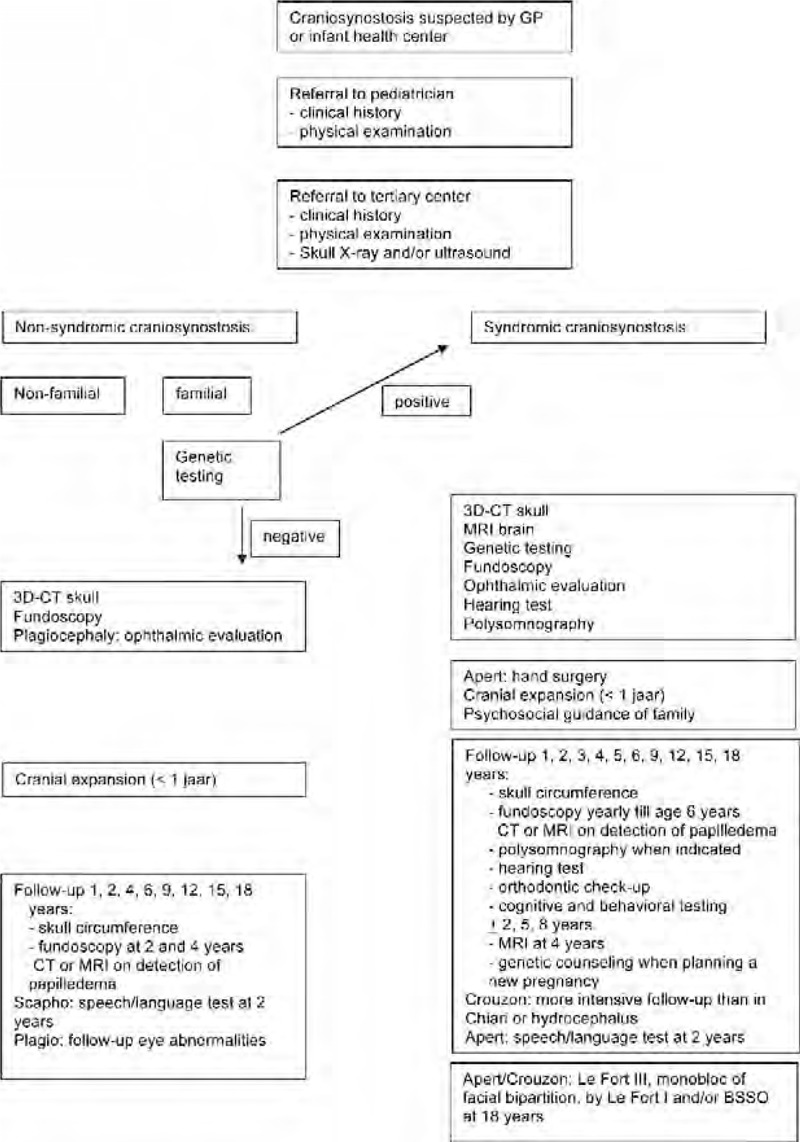
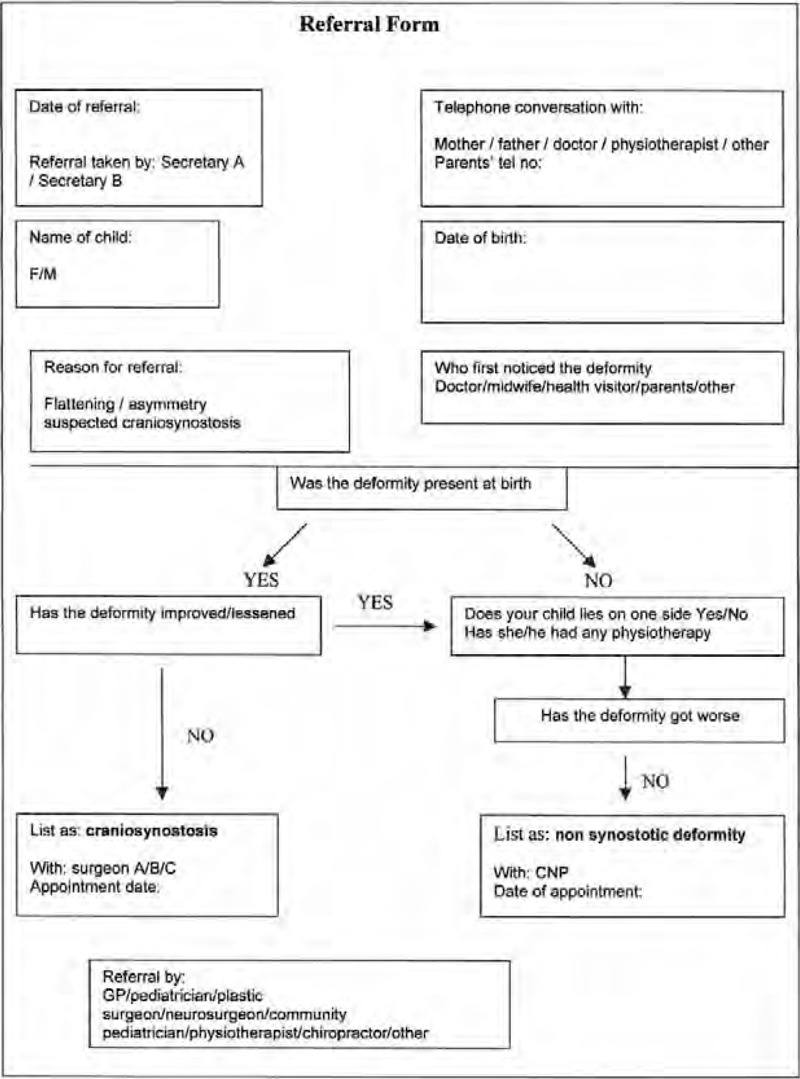
Chaired by Irene M.J. Mathijssen, MD, PhD Participants: The Dutch National Cranial and Facial Deformities Patients and Parents Association (LAPOSA) The Netherlands Society for Ophthalmology The Netherlands Society for Anesthesiology The Netherlands Society for Otorhinolaryngology The Dutch Association for Pediatrics The Netherlands Society for Oral Medicine and Oral and Maxillofacial Surgery The Netherlands Society for Neurosurgery The Netherlands Society for Plastic Surgery The Society for Orthodontists The Netherlands Society for Clinical Genetics The Dutch Association of Psychologists The Netherlands Society for Relationship Counseling and Family Therapy Address correspondence and reprint requests to Irene M.J. Mathijssen, MD, PhD, Deptartment of Plastic and Reconstructive Surgery, and Hand Surgery, Room Sk-1202, Erasmus Medical Center-Sophia, Wytemaweg 80, 3015CN Rotterdam, The Netherlands. E-mail: [email protected] ABSTRACT This guideline for care of children with craniosynostosis was developed by a national working group with representatives of 11 matrix societies of specialties and the national patients’ society. All medical aspects of care for nonsyndromic and syndromic craniosynostosis are included, as well as the social and psychologic impact for the patient and their parents. Managerial aspects are incorporated as well, such as organizing a timely referral to the craniofacial center, requirements for a dedicated craniofacial center, and centralization of this specialized care. The conclusions and recommendations within this document are founded on the available literature, with a grading of the level of evidence, thereby highlighting the areas of care that are in need of high-quality research. The development of this guideline was made possible by an educational grant of the Dutch Order of Medical Specialists. The development of this guideline was supported by an educational grant of the Dutch Order of Medical Specialists. Contents Chapter 1. General introduction 1735 Chapter 2. Introduction to craniosynostosis 1736 Chapter 3. Referral and diagnostics 1737 Chapter 4. Perioperative care 1744 Chapter 5. Surgical treatment of nonsyndromic craniosynostosis 1747 Chapter 6. Surgical treatment of syndromic craniosynostosis—the cranial vault 1751 Chapter 7. Surgical treatment of syndromic craniosynostosis—the face 1753 Chapter 8. Increased intracranial pressure 1762 Chapter 9. Hydrocephalus 1768 Chapter 10. Chiari I malformation 1769 Chapter 11. Vision, refraction and motility abnormalities 1771 Chapter 12. Obstructive sleep apnea syndrome 1772 Chapter 13. Hearing impairments 1776 Chapter 14. Dentofacial deformities 1777 Chapter 15. Deformities of the extremities 1780 Chapter 16. Cognitive functioning and behavior 1783 Chapter 17. Patients’ and parents’ perspectives 1786 Chapter 18. Psychosocial functioning 1787 Chapter 19. Criteria for the craniofacial center and its team members 1790 Chapter 20. Summary 1794 1. GENERAL INTRODUCTION Objective This guideline provides recommendations for medical practice on suspicion of craniosynostosis and after confirmation of this diagnosis. It is based on the results of scientific research and subsequent forming of opinion by a multidisciplinary working group, composed of representatives of the medical specialties involved in the treatment of craniosynostosis, related professional disciplines, and other parties involved. The wishes of parents and health professionals regarding the organization of health care for craniosynostosis were inventoried. The guideline document addresses the important issues for the support of parents with a child with a craniosynostosis. Method Employed by the Working Group The content of this guideline is based on evidence from published scientific research. Relevant articles were identified using systematic searches in Medline, Embase, and the Cochrane Library. Existing guidelines were specifically searched for in online accessible international and national guideline clearinghouses. Searches were limited to the Dutch, English, and French languages. In addition, articles were extracted from reference lists of relevant literature. This resulted in additional articles for several basic questions. Care for children with craniosynostosis was introduced in the late 1960s and consequently the English literature from those years onwards was included. Searches were performed until December 1, 2009 and articles available as “Epub ahead of publication” at that date were included as well. The following search terms were used: craniofacial, craniosynostosis combined with: genetics, hydrocephalus, Chiari, cerebral pressure, otitis, hearing, vision, psychology, anesthesia, complications, infection, development, growth, maxilla, mandible, distraction, osteotomy, Fort, midface, RED, halo, monobloc, facial bipartition, median faciotomy, and hypertelorism. Relevant articles extracted from reference lists of retrieved literature and several relevant publicati
Overview
The claims and statistics of this paper haven’t been checked yet.
Run the check — free, no account needed. It reads the open-access text and checks the sources it cites.
Integrity signals
Registry
Cites
Statistics
Figures
Verification
Claims the paper makes
The claims and statistics of this paper haven’t been checked yet.
Run the check — free, no account needed. It reads the open-access text and checks the sources it cites.
Claims other papers make about this one
Each is checked against this paper’s own text: does it say what the citing paper says it does?
The source backs part of the claim, not all of it — or backs it for a different population, condition or comparison.
In the citing paper
“Early diagnosis enables appropriate planning and intervention, also to support the normal growth of the skull and brain in the best possible way, but also as the condition can be treated minimally invasively in the first months of life with reduced mortality [15, 88].”
From Developments in diagnostic and surgical techniques in children with sagittal suture craniosynostosis: a systematic review spanning the last 30 years (2025) · cites this paper as [88]
Experimental — accuracy not yet measuredThe cited source says what the claim attributes to it.
In the citing paper
“Early diagnosis enables appropriate planning and intervention, also to support the normal growth of the skull and brain in the best possible way, but also as the condition can be treated minimally invasively in the first months of life with reduced mortality [15, 88].”
From Developments in diagnostic and surgical techniques in children with sagittal suture craniosynostosis: a systematic review spanning the last 30 years (2025) · cites this paper as [88]
Self-check
Percentages, sums and reported differences re-computed from the paper’s own numbers.
The self-check needs the paper’s full text.
Citations
Cites
Items 401–450 of 450
Benchmarking for Craniosynostosis
Mathijssen, I. M. J., & Arnaud, É. (2007) · Journal of Craniofacial Surgery · doi:10.1097/scs.0b013e31802d4c6c · Cited by 15
Self-citationA Clinicoradiologic Study of the Shoulder in Apert Syndrome
Murnaghan, M. L., Thurgur, C. H., Forster, B. B., Sawatzky, B., Hawkins, R. H., & Tredwell, S. J. (2007) · Journal of Pediatric Orthopaedics · doi:10.1097/bpo.0b013e3181455886a · Cited by 15
Otopathology in cranial facial dysostosis.
Jp, C., Dd, C., & Hj, G. (1987) · PubMed · Cited by 15
Minimally Invasive Le Fort III Distraction
Hollier, L. H., Kelly, P., Babigumira, E., Potochny, J. D., & Taylor, T. D. (2002) · Journal of Craniofacial Surgery · doi:10.1097/00001665-200201000-00009 · Cited by 14
A Triage System for Referrals of Pediatric Skull Deformities
Bredero-Boelhouwer, H., Treharne, L. J., & Mathijssen, I. M. J. (2009) · Journal of Craniofacial Surgery · doi:10.1097/scs.0b013e318191d038 · Cited by 14
Self-citationMultivectorial, External Halo-Assisted Midface Distraction in Patients With Severe Hypoplasia
Malagón-Hidalgo, H. O., Romo, G. W., Mosqueda, F. R. Q., & Magaña, F. G. (2008) · Journal of Craniofacial Surgery · doi:10.1097/scs.0b013e31818c0330 · Cited by 14
The hands in Saethre-Chotzen syndrome.
Anderson, P. J., Hall, C. M., Evans, R. D., Hayward, R. D., & Jones, B. M. (1996) · PubMed · Cited by 14
Trigonocephaly in Muenke syndrome
van der Meulen, J., van den Ouweland, A., & Hoogeboom, J. A. M. (2006) · American Journal of Medical Genetics Part A · doi:10.1002/ajmg.a.31460 · Cited by 13
Early transfusion and crystalloid infusion strategy in infants undergoing cranioplasty surgery
Cortellazzi, P., Caldiroli, D., Lamperti, M., Bricchi, M., & Valentini, L. G. (2009) · Pediatric Anesthesia · doi:10.1111/j.1460-9592.2009.03167.x · Cited by 13
Simis, K. J., Koot, H. M., Verhulst, F. C., & Hovius, S. E. R. (2000) · British Journal of Plastic Surgery · doi:10.1054/bjps.2000.3405 · Cited by 13
van der Weijden, T., Dansen, A., Schouten, B. J., Knottnerus, J. A., & Grol, R. P. T. M. (1996) · BMJ Quality & Safety · doi:10.1136/qshc.5.4.218 · Cited by 13
Dao, K. D., Shin, A. Y., Kelley, S., & Wood, V. E. (2001) · Journal of Pediatric Orthopaedics · doi:10.1097/01241398-200107000-00016 · Cited by 13
The Use of Split Thickness Skin Grafts in the Correction of Apert’s Syndactyly
Al-Qattan, M. M. (2001) · Journal of Hand Surgery (European Volume) · doi:10.1054/jhsb.2000.0507 · Cited by 12
Controversies in the Management of Craniofacial Malformations
Prahl‐Andersen, B. (2005) · Seminars in Orthodontics · doi:10.1053/j.sodo.2005.02.004 · Cited by 12
Multidirectional distraction osteogenesis for Crouzon syndrome: technical note
Ueki, K., Marukawa, K., Nakagawa, K., & Yamamoto, E. (2004) · International Journal of Oral and Maxillofacial Surgery · doi:10.1016/j.ijom.2004.03.013 · Cited by 12
Early Surgical Intervention in Apertʼs Syndactyly
Upton, J. M. (1986) · Plastic & Reconstructive Surgery · doi:10.1097/00006534-198602000-00021 · Cited by 12
Psychological aspects of parents of children with craniofacial anomalies.
Ml, C., Scheuerle, J., Laude, M., & Habal, M. B. (1991) · PubMed · Cited by 12
CRANIOFACIAL SURGERY: THE TEAM APPROACH
David, D. J. (1977) · Australian and New Zealand Journal of Surgery · doi:10.1111/j.1445-2197.1977.tb04267.x · Cited by 11
New Osteotomies for Midface Advancement in Patients With Crouzon Syndrome
Kobus, K. (2006) · Journal of Craniofacial Surgery · doi:10.1097/01.scs.0000231626.33382.cc · Cited by 11
Sheldon, S. H. (2013) · Pediatric Annals · doi:10.3928/00904481-20130924-07 · Cited by 11
Role of Cranial Sutures in Normal and Abnormal Skull Development
Babler, W. J. (1991) · Neurosurgery Clinics of North America · doi:10.1016/s1042-3680(18)30716-2 · Cited by 10
Is Isolated Sagittal Synostosis an Isolated Condition?
Butzelaar, L., Breugem, C. C., Hanlo, P., & Mink van der Molen, A. B. (2009) · Journal of Craniofacial Surgery · doi:10.1097/scs.0b013e31819b971a · Cited by 10
Audit: a Project on Peer Review in General Practice
Grol, R. P. T. M., van Eijk, J. T. M., Mesker, P. J. R., & Schellevis, F. (1985) · Family Practice · doi:10.1093/fampra/2.4.219 · Cited by 10
Venous Air Embolism in Craniosynostosis Surgery: What Do We Want to Detect?
Meyer, P. G., Rénier, D., ORLIAGUET, G. A., Blanot, S., & Carli, P. A. (2000) · Anesthesiology · doi:10.1097/00000542-200010000-00052 · Cited by 10
Combined Push-Pull Distraction for Correction of Syndromic Midfacial Hypoplasia
Schulten, A. J. M., Lim, A. A. T., Bruun, R. A., Hayes, C., Mulliken, J. B., & Padwa, B. L. (2005) · Journal of Oral and Maxillofacial Surgery · doi:10.1016/j.joms.2005.09.009 · Cited by 10
Consensus: Craniofacial synostoses
Bruce, D. A. (1996) · Child s Nervous System · doi:10.1007/bf00366159 · Cited by 9
Hearing loss in pediatric patients with isolated nonsyndromic sagittal synostosis
Prager, J. D., Wang, E. W., & Molter, D. W. (2007) · International Journal of Pediatric Otorhinolaryngology · doi:10.1016/j.ijporl.2007.10.013 · Cited by 8
Vyas, R. M., Keagle, J. N., Wexler, A. M., Cahan, L., Kawamoto, H. K., Lazareff, J. A., Wasson, K. L., & Bradley, J. P. (2007) · Journal of Craniofacial Surgery · doi:10.1097/scs.0b013e3180a77222 · Cited by 8
Safety and Efficacy of Remifentanil Infusion in Craniosynostosis Repair in Infants
de Beer, D. A. H., & Mackersie, A. M. (2001) · Pediatric Neurosurgery · doi:10.1159/000056047 · Cited by 8
A Team Approach in the Treatment of Craniofacial Deformities
Strohecker, B. (1993) · Plastic and Aesthetic Nursing · doi:10.1097/00006527-199300000-00003 · Cited by 7
[Obstructive sleep apnea syndrome in children].
Joosten, K., & Berg, S. (1998) · PubMed · Cited by 7
The hands in Saethre-Chotzen syndrome
Anderson, P., Hall, C., Evans, R., et al. (1996) · UCL Discovery (University College London) · Cited by 7
[Babies with cranial deformity].
Feijen, M. M. W., Claessens, E. A. W. M. H., Dovens, A. J. L., Vles, J. S. H., & van der Hulst, R. R. W. J. (2009) · PubMed · Cited by 6
Abnormal spliceform expression associated with splice acceptor mutations in exon IIIc of FGFR2
Wilkie, A. O. M. (2002) · American Journal of Medical Genetics · doi:10.1002/ajmg.10486 · Cited by 6
A Simplified Lateral Canthopexy Technique
Rizvi, M., Lypka, M., Gaon, M. D., Eisemann, B. S., Eisemann, M. L., & Lypka, M. (2010) · Plastic & Reconstructive Surgery · doi:10.1097/prs.0b013e3181d45d19 · Cited by 4
Combined cleft and craniofacial team--multidisciplinary approach to cleft management.
Chen, Y.-R., Sh, C., Wang, C., & Noordhoff, M. S. (1988) · PubMed · Cited by 3
Furusawa, K., Yamaoka, M., & Ichikawa, N. (1994) · The Cleft Palate-Craniofacial Journal · doi:10.1597/1545-1569(1994)031 · Cited by 3
The Otolaryngologist's Role in the Craniofacial Anomalies Team
Holt, G. R., & Watson, M. J. (1984) · Otolaryngology · doi:10.1177/019459988409200406 · Cited by 3
Tigers and elephants: an appreciation of craniofacial team nursing.
Clifford, E. (1978) · PubMed · Cited by 3
[Cleft lip and palate: the adolescent and his family].
Chapados, C. (2000) · PubMed · Cited by 3
The role of psychiatry in a craniofacial team
Sokol, A. B. (1978) · Journal of Pediatric Surgery · doi:10.1016/s0022-3468(78)80140-7 · Cited by 2
The speech-language pathologist's role on the craniofacial team.
Schaefer, L., & Sullivan (1986) · PubMed · Cited by 2
Further delineation of the acro-renal-ocular syndrome
(1996) · Pure Amsterdam UMC · doi:10.1002/(sici)1096-8628(19960329)62:3 · Cited by 1
A Team Approach to the Child with a Craniofacial Defect
Anderson, B. E., & Wicks, K. (1985) · Plastic and Aesthetic Nursing · doi:10.1097/00006527-198505010-00007 · Cited by 1
[Surgical correction of craniofacial dysostosis with midface distraction osteogenesis].
Mu, X., Yu, Z., Wei, M., Xu, H., Chai, G., Cao, D., Zhang, R.-H., Feng, S.-Z., & Zhang, D.-S. (2007) · PubMed · Cited by 1
Rw, C., & Falk, R. E. (1990) · PubMed · Cited by 1
The dentist on a craniofacial team.
Pruzansky, S. (1980) · PubMed · Cited by 1
Het obstructief slaapapnoesyndroom bij kinderen
Joosten, K., & van den Berg, S. (1998) · EUR Research Repository (Erasmus University Rotterdam) · Cited by 1
Assessment of a peak flow whistle in nonasthmatic children
Terblanche, E., Fourie, P. R., & Wessels, J. A. (1999) · Pediatric Pulmonology · doi:10.1002/(sici)1099-0496(199906)27:6
Research works printed but not linked: 16
- Feijen, 2009, Zuigelingen met een scheef hoofd newborns with a moulded head., Ned Tijdschr Geneeskd, 153, A368
- 1993, American Cleft Palate-Craniofacial Association., Cleft Palate Craniofac J, 30, S1
- Lo, 1996, Orbital dysmorphology in unilateral coronal synostosis., Cleft-Palate Craniofac J, 33, 190, 10.1597/1545-1569_1996_033_0190_odiucs_2.3.co_2 · DOI
- Kreiborg, 1986, Pre- and postsurgical facial growth in patients with Crouzons and Aperts syndromes., Cleft Palate J, 23, 78
- Tessier, 1967, Total facial osteotomy. Crouzons syndrome, Aperts syndrome: oxycephaly, scaphocephaly, turricephaly., Ann Chir Plast, 12, 273
- Le, 2001, Intracranial migration of halo fixation pins: a complication of using an extraoral distraction device., Cleft Palate Craniofac J, 38, 401, 10.1597/1545-1569_2001_038_0401_imohfp_2.0.co_2 · DOI
- Bachmayer, 1986, Stability of Le Fort III advancement surgery in children with Crouzons, Aperts, and Pfeiffers syndromes., Cleft Palate J, 23, 69
- Latham, 1966, The postnatal pattern of growth at sutures of the human skull., Dent Pract, 17, 61
- Persson, 1973, Structure and growth of facial sutures., Odontol Rev, 24, 6
- Vallino-Napoli, 1996, Audiologic and otologic characteristics of Pfeiffer syndrome., Cleft Palate Craniofac J, 33, 524, 10.1597/1545-1569_1996_033_0524_aaocop_2.3.co_2 · DOI
- Carinci, 1994, Crouzon syndrome: cephalometric analysis and evaluation of pathogenesis., Cleft Palate Craniofac J, 31, 201, 10.1597/1545-1569_1994_031_0201_cscaae_2.3.co_2 · DOI
- Kaloust, 1997, Dental development in Apert syndrome., Cleft Palate Craniofac J, 34, 117, 10.1597/1545-1569_1997_034_0117_ddias_2.3.co_2 · DOI
- Speltz, 1997, Presurgical and postsurgical mental and psychomotor development of infants with sagittal synostosis., Cleft Palate Craniofac J, 34, 374, 10.1597/1545-1569_1997_034_0374_papmap_2.3.co_2 · DOI
- Kapp-Simon, 1998, Mental development and learning disorders in children with single suture craniosynostosis., Cleft Palate Craniofac J, 35, 197, 10.1597/1545-1569_1998_035_0197_mdaldi_2.3.co_2 · DOI
- Guzelcan, 2004, Posttraumatic stress disorder following physical illnesses or their treatment., Tijdschr Psychiatr, 46, 611
- Schaefer, 1986, The speech-language pathologists role on the craniofacial team., Ear Nose Throat J, 65, 346
Cited by
Sorted by citations
Increase of prevalence of craniosynostosis
Cornelissen, M., Ottelander, B. D., Rizopoulos, D., van der Hulst, R., Mink van der Molen, A., van der Horst, C., Delye, H., van Veelen, M.-L., Bonsel, G., & Mathijssen, I. (2016) · Journal of Cranio-Maxillofacial Surgery · doi:10.1016/j.jcms.2016.07.007 · Cited by 226
Self-citationWhat’s New in Syndromic Craniosynostosis Surgery?
Taylor, J. A., & Bartlett, S. P. P. (2017) · Plastic & Reconstructive Surgery · doi:10.1097/prs.0000000000003524 · Cited by 118
Imaging in craniosynostosis: when and what?
Massimi, L., Bianchi, F., Frassanito, P., Calandrelli, R., Tamburrini, G., & Caldarelli, M. (2019) · Child s Nervous System · doi:10.1007/s00381-019-04278-x · Cited by 66
Normal human craniofacial growth and development from 0 to 4 years
Liang, C., Profico, A., Buzi, C., Khonsari, R. H., Johnson, D., O’Higgins, P., & Moazen, M. (2023) · Scientific Reports · doi:10.1038/s41598-023-36646-8 · Cited by 64
Combining deep learning with 3D stereophotogrammetry for craniosynostosis diagnosis
de Jong, G., Bijlsma, E., Meulstee, J., Wennen, M., van Lindert, E., Maal, T., Aquarius, R., & Delye, H. (2020) · Scientific Reports · doi:10.1038/s41598-020-72143-y · Cited by 62
Metadata
- Authors
- Mathijssen, I. M. J.
- Corresponding author
- Mathijssen, Irene M.J.
- Venue
- Journal of Craniofacial Surgery
- Published
- 2015-09
- Volume
- 26
- Issue
- 6
- Pages
- 1735-1807
- ISSN
- 1049-2275 (ISSN-L)
- PMC
- PMC4568904
- OpenAlex
- W2409179428
- Cited by
- 232
- References
- 453
- Citations by year
- 2026: 16 · 2025: 13 · 2024: 28 · 2023: 27 · 2022: 31 · 2021: 38 · 2020: 24 · 2019: 19 · 2018: 14 · 2017: 8 · 2016: 13
- FWCI
- 8.02
- Type
- journal article
- Language
- en
- Open access
- hybrid
- doi.org
- Licence
- cc-by-nc-nd
- Locations
- Journal of Craniofacial Surgery (publishedVersion, cc-by-nc-nd)
- PubMed Central (publishedVersion, cc-by-nc-nd)
- PubMed (publishedVersion)
- EUR Research Repository (Erasmus University Rotterdam) (submittedVersion, other-oa)
- RePub (Erasmus University Rotterdam) (submittedVersion, other-oa)
- RePub (Erasmus University Rotterdam) (submittedVersion)
- Topics
- Health Sciences › Medicine › Surgery › Craniofacial Disorders and Treatments
- Health Sciences › Medicine › Surgery › Reconstructive Facial Surgery Techniques
- Health Sciences › Medicine › Surgery › Pectus Deformity Diagnosis and Treatment
- Keywords
- craniosynostosis, nonsyndromic craniosynostosis, syndromic craniosynostosis, multidisciplinary care, surgical treatment, perioperative care, cranial vault expansion, craniofacial deformities, intracranial hypertension, hydrocephalus, psychosocial impact, parental support
About these checks
Registry, retraction, Cites and statistics results are computed, not judged, with one exception: a printed reference that no index lists is read once by a model before it counts as a citation error. Claims are extracted by a model and kept only when their quote appears verbatim in the text; each cited source is then checked, with a model’s help, for whether it says what the claim relies on. Those verdicts can be wrong — read the claim’s quote and the cited source before relying on one.
Statistics and arithmetic are recomputed, not judged.
Confidence bands are shown only for fields calibrated on our annotated test set. None is calibrated yet, so no band is shown.
What counts as a claim ›How we measure confidence ›How we check this ›
Are you an author, or do you see a problem with this page? Request a review
