

Herring gulls respond to the acoustic properties of men’s voices
Open accessThe DOI matches its Crossref record; 42 of the 42 references it cites were found in a registry or an index; none of the 25 sources its claims cite is checked for support yet.
Abstract
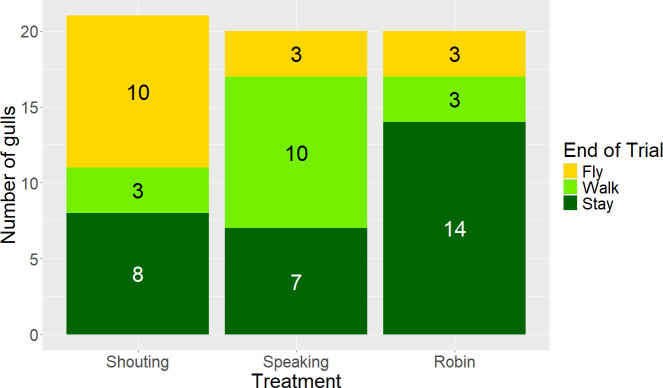
Due to ongoing global urbanization, some animals have settled in urban environments and rely increasingly on anthropogenic resources. One such urban adapter is the European herring gull, Larus argentatus , whose presence in towns has led to conflict with humans. Previous research has found gulls perceive men's shouting as a threat. We conducted a playback experiment on wild urban herring gulls in a foraging context to determine whether gulls perceive the difference between men shouting versus speaking the same words at the same volume, and whether those stimuli represented the same level of threat. Gulls reacted similarly to men shouting and speaking, as they flinched at the playback, exhibited vigilance, pecked less at the human food source and left the apparatus sooner than when exposed to robin song. However, gulls differentiated between the acoustic properties of men’s vocalizations, as they flew away from men shouting but walked away from men speaking. When attempting to deter gulls from exploiting anthropogenic resources, talking might stop them from foraging, but shouting is more effective at making them flee.
Overview
CoChat Summary
TL;DR
In a playback experiment with wild urban herring gulls, both a man shouting and a man speaking the same words at the same volume were treated as threats relative to robin song, but shouting elicited flight while speaking elicited walking away. Shouting may be more effective for making gulls leave, though both can stop them from foraging.
Key findings
- Gulls never flinched at robin playbacks, but flinched significantly more to Shouting (p = 0.004) and Speaking (p = 0.006); there was no significant difference in flinching between Shouting and Speaking (p = 0.960).
- Shouting and Speaking increased vigilance and reduced pecking relative to Robin; for pecking, the zero-inflation model was significant for Shouting (p = 0.006) and Speaking (p = 0.012).
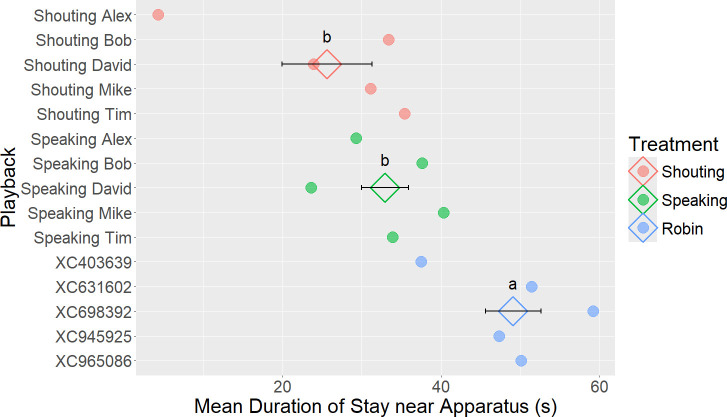
- Gulls stayed near the apparatus for significantly shorter periods under Shouting and Speaking than under Robin (Shouting p = 0.001; Speaking p < 0.001), with no significant difference between Shouting and Speaking (Welch t-test, p = 0.408); 14 gulls (23%) stayed for the whole 1 min trial.
- When gulls left early, Shouting made them 5.154 times more likely to fly away (OR = 5.154, 95% CI = [1.063, 25.000], p = 0.042), while Speaking made them 6.964 times more likely to walk away (OR = 6.964, 95% CI = [1.062, 45.676], p = 0.043) compared with Robin.
Methods
- Playback experiment on 61 wild herring gulls across nine towns in Cornwall, Southwestern England, between 24 February and 14 March 2025, during the non-breeding season; gulls were tested in 52 locations separated by at least 50 m.
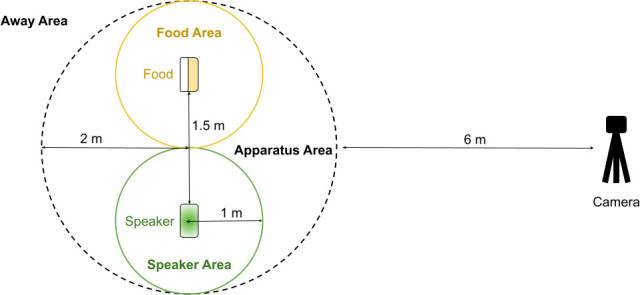
- Three treatments at the same 60 dB peak amplitude: a man shouting, a man speaking the same sentence, and European robin song; five recordings per treatment were looped into 30 s tracks, played from a speaker in a bag 150 cm from a closed box of chips, with 60 s video trials.
- Behaviours were coded in BORIS (flinching, vigilance duration, pecking, duration of stay, and how/if the gull left), then analysed in R using GLMs, GLMMs, and multinomial mixed models with town and playback frequency as random effects; observer agreement was high (ICC = 0.97, p < 0.001).
Limitations
- Stated: using human food to attract gulls may have biased the sample toward bolder, less neophobic individuals that were more likely to engage with the apparatus; the authors note this also targets possible “problem individuals” willing to steal food.
- Stated: only male voices were used; the authors say future work with female voices could test whether gulls are sensitive to pitch and whether they discriminate between genders, and they note that town population size did not explain engagement, with tourism suggested as a possible factor.
- Evident from the text: the stimuli came from five male volunteers saying one sentence, so results may not generalize to other voices, languages, contexts, or real approaching humans; no female voices or artificial sounds were tested.
Model-written summary. Check it against the paper before relying on it.
Integrity signals
Registry
Cites
Statistics
Figures
Verification
Claims the paper makes
0 Valid · 0 Not valid · 19 Not checked · 23 Own results and interpretations
A result the paper reports from its own data — it cites no other source for it, so there is none to check. The quote shows it is in the paper.
In the paper
“A Kruskal–Wallis test confirmed all three treatments were significantly different from each other in terms of fundamental frequencies (χ2 = 11.60, d.f. = 2, p = 0.003).”
§ Herring gulls respond to the acoustic properties of men’s voices > Methods > Recordings
plain- Asserted: passes — The authors put it forward as true.
- Checkable: passes — It can be checked against evidence.
- Load-bearing: passes — The paper’s conclusions depend on it.
- Based: passes — The paper gives a reason why it holds.
A result the paper reports from its own data — it cites no other source for it, so there is none to check. The quote shows it is in the paper.
In the paper
“while there was no significant difference in whether gulls flinched between the Shouting and Speaking treatments (GLM contrasts for Shouting—Speaking, estimate = 0.060, 95% CI = [−0.365, 0.484], z ratio = 0.275, p = 0.960).”
§ Herring gulls respond to the acoustic properties of men’s voices > Results
plain- Asserted: passes — The authors put it forward as true.
- Checkable: passes — It can be checked against evidence.
- Load-bearing: unclear — It is unclear whether the paper’s conclusions depend on it.
- Based: passes — The paper gives a reason why it holds.
A result the paper reports from its own data — it cites no other source for it, so there is none to check. The quote shows it is in the paper.
In the paper
“Gulls exposed to the Shouting or Speaking playbacks were also significantly less likely to continue pecking (GLMM zero-inflation model for Shouting, estimate = 3.187, 95% CI = [0.887, 5.487], z = 2.716, p = 0.006; Speaking, estimate = 3.008, 95% CI = [0.662, 5.354], z = 2.513, p = 0.012).”
- Also stated in: § Discussion · plain
“Individuals exposed to playbacks of male voices pecked at the speaker or the food fewer times and stayed near the apparatus for a shorter length of time than those exposed to robin song.”
§ Herring gulls respond to the acoustic properties of men’s voices > Results
plainstates a cause- Asserted: passes — The authors put it forward as true.
- Checkable: passes — It can be checked against evidence.
- Load-bearing: passes — The paper’s conclusions depend on it.
- Based: passes — The paper gives a reason why it holds.
- Also stated in: § Discussion · plain
A result the paper reports from its own data — it cites no other source for it, so there is none to check. The quote shows it is in the paper.
In the paper
“Gulls exposed to the Shouting and Speaking playbacks stayed near the apparatus for significantly shorter periods of time than those exposed to the Robin treatment (GLMM for Shouting, estimate = −1.700, 95% CI = [−2.647, −0.753], z = −3.520, p = 0.001; Speaking, estimate = −1.110, 95% CI = [−2.034, −0.186], z = −2.353, p < 0.001; figure 2).”
§ Herring gulls respond to the acoustic properties of men’s voices > Results
plainstates a cause- Asserted: passes — The authors put it forward as true.
- Checkable: passes — It can be checked against evidence.
- Load-bearing: passes — The paper’s conclusions depend on it.
- Based: passes — The paper gives a reason why it holds.
A result the paper reports from its own data — it cites no other source for it, so there is none to check. The quote shows it is in the paper.
In the paper
“None of the gulls flinched at the Robin playbacks, which was significantly less often than in response to both the Shouting (GLM contrasts for Robin—Shouting, estimate = −0.545, 95% CI = [−0.877, −0.213], z ratio = −3.220, p = 0.004) and Speaking treatments (GLM contrasts for Robin—Speaking, estimate = −0.486, 95% CI = [−0.797, −0.174], z-ratio = −3.058, p = 0.006)”
- Also stated in: § Discussion · plain
“Gulls subjected to the robin treatment never flinched at the playback.”
§ Herring gulls respond to the acoustic properties of men’s voices > Results
plainstates a cause- Asserted: passes — The authors put it forward as true.
- Checkable: passes — It can be checked against evidence.
- Load-bearing: passes — The paper’s conclusions depend on it.
- Based: passes — The paper gives a reason why it holds.
- Also stated in: § Discussion · plain
11 more claims
Create a free account to see all 42 claims and to verify the 24 references still open.
- It may state two separate claims as one. 12
- Probably not a substantial claim. 19
Statistics that don’t add up
Each reported p-value recomputed from its test statistic and degrees of freedom, each partial η² from its F, and each ratio, mean difference or B printed with a p checked against its own confidence interval.
Rated major: it would touch a result — a value a result rests on, reported and recomputed p-values on opposite sides of the significance level, two passages that conflict with no sign which is right, or a cited work retracted before this paper was published.
In the paper
“z = −1.884, p = 0.019”
§ Herring gulls respond to the acoustic properties of men’s voices > Results
Reported p = .019 · recomputed p = .060
The reported and recomputed p-values fall on opposite sides of .05. The check did not find which printed number differs.Rated minor: it would not touch a result — a value no result rests on, a p-value that stays on the same side of the significance level, or a conflict that is clerical, resolved elsewhere in the paper, or outside its own findings.
In the paper
“z = 2.716, p = 0.006”
§ Herring gulls respond to the acoustic properties of men’s voices > Results
Reported p = .006 · recomputed p = .007
Rated minor: it would not touch a result — a value no result rests on, a p-value that stays on the same side of the significance level, or a conflict that is clerical, resolved elsewhere in the paper, or outside its own findings.
In the paper
“z = −2.353, p < 0.001”
§ Herring gulls respond to the acoustic properties of men’s voices > Results
Reported p < .001 · recomputed p = .019
Statistics recomputed
Every reported test result, recomputed from its test statistic and degrees of freedom. A result shows as not adding up only once an independent check has confirmed it.
- Doesn’t add upz = -1.884reported p = .019 · recomputed p = .060The two fall on opposite sides of .05The reported and recomputed p-values fall on opposite sides of .05. The check did not find which printed number differs.
“z = −1.884, p = .019”
- Doesn’t add upz = 2.716reported p = .006 · recomputed p = .007
“z = 2.716, p = .006”
- Doesn’t add upz = -2.353reported p < .001 · recomputed p = .019
“z = −2.353, p < .001”
- Consistentz = 2.037reported p = .042 · recomputed p = .042
“z = 2.037, p = .042”
- Consistentz = 1.954reported p = .051 · recomputed p = .051
“z = 1.954, p = .051”
4 more recomputed tests
Create a free account to see every test the Stats check recomputed.
Self-check
Percentages, sums and reported differences re-computed from the paper’s own numbers.
Each contradiction between two passages listed here was confirmed by an independent check.
Rated major: it would touch a result — a value a result rests on, reported and recomputed p-values on opposite sides of the significance level, two passages that conflict with no sign which is right, or a cited work retracted before this paper was published.
In the paper
§ Herring gulls respond to the acoustic properties of men’s voices > Results
“Gulls who were quick to approach the apparatus stayed significantly longer”
§ Herring gulls respond to the acoustic properties of men’s voices > Results
“GLMM for latency to approach, estimate = −0.066, 95% CI = [−0.135, 0.003], z = −1.884, p = 0.019”
Rated minor: it would not touch a result — a value no result rests on, a p-value that stays on the same side of the significance level, or a conflict that is clerical, resolved elsewhere in the paper, or outside its own findings.
In the paper
§ Herring gulls respond to the acoustic properties of men’s voices > Results
“significantly more vigilant”
§ Herring gulls respond to the acoustic properties of men’s voices > Results
“Speaking, estimate = 0.744, 95% CI = [−0.002, 1.491], z = 1.954, p = 0.051”
Citations
Cites
Fitting Linear Mixed-Effects Models Using lme4
Bates, D., Mächler, M., Bolker, B., & Walker, S. (2015) · Journal of Statistical Software · doi:10.18637/jss.v067.i01 · Cited by 86,835
Wickham, H. (2016) · Use R! · doi:10.1007/978-3-319-24277-4 · Cited by 33,115
Brooks, M., Kristensen, K., Benthem, K., Magnusson, A., Berg, C., Nielsen, A., Skaug, H., Mächler, M., & Bolker, B. (2017) · The R Journal · doi:10.32614/rj-2017-066 · Cited by 12,915
DHARMa: Residual Diagnostics for Hierarchical (Multi-Level / Mixed) Regression Models
Hartig, F. (2016) · CRAN: Contributed Packages · doi:10.32614/cran.package.dharma · Cited by 4,409
Friard, O., & Gamba, M. (2016) · Methods in Ecology and Evolution · doi:10.1111/2041-210x.12584 · Cited by 3,437
Animal behavior in urban ecosystems: Modifications due to human-induced stress
Ditchkoff, S. S., Saalfeld, S. T., & Gibson, C. J. (2006) · Urban Ecosystems · doi:10.1007/s11252-006-3262-3 · Cited by 582
Metcalfe, N. B., & Alonso‐Alvarez, C. (2010) · Functional Ecology · doi:10.1111/j.1365-2435.2010.01750.x · Cited by 558
irr: Various Coefficients of Interrater Reliability and Agreement
Matthias Gamer <m.gamer@uke.uni-hamburg.de>, J. L. <. C. A. (2005) · CRAN: Contributed Packages · doi:10.32614/cran.package.irr · Cited by 540
Effects of Urbanization and Habitat Fragmentation on Bobcats and Coyotes in Southern California
Riley, S. P. D., Sauvajot, R. M., Fuller, T. K., York, E. C., Kamradt, D. A., Bromley, C., & Wayne, R. K. (2003) · Conservation Biology · doi:10.1046/j.1523-1739.2003.01458.x · Cited by 515
Atwell, J. W., Cardoso, G. C., Whittaker, D. J., Campbell-Nelson, S., Robertson, K. W., & Ketterson, E. D. (2012) · Behavioral Ecology · doi:10.1093/beheco/ars059 · Cited by 386
Habitat urbanization and its effects on birds
Seress, G., & Liker, A. (2015) · Acta Zoologica Academiae Scientiarum Hungaricae · doi:10.17109/azh.61.4.373.2015 · Cited by 253
Isaksson, C. (2015) · Functional Ecology · doi:10.1111/1365-2435.12477 · Cited by 225
Elephants Classify Human Ethnic Groups by Odor and Garment Color
Bates, L. A., Sayialel, K. N., Njiraini, N., Moss, C. J., Poole, J. H., & Byrne, R. W. (2007) · Current Biology · doi:10.1016/j.cub.2007.09.060 · Cited by 182
Urbanization and biological invasion shape animal personalities
Lapiedra, O., Chejanovski, Z. A., & Kolbe, J. J. (2016) · Global Change Biology · doi:10.1111/gcb.13395 · Cited by 170
Elephants can determine ethnicity, gender, and age from acoustic cues in human voices
McComb, K., Shannon, G., Sayialel, K. N., & Moss, C. (2014) · Proceedings of the National Academy of Sciences · doi:10.1073/pnas.1321543111 · Cited by 164
Importance of landfills to urban-nesting herring and ring-billed gulls
Belant, J. L., Ickes, S. K., & Seamans, T. W. (1998) · Landscape and Urban Planning · doi:10.1016/s0169-2046(98)00100-5 · Cited by 163
Animal Cognition in an Urbanised World
Lee, V. E., & Thornton, A. (2021) · Frontiers in Ecology and Evolution · doi:10.3389/fevo.2021.633947 · Cited by 141
The Role of Animal Cognition in Human-Wildlife Interactions
Goumas, M., Lee, V. E., Boogert, N. J., Kelley, L. A., & Thornton, A. (2020) · Frontiers in Psychology · doi:10.3389/fpsyg.2020.589978 · Cited by 107
Self-citationUrban gulls adapt foraging schedule to human‐activity patterns
Spelt, A., Soutar, O., Williamson, C. J., Memmott, J., Shamoun-Baranes, J. Z., Rock, P., & Windsor, S. P. (2020) · Ibis · doi:10.1111/ibi.12892 · Cited by 94
Isaksson, C., Sturve, J., Almroth, B. C., & Andersson, S. (2008) · Environmental Research · doi:10.1016/j.envres.2008.10.006 · Cited by 74
Increased use of intertidal resources benefits breeding success in a generalist gull species
O’Hanlon, N. J., McGill, R. A. R., & Nager, R. G. (2017) · Marine Ecology Progress Series · doi:10.3354/meps12189 · Cited by 62
Herring gulls respond to human gaze direction
Goumas, M., Burns, I., Kelley, L. A., & Boogert, N. J. (2019) · Biology Letters · doi:10.1098/rsbl.2019.0405 · Cited by 59
Self-citationHunted Woolly Monkeys (Lagothrix poeppigii) Show Threat-Sensitive Responses to Human Presence
Papworth, S., Milner‐Gulland, E. J., & Slocombe, K. E. (2013) · PLoS ONE · doi:10.1371/journal.pone.0062000 · Cited by 56
Urban herring gulls use human behavioural cues to locate food
Goumas, M., Boogert, N. J., & Kelley, L. A. (2020) · Royal Society Open Science · doi:10.1098/rsos.191959 · Cited by 56
Self-citationCoping with light pollution in urban environments: Patterns and challenges
Candolin, U. (2024) · iScience · doi:10.1016/j.isci.2024.109244 · Cited by 52
The importance of marine resources in the diet of urban gulls
de Faria, J. P., Vaz, P., Lopes, C. S., Calado, J. G., Pereira, J. M., Veríssimo, S. N., Paiva, V. H., Gonçalves, A. M. M., & Ramos, J. A. (2020) · Marine Ecology Progress Series · doi:10.3354/meps13599 · Cited by 48
Herring gull aversion to gaze in urban and rural human settlements
Goumas, M., Collins, T. R., Fordham, L., Kelley, L. A., & Boogert, N. J. (2020) · Animal Behaviour · doi:10.1016/j.anbehav.2020.08.008 · Cited by 26
Self-citationRisk-based alarm calling in a nonpasserine bird
Shah, S. S., Greig, E. I., MacLean, S. A., & Bonter, D. N. (2015) · Animal Behaviour · doi:10.1016/j.anbehav.2015.05.011 · Cited by 23
Large Terrestrial Bird Adapting Behavior in an Urbanized Zone
Alexandrino, E. R., Bogoni, J. A., Navarro, A. B., Bovo, A. A. A., Gonçalves, R. D. M., Charters, J. D., de Domini, J. A., & Ferraz, K. M. P. M. D. B. (2019) · Animals · doi:10.3390/ani9060351 · Cited by 19
<lukasz.komsta@umlub.pl>, L. K. (2005) · doi:10.32614/cran.package.outliers · Cited by 19
How birds colonize cities: genetic evidence from a common waterbird, the Eurasian coot
Minias, P., Włodarczyk, R., Minias, A. E., & Dziadek, J. (2017) · Journal of Avian Biology · doi:10.1111/jav.01334 · Cited by 15
Exploring behavioural responses of shorebirds to impulsive noise
Wright, M. D., Goodman, P. S., & Cameron, T. C. (2013) · Wildfowl (Wildfowl & Wetlands Trust) · Cited by 15
Salmi, R., Jones, C. E., & Carrigan, J. (2021) · Animal Cognition · doi:10.1007/s10071-021-01543-y · Cited by 15
Giovanni, J. D., Fawcett, T. W., Templeton, C. N., Raghav, S., & Boogert, N. J. (2022) · Frontiers in Ecology and Evolution · doi:10.3389/fevo.2022.891985 · Cited by 13
Self-citationmclogit: Multinomial Logit Models for Categorical Responses and Discrete Choices
Elff, M. (2010) · doi:10.32614/cran.package.mclogit · Cited by 12
Grey wolves (Canis lupus) discriminate between familiar and unfamiliar human voices
Gammino, B., Palacios, V., Root‐Gutteridge, H., Reby, D., & Gamba, M. (2023) · Animal Cognition · doi:10.1007/s10071-023-01796-9 · Cited by 9
Factors associated with Herring GullsLarus argentatusstealing food from humans in coastal towns
Raghav, S., & Boogert, N. J. (2022) · Bird Study · doi:10.1080/00063657.2022.2162846 · Cited by 9
Self-citationMcIvor, G. E., Lee, V. E., & Thornton, A. (2022) · Animal Behaviour · doi:10.1016/j.anbehav.2022.08.006 · Cited by 8
Links Between Human Quality of Life and Gulls in Urban Areas
Campbell, M. O. (2019) · Springer eBooks · doi:10.1007/978-981-13-6958-2_23 · Cited by 7
Hacker, F., & Graham, P. (2023) · Biology Open · doi:10.1242/bio.060016 · Cited by 4
Beasley, E. R., & Dickins, T. E. (2023) · Bird Study · doi:10.1080/00063657.2023.2166458 · Cited by 2
Supplementary material from "Herring gulls respond to human gaze direction"
Goumas, M., Burns, I., Kelley, L. A., & Boogert, N. J. (2019) · Figshare · doi:10.6084/m9.figshare.c.4588847 · Cited by 1
Self-citation
Research works printed but not linked: 2
- Ochola GO. 2024 Urbanization and environmental challenges: a review of effects of urban development on environmental resources in Kenya. Int J Env. Sci. Nat. Resour 33, 1– 8. (10.19080/IJESNR.2024.33.556369) · doi:10.19080/ijesnr.2024.33.556369
- Stanbury AJ, Burns F, Baker H, Balmer DE, Dunn T, Lindley P. The status of the UK’s breeding seabirds: an addendum to the fifth Birds of Conservation Concern in the United Kingdom, Channel Islands and Isle of Man and second IUCN Red List assessment of extinction risk for Great Britain. Br. Birds 117, 471– 487. https://britishbirds.co.uk/seabird-bocc5a
Cited by
Noreen, Z. (2026) · Otago University Research Archive (University of Otago) · doi:10.82348/our-archive.00448
Evaluating Aversion to Eye‐Like Stimuli as a Foraging Deterrent in Urban European Herring Gulls
Kelley, L. A., Thompson, R. H., Rowe, B., & Boogert, N. J. (2026) · Ecology and Evolution · doi:10.1002/ece3.73202
“An effective gull deterrent could incorporate short-term exposure to large eye-like stimuli accompanied by an acoustic deterrent such as gull alarm calls or human voices (Di Giovanni et al. 2022; Rémy et al. 2025), to maximise the deterrent effect whilst minimising the likelihood of habituation.”
Self-citation
Metadata
- Authors
- Rémy, C. M. I., Zikos, C., Kelley, L. A., & Boogert, N. J.
- Affiliations
- AgroParisTech (FR)
- University of Exeter (GB)
- Corresponding author
- Boogert, Neeltje Janna
- Venue
- Biology Letters
- Publisher
- The Royal Society
- Published
- 2025-11
- Volume
- 21
- Issue
- 11
- Pages
- 20250394-20250394
- ISSN
- 1744-9561 (ISSN-L)
- 1744-957X
- PMC
- PMC12614797
- OpenAlex
- W4416119448
- Cited by
- 2
- References
- 42
- Citations by year
- 2026: 2
- FWCI
- 1.47
- Type
- journal article
- Language
- en
- Open access
- hybrid
- doi.org
- Licence
- cc-by
- creativecommons.org/licenses/by/4.0/ (vor)
- creativecommons.org/licenses/by/4.0/ (tdm)
- Locations
- Biology Letters (publishedVersion, cc-by)
- PubMed Central (publishedVersion, cc-by)
- Europe PMC (PubMed Central) (publishedVersion, cc-by)
- PubMed (publishedVersion)
- Funders
- AgroParisTech
- Royal Society
- Université Paris-Saclay
- Topics
- Life Sciences › Agricultural and Biological Sciences › Ecology, Evolution, Behavior and Systematics › Animal Vocal Communication and Behavior
- Physical Sciences › Environmental Science › Ecology › Avian ecology and behavior
- Physical Sciences › Environmental Science › Ecology › Marine animal studies overview
- Keywords
- Larus argentatus, human vocalizations, speech acoustics, urban wildlife, human-wildlife conflict, threat perception, playback experiments, foraging behavior, sustained attention, urbanization
- MeSH terms
- Acoustics, Animals, Humans, Male, Vocalization, Animal, Charadriiformes
About these checks
Registry, retraction, Cites and statistics results are computed, not judged, with one exception: a printed reference that no index lists is read once by a model before it counts as a citation error. Claims are extracted by a model and kept only when their quote appears verbatim in the text; each cited source is then checked, with a model’s help, for whether it says what the claim relies on. Those verdicts can be wrong — read the claim’s quote and the cited source before relying on one.
A language model drew the claims from the paper on 2026-11-28, under version 3 of the claim definition (model deepseek-v4.1-flash, prompt extract-v3).
A second model labelled each claim on 2026-11-28 (model jev-1.13-20260917, definition revision gold-guideline-v0.2).
Statistics and arithmetic are recomputed, not judged.
Confidence bands are shown only for fields calibrated on our annotated test set. None is calibrated yet, so no band is shown.
What counts as a claim ›How we measure confidence ›How we check this ›
Are you an author, or do you see a problem with this page? Request a review
Data sources
Bibliographic data: Semantic Scholar, OpenAlex, Crossref.
Contains information from the Semantic Scholar Academic Graph Datasets, made available under the ODC Attribution License (ODC-BY 1.0).
Semantic Scholar’s data is described in: Kinney, R., et al. (2023). The Semantic Scholar Open Data Platform. arXiv:2301.10140.
