

The DOI matches its Crossref record; 329 of the 329 references it cites were found in a registry or an index.
An insula hierarchical network architecture for active interoceptive inference
Open accessAbstract
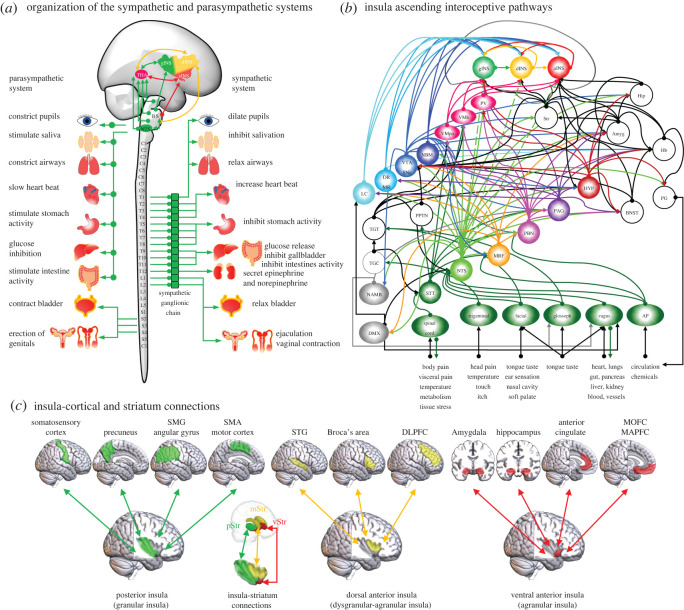
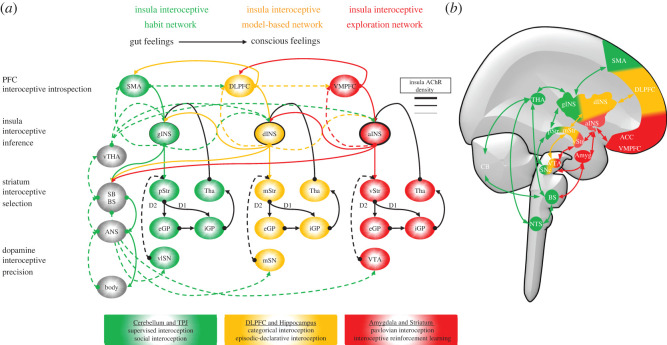
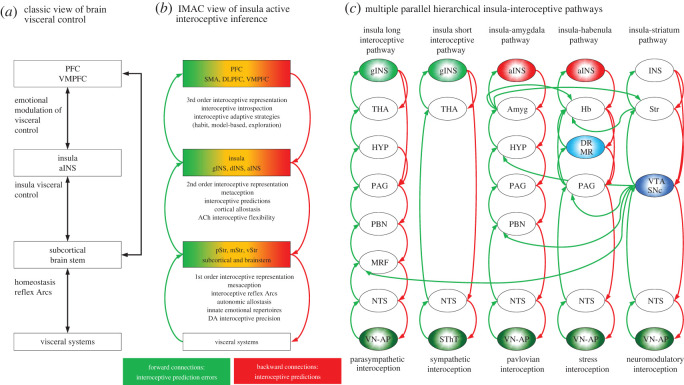
In the brain, the insular cortex receives a vast amount of interoceptive information, ascending through deep brain structures, from multiple visceral organs. The unique hierarchical and modular architecture of the insula suggests specialization for processing interoceptive afferents. Yet, the biological significance of the insula's neuroanatomical architecture, in relation to deep brain structures, remains obscure. In this opinion piece, we propose the Insula Hierarchical Modular Adaptive Interoception Control (IMAC) model to suggest that insula modules (granular, dysgranular and agranular), forming parallel networks with the prefrontal cortex and striatum, are specialized to form higher order interoceptive representations. These interoceptive representations are recruited in a context-dependent manner to support habitual, model-based and exploratory control of visceral organs and physiological processes. We discuss how insula interoceptive representations may give rise to conscious feelings that best explain lower order deep brain interoceptive representations, and how the insula may serve to defend the body and mind against pathological depression.
Overview
The claims and statistics of this paper haven’t been checked yet.
Run the check — free, no account needed. It reads the open-access text and checks the sources it cites.
Integrity signals
Registry
Cites
Statistics
Figures
Verification
Claims the paper makes
The claims and statistics of this paper haven’t been checked yet.
Run the check — free, no account needed. It reads the open-access text and checks the sources it cites.
Claims other papers make about this one
Each is checked against this paper’s own text: does it say what the citing paper says it does?
The source backs part of the claim, not all of it — or backs it for a different population, condition or comparison.
In the citing paper
“Recently, Fermin et al. attempted to expand upon this framework, proposing a three-tiered insula model [49]. The granular insula first receives interoceptive afferent signals and uses these to inform lower-order innate interoceptive representations. Resulting prediction errors are projected to the mid-dorsal insula, which facilitates preemptive adjustments to the visceral system through model-”
From Neural correlates of altered interoception in depressive and anxiety disorders: a systematic review and meta-analysis (2026) · cites this paper as [49]
Experimental — accuracy not yet measured
Self-check
Percentages, sums and reported differences re-computed from the paper’s own numbers.
The self-check needs the paper’s full text.
Citations
Cites
A neural substrate of prediction and reward
Schultz, W., Dayan, P., & Montague, P. R. (1997) · Science · doi:10.1126/science.275.5306.1593 · Cited by 9,388
Parallel organization of functionally segregated circuits linking basal ganglia and cortex
Alexander, G. E., DeLong, M. R., & Strick, P. L. (1986) · Annual Review of Neuroscience · doi:10.1146/annurev.ne.09.030186.002041 · Cited by 8,527
The free-energy principle: a unified brain theory?
Friston, K. (2010) · Nature Reviews Neuroscience · doi:10.1038/nrn2787 · Cited by 8,120
Self-citationDistributed hierarchical processing in the primate cerebral cortex
Felleman, D. J., & Van Essen, D. C. (1991) · Cerebral Cortex · doi:10.1093/cercor/1.1.1 · Cited by 7,783
How do you feel — now? The anterior insula and human awareness
(Bud) Craig, A. D. (2009) · Nature Reviews Neuroscience · doi:10.1038/nrn2555 · Cited by 6,657
Core affect and the psychological construction of emotion.
Russell, J. A. (2003) · Psychological Review · doi:10.1037/0033-295x.110.1.145 · Cited by 6,113
How do you feel? Interoception: The sense of the physiological condition of the body
Craig, A. D. (2002) · Nature Reviews Neuroscience · doi:10.1038/nrn894 · Cited by 6,006
Rao, R. P. N., & Ballard, D. H. (1999) · Nature Neuroscience · doi:10.1038/4580 · Cited by 5,483
On the Origin of Species by Means of Natural Selection
Livezey, R. L., & Darwin, C. R. (1953) · The American Midland Naturalist · doi:10.2307/2485224 · Cited by 5,431
Physiology and neurobiology of stress and adaptation: central role of the brain
McEwen, B. S. (2007) · Physiological Reviews · doi:10.1152/physrev.00041.2006 · Cited by 5,429
Research works printed but not linked: 3
- Porges SW. 2011 The polyvagal theory: neurophysiological foundations of emotions, attachment, communication, and self-regulation (norton series on interpersonal neurobiology). New York, NY: WW Norton & Company.
- Fitts PM, Posner MI. 1967 Human performance. Oxford, England: Brooks/Cole.
- Stemmler G. 2004 Physiological processes during emotion. In The regulation of emotion, pp. 48-85. New York, NY: Psychology Press.
Cited by
Sorted by citations
Bednarek, L., Harrison, B. J., Davey, C. G., Steward, T., & Jamieson, A. J. (2026) · European Archives of Psychiatry and Clinical Neuroscience · doi:10.1007/s00406-026-02201-5 · Cited by 1
Metadata
- Authors
- Fermin, A. S. R., Friston, K., & Yamawaki, S.
- Affiliations
- Hiroshima University (JP)
- Wellcome Centre for Human Neuroimaging (GB)
- Corresponding author
- Fermin, Alan S. R.
- Venue
- Royal Society Open Science
- Publisher
- The Royal Society
- Published
- 2022-06
- Volume
- 9
- Issue
- 6
- Pages
- 220226-220226
- ISSN
- 2054-5703 (ISSN-L)
- PMC
- PMC9240682
- OpenAlex
- W4283707164
- Cited by
- 101
- References
- 329
- Citations by year
- 2026: 31 · 2025: 22 · 2024: 28 · 2023: 16 · 2022: 2
- FWCI
- 2.93
- Type
- journal article
- Language
- en
- Open access
- gold
- doi.org
- Locations
- Royal Society Open Science (publishedVersion, cc-by)
- PubMed Central (publishedVersion, cc-by)
- PubMed (publishedVersion)
- DOAJ (DOAJ: Directory of Open Access Journals) (submittedVersion)
- UCL Discovery (University College London) (submittedVersion)
- Funders
- Wellcome Centre for Human Neuroimaging (205103/Z/16/Z)
- Canada-UK Artificial Intelligence Initiative (ES/T01279X/1)
- Japan Agency for Medical Research and Development (JP19dm0107093)
- Center of Innovation Program (JPMJCA2208, JPMJCE1311)
- Japan Society for the Promotion of Science (20309202, 20K07723, JPMJMS2296)
- Topics
- Health Sciences › Medicine › Psychiatry and Mental health › Psychosomatic Disorders and Their Treatments
- Life Sciences › Neuroscience › Cognitive Neuroscience › Embodied and Extended Cognition
- Life Sciences › Neuroscience › Cognitive Neuroscience › Neural and Behavioral Psychology Studies
- Keywords
- insula, interoception, prefrontal cortex, striatum, model-based control, depression
About these checks
Registry, retraction, Cites and statistics results are computed, not judged, with one exception: a printed reference that no index lists is read once by a model before it counts as a citation error. Claims are extracted by a model and kept only when their quote appears verbatim in the text; each cited source is then checked, with a model’s help, for whether it says what the claim relies on. Those verdicts can be wrong — read the claim’s quote and the cited source before relying on one.
Statistics and arithmetic are recomputed, not judged.
Confidence bands are shown only for fields calibrated on our annotated test set. None is calibrated yet, so no band is shown.
What counts as a claim ›How we measure confidence ›How we check this ›
Are you an author, or do you see a problem with this page? Request a review
