

Stratigraphic signatures of mass extinctions: ecological and sedimentary determinants
Open accessThe DOI matches its Crossref record; 56 of the 56 references it cites were found in a registry or an index; none of the 79 sources its claims cite is checked for support yet.
Abstract
Stratigraphic patterns of last occurrences (LOs) of fossil taxa potentially fingerprint mass extinctions and delineate rates and geometries of those events. Although empirical studies of mass extinctions recognize that random sampling causes LOs to occur earlier than the time of extinction (Signor–Lipps effect), sequence stratigraphic controls on the position of LOs are rarely considered. By tracing stratigraphic ranges of extant mollusc species preserved in the Holocene succession of the Po coastal plain (Italy), we demonstrated that, if mass extinction took place today, complex but entirely false extinction patterns would be recorded regionally due to shifts in local community composition and non-random variation in the abundance of skeletal remains, both controlled by relative sea-level changes. Consequently, rather than following an apparent gradual pattern expected from the Signor–Lipps effect, LOs concentrated within intervals of stratigraphic condensation and strong facies shifts mimicking sudden extinction pulses. Methods assuming uniform recovery potential of fossils falsely supported stepwise extinction patterns among studied species and systematically underestimated their stratigraphic ranges. Such effects of stratigraphic architecture, co-produced by ecological, sedimentary and taphonomic processes, can easily confound interpretations of the timing, duration and selectivity of mass extinction events. Our results highlight the necessity of accounting for palaeoenvironmental and sequence stratigraphic context when inferring extinction dynamics from the fossil record.
Overview
CoChat Summary
TL;DR
Using Holocene molluscs from the Po coastal plain, the paper shows that last occurrences (LOs) of extant species are clustered by sequence stratigraphic surfaces and facies shifts rather than following a gradual Signor–Lipps pattern. If a mass extinction occurred today, these stratigraphic and ecological controls would produce false extinction pulses and systematically underestimated stratigraphic ranges.
Key findings
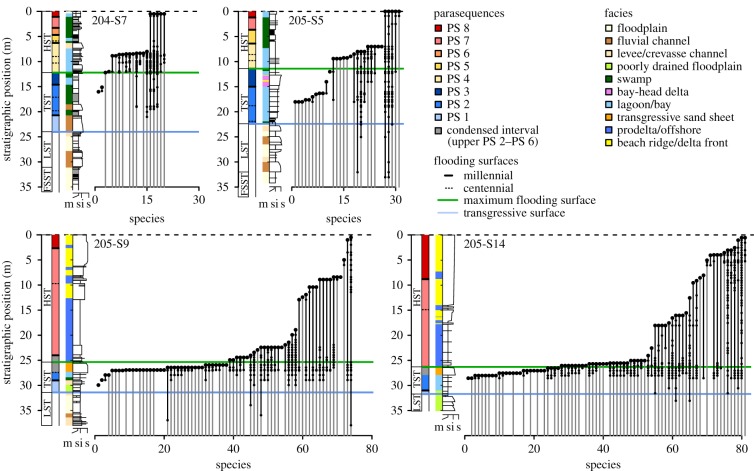
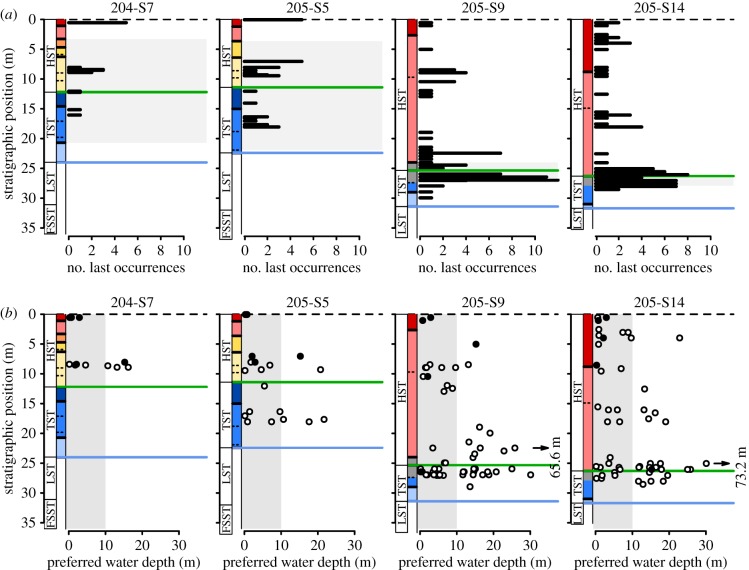
- Only 6 of 119 extant species (5%) reach the top of the sedimentary succession, the hypothetical extinction horizon; LOs instead cluster at intervals of stratigraphic condensation and strong facies shifts, such as around the maximum flooding surface (MFS) in distal cores and within parasequence 4 in proximal cores.
- Combining cores reduces range truncation: for 30 of 64 species recorded in more than one core, LOs shifted upward to a younger parasequence, but only 16 species (13%) reach the youngest parasequence 8, and 67 species (56%) do not range beyond the condensed interval around the MFS.
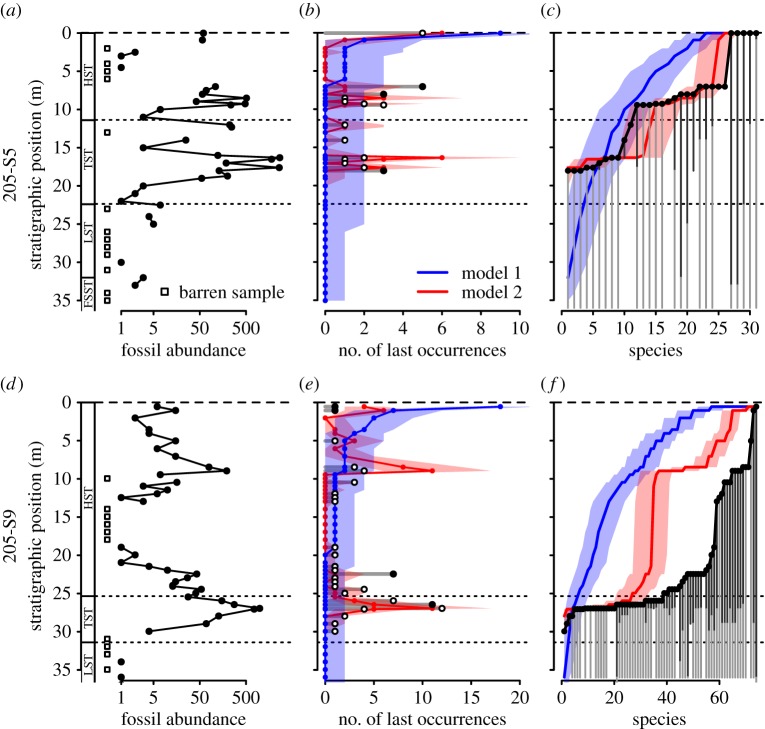
- Null simulations assuming uniform sampling produce gradual downward smearing of LOs, whereas simulations incorporating observed fossil-abundance changes produce stepwise LO patterns and predict many proximal LO clusters; distal-core LO clusters remain incongruent with abundance alone, implicating facies control.
- Classical 95% confidence intervals fail to reach the top of the succession for 44%, 55%, 74% and 79% of species in cores 205-S5, 204-S7, 205-S14 and 205-S9, respectively; ordination-based intervals reduce these to 0%, 12%, 52% and 23%. The likelihood-ratio test incorrectly rejects simultaneous extinction in three of four cores (p = 0.17 for core 205-S5 and p < 0.001 for the remaining cores).
Methods
- The study used four cores through the topmost 40 m of the Holocene Po coastal plain succession, forming an L-shaped 35 km transect; 229 bulk samples of about 10 cm core interval were collected with average vertical spacing of 0.57 m (range 0.05–1.52 m), yielding 119 species and 38,093 specimens.
- Present-day bathymetric preferences were estimated from the ENEA Italian Mollusc Census Database using 403 Adriatic shelf samples from 0 to 124 m water depth, containing approximately 240,000 individuals of 439 species; preferred water depth was estimated for 72 of 119 species (60.5%).
- Analyses included empirically calibrated resampling null models (uniform sampling versus abundance-varying sampling), graphical abundance–LO relationships, a likelihood-ratio test for simultaneous extinction, a two-step algorithm for number of extinction pulses, and comparison of Strauss–Sadler versus ordination-based confidence intervals; all analyses were performed in R.
Limitations
- The paper states that brackish habitats are underrepresented in the ENEA database, which may overestimate water depths for species reaching peak abundance in brackish conditions; it also states that datasets restricted to individual outcrops or local composite sections are unlikely to fully capture a taxon’s environmental and stratigraphic distribution, and extrapolating local patterns to regional or global scales is problematic.
- The paper notes that combining data from multiple sections may reduce facies and sampling effects but often sacrifices temporal and spatial resolution, and that research strategies accounting for stratigraphic architecture are data-intensive and require rigorous palaeoenvironmental and sequence stratigraphic frameworks.
- Evident from the text: the study is based on Holocene extant molluscs from one region and four cores, with a hypothetical extinction horizon at the modern sedimentary surface; its short temporal scale lacks background extinctions, and the findings are presented as an analogue for, rather than a direct observation of, ancient mass extinction records.
Model-written summary. Check it against the paper before relying on it.
Integrity signals
Registry
Cites
Statistics
Figures
Verification
Claims the paper makes
0 Valid · 0 Not valid · 39 Not checked · 73 Own results and interpretations
A result the paper reports from its own data — it cites no other source for it, so there is none to check. The quote shows it is in the paper.
In the paper
“The same interval in core 204-S7, located further updip, records swamp and floodplain deposits mostly devoid of macrofossils (figure 1).”
§ Stratigraphic signatures of mass extinctions: ecological and sedimentary determinants > Results
plainSingle case- Asserted: passes — The authors put it forward as true.
- Checkable: passes — It can be checked against evidence.
- Load-bearing: unclear — It is unclear whether the paper’s conclusions depend on it.
- Based: passes — The paper gives a reason why it holds.
A result the paper states — it cites no source for it, so there is none to check. The quote shows it is in the paper.
In the paper
“The same shallowing trend is manifested in the two proximal cores by a reduction of marine influence in back-barrier settings.”
§ Stratigraphic signatures of mass extinctions: ecological and sedimentary determinants > Results
plainstates an association- Asserted: passes — The authors put it forward as true.
- Checkable: passes — It can be checked against evidence.
- Load-bearing: passes — The paper’s conclusions depend on it.
- Based: passes — The paper gives a reason why it holds.
A result the paper reports from its own data — it cites no other source for it, so there is none to check. The quote shows it is in the paper.
In the paper
“The observed stratigraphic patterns in LOs depart significantly from the null model assuming both facies-independent distribution of species and uniform sampling intensity (model 1 in figure 3; electronic supplementary material, figure S3).”
§ Stratigraphic signatures of mass extinctions: ecological and sedimentary determinants > Results
plain- Asserted: passes — The authors put it forward as true.
- Checkable: passes — It can be checked against evidence.
- Load-bearing: passes — The paper’s conclusions depend on it.
- Based: passes — The paper gives a reason why it holds.
A result the paper reports from its own data — it cites no other source for it, so there is none to check. The quote shows it is in the paper.
In the paper
“However, the distribution of LOs observed in the two distal cores is incongruent with the predictions of model 2.”
§ Stratigraphic signatures of mass extinctions: ecological and sedimentary determinants > Results
plain- Asserted: passes — The authors put it forward as true.
- Checkable: passes — It can be checked against evidence.
- Load-bearing: passes — The paper’s conclusions depend on it.
- Based: passes — The paper gives a reason why it holds.
None of the sources cited for this claim have been checked yet.
In the paper
“Moreover, LOs do not follow a simple gradual pattern predicted by the Signor–Lipps effect [8,25].”
§ Stratigraphic signatures of mass extinctions: ecological and sedimentary determinants > Results
What the sources say
- Not checked yetcites [8] Signor PW, Lipps JH 1982 Sampling bias, gradual extinction patterns and catastrophes in the fossil record. Geol. Soc. Am. Spec. Pap. 190, 291– 296. (10.1130/SPE190-p291) source
- Not checked yetcites [25] Meldahl KH 1990 Sampling, species abundance, and the stratigraphic signature of mass extinction: a test using Holocene tidal flat molluscs. Geology 18, 890– 893. (10.1130/0091-7613(1990)018%3C0890:SSAATS%3E2.3.CO;2) source
plain- Asserted: passes — The authors put it forward as true.
- Checkable: passes — It can be checked against evidence.
- Load-bearing: passes — The paper’s conclusions depend on it.
- Based: passes — The paper gives a reason why it holds.
75 more claims
Create a free account to see all 112 claims and to verify the 79 references still open.
- It may state two separate claims as one. 23
- Probably not a substantial claim. 12
Citations
Cites
Principles of sequence stratigraphy
(2007) · Choice Reviews Online · doi:10.5860/choice.44-4462 · Cited by 1,633
Mollusks as ecosystem engineers: the role of shell production in aquatic habitats
Gutiérrez, J. L., Jones, C. G., Strayer, D. L., & Iribarne, O. O. (2003) · Oikos · doi:10.1034/j.1600-0706.2003.12322.x · Cited by 1,103
Pattern of Marine Mass Extinction Near the Permian-Triassic Boundary in South China
Jin, Y. G., Wang, Y., Wang, W., Shang, Q. H., Cao, C. Q., & Erwin, D. H. (2000) · Science · doi:10.1126/science.289.5478.432 · Cited by 664
Sampling bias, gradual extinction patterns and catastrophes in the fossil record
Signor, P. W., & Lipps, J. H. (1982) · Geological Implications of Impacts of Large Asteroids and Comets on the Earth · doi:10.1130/spe190-p291 · Cited by 600
Biological Extinction in Earth History
Raup, D. M. (1986) · Science · doi:10.1126/science.11542058 · Cited by 456
Two pulses of extinction during the Permian–Triassic crisis
Song, H., Wignall, P. B., Tong, J., & Yin, H. (2013) · Nature Geoscience · doi:10.1038/ngeo1649 · Cited by 434
The Stratigraphy of Shell Concentrations
Kidwell, S. M. (1991) · Topics in Geobiology · doi:10.1007/978-1-4899-5034-5_5 · Cited by 378
Classical confidence intervals and Bayesian probability estimates for ends of local taxon ranges
Strauss, D., & Sadler, P. M. (1989) · Mathematical Geology · doi:10.1007/bf00897326 · Cited by 357
High-resolution sequence stratigraphy of clastic shelves I: Units and bounding surfaces
Zecchin, M., & Catuneanu, O. (2012) · Marine and Petroleum Geology · doi:10.1016/j.marpetgeo.2012.08.015 · Cited by 301
Impact of the terminal Cretaceous event on plant–insect associations
Labandeira, C. C., Johnson, K. R., & Wilf, P. (2002) · Proceedings of the National Academy of Sciences · doi:10.1073/pnas.042492999 · Cited by 286
Sequence Stratigraphy, Biostratigraphy, and Taphonomy in Shallow Marine Environments
Brett, C. E. (1995) · PALAIOS · doi:10.2307/3515097 · Cited by 285
The stratigraphic distribution of fossils
Holland, S. M. (1995) · Paleobiology · doi:10.1017/s0094837300013099 · Cited by 268
Smith, A. B., Gale, A. S., & Monks, N. (2001) · Paleobiology · Cited by 231
Taphonomic Feedback Ecological Consequences of Shell Accumulation
Kidwell, S. M., & Jablonski, D. (1983) · Topics in Geobiology · doi:10.1007/978-1-4757-0740-3_5 · Cited by 209
Confidence intervals on stratigraphic ranges with nonrandom distributions of fossil horizons
Marshall, C. R. (1997) · Paleobiology · doi:10.1017/s0094837300016766 · Cited by 196
The quality of the fossil record: A sequence stratigraphic perspective
Holland, S. M. (2000) · Paleobiology · doi:10.1017/s0094837300026919 · Cited by 182
When did the dodo become extinct?
Roberts, D. L., & Solow, A. R. (2003) · Nature · doi:10.1038/426245a · Cited by 176
Patzkowsky, M. E., & Holland, S. M. (2012) · University of Chicago Press eBooks · doi:10.7208/chicago/9780226649399.001.0001 · Cited by 151
Amorosi, A., Bruno, L., Campo, B., Morelli, A., Rossi, V., Scarponi, D., Hong, W., Bohacs, K. M., & Drexler, T. M. (2017) · Marine and Petroleum Geology · doi:10.1016/j.marpetgeo.2017.01.020 · Cited by 139
Self-citationSudden and Gradual Molluscan Extinctions in the Latest Cretaceous of Western European Tethys
Marshall, C. R., & Ward, P. D. (1996) · Science · doi:10.1126/science.274.5291.1360 · Cited by 137
Amorosi, A., Maselli, V., & Trincardi, F. (2016) · Earth-Science Reviews · doi:10.1016/j.earscirev.2015.10.010 · Cited by 133
Self-citationThe non-uniformity of fossil preservation
Holland, S. M. (2016) · Philosophical Transactions of the Royal Society B: Biological Sciences · doi:10.1098/rstb.2015.0130 · Cited by 117
Stratigraphic paleobiology: understanding the distribution of fossil taxa in time and space
(2012) · Choice Reviews Online · doi:10.5860/choice.50-0901 · Cited by 111
Bond, D. P. G., Wignall, P. B., Joachimski, M. M., Sun, Y., Savov, I., Grasby, S. E., Beauchamp, B., & Blomeier, D. P. G. (2015) · Geological Society of America Bulletin · doi:10.1130/b31216.1 · Cited by 110
Scarponi, D., & Kowalewski, M. (2004) · Geology · doi:10.1130/g20808.1 · Cited by 108
Self-citationQuantifying the process and abruptness of the end-Permian mass extinction
Wang, Y., Sadler, P. M., Shen, S.-Z., Erwin, D. H., Zhang, Y.-C., Wang, X.-D., Wang, W., Crowley, J. L., & Henderson, C. M. (2014) · Paleobiology · doi:10.1666/13022 · Cited by 93
Tomašových, A., & Kidwell, S. M. (2010) · Paleobiology · doi:10.1666/08092.1 · Cited by 92
Genus extinction, origination, and the durations of sedimentary hiatuses
Peters, S. E. (2006) · Paleobiology · doi:10.1666/05081.1 · Cited by 89
Sequence stratigraphy and the resolution of the fossil record
Scarponi, D., Kaufman, D., Amorosi, A., & Kowalewski, M. (2013) · Geology · doi:10.1130/g33849.1 · Cited by 89
Self-citationPaleoENM: applying ecological niche modeling to the fossil record
Myers, C., Stigall, A. L., & Lieberman, B. S. (2015) · Paleobiology · doi:10.1017/pab.2014.19 · Cited by 84
Stratigraphic Variation in the Timing of First and Last Occurrences
HOLLAND, S. M., & PATZKOWSKY, M. E. (2002) · PALAIOS · doi:10.1669/0883-1351(2002)017<0134:svitto>2.0.co;2 · Cited by 82
Macrofossil evidence for a rapid and severe Cretaceous–Paleogene mass extinction in Antarctica
Witts, J. D., Whittle, R. J., Wignall, P. B., Crame, J. A., Francis, J. E., Newton, R. J., & Bowman, V. C. (2016) · Nature Communications · doi:10.1038/ncomms11738 · Cited by 81
He, W., Shi, G. R., Twitchett, R. J., Zhang, Y., Zhang, K., Song, H., Yue, M., Wu, S., Wu, H. ‐., Yang, T., et al. (2014) · Geobiology · doi:10.1111/gbi.12119 · Cited by 79
Early Holocene transgressive palaeogeography in the Po coastal plain (northern Italy)
Bruno, L., Bohacs, K. M., Campo, B., Drexler, T. M., Rossi, V., Sammartino, I., Scarponi, D., Hong, W., & Amorosi, A. (2017) · Sedimentology · doi:10.1111/sed.12374 · Cited by 78
Self-citationThe stratigraphy of mass extinction
Holland, S. M., & Patzkowsky, M. E. (2015) · Palaeontology · doi:10.1111/pala.12188 · Cited by 76
Models for simulating the fossil record
Holland, S. M., & Patzkowsky, M. E. (1999) · Geology · doi:10.1130/0091-7613(1999)027<0491:mfstfr>2.3.co;2 · Cited by 74
Differential responses of marine communities to natural and anthropogenic changes
Kowalewski, M., Wittmer, J. M., Dexter, T. A., Amorosi, A., & Scarponi, D. (2015) · Proceedings of the Royal Society B Biological Sciences · doi:10.1098/rspb.2014.2990 · Cited by 65
Self-citationSCARPONI, D., & KOWALEWSKI, M. (2007) · PALAIOS · doi:10.2110/palo.2005.p05-020r · Cited by 57
Self-citationConfidence limits on fossil ranges that account for facies changes
Holland, S. M. (2003) · Paleobiology · doi:10.1666/0094-8373(2003)029<0468:clofrt>2.0.co;2 · Cited by 47
Estimating times of extinction in the fossil record
Wang, S. C., & Marshall, C. R. (2016) · Biology Letters · doi:10.1098/rsbl.2015.0989 · Cited by 45
Graptolite community responses to global climate change and the Late Ordovician mass extinction
Sheets, H. D., Mitchell, C. E., Melchin, M. J., Loxton, J., Štorch, P., Carlucci, K. L., & Hawkins, A. D. (2016) · Proceedings of the National Academy of Sciences · doi:10.1073/pnas.1602102113 · Cited by 37
Wittmer, J. M., Dexter, T. A., Scarponi, D., Amorosi, A., & Kowalewski, M. (2014) · The Journal of Geology · doi:10.1086/677901 · Cited by 36
Self-citationMeldahl, K. H. (1990) · Geology · doi:10.1130/0091-7613(1990)018<0890:ssaats>2.3.co;2 · Cited by 35
Scarponi, D., Azzarone, M., Kusnerik, K., Amorosi, A., Bohacs, K. M., Drexler, T. M., & Kowalewski, M. (2017) · Marine and Petroleum Geology · doi:10.1016/j.marpetgeo.2017.03.031 · Cited by 31
Self-citationConfidence intervals for pulsed mass extinction events
Wang, S. C., & Everson, P. J. (2007) · Paleobiology · doi:10.1666/06056.1 · Cited by 30
Using Confidence Intervals to Quantify the Uncertainty in the End-Points of Stratigraphic Ranges
Marshall, C. R. (2010) · The Paleontological Society Papers · doi:10.1017/s1089332600001911 · Cited by 27
Adaptive credible intervals on stratigraphic ranges when recovery potential is unknown
Wang, S. C., Everson, P. J., Zhou, H. J., Park, D., & Chudzicki, D. J. (2016) · Paleobiology · doi:10.1017/pab.2015.37 · Cited by 25
Jarochowska, E., & Munnecke, A. (2016) · Geological Journal · doi:10.1002/gj.2674 · Cited by 22
Tomašových, A., & Schlögl, J. (2008) · PALAIOS · doi:10.2110/palo.2008.p08-033r · Cited by 21
Trilobite biofacies and sequence stratigraphy: an example from the Upper Ordovician of Oklahoma
Carlucci, J. R., & Westrop, S. R. (2015) · Lethaia · doi:10.1111/let.12107 · Cited by 17
Use of biodiversity hotspots for conservation of Marine Molluscs: a regional approach
Bedulli, D., Bassignani, F., & BRUSCHI, A. (2002) · Mediterranean Marine Science · doi:10.12681/mms.250 · Cited by 17
Jarochowska, E., Ray, D. C., Röstel, P., Worton, G., & Munnecke, A. (2018) · Palaeontology · doi:10.1111/pala.12326 · Cited by 11
Zuschin, M., Harzhauser, M., & Mandic, O. (2011) · Geological Society, London, Special Publications · doi:10.1144/sp358.9 · Cited by 9
Estimating the number of pulses in a mass extinction
Wang, S. C., & Zhong, L. (2018) · Paleobiology · doi:10.1017/pab.2016.30 · Cited by 6
Data from: Stratigraphic signatures of mass extinctions: ecological and sedimentary determinants
Nawrot, R., Scarponi, D., Azzarone, M., Dexter, T. A., Kusnerik, K. M., Wittmer, J. M., Amorosi, A., & Kowalewski, M. (2018) · Data Archiving and Networked Services (DANS) · doi:10.5061/dryad.j9c15ff · Cited by 2
Self-citation(2006)
Research works printed but not linked: 1
- R Core Team. 2018 R: a language and environment for statistical computing. Version 3.4.4. Vienna, Austria: R Foundation for Statistical Computing See http://www.Rproject.org.
Cited by
An early Miocene extinction in pelagic sharks
Sibert, E. C., & Rubin, L. D. (2021) · Science · doi:10.1126/science.aaz3549 · Cited by 62
Danise, S., Clémence, M.-É., Price, G. D., Murphy, D. P., Gómez, J. J. M., & Twitchett, R. J. (2019) · Palaeogeography Palaeoclimatology Palaeoecology · doi:10.1016/j.palaeo.2019.03.039 · Cited by 57
The Stratigraphy of Mass Extinctions and Recoveries
Holland, S. M. (2019) · Annual Review of Earth and Planetary Sciences · doi:10.1146/annurev-earth-071719-054827 · Cited by 55
Amorosi, A., Barbieri, G., Bruno, L., Campo, B., Drexler, T. M., Hong, W., Rossi, V., Sammartino, I., Scarponi, D., Vaiani, S. C., et al. (2019) · Sedimentology · doi:10.1111/sed.12621 · Cited by 55
Self-citationTomášových, A., Kidwell, S. M., Alexander, C., & Kaufman, D. S. (2019) · Paleoceanography and Paleoclimatology · doi:10.1029/2018pa003553 · Cited by 52
Metadata
- Authors
- Nawrot, R., Scarponi, D., Azzarone, M., Dexter, T. A., Kusnerik, K. M., Wittmer, J. M., Amorosi, A., & Kowalewski, M.
- Affiliations
- Florida Museum of Natural History (US)
- University of Bologna (IT)
- College of The Bahamas (BS)
- SUNY Geneseo (US)
- Corresponding author
- Nawrot, Rafał
- ORCID
- Venue
- Proceedings of the Royal Society B: Biological Sciences
- Publisher
- The Royal Society
- Published
- 2018-09-12
- Volume
- 285
- Issue
- 1886
- Pages
- 20181191
- ISSN
- 0080-4649 (ISSN-L)
- 0962-8452
- 1471-2954
- PMC
- PMC6158527
- OpenAlex
- W2892092275
- Cited by
- 38
- References
- 56
- Citations by year
- 2026: 3 · 2025: 5 · 2024: 4 · 2023: 5 · 2022: 5 · 2021: 7 · 2020: 4 · 2019: 5
- FWCI
- 2.07
- Type
- journal article
- Language
- en
- Open access
- hybrid
- doi.org
- Licence
- cc-by
- royalsociety.org/journals/ethics-policies/data-sharing-mining/ (tdm)
- Locations
- Proceedings of the Royal Society B Biological Sciences (publishedVersion, cc-by)
- Europe PMC (PubMed Central) (publishedVersion, cc-by)
- PubMed Central (publishedVersion, cc-by)
- PubMed (publishedVersion)
- Archivio istituzionale della ricerca (Alma Mater Studiorum Università di Bologna) (submittedVersion, cc-by)
- Funders
- National Science Foundation (EAR-0920075, EAR-1559196)
- Topics
- Physical Sciences › Earth and Planetary Sciences › Paleontology › Paleontology and Stratigraphy of Fossils
- Physical Sciences › Earth and Planetary Sciences › Paleontology › Evolution and Paleontology Studies
- Physical Sciences › Earth and Planetary Sciences › Earth-Surface Processes › Geological formations and processes
- Keywords
- mass extinction, sequence stratigraphy, Mollusca, Holocene, relative sea-level change, taphonomy, extinction selectivity
- MeSH terms
- Animals, Ecology, Biological Evolution, Fossils, Italy, Mollusca, Paleontology, Biodiversity, Extinction, Biological
About these checks
Registry, retraction, Cites and statistics results are computed, not judged, with one exception: a printed reference that no index lists is read once by a model before it counts as a citation error. Claims are extracted by a model and kept only when their quote appears verbatim in the text; each cited source is then checked, with a model’s help, for whether it says what the claim relies on. Those verdicts can be wrong — read the claim’s quote and the cited source before relying on one.
A language model drew the claims from the paper on 2026-11-24, under version 3 of the claim definition (model deepseek-v4.1-flash, prompt extract-v3).
A second model labelled each claim on 2026-11-24 (model jev-1.13-20260917, definition revision gold-guideline-v0.2).
Statistics and arithmetic are recomputed, not judged.
Confidence bands are shown only for fields calibrated on our annotated test set. None is calibrated yet, so no band is shown.
What counts as a claim ›How we measure confidence ›How we check this ›
Are you an author, or do you see a problem with this page? Request a review
Data sources
Bibliographic data: Semantic Scholar, OpenAlex, Crossref.
Contains information from the Semantic Scholar Academic Graph Datasets, made available under the ODC Attribution License (ODC-BY 1.0).
Semantic Scholar’s data is described in: Kinney, R., et al. (2023). The Semantic Scholar Open Data Platform. arXiv:2301.10140.
