

The DOI matches its Crossref record; 1 of the 1 references it cites were found in a registry or an index.
Nearly maximal information gain due to time integration in central dogma reactions
Open accessPreprint — published as 10.1016/j.isci.2023.106767 · Paper page
Abstract
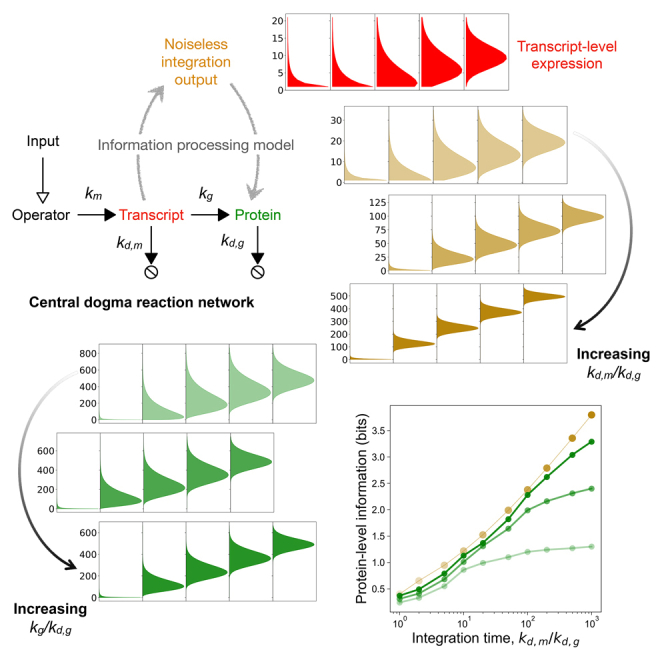
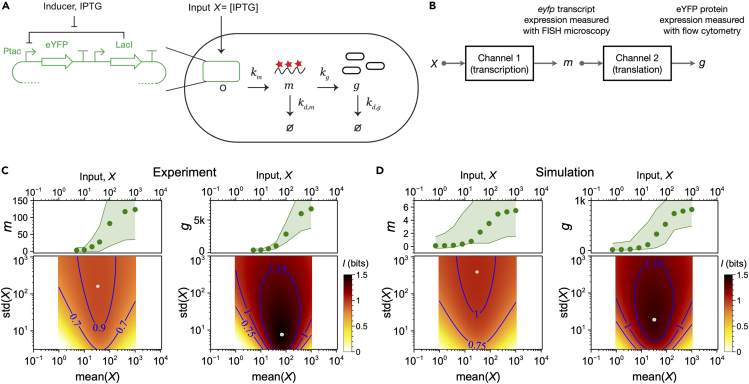
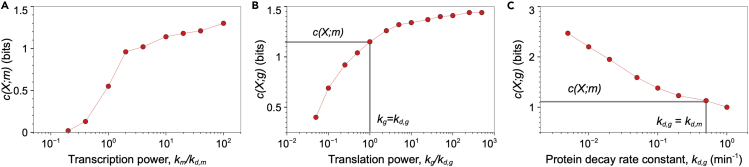
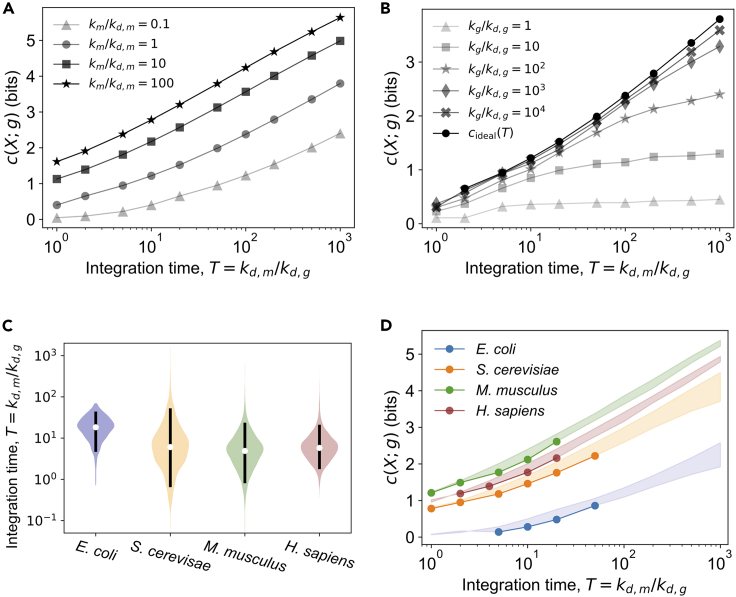
Living cells process information about their environment through the central dogma processes of transcription and translation, which drive the cellular response to stimuli. Here, we study the transfer of information from environmental input to the transcript and protein expression levels. Evaluation of both experimental and analogous simulation data reveals that transcription and translation are not two simple information channels connected in series. Instead, we show that the central dogma reactions often create a time-integrating information channel, where the translation channel receives and integrates multiple outputs from the transcription channel. This information channel model of the central dogma provides new information-theoretic selection criteria for the central dogma rate constants. Using the data for four well-studied species we show that their central dogma rate constants achieve information gain due to time integration while also keeping the loss due to stochasticity in translation relatively low ( < 0.5 bits).
Overview
The claims and statistics of this paper haven’t been checked yet.
Run the check — free, no account needed. It reads the open-access text and checks the sources it cites.
Integrity signals
Registry
Cites
Statistics
Figures
Verification
Claims the paper makes
The claims and statistics of this paper haven’t been checked yet.
Run the check — free, no account needed. It reads the open-access text and checks the sources it cites.
Self-check
Percentages, sums and reported differences re-computed from the paper’s own numbers.
The self-check needs the paper’s full text.
Citations
Cites
Global quantification of mammalian gene expression control
Schwanhäusser, B., Busse, D., Li, N., Dittmar, G., Schuchhardt, J., Wolf, J., Chen, W., & Selbach, M. (2011) · Nature · doi:10.1038/nature10098 · Cited by 6,566
Research works printed but not linked: 42
- 1958, On protein synthesis, in Symp Soc Exp Biol, 12, 8
- 10.1038/227561a0 · DOI · Paper page
- 10.1371/journal.pbio.2003243 · DOI
- 10.1126/science.1204553 · DOI · Paper page
- 10.1073/pnas.0806077105 · DOI · Paper page
- 10.1038/ng.821 · DOI · Paper page
- 10.1073/pnas.1119407109 · DOI
- 10.1126/science.1234511 · DOI
- 10.1016/j.copbio.2014.05.002 · DOI
- 10.1126/science.1254933 · DOI · Paper page
- 2019, The limited information capacity of cross-reactive sensors drives the evolutionary expansion of signaling, Cell systems, 8, 76, 10.1016/j.cels.2018.12.006 · DOI
- 10.1073/pnas.1615660114 · DOI
- 2018, A system for gene expression noise control in yeast, ACS synthetic biology, 7, 2618, 10.1021/acssynbio.8b00279 · DOI
- 2014, Mutual information and the fidelity of response of gene regulatory models, Physical biology, 11, 046004, 10.1088/1478-3975/11/4/046004 · DOI
- 10.7554/eLife.06559 · DOI
- 2014, Information theory and signal transduction systems: from molecular information processing to network inference, in Seminars in cell & developmental biology, 35, 98, 10.1016/j.semcdb.2014.06.011 · DOI
- 2016, Information processing in bacteria: memory, computation, and statistical physics: a key issues review, Reports on Progress in Physics, 79, 052601, 10.1088/0034-4885/79/5/052601 · DOI
- 10.1073/pnas.1716659115 · DOI
- 2018, Single-cell systems biology: probing the basic unit of information flow, Current opinion in systems biology, 8, 7, 10.1016/j.coisb.2017.11.011 · DOI
- 10.1038/s41467-019-10751-7 · DOI
- T. M. Cover , Elements of information theory John Wiley & Sons, 1999).
- J. Rammohan , S. Lund , N. Alperovich , V. Paralanov , E. Strychalski , and D. Ross , Comparison of bias and resolvability in single-cell and single-transcript methods, Submitted to Communications Biology (2020). · doi:10.21203/rs.3.rs-84848/v1
- J. Rammohan , Results of single-cell and single-transcript measurements collected for bias and resolvability attribution using split samples (brass) study, National Institute of Standards and Technology (2020), https://doi.org/10.18434/mds2-2300 (Accessed 2021-08-30). · DOI
- W. Bialek , Biophysics: searching for principles (Princeton University Press, 2012).
- 10.1038/s42003-020-01145-3 · DOI
- 1978, The capacity of a channel of the poisson type, Theory of Probability & Its Applications, 23, 143, 10.1137/1123013 · DOI
- 2008, On the capacity of the discrete-time poisson channel, IEEE Transactions on Information Theory, 55, 303
- 1955, On binary channels and their cascades, IRE Transactions on Information Theory, 1, 19, 10.1109/TIT.1955.1055138 · DOI
- 1993, On the capacity of a cascade of channels, IEEE Transactions on Information Theory, 39, 1310, 10.1109/18.243448 · DOI
- 2007, On capacity of line networks, IEEE Transactions on Information Theory, 53, 4039, 10.1109/TIT.2007.907513 · DOI
- 10.1073/pnas.112318199 · DOI · Paper page
- 2021, Harnessing machine learning to unravel protein degradation in escherichia coli, Msystems, 6, e01296
- 10.1002/msb.134886 · DOI
- 10.1073/pnas.0605420103 · DOI · Paper page
- 10.1093/nar/gkp542 · DOI · Paper page
- 10.1021/pr101183k · DOI · Paper page
- 10.1006/tpbi.1995.1027 · DOI · Paper page
- 10.1007/s00438-003-0883-6 · DOI · Paper page
- 2020, Biphasic cell-size and growth-rate homeostasis by single bacillus subtilis cells, Current Biology, 30, 2238, 10.1016/j.cub.2020.04.030 · DOI
- 1994, Information theoretic considerations for cellular mobile radio, IEEE transactions on Vehicular Technology, 43, 359, 10.1109/25.293655 · DOI
- 2003, Capacity bounds via duality with applications to multiple-antenna systems on flat-fading channels, IEEE Transactions on Information Theory, 49, 2426, 10.1109/TIT.2003.817449 · DOI · Paper page
- 2004, Formalization of the mesf unit of fluorescence intensity, Cytometry Part B: Clinical Cytometry: The Journal of the International Society for Analytical Cytology, 57, 1
Metadata
- Authors
- Sarkar, S., & Rammohan, J.
- Affiliations
- National Institute of Standards and Technology (US)
- Corresponding author
- Sarkar, Swarnavo
- Venue
- iScience
- Publisher
- openRxiv
- Published
- 2022-01-04
- Volume
- 26
- Issue
- 6
- Pages
- 106767-106767
- ISSN
- 2589-0042 (ISSN-L)
- PMC
- PMC10206154
- OpenAlex
- W4367295967
- Cited by
- 0
- References
- 1
- FWCI
- 0.00
- Type
- journal article
- Language
- en
- Open access
- gold
- doi.org
- Licence
- cc-by
- Locations
- iScience (publishedVersion, cc-by)
- bioRxiv (Cold Spring Harbor Laboratory) (acceptedVersion)
- PubMed Central (publishedVersion, cc-by)
- PubMed (publishedVersion)
- DOAJ (DOAJ: Directory of Open Access Journals) (submittedVersion, cc-by-sa)
- Topics
- Life Sciences › Biochemistry, Genetics and Molecular Biology › Molecular Biology › Gene Regulatory Network Analysis
- Life Sciences › Biochemistry, Genetics and Molecular Biology › Molecular Biology › RNA and protein synthesis mechanisms
- Physical Sciences › Physics and Astronomy › Statistical and Nonlinear Physics › Advanced Thermodynamics and Statistical Mechanics
- Keywords
- central dogma, information transmission, time integration, transcription, translation (biology), information gain, rate constants, cellular information processing
About these checks
Registry, retraction, Cites and statistics results are computed, not judged, with one exception: a printed reference that no index lists is read once by a model before it counts as a citation error. Claims are extracted by a model and kept only when their quote appears verbatim in the text; each cited source is then checked, with a model’s help, for whether it says what the claim relies on. Those verdicts can be wrong — read the claim’s quote and the cited source before relying on one.
Statistics and arithmetic are recomputed, not judged.
Confidence bands are shown only for fields calibrated on our annotated test set. None is calibrated yet, so no band is shown.
What counts as a claim ›How we measure confidence ›How we check this ›
Are you an author, or do you see a problem with this page? Request a review
How to cite
Cite CoChat for the checks on this page, and the paper for its own findings.
- This page
- CoChat. (2026). Citation check: Nearly maximal information gain due to time integration in central dogma reactions. https://app.cochat.ai/papers/10.1101/2022.01.02.474710
- The paper
- Sarkar, S., & Rammohan, J. (2022). Nearly maximal information gain due to time integration in central dogma reactions. iScience. https://doi.org/10.1101/2022.01.02.474710
Data sources
Bibliographic data: Semantic Scholar, OpenAlex, Crossref.
Contains information from the Semantic Scholar Academic Graph Datasets, made available under the ODC Attribution License (ODC-BY 1.0).
Semantic Scholar’s data is described in: Kinney, R., et al. (2023). The Semantic Scholar Open Data Platform. arXiv:2301.10140.
