

The DOI matches its Crossref record; 44 of the 46 references it cites were found in a registry or an index.
SARS-CoV-2 infection in Africa: A systematic review and meta-analysis of standardised seroprevalence studies, from January 2020 to December 2021
Open accessPreprint — published as 10.1136/bmjgh-2022-008793
Abstract
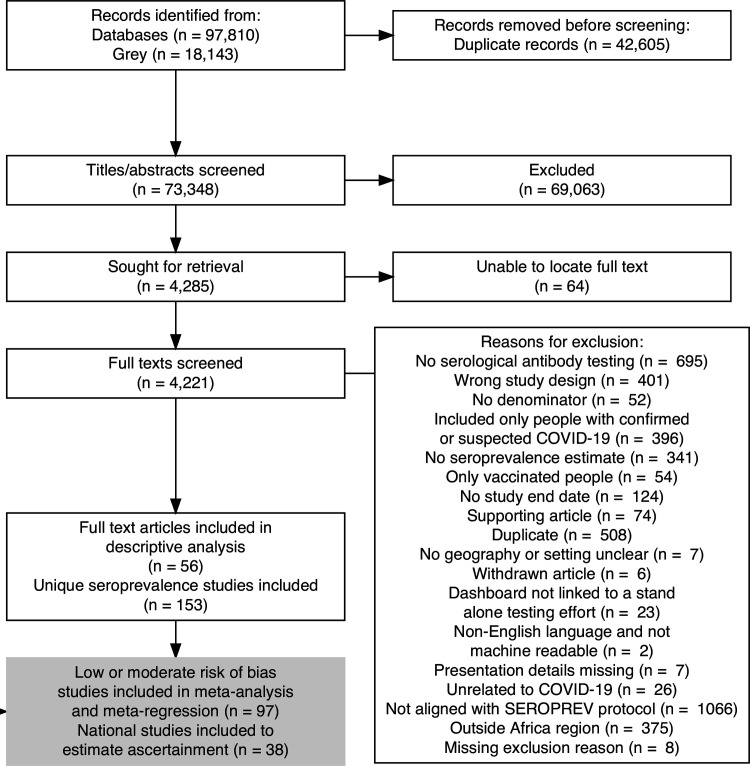
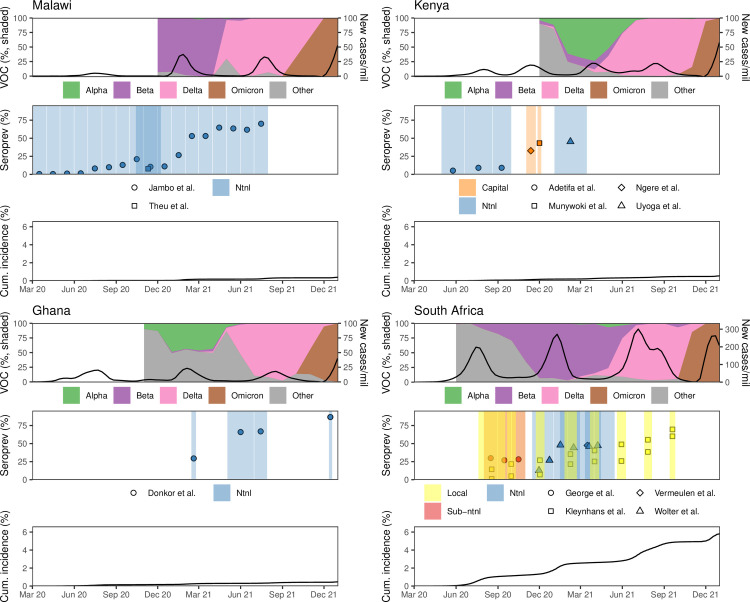
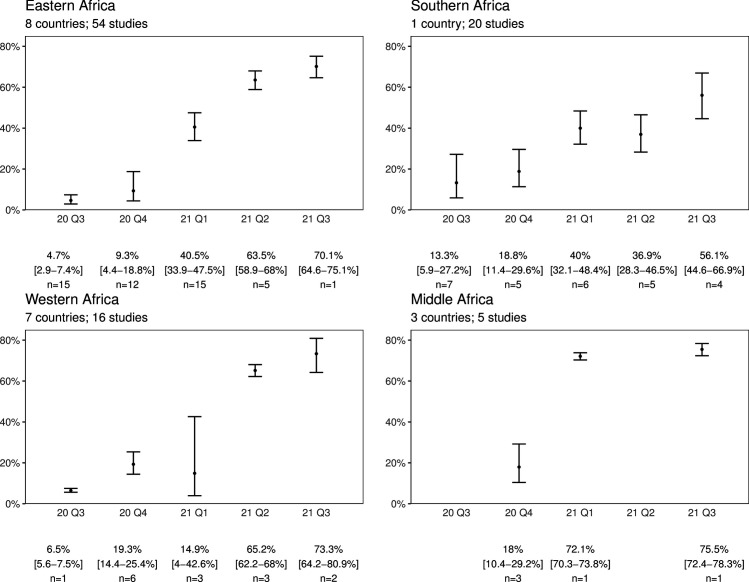
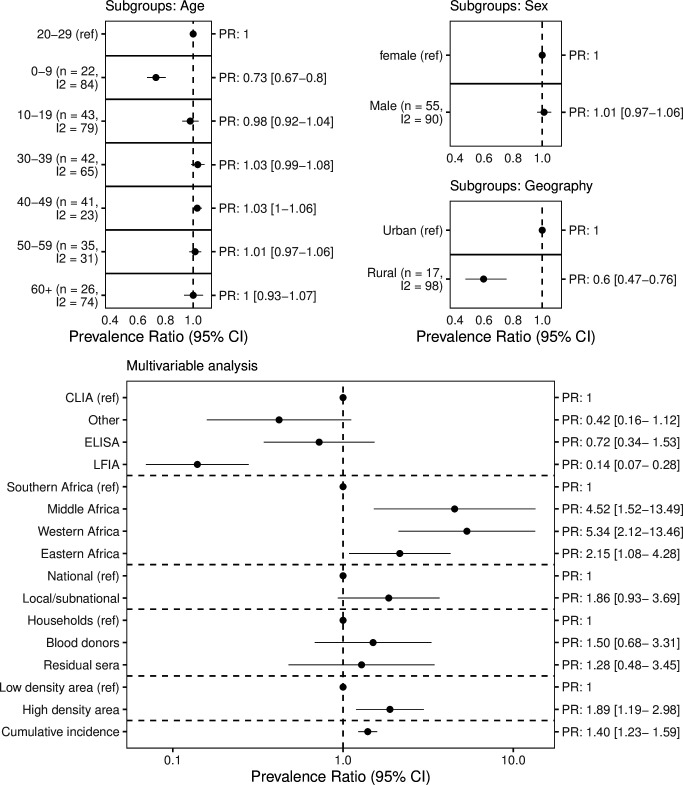
INTRODUCTION: Estimating COVID-19 cumulative incidence in Africa remains problematic due to challenges in contact tracing, routine surveillance systems and laboratory testing capacities and strategies. We undertook a meta-analysis of population-based seroprevalence studies to estimate SARS-CoV-2 seroprevalence in Africa to inform evidence-based decision making on public health and social measures (PHSM) and vaccine strategy. METHODS: We searched for seroprevalence studies conducted in Africa published 1 January 2020-30 December 2021 in Medline, Embase, Web of Science and Europe PMC (preprints), grey literature, media releases and early results from WHO Unity studies. All studies were screened, extracted, assessed for risk of bias and evaluated for alignment with the WHO Unity seroprevalence protocol. We conducted descriptive analyses of seroprevalence and meta-analysed seroprevalence differences by demographic groups, place and time. We estimated the extent of undetected infections by comparing seroprevalence and cumulative incidence of confirmed cases reported to WHO. PROSPERO: CRD42020183634. RESULTS: We identified 56 full texts or early results, reporting 153 distinct seroprevalence studies in Africa. Of these, 97 (63%) were low/moderate risk of bias studies. SARS-CoV-2 seroprevalence rose from 3.0% (95% CI 1.0% to 9.2%) in April-June 2020 to 65.1% (95% CI 56.3% to 73.0%) in July-September 2021. The ratios of seroprevalence from infection to cumulative incidence of confirmed cases was large (overall: 100:1, ranging from 18:1 to 954:1) and steady over time. Seroprevalence was highly heterogeneous both within countries-urban versus rural (lower seroprevalence for rural geographic areas), children versus adults (children aged 0-9 years had the lowest seroprevalence)-and between countries and African subregions. CONCLUSION: We report high seroprevalence in Africa suggesting greater population exposure to SARS-CoV-2 and potential protection against COVID-19 severe disease than indicated by surveillance data. As seroprevalence was heterogeneous, targeted PHSM and vaccination strategies need to be tailored to local epidemiological situations.
Overview
The claims and statistics of this paper haven’t been checked yet.
Run the check — free, no account needed. It reads the open-access text and checks the sources it cites.
Integrity signals
Registry
Cites
Statistics
Figures
Verification
Claims the paper makes
The claims and statistics of this paper haven’t been checked yet.
Run the check — free, no account needed. It reads the open-access text and checks the sources it cites.
Claims other papers make about this one
Each is checked against this paper’s own text: does it say what the citing paper says it does?
In the citing paper
“other studies have done multinational systematic reviews and meta-analyses of seroprevalence surveys.14, 15”
From Estimating global, regional, and national daily and cumulative infections with SARS-CoV-2 through Nov 14, 2021: a statistical analysis (2022) · cites this paper as [14]
Self-check
Percentages, sums and reported differences re-computed from the paper’s own numbers.
The self-check needs the paper’s full text.
Citations
Cites
Fitting Linear Mixed-Effects Models Using lme4
Bates, D., Mächler, M., Bolker, B., & Walker, S. (2015) · Journal of Statistical Software · doi:10.18637/jss.v067.i01 · Cited by 86,835
Munn, Z., Moola, S., Lisy, K., Riitano, D., & Tufanaru, C. (2015) · International Journal of Evidence-Based Healthcare · doi:10.1097/xeb.0000000000000054 · Cited by 3,131
A global database of COVID-19 vaccinations
Mathieu, E., Ritchie, H., Ortiz-Ospina, E., Roser, M., Hasell, J., Appel, C., Giattino, C., & Rodés-Guirao, L. (2021) · Nature Human Behaviour · doi:10.1038/s41562-021-01122-8 · Cited by 1,974
Seow, J., Graham, C., Merrick, B., Acors, S., Pickering, S., Steel, K. J. A., Hemmings, O., O’Byrne, A., Kouphou, N., Galao, R. P., et al. (2020) · Nature Microbiology · doi:10.1038/s41564-020-00813-8 · Cited by 1,419
Evidence for antibody as a protective correlate for COVID-19 vaccines
Earle, K. A., Ambrosino, D. M., Fiore-Gartland, A., Goldblatt, D., Gilbert, P. B., Siber, G. R., Dull, P., & Plotkin, S. A. (2021) · Vaccine · doi:10.1016/j.vaccine.2021.05.063 · Cited by 870
Antibody tests for identification of current and past infection with SARS‐CoV‐2
Geppert, J., Scandrett, K., Bigio, J., Sulis, G., Hettiarachchi, D., Mathangasinghe, Y., Weeratunga, P., Wickramasinghe, D., Bergman, H., Buckley, S. B., et al. (2022) · LSTM Online Archive (Liverpool School of Tropical Medicine) · Cited by 837
Antibody tests for identification of current and past infection with SARS-CoV-2
Deeks, J. J., Dinnes, J., Takwoingi, Y., Davenport, C., Spijker, R., Taylor-Phillips, S., Adriano, A., Beese, S., Dretzke, J., di Ruffano, L. F., et al. (2020) · Cochrane Database of Systematic Reviews · doi:10.1002/14651858.cd013652 · Cited by 649
Ancestral SARS-CoV-2-specific T cells cross-recognize the Omicron variant
Gao, Y., Cai, C., Grifoni, A., Müller, T. R., Niessl, J., Olofsson, A., Humbert, M., Hansson, L., Österborg, A., Bergman, P., et al. (2022) · Nature Medicine · doi:10.1038/s41591-022-01700-x · Cited by 409
How are systematic reviews of prevalence conducted? A methodological study
on behalf of the Prevalence Estimates Reviews – Systematic Review Methodology Group (PERSyst), Borges Migliavaca, C., Stein, C., Colpani, V., Barker, T. H., Munn, Z., & Falavigna, M. (2020) · BMC Medical Research Methodology · doi:10.1186/s12874-020-00975-3 · Cited by 359
Bergeri, I., Whelan, M. G., Ware, H., Subissi, L., Nardone, A., Lewis, H. C., Li, Z., Ma, X., Valenciano, M., Cheng, B., et al. (2022) · PLoS Medicine · doi:10.1371/journal.pmed.1004107 · Cited by 307
Self-citation
Cited by
Sorted by citations
Barber, R. M., Sorensen, R. J. D., Pigott, D. M., Bisignano, C., Carter, A., Amlag, J. O., Collins, J. K., Abbafati, C., Adolph, C., Allorant, A., et al. (2022) · The Lancet · doi:10.1016/s0140-6736(22)00484-6 · Cited by 298
Levin, A. T., Owusu-Boaitey, N., Pugh, S., Fosdick, B. K., Zwi, A. B., Malani, A., Soman, S., Besançon, L., Kashnitsky, I., Ganesh, S., et al. (2022) · BMJ Global Health · doi:10.1136/bmjgh-2022-008477 · Cited by 208
The evolving SARS-CoV-2 epidemic in Africa: Insights from rapidly expanding genomic surveillance
Tegally, H., San, J. E., Cotten, M. L., Moir, M., Tegomoh, B., Mboowa, G., Martin, D. P., Baxter, C., Lambisia, A. W., Diallo, A. B., et al. (2022) · Science · doi:10.1126/science.abq5358 · Cited by 190
Self-citationMüller, S. A., Isaaka, L., Mumm, R., Scheidt‐Nave, C., Heldt, K., Schuster, A., Abdulaziz, M., Bcheraoui, C. E., Hanefeld, J., & Agweyu, A. (2023) · The Lancet Global Health · doi:10.1016/s2214-109x(23)00384-4 · Cited by 61
Counting the global COVID-19 dead
Jha, P., Brown, P. E., & Ansumana, R. (2022) · The Lancet · doi:10.1016/s0140-6736(22)00845-5 · Cited by 49
Metadata
- Authors
- Lewis, H., Ware, H., Whelan, M., Subissi, L., Li, Z., Ma, X., Nardone, A., Valenciano, M., Cheng, B., Noel, K., Cao, C., Yanes-Lane, M., Herring, B., Talisuna, A., Nsenga, N., Balde, T., Clifton, D., Van Kerkhove, M., Buckeridge, D., Bobrovitz, N., Okeibunor, J., Arora, R., Bergeri, I., & the UNITY Studies Collaborator Group
- Affiliations
- University of Calgary (CA)
- World Health Organization (CH)
- University of Waterloo (CA)
- University of Toronto (CA)
- World Health Organization Regional Office for Africa (CG)
- ORCID
- Venue
- BMJ Global Health
- Publisher
- openRxiv
- Published
- 2022-02-15
- Volume
- 7
- Issue
- 8
- Pages
- e008793-e008793
- ISSN
- 2059-7908 (ISSN-L)
- PMC
- PMC9402450
- OpenAlex
- W4292774342
- Cited by
- 177
- References
- 46
- Citations by year
- 2026: 25 · 2025: 30 · 2024: 39 · 2023: 47 · 2022: 36
- FWCI
- 4.07
- Type
- journal article
- Language
- en
- Open access
- gold
- doi.org
- Licence
- cc-by-nc
- Locations
- BMJ Global Health (publishedVersion, cc-by-nc)
- medRxiv (acceptedVersion, cc-by-nc-nd)
- PubMed Central (publishedVersion, cc-by-nc)
- PubMed (publishedVersion)
- HAL (submittedVersion, cc-by-nc-nd)
- HAL (submittedVersion)
- DOAJ (DOAJ: Directory of Open Access Journals) (submittedVersion, cc-by-sa)
- Funders
- World Health Organization
- Public Health Agency of Canada
- Koch Institute for Integrative Cancer Research, Massachusetts Institute of Technology
- Public Health Agency
- Bundesministerium für Gesundheit
- Canadian Medical Association
- Robert Koch Institut
- Centers for Disease Control and Prevention
- Medical Research Council (MR/T008822/1)
- Topics
- Physical Sciences › Mathematics › Modeling and Simulation › COVID-19 epidemiological studies
- Health Sciences › Medicine › Infectious Diseases › SARS-CoV-2 and COVID-19 Research
- Health Sciences › Medicine › Infectious Diseases › SARS-CoV-2 detection and testing
- Keywords
- SARS-CoV-2, COVID-19 pandemic, seroprevalence, Africa, underreporting of infections, urban-rural differences, age differences in infection, subregional variation, public health and social measures, risk of bias assessment, SARS-CoV-2 reinfection
- MeSH terms
- COVID-19, SARS-CoV-2, Adult, Africa, Child, Europe, Humans, Seroepidemiologic Studies
About these checks
Registry, retraction, Cites and statistics results are computed, not judged, with one exception: a printed reference that no index lists is read once by a model before it counts as a citation error. Claims are extracted by a model and kept only when their quote appears verbatim in the text; each cited source is then checked, with a model’s help, for whether it says what the claim relies on. Those verdicts can be wrong — read the claim’s quote and the cited source before relying on one.
Statistics and arithmetic are recomputed, not judged.
Confidence bands are shown only for fields calibrated on our annotated test set. None is calibrated yet, so no band is shown.
What counts as a claim ›How we measure confidence ›How we check this ›
Are you an author, or do you see a problem with this page? Request a review
