PreprintCited by 17Machine Learning in BioinformaticsBacterial Genetics and BiotechnologyProtein Structure and Dynamics

The DOI matches its Crossref record; 1 of the 1 references it cites were found in a registry or an index.

General Features of Transmembrane Beta Barrels From a Large Database

Open access
Montezano, Daniel, Bernstein, Rebecca, Copeland, Matthew M., Slusky, Joanna S. G.·2022·Proceedings of the National Academy of Sciences

Preprint — published as 10.1073/pnas.2220762120 · Paper page

Abstract

Large datasets contribute new insights to subjects formerly investigated by exemplars. We used co-evolution data to create a large, high-quality database of transmembrane β-barrels (TMBB). By applying simple feature detection on generated evolutionary contact maps, our method (IsItABarrel) achieves 95.88% balanced accuracy when discriminating among protein classes. Moreover, comparison with IsItABarrel revealed a high rate of false positives in previous TMBB algorithms. In addition to being more accurate than previous datasets, our database (available online) contains 1,894,206 bacterial TMBB proteins from 20 evolutionary classes, respectively 17 and 2.2 times larger than the previous sets TMBB-DB and OMPdb. We anticipate that due to its quality and size the database will serve as a useful resource where high quality TMBB sequence data is required. We found that TMBBs can be divided into 10 types, three of which have not been previously reported. We find tremendous variance in proteome percentage among TMBB-containing organisms with some using 6.79% of their proteome for TMBBs and others using as little as 0.27% of their proteome. The distribution of the lengths of the TMBBs is suggestive of previously hypothesized duplication events. In addition, we find that the C-terminal β-signal varies among different classes of bacteria though it is most commonly HyGHyGY+F. However, this β-signal is only characteristic of prototypical TMBBs. The nine non-prototypical barrel types have other C-terminal motifs and it remains to be determined if these alternative motifs facilitate TMBB insertion or perform any other signaling function. Significance Statement: Outer membrane proteins (OMPs) control all interactions between Gram negative bacteria and their environments including uptake and efflux of antibiotics. We created an algorithm that identifies bacterial OMPs from sequence. The quality of our algorithm allows us to identify most OMPs (∼1.8 million) from prokaryotic genomes including >240,000 unrelated to previously structurally-resolved OMPs. We identify ten types of OMPs in our database. The largest type’s signal sequence—used for targeting the membrane-insertion machinery—varies by phylogenetic class. All other types of OMPs do not have a related signal sequence, raising new questions of how these proteins fold. Our web-accessible database will allow for further exploration of the varieties of outer membrane proteins to uncover new targets for controlling antibiotic resistance.

Overview

The claims and statistics of this paper haven’t been checked yet.

Run the check — free, no account needed. It reads the open-access text and checks the sources it cites.

A few free checks a day · papers already verified open instantly · results are public

Integrity signals

Registry

Crossref · 10.1101/2022.04.13.488089

Cites

1 of 1 references verified0 citation errors · 0 not checkable

Statistics

Figures

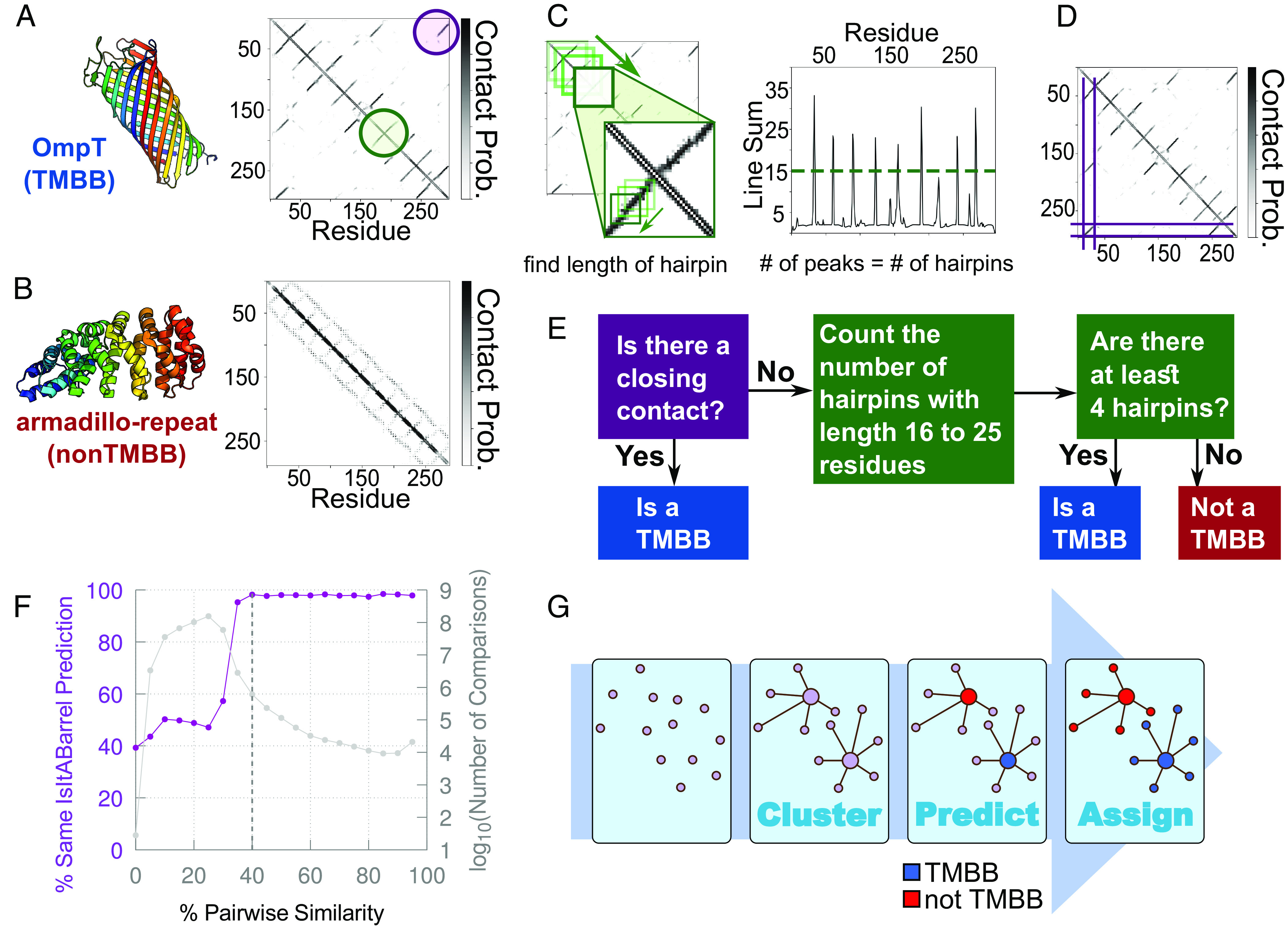
Fig. 1. The IsItABarrel algorithm. (A and B) Structures are colored from N to C terminus using rainbows from blue to red. Probability of contact is indicated by pixel gray value, with darker pixel indicating stronger contact between residues in x and y axis. (A) OmpT (PDB ID: 1I78) (Left) and corresponding contact map predicted by RaptorX-Contact (Right). The map shows typical features of β-barrel proteins, antiparallel contacts between neighboring strands (green circle) and the closing contact between the first and last strands of the barrel (purple circle). (B) Structure of the non-TMBB armadillo-repeat protein (PDB ID: 4V3O) (Left) and corresponding contact map predicted by RaptorX-Contact (Right) without the typical features found in maps of β-barrels. (C) Strand–strand interaction (β-hairpin) detection. Map is scanned along the main diagonal in search of β-hairpins. Detected β-hairpins are characterized in terms of the length of their contact network (Inset). The sum of the contact probabilities along a successfully detected β-hairpin is compared against the threshold for inclusion in the final TMBB classification step. (D) A closing contacts line is detected that aligns with the first and last strands. (E) Classification by IsItABarrel is a two-step process requiring either a closing contact or four hairpins. (F) Sequences sharing more than 40% identity tend to have the same IsItABarrel classification. Percentage of pairs that share the same IsItABarrel prediction (y axis) for each bin of percent similarity (x axis) (purple), total number of comparisons (log10) at each similarity level (gray). Dashed line at 40% pairwise sequence similarity. (G) Steps the algorithm used to assign IsItABarrel predictions by similarity. A large set of sequences is clustered by sequence similarity. IsItABarrel predictions are made for the cluster representatives. Cluster members are assigned the same prediction as their cluster representative.
Fig. 1. The IsItABarrel algorithm. (A and B) Structures are colored from N to C terminus using rainbows from blue to red. Probability of contact is indicated by pixel gray value, with darker pixel indicating stronger contact between residues in x and y axis. (A) OmpT (PDB ID: 1I78) (Left) and corresponding contact map predicted by RaptorX-Contact (Right). The map shows typical features of β-barrel proteins, antiparallel contacts between neighboring strands (green circle) and the closing contact between the first and last strands of the barrel (purple circle). (B) Structure of the non-TMBB armadillo-repeat protein (PDB ID: 4V3O) (Left) and corresponding contact map predicted by RaptorX-Contact (Right) without the typical features found in maps of β-barrels. (C) Strand–strand interaction (β-hairpin) detection. Map is scanned along the main diagonal in search of β-hairpins. Detected β-hairpins are characterized in terms of the length of their contact network (Inset). The sum of the contact probabilities along a successfully detected β-hairpin is compared against the threshold for inclusion in the final TMBB classification step. (D) A closing contacts line is detected that aligns with the first and last strands. (E) Classification by IsItABarrel is a two-step process requiring either a closing contact or four hairpins. (F) Sequences sharing more than 40% identity tend to have the same IsItABarrel classification. Percentage of pairs that share the same IsItABarrel prediction (y axis) for each bin of percent similarity (x axis) (purple), total number of comparisons (log10) at each similarity level (gray). Dashed line at 40% pairwise sequence similarity. (G) Steps the algorithm used to assign IsItABarrel predictions by similarity. A large set of sequences is clustered by sequence similarity. IsItABarrel predictions are made for the cluster representatives. Cluster members are assigned the same prediction as their cluster representative.CC BY-NC-ND · PubMed Central
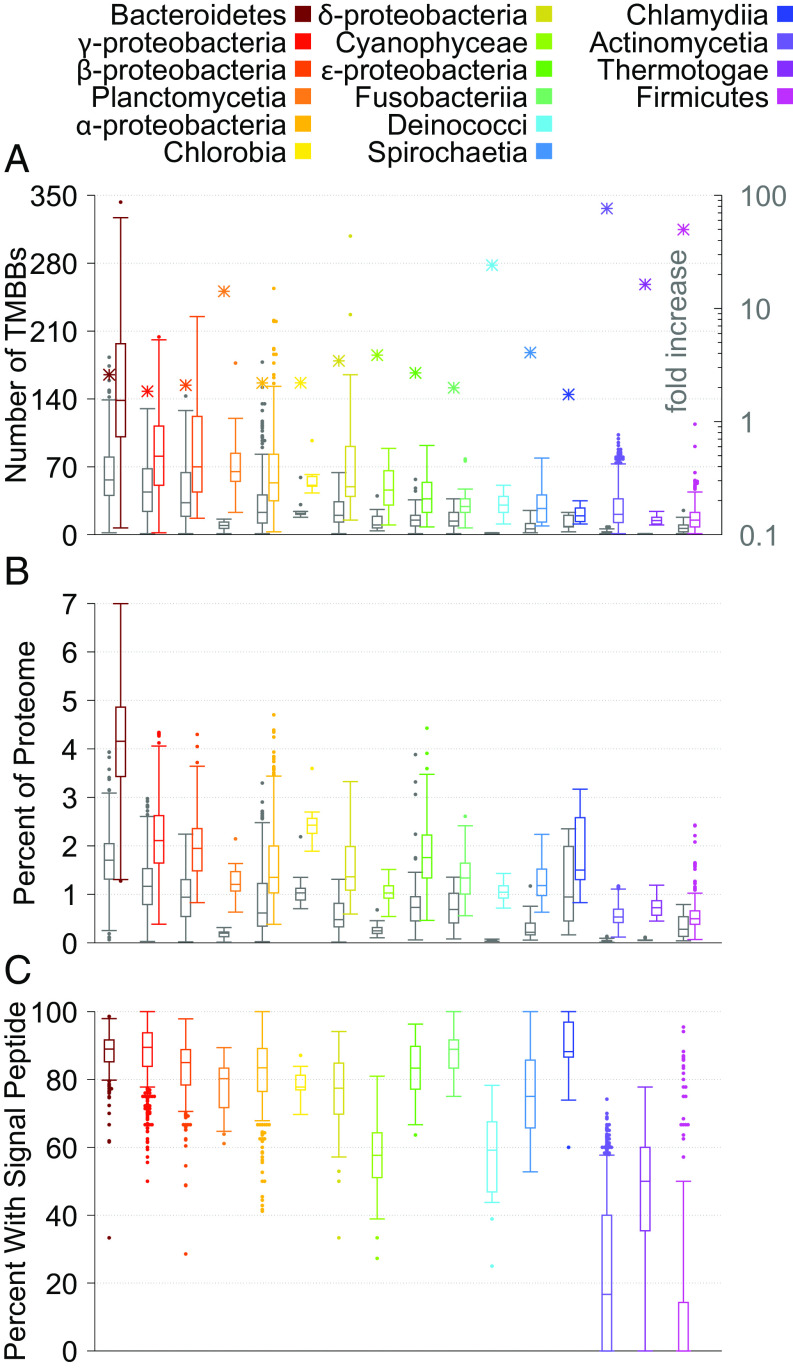
Fig. 2. TMBB content in bacterial proteomes and signal peptide prevalence among organisms. Colored by class/phylum, categories are sorted by decreasing median number of TMBBs. (A) Distribution of number of TMBBs in 2,959 reference and representative bacterial proteomes. TMBBs predicted with IsItABarrel that were within other datasets (gray), and updated numbers after a full search with IsItABarrel (color). Number of TMBB proteins per organism by class/phylum (boxplot), fold increase in number of TMBBs from the initial search (stars using log10 scale at right). (B) Distribution of percentage of proteome predicted to encode TMBB proteins (same organisms as in A). (C) Percent of TMBBs with signal peptide detected by SignalP 5.0 for each organism, grouped by class/phylum.
Fig. 2. TMBB content in bacterial proteomes and signal peptide prevalence among organisms. Colored by class/phylum, categories are sorted by decreasing median number of TMBBs. (A) Distribution of number of TMBBs in 2,959 reference and representative bacterial proteomes. TMBBs predicted with IsItABarrel that were within other datasets (gray), and updated numbers after a full search with IsItABarrel (color). Number of TMBB proteins per organism by class/phylum (boxplot), fold increase in number of TMBBs from the initial search (stars using log10 scale at right). (B) Distribution of percentage of proteome predicted to encode TMBB proteins (same organisms as in A). (C) Percent of TMBBs with signal peptide detected by SignalP 5.0 for each organism, grouped by class/phylum.CC BY-NC-ND · PubMed Central
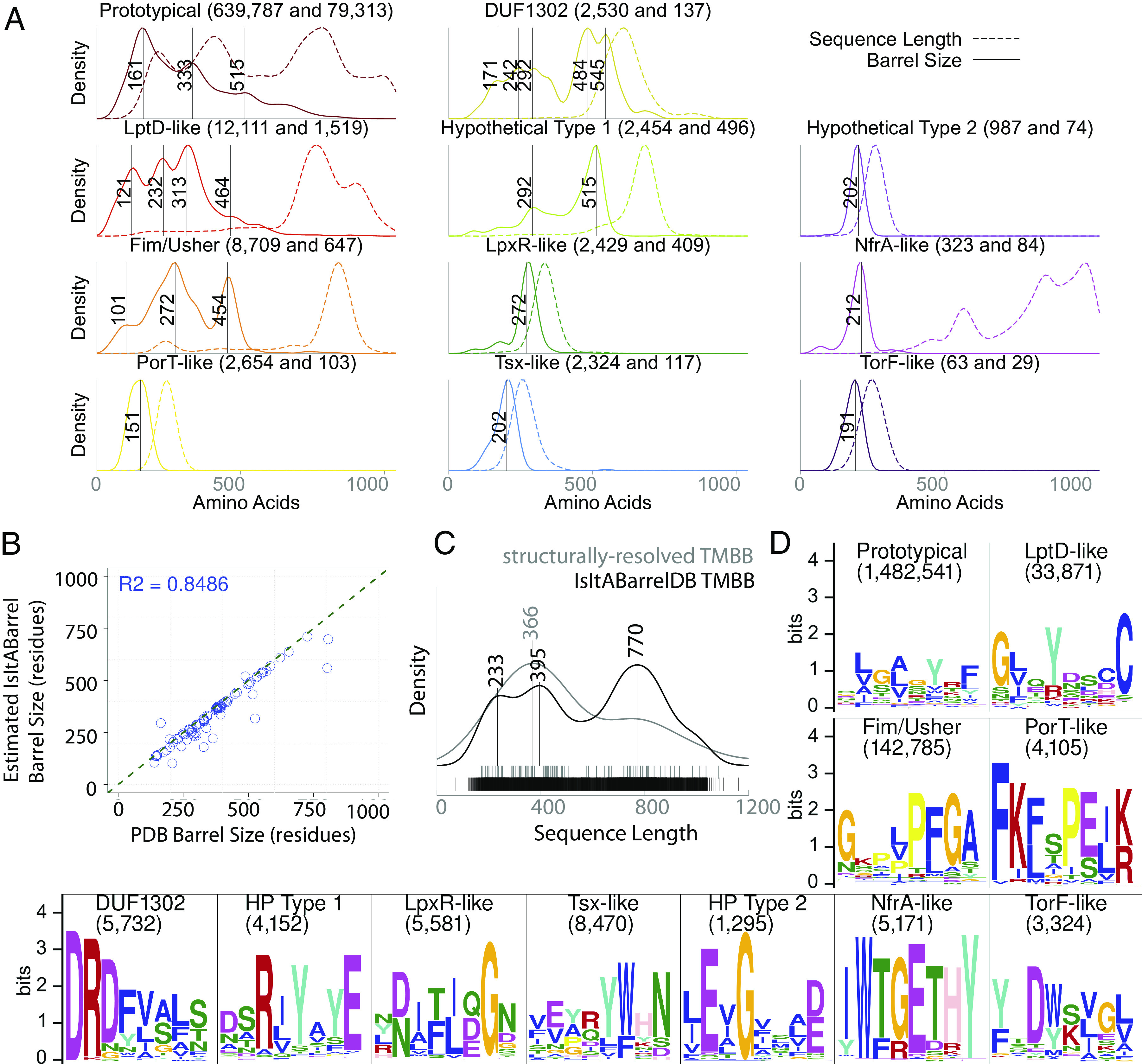
Fig. 3. Analysis of IsItABarrelDB by protein type. (A) Distribution of sequence lengths (dashed lines) and barrel lengths (solid lines) of the eleven largest types of TMBBs in the IsItABarrelDB. Number of TMBBs used to calculate sequence and barrel lengths in parenthesis. Maxima of the barrel sizes are labeled. (B) Correlation between barrel size for structurally resolved barrels and barrel size estimated by IsItABarrel using the closing contact feature. (C) Kernel density estimate of the distribution of sequence lengths for structurally resolved (gray) and IsItABarrelDB (black) TMBBs, rug plot showing instances below. (D) C-terminal sequence motifs found by MEME. Logo plots of motifs found in the C terminus of TMBBs for each protein type. The letters at each position are ordered from top to bottom by most common to least common. The height of each letter is proportional to its frequency in the column, while the height of the stack is adjusted to be the information content expressed in bits of the aligned sequences at that particular position. The colors of the letters indicate physicochemical properties: orange–small, magenta–acidic, blue–hydrophobic plus cysteine, cyan–tyrosine, pink–histidine, green–polar, red–basic, yellow–proline. The number of TMBBs used for the search is at top in parenthesis.
Fig. 3. Analysis of IsItABarrelDB by protein type. (A) Distribution of sequence lengths (dashed lines) and barrel lengths (solid lines) of the eleven largest types of TMBBs in the IsItABarrelDB. Number of TMBBs used to calculate sequence and barrel lengths in parenthesis. Maxima of the barrel sizes are labeled. (B) Correlation between barrel size for structurally resolved barrels and barrel size estimated by IsItABarrel using the closing contact feature. (C) Kernel density estimate of the distribution of sequence lengths for structurally resolved (gray) and IsItABarrelDB (black) TMBBs, rug plot showing instances below. (D) C-terminal sequence motifs found by MEME. Logo plots of motifs found in the C terminus of TMBBs for each protein type. The letters at each position are ordered from top to bottom by most common to least common. The height of each letter is proportional to its frequency in the column, while the height of the stack is adjusted to be the information content expressed in bits of the aligned sequences at that particular position. The colors of the letters indicate physicochemical properties: orange–small, magenta–acidic, blue–hydrophobic plus cysteine, cyan–tyrosine, pink–histidine, green–polar, red–basic, yellow–proline. The number of TMBBs used for the search is at top in parenthesis.CC BY-NC-ND · PubMed Central
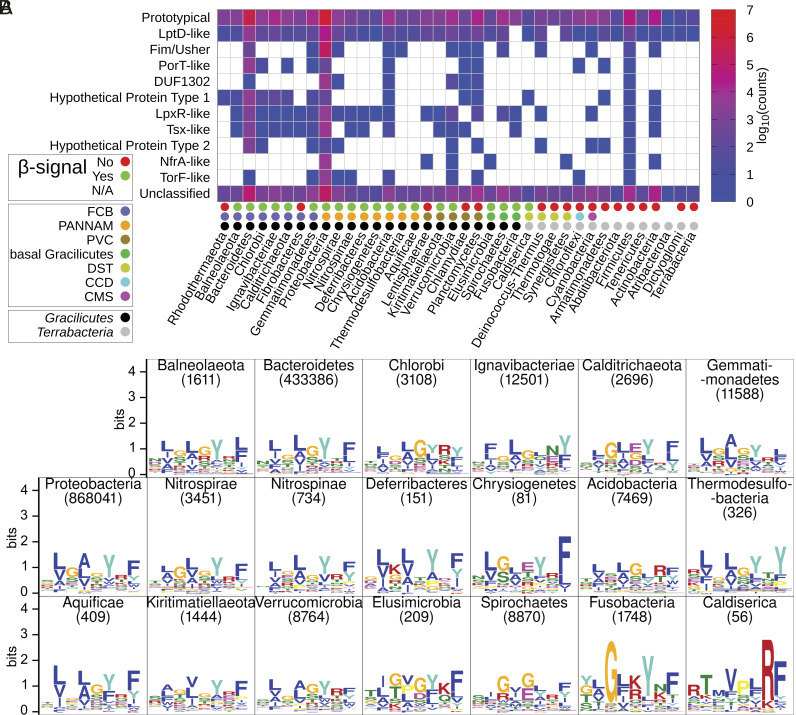
Fig. 4. Analysis of IsItABarrelDB by phylum. (A) The distribution of the eleven protein types and unclassified IsItABarrelDB TMBB sequences among 38 phyla. A red to blue scale indicates greater to fewer numbers of that protein type or no proteins of that type (white). Phyla are organized by Terrabacteria and Gracilicutes (gray and black dots, lowest row), and colored dots that show clades within those categories (middle row), clades are as previously described (48, 49) FCB–Fibrobacteres/Chlorobi/Bacteroidetes, PANNAM–Proteobacteria/Acidobacteria/Nitrospinae/Nitrospirae/Aminicenantes/Methylomirabilis, PVC–Planctomycetes/Verrucomicrobia/Chlamydiae, DST–Deinococcus-Thermus/Synergistetes/Thermotogae, CCD–CPR/Chloroflexi/Dormibacteraeota, CMS–Cyanobacteria/Melainabacteria/Margulisbacteria-Saganbacteria. Dots are also used to indicate the presence of a classic β-signal (top row, red, and green). The Unclassified type across all phyla includes 274,245 sequences. (B) Sequence logos of the prototypical β-signal of each phyla that has a clear traditional β-signal. Logos as described in Fig. 2D. No logo plot was created for Atribacterota because it only contained two proteins.
Fig. 4. Analysis of IsItABarrelDB by phylum. (A) The distribution of the eleven protein types and unclassified IsItABarrelDB TMBB sequences among 38 phyla. A red to blue scale indicates greater to fewer numbers of that protein type or no proteins of that type (white). Phyla are organized by Terrabacteria and Gracilicutes (gray and black dots, lowest row), and colored dots that show clades within those categories (middle row), clades are as previously described (48, 49) FCB–Fibrobacteres/Chlorobi/Bacteroidetes, PANNAM–Proteobacteria/Acidobacteria/Nitrospinae/Nitrospirae/Aminicenantes/Methylomirabilis, PVC–Planctomycetes/Verrucomicrobia/Chlamydiae, DST–Deinococcus-Thermus/Synergistetes/Thermotogae, CCD–CPR/Chloroflexi/Dormibacteraeota, CMS–Cyanobacteria/Melainabacteria/Margulisbacteria-Saganbacteria. Dots are also used to indicate the presence of a classic β-signal (top row, red, and green). The Unclassified type across all phyla includes 274,245 sequences. (B) Sequence logos of the prototypical β-signal of each phyla that has a clear traditional β-signal. Logos as described in Fig. 2D. No logo plot was created for Atribacterota because it only contained two proteins.CC BY-NC-ND · PubMed Central

Verification

Claims the paper makes

The claims and statistics of this paper haven’t been checked yet.

Run the check — free, no account needed. It reads the open-access text and checks the sources it cites.

A few free checks a day · papers already verified open instantly · results are public

Self-check

Percentages, sums and reported differences re-computed from the paper’s own numbers.

The self-check needs the paper’s full text.

Citations

Cites

Research works printed but not linked: 54

  1. 2002, The structure of bacterial outer membrane proteins, Biochimica et Biophysica Acta (BBA) - Biomembranes, 1565, 308, 10.1016/S0005-2736(02)00577-1 · DOI
  2. 10.1093/molbev/msq017 · DOI
  3. M. W. Franklin et al., Evolutionary pathways of repeat protein topology in bacterial outer membrane proteins. Elife 7 (2018). · DOI
  4. 2018, Efflux Pumps Represent Possible Evolutionary Convergence onto the beta-Barrel Fold, Structure, 26, 1266, 10.1016/j.str.2018.06.007 · DOI
  5. S. E. Rollauer , M. A. Sooreshjani , N. Noinaj , S. K. Buchanan , Outer membrane protein biogenesis in Gram-negative bacteria. Philos Trans R Soc Lond B Biol Sci 370 (2015). · DOI
  6. 2021, Membrane Barrels Are Taller, Fatter, Inside-Out Soluble Barrels, J Phys Chem B, 125, 3622, 10.1021/acs.jpcb.1c00878 · DOI
  7. 2002, Toward genomic identification of beta-barrel membrane proteins: composition and architecture of known structures, Protein science : a publication of the Protein Society, 11, 301, 10.1110/ps.29402 · DOI
  8. 2012, A knowledge-based potential highlights unique features of membrane alpha-helical and beta-barrel protein insertion and folding, Protein science : a publication of the Protein Society, 21, 50, 10.1002/pro.758 · DOI
  9. 10.1016/j.jmb.2005.09.094 · DOI
  10. 10.1002/prot.20929 · DOI
  11. 10.1016/S1476-9271(02)00085-3 · DOI
  12. 2002, The beta-barrel finder (BBF) program, allowing identification of outer membrane beta-barrel proteins encoded within prokaryotic genomes, Protein science : a publication of the Protein Society, 11, 2196, 10.1110/ps.0209002 · DOI
  13. 10.1093/bioinformatics/btq308 · DOI
  14. 10.1093/bioinformatics/btw025 · DOI
  15. 10.1093/nar/gkh351 · DOI
  16. 10.1016/j.bpc.2005.04.005 · DOI
  17. 10.1093/bioinformatics/bts233 · DOI
  18. 10.1093/nar/gkl205 · DOI
  19. 10.1002/prot.21788 · DOI
  20. 10.1093/bioinformatics/btw444 · DOI
  21. 10.1073/pnas.1716817115 · DOI
  22. 10.1093/nar/gkl262 · DOI
  23. 10.1186/1471-2105-6-56 · DOI
  24. 10.1093/nar/gkp325 · DOI
  25. 10.1002/prot.20092 · DOI
  26. 10.1093/bioinformatics/btm548 · DOI
  27. 10.1093/bioinformatics/18.suppl_1.S46 · DOI
  28. 10.1186/1471-2105-5-29 · DOI
  29. 10.1093/bioinformatics/btr549 · DOI
  30. 2020, Cascading classifier application for topology prediction of transmembrane beta-barrel proteins, Journal of bioinformatics and computational biology, 18, 2050034, 10.1142/S0219720020500341 · DOI
  31. 10.1093/bioinformatics/bts478 · DOI
  32. 10.1093/nar/gkq863 · DOI
  33. 10.1371/journal.pone.0028766 · DOI · Paper page
  34. 10.1093/bioinformatics/btu500 · DOI
  35. 10.1073/pnas.1314045110 · DOI
  36. 10.1016/0005-2795(75)90109-9 · DOI · Paper page
  37. 2020, One or two membranes? Diderm Firmicutes challenge the Gram-positive/Gram-negative divide, Molecular microbiology, 113, 659, 10.1111/mmi.14469 · DOI
  38. 10.1016/0022-2836(91)90880-F · DOI
  39. 10.1038/s41467-019-11230-9 · DOI
  40. 10.1073/pnas.1322473111 · DOI
  41. X. Wang , J. H. Peterson , H. D. Bernstein , Bacterial Outer Membrane Proteins Are Targeted to the Bam Complex by Two Parallel Mechanisms. mBio 12 (2021). · DOI
  42. 10.1371/journal.pbio.0040377 · DOI
  43. 10.1093/nar/gkv416 · DOI
  44. 10.1073/pnas.1415955112 · DOI
  45. 10.1093/bioinformatics/btt355 · DOI
  46. 10.1021/ja209895m · DOI
  47. 10.1016/S0959-440X(03)00099-X · DOI
  48. 10.1038/nature12447 · DOI
  49. 10.1186/1471-2164-13-510 · DOI
  50. 10.1016/S0092-8674(03)00203-4 · DOI
  51. 10.1093/bioinformatics/btv472 · DOI
  52. 10.1093/nar/gki402 · DOI
  53. 10.1093/nar/gkp786 · DOI
  54. 10.1038/s41587-019-0036-z · DOI

Metadata

Authors
Montezano, D., Bernstein, R., Copeland, M. M., & Slusky, J. S. G.
Affiliations
University of Kansas (US)
Corresponding author
Slusky, Joanna S. G.
Venue
Proceedings of the National Academy of Sciences
Publisher
openRxiv
Published
2022-04-13
Volume
120
Issue
29
Pages
e2220762120-e2220762120
ISSN
0027-8424 (ISSN-L)
OpenAlex
W4383874614
Cited by
17
References
1
Citations by year
2026: 8 · 2025: 3 · 2024: 6
FWCI
1.51
Type
journal article
Language
en
Open access
Licence
cc-by-nc-nd
Locations
  • Proceedings of the National Academy of Sciences (publishedVersion, cc-by-nc-nd)
  • bioRxiv (Cold Spring Harbor Laboratory) (acceptedVersion)
  • PubMed Central (publishedVersion, cc-by-nc-nd)
  • PubMed (publishedVersion)
  • eScholarship (California Digital Library) (submittedVersion, cc-by-nc-nd)
Funders
  • National Science Foundation (2117449, 2226804, P20GM103418)
  • American-Scandinavian Foundation
  • University of Kansas
  • National Institutes of Health
  • Office of Research, University of Kansas
  • National Institute of General Medical Sciences (DP2GM128201, P20GM103418)
Topics
  • Life Sciences › Biochemistry, Genetics and Molecular Biology › Molecular Biology › Machine Learning in Bioinformatics
  • Life Sciences › Biochemistry, Genetics and Molecular Biology › Genetics › Bacterial Genetics and Biotechnology
  • Life Sciences › Biochemistry, Genetics and Molecular Biology › Molecular Biology › Protein Structure and Dynamics
Keywords
transmembrane beta-barrel, bacterial membrane proteins, protein coevolution, protein databases, proteome composition
MeSH terms
Algorithms, Bacterial Proteins, Biological Evolution, Humans, Consensus Sequence, Proteome

About these checks

Registry, retraction, Cites and statistics results are computed, not judged, with one exception: a printed reference that no index lists is read once by a model before it counts as a citation error. Claims are extracted by a model and kept only when their quote appears verbatim in the text; each cited source is then checked, with a model’s help, for whether it says what the claim relies on. Those verdicts can be wrong — read the claim’s quote and the cited source before relying on one.

Statistics and arithmetic are recomputed, not judged.

Confidence bands are shown only for fields calibrated on our annotated test set. None is calibrated yet, so no band is shown.

What counts as a claim ›How we measure confidence ›How we check this ›

Are you an author, or do you see a problem with this page? Request a review