

Engineering Highly Thermostable Cas12b via De Novo Structural Analyses for One-Pot Detection of Nucleic Acids
Open accessPreprint — published as 10.1016/j.xcrm.2023.101037
The DOI matches its Crossref record; 54 of the 54 references it cites were found in a registry or an index.
Abstract
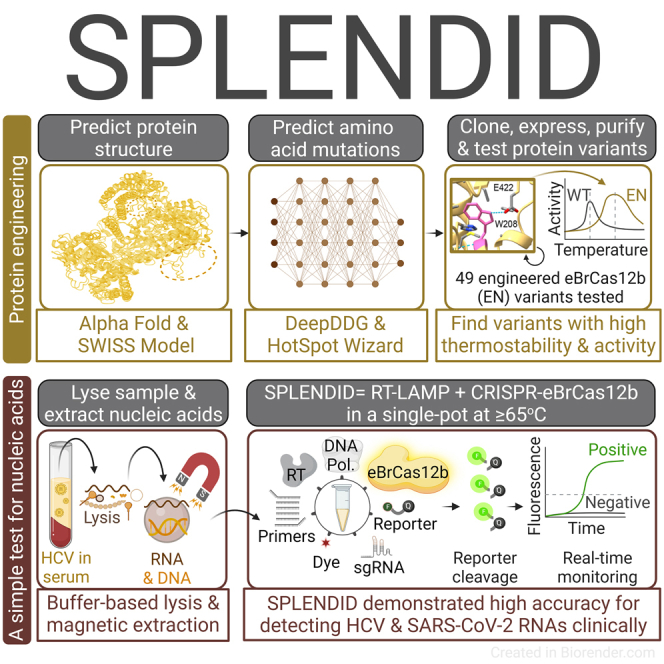
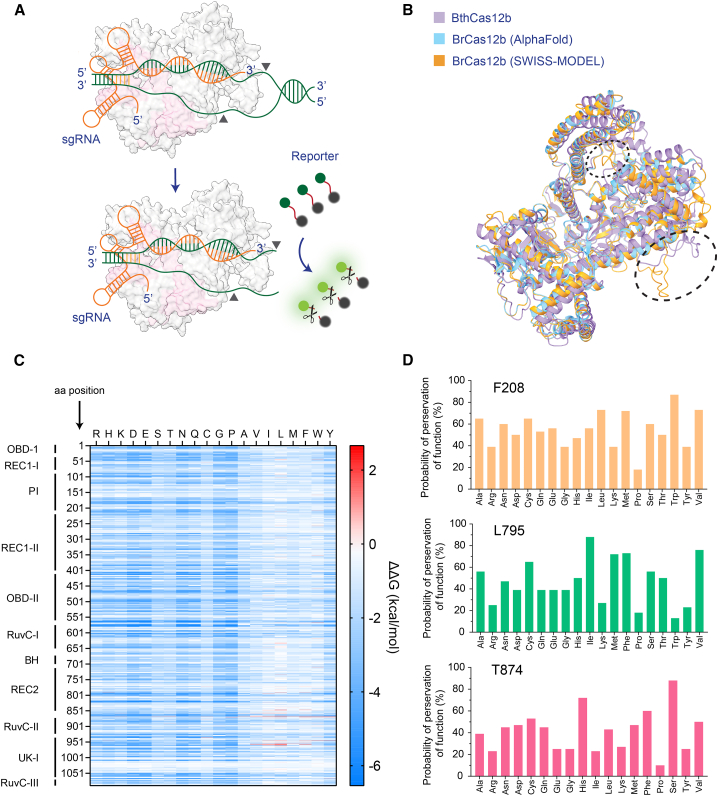
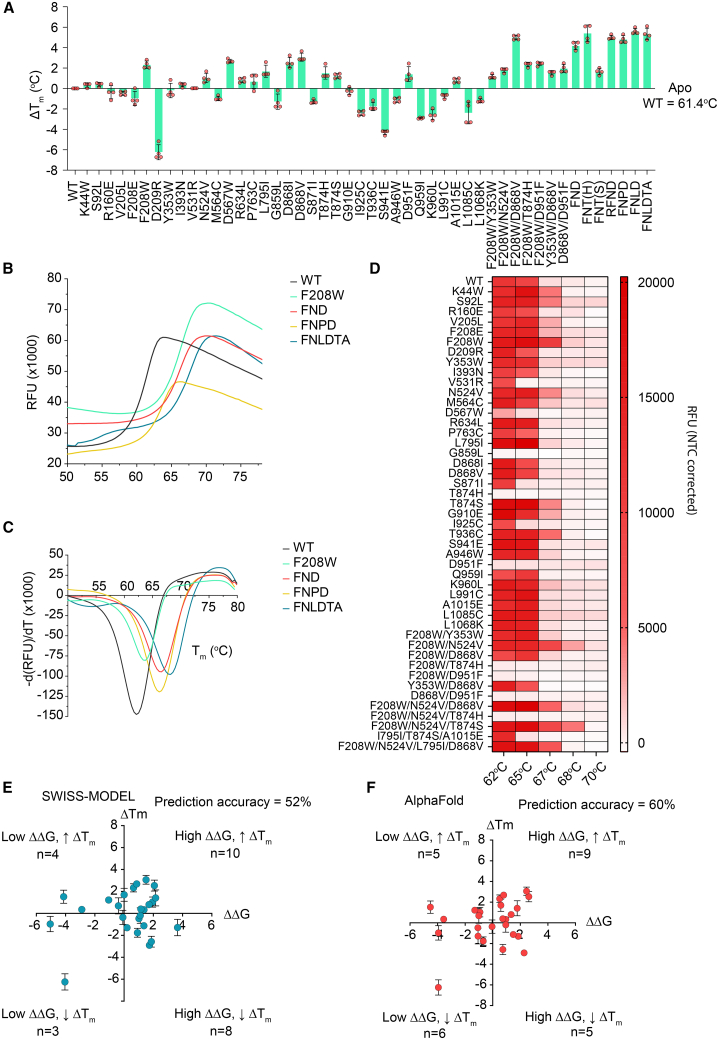
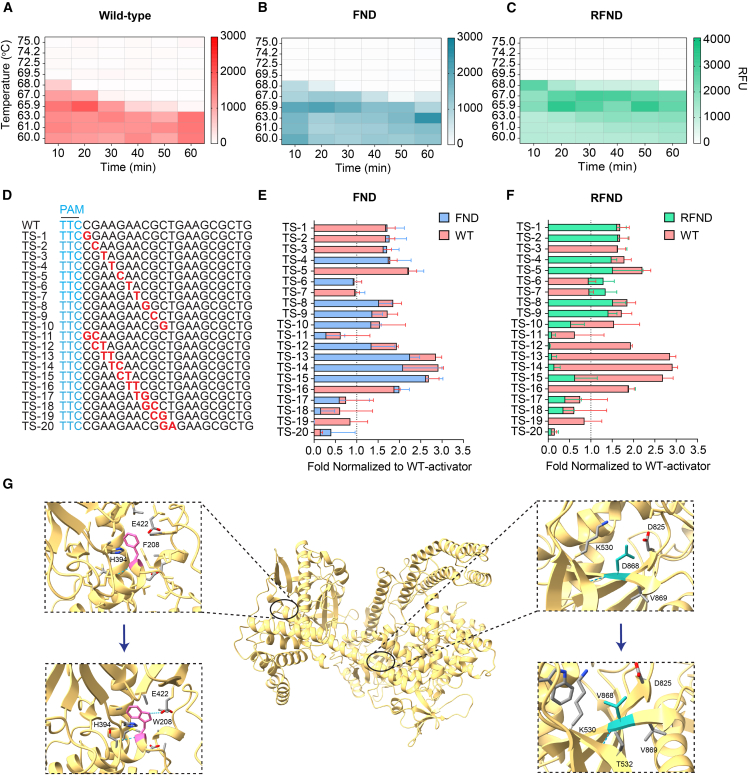
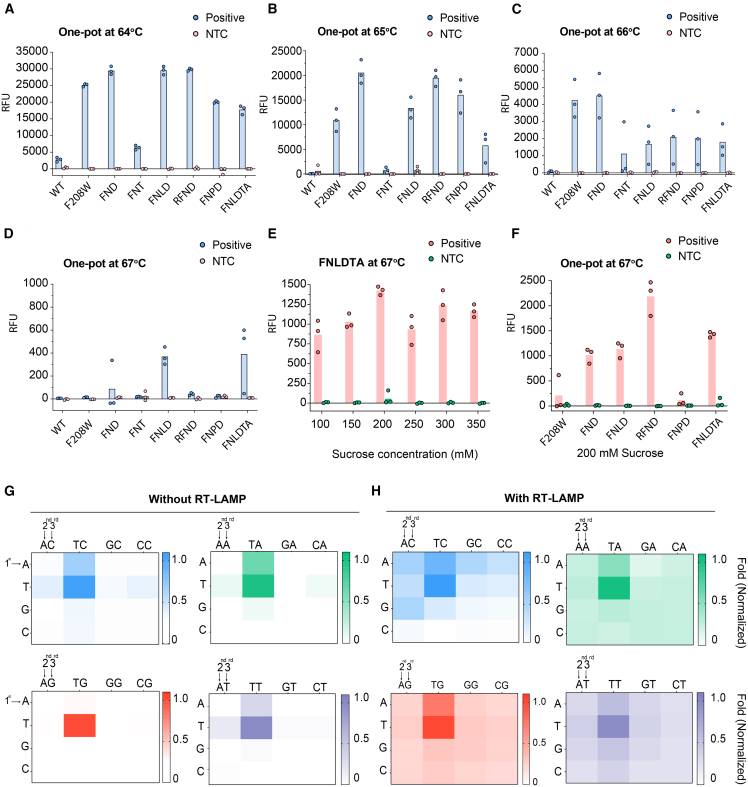
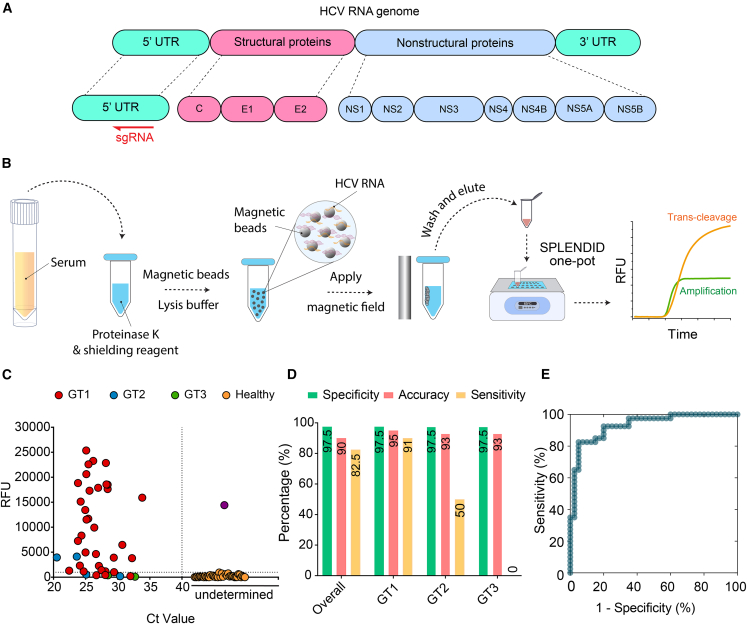
Clustered Regularly Interspaced Short Palindromic Repeats (CRISPR)-based diagnostics have elevated nucleic acid detection in terms of sensitivity, specificity, and rapidity in recent years. CRISPR-Cas systems can be combined with a pre-amplification step in a one-pot reaction to simplify workflow and reduce carryover contamination. Here, we report an engineered Cas12b system from Brevibacillus (eBrCas12b) with improved thermostability that falls within the optimal range (60-65°C) of the Reverse Transcription-Loop-Mediated Isothermal Amplification (RT-LAMP). Using de novo structural analyses via DeepDDG and HotSpot Wizard based on Alpha Fold and SWISS-MODEL predicted structures, mutations were introduced into the REC and RuvC domains of wild-type BrCas12b to tighten the hydrophobic cores of the protein, thereby enhancing its stability at high temperatures. We expressed, purified, and systematically characterized 49 BrCas12b variants with an emphasis on functionality and thermostability. The assay utilizing eBrCas12b, which we coined SPLENDID ( S ingle- p ot L AMP-mediated e ngineered BrCas12b for n ucleic acid d etection of i nfectious d iseases), exhibits robust trans-cleavage activity up to 67°C in a one-pot setting—4°C and 7°C higher than wild-type BrCas12b and AapCas12b, respectively. We further validated SPLENDID clinically in 40 Hepatitis C (HCV) positive and 40 negative serum samples. A specificity of 97.5%, an accuracy of 90.0%, and a sensitivity of 82.5% were achieved. Results can be obtained via one-pot testing in as little as 20 minutes. With the extraction process, the entire assay can be performed in under an hour. Therefore, we believe that SPLENDID has the potential to become a widely universal platform for the detection of infectious diseases.
Overview
The claims and statistics of this paper haven’t been checked yet.
Free: it reads the open-access text and checks the first 5 claims that cite a source we can check. Create a free account to check every claim.
Integrity signals
Registry
Cites
Statistics
Figures
Verification
Claims the paper makes
The claims and statistics of this paper haven’t been checked yet.
Free: it reads the open-access text and checks the first 5 claims that cite a source we can check. Create a free account to check every claim.
Self-check
Percentages, sums and reported differences re-computed from the paper’s own numbers.
The self-check needs the paper’s full text.
Citations
Cites
Highly accurate protein structure prediction with AlphaFold
Jumper, J., Evans, R., Pritzel, A., Green, T., Figurnov, M., Ronneberger, O., Tunyasuvunakool, K., Bates, R., Žídek, A., Potapenko, A., et al. (2021) · Nature · doi:10.1038/s41586-021-03819-2 · Cited by 43,764
SWISS-MODEL: homology modelling of protein structures and complexes
Waterhouse, A., Bertoni, M., Bienert, S., Studer, G., Tauriello, G., Gumienny, R., Heer, F. T., de Beer, T. A. P., Rempfer, C., Bordoli, L., et al. (2018) · Nucleic Acids Research · doi:10.1093/nar/gky427 · Cited by 13,067
ColabFold - Making protein folding accessible to all
Mirdita, M., Schütze, K., Moriwaki, Y., Heo, L., Ovchinnikov, S., & Steinegger, M. (2021) · doi:10.1101/2021.08.15.456425 · Cited by 9,391
Loop-mediated isothermal amplification of DNA
Notomi, T. (2000) · Nucleic Acids Research · doi:10.1093/nar/28.12.e63 · Cited by 8,805
CRISPR-Cas12a target binding unleashes indiscriminate single-stranded DNase activity
Chen, J. S., Ma, E., Harrington, L. B., Da Costa, M., Tian, X., Palefsky, J. M., & Doudna, J. A. (2018) · Science · doi:10.1126/science.aar6245 · Cited by 4,507
Nucleic acid detection with CRISPR-Cas13a/C2c2
Gootenberg, J. S., Abudayyeh, O. O., Lee, J. W., Essletzbichler, P., Dy, A. J., Joung, J., Verdine, V., Donghia, N., Daringer, N. M., Freije, C. A., et al. (2017) · Science · doi:10.1126/science.aam9321 · Cited by 3,844
CRISPR–Cas12-based detection of SARS-CoV-2
Broughton, J. P., Deng, X., Yu, G., Fasching, C. L., Servellita, V., Singh, J., Miao, X., Streithorst, J. A., Granados, A., Sotomayor-Gonzalez, A., et al. (2020) · Nature Biotechnology · doi:10.1038/s41587-020-0513-4 · Cited by 2,717
Multiplexed and portable nucleic acid detection platform with Cas13, Cas12a, and Csm6
Gootenberg, J. S., Abudayyeh, O. O., Kellner, M. J., Joung, J., Collins, J. J., & Zhang, F. (2018) · Science · doi:10.1126/science.aaq0179 · Cited by 2,638
Guex, N., Peitsch, M. C., & Schwede, T. (2009) · ELECTROPHORESIS · doi:10.1002/elps.200900140 · Cited by 2,097
The SWISS-MODEL Repository—new features and functionality
Bienert, S., Waterhouse, A., de Beer, T. A. P., Tauriello, G., Studer, G., Bordoli, L., & Schwede, T. (2017) · Nucleic Acids Research · doi:10.1093/nar/gkw1132 · Cited by 1,745
Research works printed but not linked: 1
- 2021, Accelerated RNA detection using tandem CRISPR nucleases (vol 17, pg 982, 2021), Nat Chem Biol, 17, 1210, 10.1038/s41589-021-00882-8 · DOI
Metadata
- Authors
- Nguyen, L. T., Rananaware, S. R., Yang, L. G., Macaluso, N. C., Ocana-Ortiz, J. E., Meister, K. S., Pizzano, B. L. M., Sandoval, L. S. W., Hautamaki, R. C., Fang, Z. R., Joseph, S. M., Shoemaker, G. M., Carman, D. R., Chang, L., Rakestraw, N. R., Zachary, J. F., Guerra, S., Perez, A., & Jain, P. K.
- Affiliations
- University of Florida (US)
- University of Puerto Rico-Mayaguez (PR)
- Corresponding author
- Jain, Piyush K.
- ORCID
- Venue
- Cell Reports Medicine
- Publisher
- openRxiv
- Published
- 2022-10-04
- Volume
- 4
- Issue
- 5
- Pages
- 101037-101037
- ISSN
- 2666-3791 (ISSN-L)
- PMC
- PMC10213852
- OpenAlex
- W4376121457
- Cited by
- 75
- References
- 54
- Citations by year
- 2026: 22 · 2025: 32 · 2024: 19 · 2023: 2
- FWCI
- 4.33
- Type
- journal article
- Language
- en
- Open access
- gold
- doi.org
- Licence
- cc-by-nc-nd
- Locations
- Cell Reports Medicine (publishedVersion, cc-by-nc-nd)
- SSRN Electronic Journal (publishedVersion)
- medRxiv (acceptedVersion, cc-by-nc-nd)
- PubMed Central (publishedVersion, cc-by-nc-nd)
- PubMed (publishedVersion)
- Funders
- University of Florida
- National Institutes of Health
- National Institute of General Medical Sciences (R35GM147788)
- National Institute of Allergy and Infectious Diseases (R21AI168795, R21AI156321)
- Topics
- Life Sciences › Biochemistry, Genetics and Molecular Biology › Molecular Biology › CRISPR and Genetic Engineering
- Physical Sciences › Engineering › Biomedical Engineering › Biosensors and Analytical Detection
- Health Sciences › Medicine › Infectious Diseases › SARS-CoV-2 detection and testing
- Keywords
- thermostability engineering, CRISPR-Cas diagnostics, RT-LAMP, trans-cleavage activity, COVID-19 detection, point-of-care testing
- MeSH terms
- COVID-19, SARS-CoV-2, COVID-19 Testing, Humans, Nucleic Acids, CRISPR-Cas Systems
About these checks
Registry, retraction, Cites and statistics results are computed, not judged, with one exception: a printed reference that no index lists is read once by a model before it counts as a citation error. Claims are extracted by a model and kept only when their quote appears verbatim in the text; each cited source is then checked, with a model’s help, for whether it says what the claim relies on. Those verdicts can be wrong — read the claim’s quote and the cited source before relying on one.
Statistics and arithmetic are recomputed, not judged.
Confidence bands are shown only for fields calibrated on our annotated test set. None is calibrated yet, so no band is shown.
What counts as a claim ›How we measure confidence ›How we check this ›
Are you an author, or do you see a problem with this page? Request a review
How to cite
Cite CoChat for the checks on this page, and the paper for its own findings.
- This page
- CoChat. (2026). Citation check: Engineering Highly Thermostable Cas12b via De Novo Structural Analyses for One-Pot Detection of Nucleic Acids. https://app.cochat.ai/papers/10.1101/2022.10.02.22280626
- The paper
- Nguyen, L. T., Rananaware, S. R., Yang, L. G., Macaluso, N. C., Ocana-Ortiz, J. E., Meister, K. S., Pizzano, B. L. M., Sandoval, L. S. W., Hautamaki, R. C., Fang, Z. R., Joseph, S. M., Shoemaker, G. M., Carman, D. R., Chang, L., Rakestraw, N. R., Zachary, J. F., Guerra, S., Perez, A., & Jain, P. K. (2022). Engineering Highly Thermostable Cas12b via De Novo Structural Analyses for One-Pot Detection of Nucleic Acids. Cell Reports Medicine. https://doi.org/10.1101/2022.10.02.22280626
Data sources
Bibliographic data: Semantic Scholar, OpenAlex, Crossref.
Contains information from the Semantic Scholar Academic Graph Datasets, made available under the ODC Attribution License (ODC-BY 1.0).
Semantic Scholar’s data is described in: Kinney, R., et al. (2023). The Semantic Scholar Open Data Platform. arXiv:2301.10140.
