

Efflux pump gene amplifications bypass necessity of multiple target mutations for resistance against dual-targeting antibiotic
Open accessPreprint — published as 10.1038/s41467-023-38507-4 · Paper page
The DOI matches its Crossref record; 70 of the 70 references it cites were found in a registry or an index.
Abstract
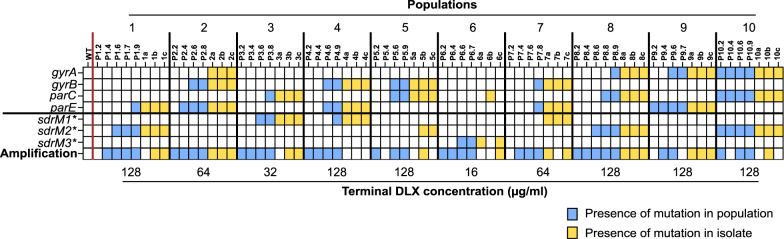
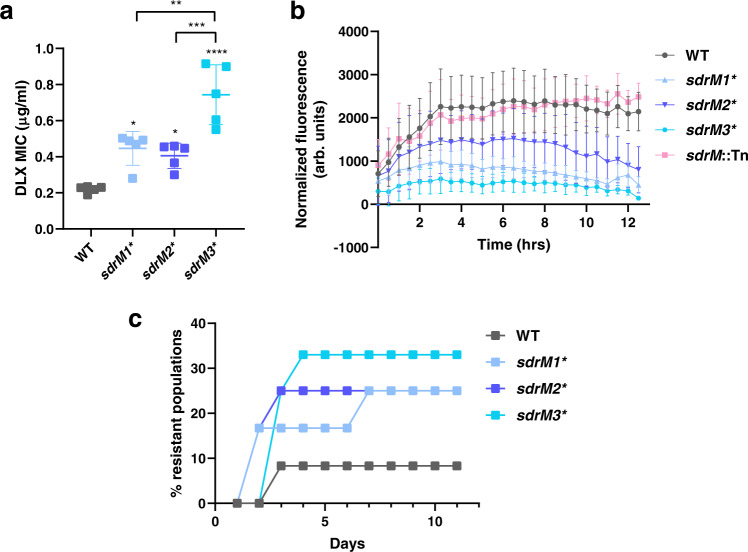
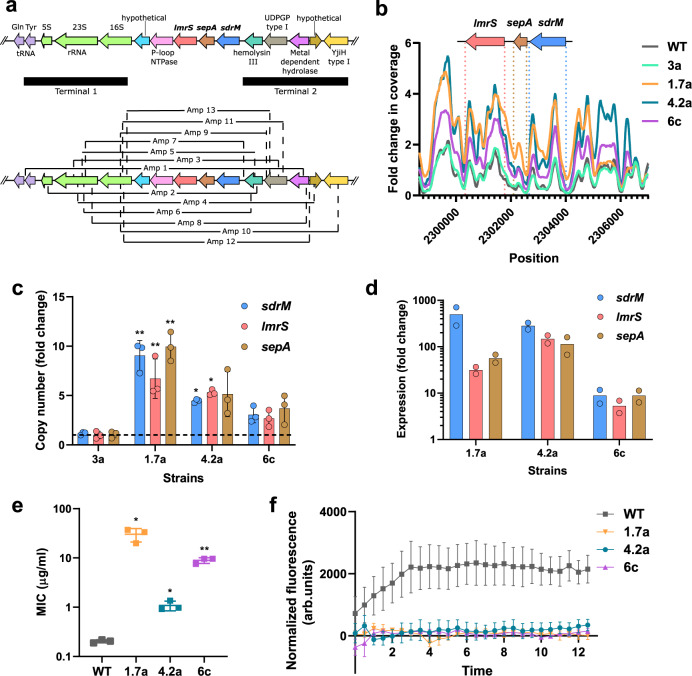
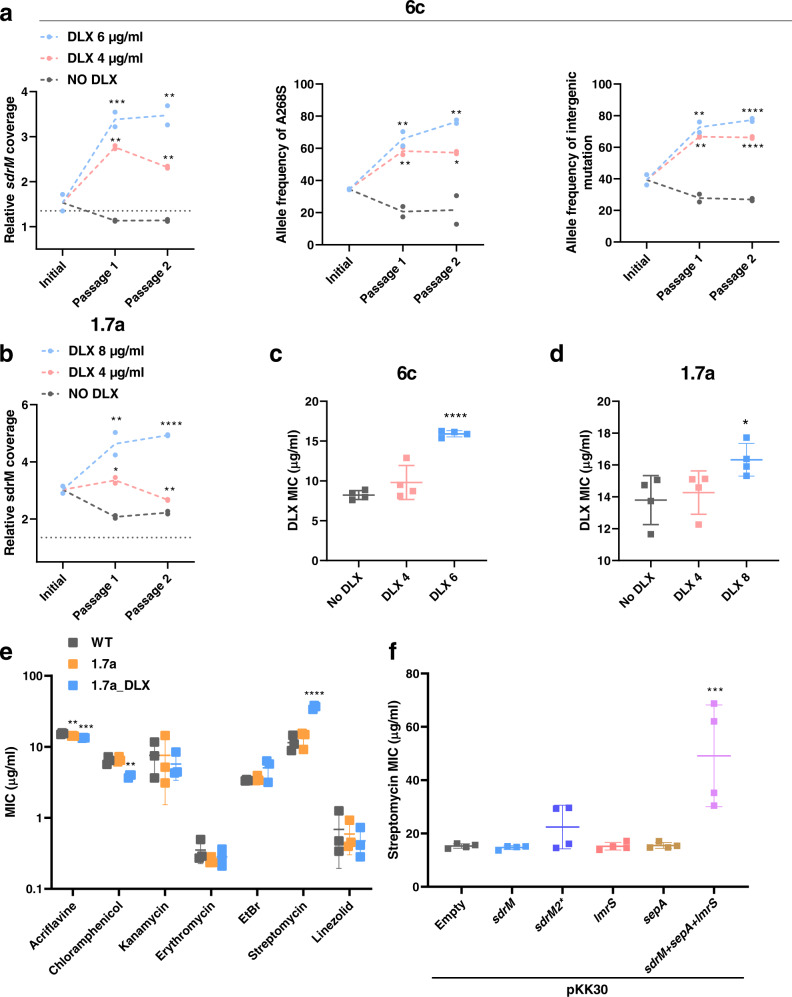
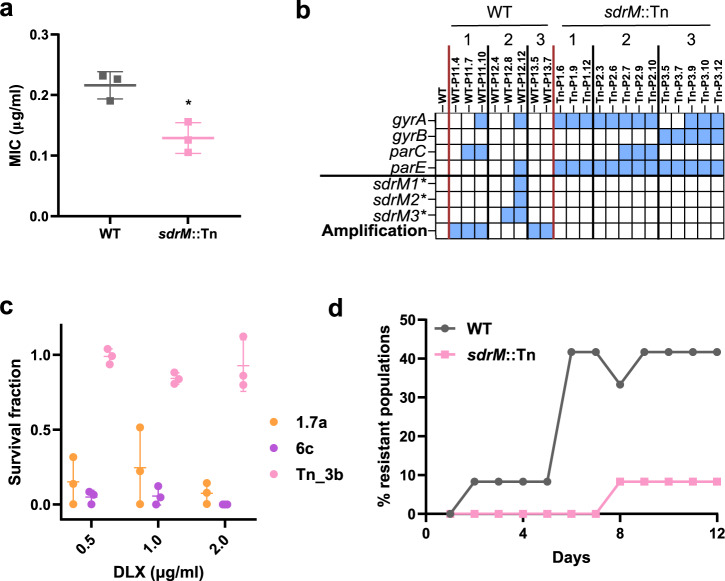
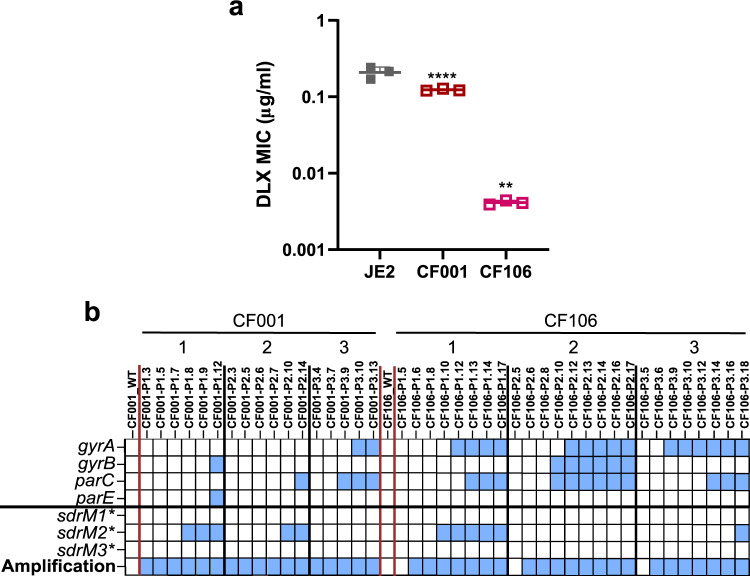
The rise of antimicrobial resistance has motivated the development of antibiotics that have multiple cellular targets, to theoretically reduce the frequency of resistance evolution, but adaptive trajectories and genetic determinants of resistance against such antibiotics are understudied. Here we investigate these in methicillin resistant Staphylococcus aureus (MRSA) using experimental evolution of ten independent populations in the presence of delafloxacin (DLX), a novel fluoroquinolone that targets both DNA gyrase and topoisomerase IV. We show that coding sequence mutations and genomic amplifications of the gene encoding a poorly characterized efflux pump, SdrM, lead to the evolution of high DLX resistance, circumventing the requirement for mutations in the target enzymes. Almost all of our evolved populations had one of two SdrM coding sequence mutations, which led to moderate DLX resistance. Additionally, these populations had 13 distinct genomic amplifications, each containing sdrM and two adjacent genes encoding efflux pumps, which resulted in up to 100-fold higher DLX resistance. While increased sdrM expression provided the selective advantage of the amplification in the DLX evolution, the adjacent efflux pumps hitchhiking in the genomic amplification contributed to cross-resistance against the aminoglycoside streptomycin. Finally, lack of sdrM necessitated mutations in both DNA gyrase and topoisomerase IV to evolve DLX resistance, and the presence of sdrM thus increased the frequency of resistance evolution. Our study highlights that instead of reduced rates of resistance, evolution of resistance to antibiotics with multiple cellular targets can involve alternate high-frequency evolutionary paths such as genomic amplifications of efflux pumps, that may cause unexpected alterations of the fitness landscape, including antibiotic cross-resistance.
Overview
The claims and statistics of this paper haven’t been checked yet.
Free: it reads the open-access text and checks the first 5 claims that cite a source we can check. Create a free account to check every claim.
Integrity signals
Registry
Cites
Statistics
Figures
Verification
Claims the paper makes
The claims and statistics of this paper haven’t been checked yet.
Free: it reads the open-access text and checks the first 5 claims that cite a source we can check. Create a free account to check every claim.
Self-check
Percentages, sums and reported differences re-computed from the paper’s own numbers.
The self-check needs the paper’s full text.
Citations
Cites
Trimmomatic: a flexible trimmer for Illumina sequence data
Bolger, A. M., Lohse, M., & Usadel, B. (2014) · Bioinformatics · doi:10.1093/bioinformatics/btu170 · Cited by 65,548
Highly accurate protein structure prediction with AlphaFold
Jumper, J., Evans, R., Pritzel, A., Green, T., Figurnov, M., Ronneberger, O., Tunyasuvunakool, K., Bates, R., Žídek, A., Potapenko, A., et al. (2021) · Nature · doi:10.1038/s41586-021-03819-2 · Cited by 43,764
Cutadapt removes adapter sequences from high-throughput sequencing reads
Martin, M. (2011) · EMBnet.journal · doi:10.14806/ej.17.1.200 · Cited by 33,889
fastp: an ultra-fast all-in-one FASTQ preprocessor
Chen, S., Zhou, Y., Chen, Y., & Gu, J. (2018) · Bioinformatics · doi:10.1093/bioinformatics/bty560 · Cited by 29,721
Global burden of bacterial antimicrobial resistance in 2019: a systematic analysis
Murray, C. J. L., Ikuta, K. S., Sharara, F., Swetschinski, L., Robles Aguilar, G., Gray, A., Han, C., Bisignano, C., Rao, P., Wool, E., et al. (2022) · The Lancet · doi:10.1016/s0140-6736(21)02724-0 · Cited by 16,316
Szklarczyk, D., Gable, A. L., Nastou, K. C., Lyon, D., Kirsch, R., Pyysalo, S., Doncheva, N. T., Legeay, M., Fang, T., Bork, P., et al. (2021) · Nucleic Acids Research · doi:10.1093/nar/gkaa1074 · Cited by 8,056
Varadi, M., Anyango, S., Deshpande, M., Nair, S., Natassia, C., Yordanova, G., Yuan, D., Stroe, O., Wood, G., Laydon, A., et al. (2022) · Nucleic Acids Research · doi:10.1093/nar/gkab1061 · Cited by 7,850
Klevens, R. M. (2007) · JAMA · doi:10.1001/jama.298.15.1763 · Cited by 3,726
CDD/SPARCLE: the conserved domain database in 2020
Lu, S., Wang, J., Chitsaz, F., Derbyshire, M. K., Geer, R. C., Gonzales, N. R., Gwadz, M., Hurwitz, D. I., Marchler, G. H., Song, J. S., et al. (2020) · Nucleic Acids Research · doi:10.1093/nar/gkz991 · Cited by 3,028
Mechanisms of Antibiotic Resistance
Munita, J. M., & Arias, C. A. (2016) · Microbiology Spectrum · doi:10.1128/microbiolspec.vmbf-0016-2015 · Cited by 2,782
Research works printed but not linked: 4
- 10.1128/AAC.00580-10 · DOI · Paper page
- 2002, Cloning and characterization of a novel chromosomal drug efflux gene in Staphylococcus aureus, Biological and Pharmaceutical Bulletin, 25, 1533, 10.1248/bpb.25.1533 · DOI
- 2020, Emergence of Delafloxacin-Resistant Staphylococcus aureus in Brooklyn, New York, Clin Infect Dis, 70, 1758, 10.1093/cid/ciz787 · DOI
- 10.1128/m Bio.00308-15 · doi:10.1128/m
Metadata
- Authors
- Silva, K. P. T., Sundar, G., & Khare, A.
- Affiliations
- National Institutes of Health (US)
- Corresponding author
- Khare, Anupama
- ORCID
- Khare, Anupama
- Venue
- Nature Communications
- Publisher
- openRxiv
- Published
- 2022-11-30
- Volume
- 14
- Issue
- 1
- Pages
- 3402-3402
- ISSN
- 2041-1723 (ISSN-L)
- PMC
- PMC10256781
- OpenAlex
- W4380085817
- Cited by
- 44
- References
- 70
- Citations by year
- 2026: 13 · 2025: 16 · 2024: 12 · 2023: 3
- FWCI
- 9.06
- Type
- journal article
- Language
- en
- Open access
- gold
- doi.org
- Licence
- cc-by
- Locations
- Nature Communications (publishedVersion, cc-by)
- bioRxiv (Cold Spring Harbor Laboratory) (acceptedVersion)
- PubMed Central (publishedVersion, cc-by)
- PubMed (publishedVersion)
- RePEc: Research Papers in Economics (submittedVersion)
- DOAJ (DOAJ: Directory of Open Access Journals) (submittedVersion, cc-by-sa)
- Funders
- National Institutes of Health
- National Cancer Institute
- Topics
- Health Sciences › Medicine › Infectious Diseases › Antimicrobial Resistance in Staphylococcus
- Health Sciences › Medicine › Microbiology (medical) › Antibiotic Resistance in Bacteria
- Life Sciences › Biochemistry, Genetics and Molecular Biology › Genetics › Evolution and Genetic Dynamics
- Keywords
- methicillin-resistant Staphylococcus aureus, gene amplification, DNA gyrase, topoisomerase IV, experimental evolution, antibiotic resistance evolution, fitness landscape, fluoroquinolones
- MeSH terms
- Anti-Bacterial Agents, Gene Amplification, Microbial Sensitivity Tests, Mutation, Fluoroquinolones, Methicillin-Resistant Staphylococcus aureus
About these checks
Registry, retraction, Cites and statistics results are computed, not judged, with one exception: a printed reference that no index lists is read once by a model before it counts as a citation error. Claims are extracted by a model and kept only when their quote appears verbatim in the text; each cited source is then checked, with a model’s help, for whether it says what the claim relies on. Those verdicts can be wrong — read the claim’s quote and the cited source before relying on one.
Statistics and arithmetic are recomputed, not judged.
Confidence bands are shown only for fields calibrated on our annotated test set. None is calibrated yet, so no band is shown.
What counts as a claim ›How we measure confidence ›How we check this ›
Are you an author, or do you see a problem with this page? Request a review
How to cite
Cite CoChat for the checks on this page, and the paper for its own findings.
- This page
- CoChat. (2026). Citation check: Efflux pump gene amplifications bypass necessity of multiple target mutations for resistance against dual-targeting antibiotic. https://app.cochat.ai/papers/10.1101/2022.11.30.518202
- The paper
- Silva, K. P. T., Sundar, G., & Khare, A. (2022). Efflux pump gene amplifications bypass necessity of multiple target mutations for resistance against dual-targeting antibiotic. Nature Communications. https://doi.org/10.1101/2022.11.30.518202
Data sources
Bibliographic data: Semantic Scholar, OpenAlex, Crossref.
Contains information from the Semantic Scholar Academic Graph Datasets, made available under the ODC Attribution License (ODC-BY 1.0).
Semantic Scholar’s data is described in: Kinney, R., et al. (2023). The Semantic Scholar Open Data Platform. arXiv:2301.10140.
