

Pathogenicity Prediction of GABA A Receptor Missense Variants
Open accessPreprint — published as 10.1002/ijch.202300161
The DOI matches its Crossref record; 28 of the 28 references it cites were found in a registry or an index.
Abstract
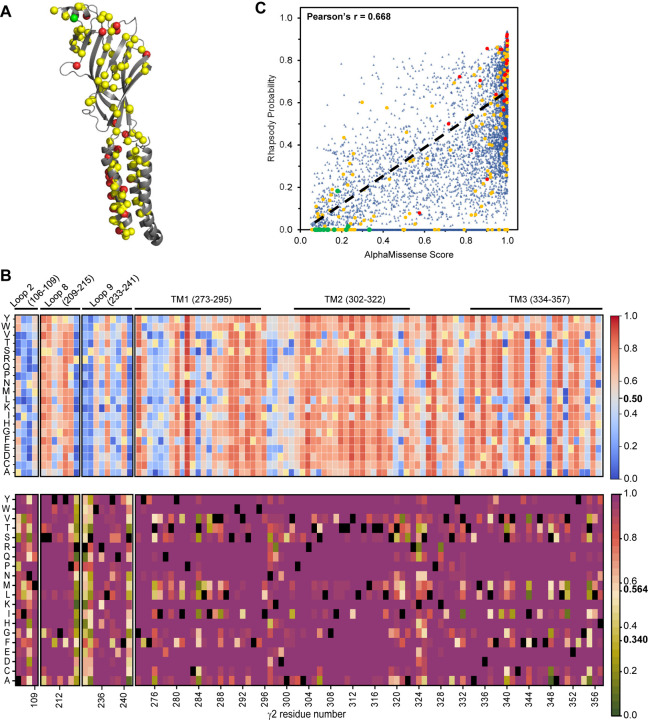
Variants in the genes encoding the subunits of gamma-aminobutyric acid type A (GABA A ) receptors are associated with epilepsy. To date, over 1000 clinical variants have been identified in these genes. However, the majority of these variants lack functional studies and their clinical significance is uncertain although accumulating evidence indicates that proteostasis deficiency is the major disease-causing mechanism for GABA A receptor variants. Here, we apply two state-of-the-art modeling tools, namely AlphaMissense, which uses an artificial intelligence-based approach based on AlphaFold structures, and Rhapsody, which integrates sequence evolution and known structure-based data, to predict the pathogenicity of saturating missense variants in genes that encode the major subunits of GABA A receptors in the central nervous system, including GABRA1 , GABRB2 , GABRB3 , and GABRG2 . Our results demonstrate that the predicted pathogenicity correlates well between AlphaMissense and Rhapsody although AlphaMissense tends to generate higher pathogenic probability. Furthermore, almost all annotated pathogenic variants in the ClinVar clinical database are successfully identified from the prediction, whereas uncertain variants from ClinVar partially due to the lack of experimental data are differentiated into different pathogenicity groups. The pathogenicity prediction of GABA A receptor missense variants provides a resource to the community as well as guidance for future experimental and clinical investigations.
Overview
The claims and statistics of this paper haven’t been checked yet.
Free: it reads the open-access text and checks the first 5 claims that cite a source we can check. Create a free account to check every claim.
Integrity signals
Registry
Cites
Statistics
Figures
Verification
Claims the paper makes
The claims and statistics of this paper haven’t been checked yet.
Free: it reads the open-access text and checks the first 5 claims that cite a source we can check. Create a free account to check every claim.
Self-check
Percentages, sums and reported differences re-computed from the paper’s own numbers.
The self-check needs the paper’s full text.
Citations
Cites
Highly accurate protein structure prediction with AlphaFold
Jumper, J., Evans, R., Pritzel, A., Green, T., Figurnov, M., Ronneberger, O., Tunyasuvunakool, K., Bates, R., Žídek, A., Potapenko, A., et al. (2021) · Nature · doi:10.1038/s41586-021-03819-2 · Cited by 43,764
Richards, S., Aziz, N., Bale, S., Bick, D., Das, S., Gastier-Foster, J., Grody, W. W., Hegde, M., Lyon, E., Spector, E., et al. (2015) · Genetics in Medicine · doi:10.1038/gim.2015.30 · Cited by 32,594
Fast, scalable generation of high‐quality protein multiple sequence alignments using Clustal Omega
Sievers, F., Wilm, A., Dineen, D., Gibson, T. J., Karplus, K., Li, W., Lopez, R., McWilliam, H., Remmert, M., Söding, J., et al. (2011) · Molecular Systems Biology · doi:10.1038/msb.2011.75 · Cited by 15,355
ClinVar: improving access to variant interpretations and supporting evidence
Landrum, M. J., Lee, J. M., Benson, M., Brown, G. R., Chao, C., Chitipiralla, S., Gu, B., Hart, J., Hoffman, D., Jang, W., et al. (2018) · Nucleic Acids Research · doi:10.1093/nar/gkx1153 · Cited by 4,196
Accurate proteome-wide missense variant effect prediction with AlphaMissense
Cheng, J., Novati, G., Pan, J., Bycroft, C., Žemgulytė, A., Applebaum, T., Pritzel, A., Wong, L. H., Zielinski, M., Sargeant, T., et al. (2023) · Science · doi:10.1126/science.adg7492 · Cited by 2,163
Macdonald, R. L., & Olsen, R. W. (1994) · Annual Review of Neuroscience · doi:10.1146/annurev.ne.17.030194.003033 · Cited by 1,975
Crystal structure of a human GABAA receptor
Miller, P. S., & Aricescu, A. R. (2014) · Nature · doi:10.1038/nature13293 · Cited by 710
GABAA receptor signalling mechanisms revealed by structural pharmacology
Masiulis, S., Desai, R., Uchański, T., Serna Martin, I., Laverty, D., Karia, D., Malinauskas, T., Zivanov, J., Pardon, E., Kotecha, A., et al. (2019) · Nature · doi:10.1038/s41586-018-0832-5 · Cited by 551
Shared structural mechanisms of general anaesthetics and benzodiazepines
Kim, J. J., Gharpure, A., Teng, J., Zhuang, Y., Howard, R. J., Zhu, S., Noviello, C. M., Walsh, R. M., Lindahl, E., & Hibbs, R. E. (2020) · Nature · doi:10.1038/s41586-020-2654-5 · Cited by 382
Cryo-EM structure of the human α1β3γ2 GABAA receptor in a lipid bilayer
Laverty, D., Desai, R., Uchański, T., Masiulis, S., Stec, W. J., Malinauskas, T., Zivanov, J., Pardon, E., Steyaert, J., Miller, K. W., et al. (2019) · Nature · doi:10.1038/s41586-018-0833-4 · Cited by 316
Research works printed but not linked: 1
- a Maljevic S., Møller R. S., Reid C. A., Pérez-Palma E., Lal D., May P., Lerche H., Curr Opin Neurol 2019, 32, 183– 190; 30664068 b XiangWei W., Jiang Y., Yuan H., Current opinion in physiology 2018, 2, 27– 35. 29756080 PMC5945193 · DOI · Paper page
Metadata
- Authors
- Wang, Y.-J., Vu, G. H., & Mu, T.-W.
- Affiliations
- Case Western Reserve University (US)
- Corresponding author
- Mu, Ting-Wei
- Venue
- Israel Journal of Chemistry
- Publisher
- openRxiv
- Published
- 2023-11-16
- Volume
- 64
- Issue
- 12
- ISSN
- 0021-2148 (ISSN-L)
- PMC
- PMC10680766
- OpenAlex
- W4391282282
- Semantic Scholar
- 888a9f3ac8509525fdb0c23638b4256fc53ee9af
- Cited by
- 8
- References
- 28
- Citations by year
- 2025: 4 · 2024: 4
- FWCI
- 2.12
- Type
- journal article
- Language
- en
- Open access
- hybrid
- doi.org
- Licence
- cc-by
- Locations
- Israel Journal of Chemistry (publishedVersion, cc-by)
- bioRxiv (Cold Spring Harbor Laboratory) (acceptedVersion, cc-by-nc)
- PubMed (publishedVersion)
- PubMed Central (submittedVersion, cc-by-nc)
- Scholarly Commons @ Case Western Reserve University (submittedVersion, cc-by)
- Funders
- National Institutes of Health
- National Institute of Neurological Disorders and Stroke (R01NS117176, R01NS105789)
- Topics
- Life Sciences › Biochemistry, Genetics and Molecular Biology › Genetics › Genomics and Rare Diseases
- Health Sciences › Medicine › Clinical Neurology › Epilepsy research and treatment
- Life Sciences › Neuroscience › Cellular and Molecular Neuroscience › Neuroscience and Neuropharmacology Research
- Keywords
- GABAA receptor, missense mutations, pathogenicity prediction, epilepsy, AlphaMissense, rhapsody, GABRA1, GABRB2, GABRB3, GABRG2, protein stability, plasma membrane expression, ClinVar, variant interpretation
About these checks
Registry, retraction, Cites and statistics results are computed, not judged, with one exception: a printed reference that no index lists is read once by a model before it counts as a citation error. Claims are extracted by a model and kept only when their quote appears verbatim in the text; each cited source is then checked, with a model’s help, for whether it says what the claim relies on. Those verdicts can be wrong — read the claim’s quote and the cited source before relying on one.
Statistics and arithmetic are recomputed, not judged.
Confidence bands are shown only for fields calibrated on our annotated test set. None is calibrated yet, so no band is shown.
What counts as a claim ›How we measure confidence ›How we check this ›
Are you an author, or do you see a problem with this page? Request a review
How to cite
Cite CoChat for the checks on this page, and the paper for its own findings.
- This page
- CoChat. (2026). Citation check: Pathogenicity Prediction of GABA A Receptor Missense Variants. https://app.cochat.ai/papers/10.1101/2023.11.14.567135
- The paper
- Wang, Y.-J., Vu, G. H., & Mu, T.-W. (2023). Pathogenicity Prediction of GABA A Receptor Missense Variants. Israel Journal of Chemistry. https://doi.org/10.1101/2023.11.14.567135
Data sources
Bibliographic data: Semantic Scholar, OpenAlex, Crossref.
Contains information from the Semantic Scholar Academic Graph Datasets, made available under the ODC Attribution License (ODC-BY 1.0).
Semantic Scholar’s data is described in: Kinney, R., et al. (2023). The Semantic Scholar Open Data Platform. arXiv:2301.10140.
