

ChatGPT Influence on Medical Decision-Making, Bias, and Equity: A Randomized Study of Clinicians Evaluating Clinical Vignettes
Open accessThe DOI matches its Crossref record; 12 of the 12 references it cites were found in a registry or an index.
Abstract
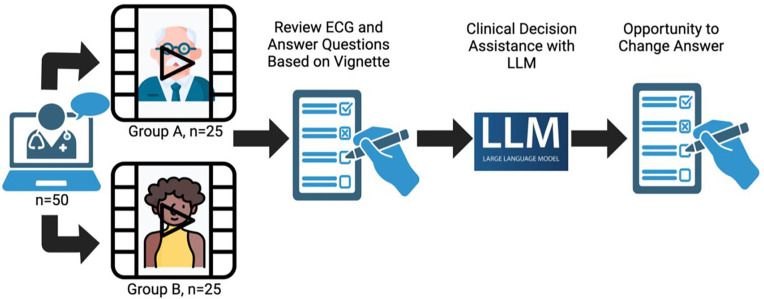
In a randomized, pre-post intervention study, we evaluated the influence of a large language model (LLM) generative AI system on accuracy of physician decision-making and bias in healthcare. 50 US-licensed physicians reviewed a video clinical vignette, featuring actors representing different demographics (a White male or a Black female) with chest pain. Participants were asked to answer clinical questions around triage, risk, and treatment based on these vignettes, then asked to reconsider after receiving advice generated by ChatGPT+ (GPT4). The primary outcome was the accuracy of clinical decisions based on pre-established evidence-based guidelines. Results showed that physicians are willing to change their initial clinical impressions given AI assistance, and that this led to a significant improvement in clinical decision-making accuracy in a chest pain evaluation scenario without introducing or exacerbating existing race or gender biases. A survey of physician participants indicates that the majority expect LLM tools to play a significant role in clinical decision making.
Overview
The claims and statistics of this paper haven’t been checked yet.
Free: it reads the open-access text and checks the first 5 claims that cite a source we can check. Create a free account to check every claim.
Integrity signals
Registry
Cites
Statistics
Figures
Verification
Claims the paper makes
The claims and statistics of this paper haven’t been checked yet.
Free: it reads the open-access text and checks the first 5 claims that cite a source we can check. Create a free account to check every claim.
Self-check
Percentages, sums and reported differences re-computed from the paper’s own numbers.
The self-check needs the paper’s full text.
Citations
Cites
Basics of Qualitative Research (3rd ed.): Techniques and Procedures for Developing Grounded Theory
Corbin, J., & Strauss, A. (2008) · SAGE · doi:10.4135/9781452230153 · Cited by 12,136
Dissecting racial bias in an algorithm used to manage the health of populations
Obermeyer, Z., Powers, B., Vogeli, C., & Mullainathan, S. (2019) · Science · doi:10.1126/science.aax2342 · Cited by 7,137
The potential for artificial intelligence in healthcare
Davenport, T., & Kalakota, R. (2019) · Future Healthcare Journal · doi:10.7861/futurehosp.6-2-94 · Cited by 3,800
Large language models propagate race-based medicine
Omiye, J. A., Lester, J. C., Spichak, S., Rotemberg, V., & Daneshjou, R. (2023) · npj Digital Medicine · doi:10.1038/s41746-023-00939-z · Cited by 417 · cited 1×
“…case prompts (including with vs. without demographic information) to confirm that the produced LLM outputs remained similar in meaning (and not showing different suggestions depending on the patient’s stated race or gender that has been observed under other specific adversarial scenarios) 10 .”
BackgroundHealth equity among black women in the United States
Chinn, J. J., Martin, I. K., & Redmond, N. (2021) · Journal of Women's Health · doi:10.1089/jwh.2020.8868 · Cited by 320
Chatbot vs medical student performance on free-response clinical reasoning examinations.
Strong, E., DiGiammarino, A., Weng, Y., Kumar, A., Hosamani, P., Hom, J., & Chen, J. H. (2023) · JAMA Internal Medicine · doi:10.1001/jamainternmed.2023.2909 · Cited by 169
Self-citationThe Hawthorne effect in direct observation research with physicians and patients
Goodwin, M. A., Stange, K. C., Zyzanski, S. J., Crabtree, B. F., Borawski, E. A., & Flocke, S. A. (2017) · Journal of Evaluation in Clinical Practice · doi:10.1111/jep.12781 · Cited by 144
“Who goes first? Influences of human-AI workflow on decision making in clinical imaging,”
Fogliato, R., Chappidi, S., Lungren, M., Fisher, P., Wilson, D., Fitzke, M., Parkinson, M., Horvitz, E., Inkpen, K., & Nushi, B. (2022) · 2022 ACM Conference on Fairness Accountability and Transparency · doi:10.1145/3531146.3533193 · Cited by 103
Ito, N., Kadomatsu, S., Fujisawa, M., Fukaguchi, K., Ishizawa, R., Kanda, N., Kasugai, D., Nakajima, M., Goto, T., & Tsugawa, Y. (2023) · JMIR Medical Education · doi:10.2196/47532 · Cited by 63
Assessing Biases in Medical Decisions via Clinician and AI Chatbot Responses to Patient Vignettes
Kim, J., Cai, Z. R., Chen, M. L., Simard, J. F., & Linos, E. (2023) · JAMA Network Open · doi:10.1001/jamanetworkopen.2023.38050 · Cited by 59
Research works printed but not linked: 1
- Marshall C, Rossman GB. Designing Qualitative Research. 5th ed. Thousand Oaks, CA: SAGE Publications; 2010.
Cited by
Large Language Model Influence on Diagnostic Reasoning: A Randomized Clinical Trial
Goh, E., Gallo, R., Hom, J., Strong, E., Weng, Y., Kerman, H., Cool, J. A., Kanjee, Z., Parsons, A. S., Ahuja, N., et al. (2024) · JAMA Network Open · doi:10.1001/jamanetworkopen.2024.40969 · Cited by 724
Self-citationFine-Tuning Large Language Models for Specialized Use Cases
Anisuzzaman, D., Malins, J. G., Friedman, P. A., & Attia, Z. I. (2024) · Mayo Clinic Proceedings Digital Health · doi:10.1016/j.mcpdig.2024.11.005 · Cited by 272
Addressing 6 challenges in generative AI for digital health: A scoping review
Templin, T., Perez, M. W., Sylvia, S., Leek, J. T., & Sinnott-Armstrong, N. (2024) · PLOS Digital Health · doi:10.1371/journal.pdig.0000503 · Cited by 139
ChatGPT: Transforming Healthcare with AI
Neha, F., Bhati, D., Shukla, D. K., & Amiruzzaman, M. (2024) · AI · doi:10.3390/ai5040126 · Cited by 59
Cognitive Biases and Artificial Intelligence
Wang, J., & Redelmeier, D. A. (2024) · NEJM AI · doi:10.1056/aics2400639 · Cited by 56
Influence of a Large Language Model on Diagnostic Reasoning: A Randomized Clinical Vignette Study
Goh, E., Gallo, R., Hom, J., Strong, E., Weng, Y., Kerman, H., Cool, J., Kanjee, Z., Parsons, A. S., Ahuja, N., et al. (2024) · doi:10.1101/2024.03.12.24303785 · Cited by 38
“…improvements in large language models (LLMs) – machine learning systems that produce human-like responses from free text prompts – have shown the ability to solve complex cases, display human-like clinical reasoning, take patient histories, and communicate empathetically 9,10,11,12,13,14 .”
BackgroundSelf-citationEthical Application of Generative Artificial Intelligence in Medicine
Hasan, S. S., Fury, M. S., Woo, J. J., Kunze, K. N., & Ramkumar, P. N. (2024) · Arthroscopy The Journal of Arthroscopic and Related Surgery · doi:10.1016/j.arthro.2024.12.011 · Cited by 52
Taşsöker, M. (2025) · BMC Oral Health · doi:10.1186/s12903-025-06444-x · Cited by 29
“Most existing studies have evaluated LLMs using general medical knowledge questions or simulated clinical vignettes and limited research has investigated their performance on real-world, complex case material [4–9].”
The impact of generative artificial intelligence on socioeconomic inequalities and policy makingPreprint
Capraro, V., Lentsch, A., Acemoğlu, D., Akgün, S., Akhmedova, A., Bilancini, E., Bonnefon, J., Brañas‐Garza, P., Butera, L., Douglas, K. M., et al. (2023) · PsyArXiv (OSF Preprints) · doi:10.31234/osf.io/6fd2y · Cited by 48
Nguyen, O. N., Amin, D., Bennett, J. P., Hetlevik, Ø., Malik, S., Tout, A., Vornhagen, H., & Vellinga, A. (2025) · Journal of Antimicrobial Chemotherapy · doi:10.1093/jac/dkaf077 · Cited by 25
Enhancing clinical decision‐making: Optimizing ChatGPT's performance in hypertension care
Miao, J., Thongprayoon, C., Fülöp, T., & Cheungpasitporn, W. (2024) · Journal of Clinical Hypertension · doi:10.1111/jch.14822 · Cited by 23
GPT-4's performance in supporting physician decision-making in nephrology multiple-choice questions
Noda, R., Tanabe, K., Ichikawa, D., & Shibagaki, Y. (2025) · Scientific Reports · doi:10.1038/s41598-025-99774-3 · Cited by 24
“There is also a report that GPT-4's advice improved the accuracy of physicians’ decision-making in chest pain evaluation scenarios 31 .”
The Impact of Generative Artificial Intelligence on Socioeconomic Inequalities and Policy MakingPreprint
Capraro, V., Lentsch, A., Acemoğlu, D., Akgün, S., Akhmedova, A., Bilancini, E., Bonnefon, J., Brañas‐Garza, P., Butera, L., Douglas, K. M., et al. (2024) · SSRN Electronic Journal · doi:10.2139/ssrn.4666103 · Cited by 18
Sun, D., Hadjiiski, L., Bruno, G., Gormley, J., Chan, H.-P., Caoili, E. M., Cohan, R. H., Alva, A., Mihalcea, R., Zhou, C., et al. (2025) · Scientific Reports · doi:10.1038/s41598-025-27593-7 · Cited by 9
“The potential applications of large language models (LLMs) in healthcare are vast, from automating routine tasks 1–3 to supporting complex decision-making processes 4–6 .”
Liu, X., Lai, R., Wu, C., Yan, C., Gan, Z., Yang, Y., Zeng, X., Liu, J., Liao, L., Lin, Y., et al. (2024) · Frontiers in Public Health · doi:10.3389/fpubh.2024.1391906 · Cited by 16
Wislocki, K. E., Sami, S., Liberzon, G., & Zalta, A. K. (2025) · JMIR Mental Health · doi:10.2196/80801 · Cited by 9
“Prior research has demonstrated that GAI models may be helpful in supporting physician decision-making [18].”
Assessing the User Experience of an LLM-Based Conversational Assistant in Diabetes Mellitus Care
Furtado, V., Araujo, J., Furtado, E. S., Bomfim, R., Silva, V., Mororo, N. A. C., Vasconcelos, L., Carvalho, C., Severo, M., Torres, J., et al. (2025) · Journal of Healthcare Informatics Research · doi:10.1007/s41666-025-00217-5 · Cited by 9
“Furthermore,configuringthe personalityandcommunicationstyleoftheseassistantsisnotatrivialtaskandcan show significant variations in their results [5].”
Exploring the impact of generative AI tools on healthcare delivery in Tanzania
Shidende, N., & Mwogosi, A. (2025) · Journal of Health Organization and Management · doi:10.1108/jhom-01-2025-0007 · Cited by 12
Critical Appraisal Tools for Evaluating Artificial Intelligence in Clinical Studies: Scoping Review
Cabello, J. B., García, V. R., Torralba, M., Fernandez, M. M., Ubeda, M., Ansuategi, E., Ramos-Ruperto, L., Emparanza, J. I., Urreta, I., Iglesias, M. T., et al. (2025) · Journal of Medical Internet Research · doi:10.2196/77110 · Cited by 14
“In the other primary study [79], the study population was a group of clinicians randomly allocated to view 1 of 2 videos with clinical scenarios, and the clinicians’ answers were evaluated before and after a chatbot interaction (ChatGPT).”
Silva, V., Furtado, E. S., Oliveira, J. D. S., & Furtado, V. (2024) · doi:10.5753/sbcas.2024.2252 · Cited by 6
“Além disso, a configuração da personalidade e do estilo de comunicação desses assistentes não é uma tarefa trivial, e podem apresentar variações significativas em seus resultados [Goh et al., 2023].”
BackgroundLee, J., Shang, T., Baik, J. Y., Duong-Tran, D., Yang, S., Li, L., & Shen, L. (2026) · IEEE International Conference on Healthcare Informatics (ICHI) · doi:10.1007/s41666-026-00241-z · Cited by 20
“Beyond prediction, LLMs can generate explanatory rationales, serving as a form of second opinion for clinicians and potentially mitigating mispractice [16 ].”
Artificial Intelligence to Reshape the Healthcare Ecosystem
Reali, G., & Femminella, M. (2024) · Future Internet · doi:10.3390/fi16090343 · Cited by 7
AI for precision medicine must keep non-random complexity in mind to support equity in outcomes
Smarr, B. L. (2024) · IEEE International Conference on eScience · doi:10.1109/e-science62913.2024.10678664 · Cited by 2
“It is likely the same will happen, or is happening, with Health AI [46] even as some LMs reduce other biases coming from practitioners’ personal biases [47].”
BackgroundDing, Z., Wei, R., Xia, J., Mu, Y., Wang, J., & Lin, Y. (2024) · Briefings in Bioinformatics · doi:10.1093/bib/bbae641 · Cited by 3
Meddeb, A., Bakhtiari, N., Rangus, I., Fetscher, L., Leguellec, B., Busch, F., Doucet, A., Hua, V. T., Verot-Nguyen, F., Paiusan, L. V., et al. (2026) · Journal of NeuroInterventional Surgery · doi:10.1136/jnis-2026-025429 · Cited by 1
Joshi, S., Mehta, M., Mendoza, M., Rivera, Y. M., & Singh, V. K. (2026) · JMIR Formative Research · doi:10.2196/87465 · Cited by 2
“While health information systems, including large language models (LLMs) such as ChatGPT, are widely regarded as transformative tools for improving access to health resources, concerns are growing that these technologies may exacerbate existing inequities rather than reduce them [4-7].”
Hunton, R. W. (2025) · The Journal of Physician Assistant Education · doi:10.1097/jpa.0000000000000664
Miranda, J. P. P., & Yambao, J. A. (2025) · SSRN Electronic Journal · doi:10.2139/ssrn.5364333
Kalyan Chakravarthy, K. (2025) · SSRN Electronic Journal · doi:10.2139/ssrn.5393117
Ahmad, H. F., Sajid, J., Rasool, R. U., & Malik, A. W. (2025) · Cluster Computing · doi:10.1007/s10586-025-05793-0 · Cited by 1
“Studying the impact of ChatGPT in medical decision-making and bias, this commentary points to the need to consider and eliminate bias in AI and recognize the potential of AI to support equity in healthcare [220].”
Joshi, S., Mendoza, M., Rivera, Y. M., & Singh, V. K. (2025) · doi:10.2196/preprints.87465
Zhao, F.-F., Zhan-chi, H., Liang, J.-J., Liu, Z., He, X., Chen, Y., Guo, B., Wang, Y., Tham, Y. C., & Cen, L. (2025) · BMJ Open Ophthalmology · doi:10.1136/bmjophth-2025-002185
Multimorbidity measurement strategies for predicting hospital visits
Neves, B. D., Moreira, J. M., Gonçalves, S., Cerejo, J., Mota, I., Silva, N. A., Leite, F., & Silva, M. J. (2025) · BMC Health Services Research · doi:10.1186/s12913-025-13817-z
Omosun, F., & Young, A. (2025) · Journal of Health Communication · doi:10.1080/10810730.2025.2533812
“The findings demonstrate the accuracy of clinical suggestions when based on provided pre-established evidence-based guidelines, without introducing race or gender bias (Goh et al., 2023).”
Feng, H., & Wang, X. (2026) · Frontiers in Physiology · doi:10.3389/fphys.2026.1846567 · Cited by 1
Generative AI for Healthcare and Education: The Good, the Bad, and the Unknown
Sartori, L., & Piva, R. (2026) · Springer eBooks · doi:10.1007/978-3-031-61050-9_41-1
A scoping review of bias in large AI models for medicine and healthcare
Xiao, Y., Chen, Z., Huang, J.-T., Chen, W., Liu, Y., Li, K., Mousavi, M. R., Dobson, R., & Zhang, J. M. (2026) · Communications Health · doi:10.1038/s44528-026-00041-2 · Cited by 2
Multimorbidity Measurement Strategies for Predicting Hospital Visits
Neves, B., Moreira, J. M., Gonçalves, S., Cerejo, J., Mota, I., Silva, N. A., Leite, F., & Silva, M. J. (2025) · doi:10.21203/rs.3.rs-6515465/v1
Metadata
- Authors
- Goh, E., Bunning, B., Khoong, E., Gallo, R., Milstein, A., Centola, D., & Chen, J. H.
- Affiliations
- Stanford University (US)
- San Francisco General Hospital (US)
- VA Palo Alto Health Care System (US)
- University of Pennsylvania (US)
- Stanford Medicine (US)
- Corresponding author
- Goh, Ethan
- ORCID
- Venue
- medRxiv
- Publisher
- openRxiv
- Published
- 2023-11-27
- PMC
- PMC10705632
- OpenAlex
- W4389041771
- Cited by
- 37
- References
- 12
- Citations by year
- 2026: 6 · 2025: 16 · 2024: 14 · 2023: 1
- Type
- posted content
- Language
- en
- Open access
- green
- doi.org
- Licence
- cc-by
- Locations
- medRxiv (acceptedVersion, cc-by)
- PubMed (publishedVersion)
- PubMed Central (submittedVersion, cc-by)
- Funders
- U.S. Department of Veterans Affairs
- Intermountain Healthcare
- Peterson Center on Healthcare
- National Institutes of Health
- National Heart, Lung, and Blood Institute (K23HL157750)
- National Institute on Drug Abuse (UG1DA015815)
- U.S. National Library of Medicine (T15LM007033)
- Topics
- Health Sciences › Medicine › Health Informatics › Artificial Intelligence in Healthcare and Education
- Health Sciences › Medicine › Family Practice › Clinical Reasoning and Diagnostic Skills
- Physical Sciences › Computer Science › Artificial Intelligence › Ethics and Social Impacts of AI
- Keywords
- ChatGPT, large language models, generative AI, clinical decision-making, physician bias, racial bias, gender bias, health care equity, chest pain evaluation, clinical vignettes, AI-assisted clinical decision support, physician attitudes toward AI
About these checks
Registry, retraction, Cites and statistics results are computed, not judged, with one exception: a printed reference that no index lists is read once by a model before it counts as a citation error. Claims are extracted by a model and kept only when their quote appears verbatim in the text; each cited source is then checked, with a model’s help, for whether it says what the claim relies on. Those verdicts can be wrong — read the claim’s quote and the cited source before relying on one.
Statistics and arithmetic are recomputed, not judged.
Confidence bands are shown only for fields calibrated on our annotated test set. None is calibrated yet, so no band is shown.
What counts as a claim ›How we measure confidence ›How we check this ›
Are you an author, or do you see a problem with this page? Request a review
Data sources
Bibliographic data: Semantic Scholar, OpenAlex, Crossref.
Contains information from the Semantic Scholar Academic Graph Datasets, made available under the ODC Attribution License (ODC-BY 1.0).
Semantic Scholar’s data is described in: Kinney, R., et al. (2023). The Semantic Scholar Open Data Platform. arXiv:2301.10140.
