

Chalkophomycin Biosynthesis Revealing Unique Enzyme Architecture for a Hybrid Nonribosomal Peptide Synthetase and Polyketide Synthase
Open accessPreprint — published as 10.3390/molecules29091982
The DOI matches its Crossref record; 64 of the 64 references it cites were found in a registry or an index.
Abstract
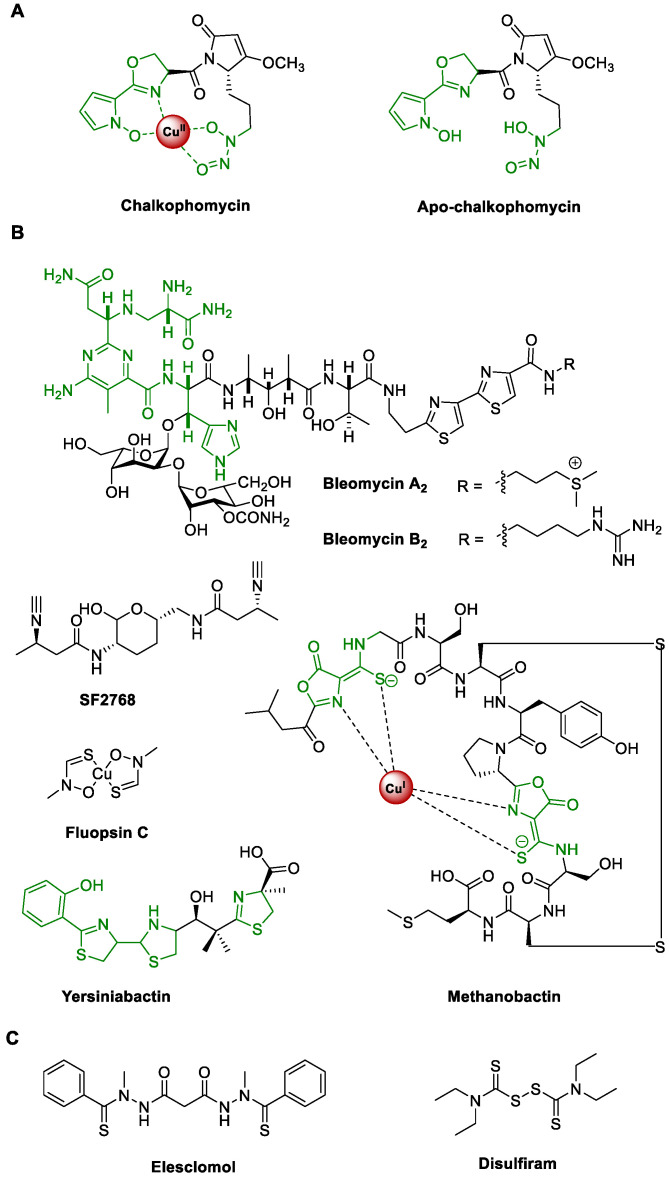
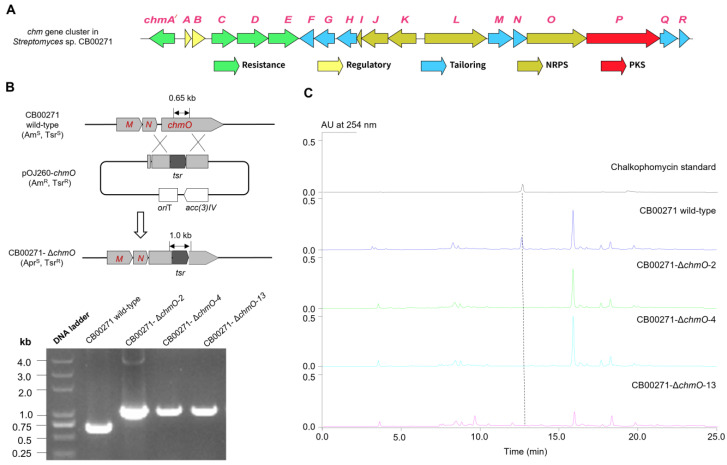
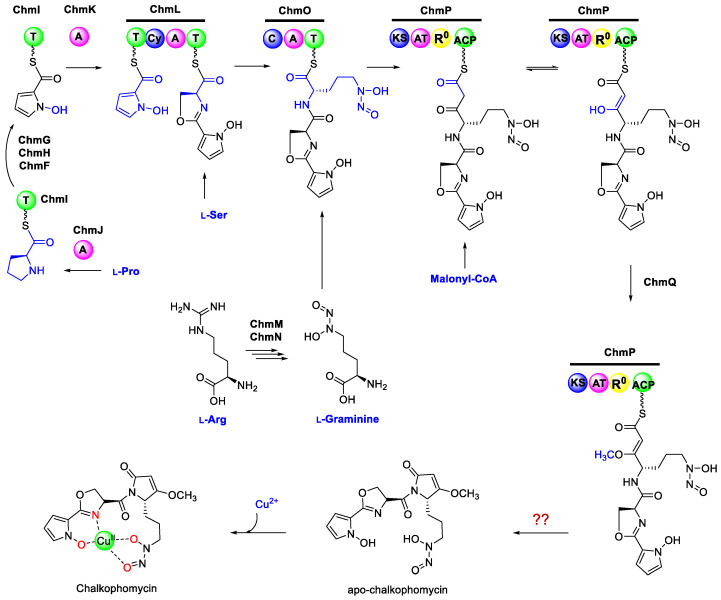
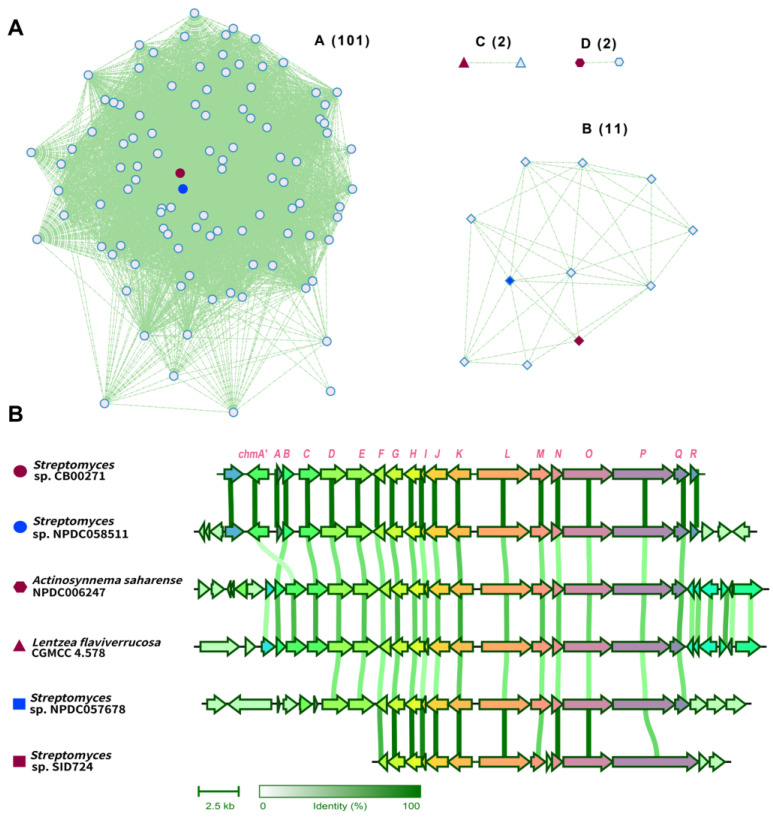
Chalkophomycin is a novel chalkophore with antibiotic activities isolated from Streptomyces sp. CB00271, while its potential in studying cellular copper homeostasis makes it an important probe and drug lead. The constellation of N -hydroxylpyrrole, 2 H -oxazoline, diazeniumdiolate, and methoxypyrrolinone functional groups into one compact molecular architecture capable to coordinate cupric ion draws interest to unprecedented enzymology responsible for chalkophomycin biosynthesis. To elucidate the biosynthetic machinery for chalkophomycin production, the chm biosynthetic gene cluster from S. sp. CB00271 was identified, and its involvement in chalkophomycin biosynthesis was confirmed by gene replacement. The chm cluster was localized to a ∼31 kb DNA region, consisting of 19 open reading frames that encode five non-ribosomal peptide synthetase (ChmHIJLO), one modular polyketide synthases (ChmP), six tailoring enzymes (ChmFGMNQR), two regulatory proteins (ChmAB), and four resistance proteins (ChmA′CDE). A model for chalkophomycin biosynthesis is proposed based on functional assignments from sequence analysis and structure modelling, and is further supported by analogy to over 100 chm -type gene clusters in public databases. Our studies thus set the stage to fully investigate chalkophomycin biosynthesis and to engineer chalkophomycin analogues through a synthetic biology approach.
Overview
The claims and statistics of this paper haven’t been checked yet.
Free: it reads the open-access text and checks the first 5 claims that cite a source we can check. Create a free account to check every claim.
Integrity signals
Registry
Cites
Statistics
Figures
Verification
Claims the paper makes
The claims and statistics of this paper haven’t been checked yet.
Free: it reads the open-access text and checks the first 5 claims that cite a source we can check. Create a free account to check every claim.
Self-check
Percentages, sums and reported differences re-computed from the paper’s own numbers.
The self-check needs the paper’s full text.
Citations
Cites
Highly accurate protein structure prediction with AlphaFold
Jumper, J., Evans, R., Pritzel, A., Green, T., Figurnov, M., Ronneberger, O., Tunyasuvunakool, K., Bates, R., Žídek, A., Potapenko, A., et al. (2021) · Nature · doi:10.1038/s41586-021-03819-2 · Cited by 43,764
AutoDock Vina 1.2.0: New Docking Methods, Expanded Force Field, and Python Bindings
Eberhardt, J., Santos-Martins, D., Tillack, A. F., & Forli, S. (2021) · Journal of Chemical Information and Modeling · doi:10.1021/acs.jcim.1c00203 · Cited by 7,546
Copper induces cell death by targeting lipoylated TCA cycle proteins
Tsvetkov, P., Coy, S., Petrova, B., Dreishpoon, M., Verma, A., Abdusamad, M., Rossen, J., Joesch-Cohen, L., Humeidi, R., Spangler, R. D., et al. (2022) · Science · doi:10.1126/science.abf0529 · Cited by 4,932
NCBI BLAST: a better web interface
Johnson, M., Zaretskaya, I., Raytselis, Y., Merezhuk, Y., McGinnis, S., & Madden, T. L. (2008) · Nucleic Acids Research · doi:10.1093/nar/gkn201 · Cited by 4,232
Blin, K., Shaw, S., Augustijn, H. E., Reitz, Z. L., Biermann, F., Alanjary, M., Fetter, A., Terlouw, B. R., Metcalf, W. W., Helfrich, E. J. N., et al. (2023) · Nucleic Acids Research · doi:10.1093/nar/gkad344 · Cited by 2,290
Cytoscape Automation: empowering workflow-based network analysis
Otasek, D., Morris, J. H., Bouças, J., Pico, A. R., & Demchak, B. (2019) · Genome Biology · doi:10.1186/s13059-019-1758-4 · Cited by 1,791
clinker & clustermap.js: automatic generation of gene cluster comparison figures
Gilchrist, C. L. M., & Chooi, Y.-H. (2021) · Bioinformatics · doi:10.1093/bioinformatics/btab007 · Cited by 1,600
A computational framework to explore large-scale biosynthetic diversity
Navarro-Muñoz, J. C., Selem-Mojica, N., Mullowney, M. W., Kautsar, S. A., Tryon, J. H., Parkinson, E. I., De Los Santos, E. L. C., Yeong, M., Cruz-Morales, P., Abubucker, S., et al. (2020) · Nature Chemical Biology · doi:10.1038/s41589-019-0400-9 · Cited by 1,025
Biological formation of pyrroles: Nature's logic and enzymatic machinery
Walsh, C. T., Garneau‐Tsodikova, S., & Howard‐Jones, A. R. (2006) · Natural Product Reports · doi:10.1039/b605245m · Cited by 445
PKS and NRPS release mechanisms
Du, L., & Lou, L. (2009) · Natural Product Reports · doi:10.1039/b912037h · Cited by 401
Research works printed but not linked: 4
- 1979, Malyngamide A, a novel chlorinated metabolite of the marine cyanophyte Lyngbya majuscule, J. Am. Chem. Soc, 101, 1
- 2002, Pymol: an open-source molecular graphics tool, CCP4 Newslett. Pro. Crystallogr, 40, 82
- 10.1101/2024.01.24.577118 · DOI
- 10.1016/S1074-5521(03)00286-2 · doi:10.1016/s1074-5521(03)00286-2
Metadata
- Authors
- Yang, L., Yi, L., Gong, B., Chen, L., Li, M., Zhu, X., Duan, Y., & Huang, Y.
- Affiliations
- Anhui Medical University (CN)
- Central South University (CN)
- Chinese Academy of Sciences (CN)
- Corresponding author
- Huang, Yong
- Venue
- Molecules
- Publisher
- openRxiv
- Published
- 2024-03-14
- Volume
- 29
- Issue
- 9
- Pages
- 1982-1982
- ISSN
- 1420-3049 (ISSN-L)
- PMC
- PMC11085572
- OpenAlex
- W4395674817
- Cited by
- 7
- References
- 64
- Citations by year
- 2026: 3 · 2025: 2 · 2024: 2
- FWCI
- 1.98
- Type
- journal article
- Language
- en
- Open access
- gold
- doi.org
- Licence
- cc-by
- Locations
- Molecules (publishedVersion, cc-by)
- bioRxiv (Cold Spring Harbor Laboratory) (acceptedVersion, cc-by-nc)
- PubMed Central (publishedVersion, cc-by)
- PubMed (publishedVersion)
- DOAJ (DOAJ: Directory of Open Access Journals) (submittedVersion)
- Funders
- National Natural Science Foundation of China (111 Project, 2022JJ40408, BP0820034, 82204256, 82373772)
- Natural Science Foundation of Hunan Province (2022JJ40408)
- Higher Education Discipline Innovation Project (BP0820034)
- Topics
- Life Sciences › Immunology and Microbiology › Applied Microbiology and Biotechnology › Microbial Natural Products and Biosynthesis
- Life Sciences › Biochemistry, Genetics and Molecular Biology › Genetics › Bacterial Genetics and Biotechnology
- Life Sciences › Immunology and Microbiology › Microbiology › Antimicrobial Peptides and Activities
- Keywords
- nonribosomal peptide synthetase, polyketide synthase, Streptomyces, biosynthetic gene clusters, copper homeostasis, antibiotic biosynthesis, diazeniumdiolates, tailoring enzymes, synthetic biology
- MeSH terms
- Bacterial Proteins, Multigene Family, Peptide Synthases, Streptomyces, Polyketide Synthases
About these checks
Registry, retraction, Cites and statistics results are computed, not judged, with one exception: a printed reference that no index lists is read once by a model before it counts as a citation error. Claims are extracted by a model and kept only when their quote appears verbatim in the text; each cited source is then checked, with a model’s help, for whether it says what the claim relies on. Those verdicts can be wrong — read the claim’s quote and the cited source before relying on one.
Statistics and arithmetic are recomputed, not judged.
Confidence bands are shown only for fields calibrated on our annotated test set. None is calibrated yet, so no band is shown.
What counts as a claim ›How we measure confidence ›How we check this ›
Are you an author, or do you see a problem with this page? Request a review
How to cite
Cite CoChat for the checks on this page, and the paper for its own findings.
- This page
- CoChat. (2026). Citation check: Chalkophomycin Biosynthesis Revealing Unique Enzyme Architecture for a Hybrid Nonribosomal Peptide Synthetase and Polyketide Synthase. https://app.cochat.ai/papers/10.1101/2024.03.14.584926
- The paper
- Yang, L., Yi, L., Gong, B., Chen, L., Li, M., Zhu, X., Duan, Y., & Huang, Y. (2024). Chalkophomycin Biosynthesis Revealing Unique Enzyme Architecture for a Hybrid Nonribosomal Peptide Synthetase and Polyketide Synthase. Molecules. https://doi.org/10.1101/2024.03.14.584926
Data sources
Bibliographic data: Semantic Scholar, OpenAlex, Crossref.
Contains information from the Semantic Scholar Academic Graph Datasets, made available under the ODC Attribution License (ODC-BY 1.0).
Semantic Scholar’s data is described in: Kinney, R., et al. (2023). The Semantic Scholar Open Data Platform. arXiv:2301.10140.
