

The DOI matches its Crossref record; 1 of the 1 references it cites were found in a registry or an index.
ArtiDock: accurate Machine Learning approach to protein-ligand docking optimized for high-throughput virtual screening
Open accessPreprint — published as 10.1021/acs.jcim.5c02777
Abstract
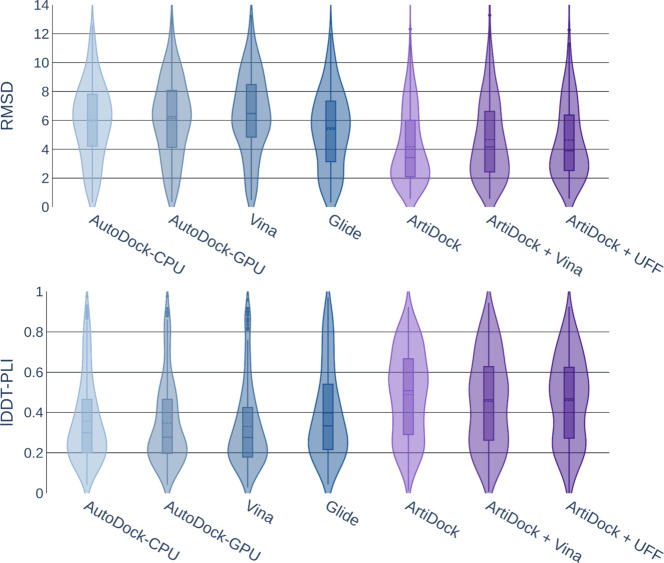
Classical protein-ligand docking has been a cornerstone technique in computational drug discovery for decades, but has reached an accuracy and performance plateau. Recently introduced Machine Learning (ML) based docking methods offer a promising paradigm shift, but their practical adoption is hampered by accuracy-to-speed trade-offs, inadequate benchmarking standards, and questionable chemical validity of predicted poses. In this study, we introduce ArtiDock - an ML-based docking technique optimized for high-throughput virtual screening applications. To evaluate ArtiDock, we developed a dedicated performance and accuracy benchmark for pocket-specific rigid protein-ligand docking, which mimics realistic industrial drug discovery scenarios and is based on the novel PLINDER dataset. We demonstrate that ArtiDock is 29-38% more accurate in comparison to leading open-source and commercial classical docking techniques such as AutoDock, Vina, and Glide, while providing a low computational cost. ArtiDock notably excels in challenging docking scenarios involving unbound protein structures and binding sites containing ions and structured water molecules. Our results show that ArtiDock could be considered as a method of choice in high-throughput virtual screening scenarios.
Overview
The claims and statistics of this paper haven’t been checked yet.
Run the check — free, no account needed. It reads the open-access text and checks the sources it cites.
Integrity signals
Registry
Cites
Statistics
Figures
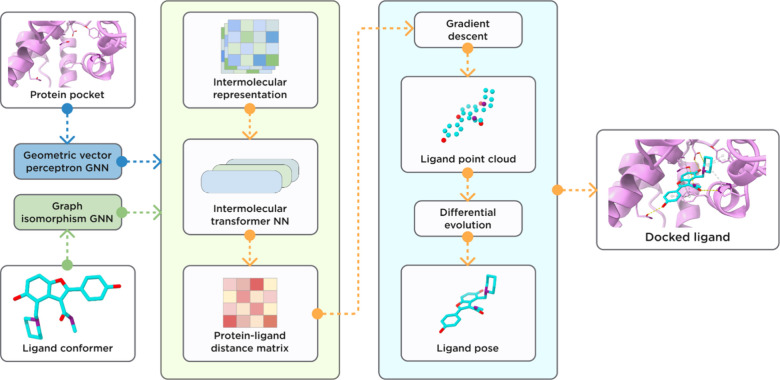
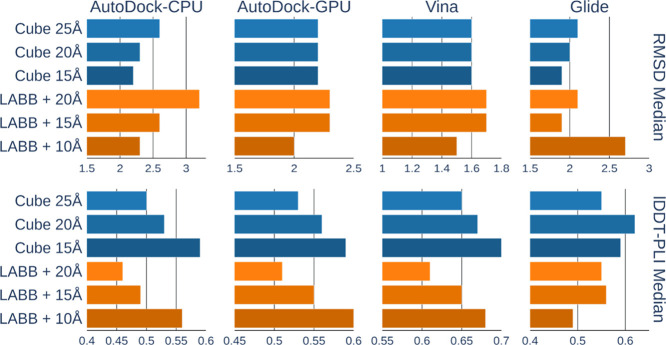
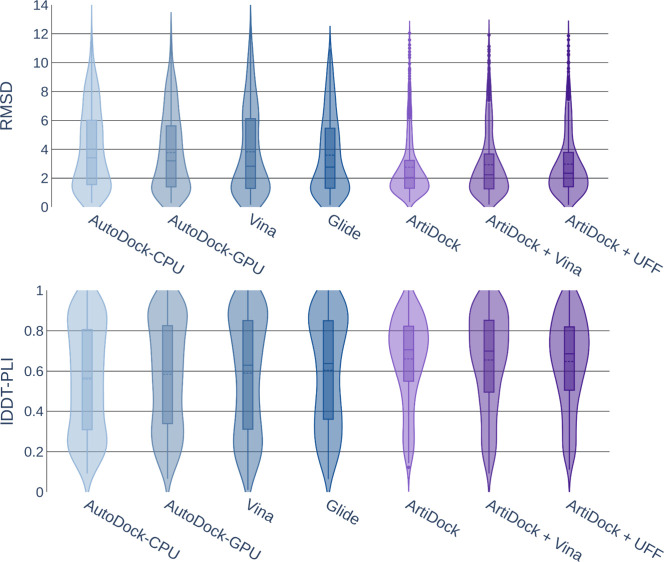
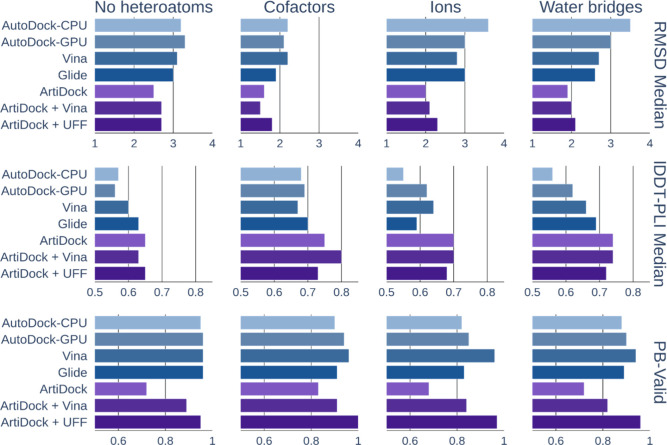
Verification
Claims the paper makes
The claims and statistics of this paper haven’t been checked yet.
Run the check — free, no account needed. It reads the open-access text and checks the sources it cites.
Self-check
Percentages, sums and reported differences re-computed from the paper’s own numbers.
The self-check needs the paper’s full text.
Citations
Cites
Highly accurate protein structure prediction with AlphaFold
Jumper, J., Evans, R., Pritzel, A., Green, T., Figurnov, M., Ronneberger, O., Tunyasuvunakool, K., Bates, R., Žídek, A., Potapenko, A., et al. (2021) · Nature · doi:10.1038/s41586-021-03819-2 · Cited by 43,764
Research works printed but not linked: 49
- 10.1002/jcc.21498 · DOI
- 10.4018/978-1-5225-1762-7.ch030 · DOI
- 10.1038/s42256-021-00409-9 · DOI
- 10.1101/2022.06.06.495043 · DOI
- 10.48550/arXiv.2202.05146 · DOI
- G. Zhou et al., “Uni-Mol: A Universal 3D Molecular Representation Learning Framework,” presented at the The Eleventh International Conference on Learning Representations, Sep 2022. Accessed: May 20, 2025. [Online]. Available: https://openreview.net/forum?id=6K2RM6wVqKu · DOI · Paper page
- 10.1039/D3SC04185A · DOI
- 10.48550/arXiv.2210.01776 · DOI
- 10.48550/arXiv.2402.18396 · DOI
- 10.1126/science.adl2528 · DOI · Paper page
- 10.48550/arXiv.2412.10743 · DOI
- 10.1038/s41586-024-07487-w · DOI · Paper page
- 10.1101/2024.10.10.615955 · DOI · Paper page
- 10.1101/2024.11.19.624167 · DOI
- 10.1101/2025.01.08.631967 · DOI
- 10.1002/prot.26605 · DOI
- 10.1101/2025.02.03.636309 · DOI
- 10.1101/2024.07.17.603955 · DOI
- 10.1093/nar/28.1.235 · DOI · Paper page
- 10.1002/jcc.21256 · DOI
- 10.1002/pro.3934 · DOI
- 10.1021/acs.jctc.0c01006 · DOI
- 10.1002/jcc.21334 · DOI · Paper page
- 10.1021/acs.jcim.1c00203 · DOI
- 10.1021/jm0306430 · DOI · Paper page
- 10.1021/jm030644s · DOI
- 10.1021/jm051256o · DOI
- 10.1021/acs.jctc.1c00810 · DOI
- A. N. Jain , A. E. Cleves , and P. Walters , “Deep-Learning Based Docking Methods: Fair Comparisons to Conventional Docking Workflows,” arXiv. doi: 2412.02889.
- 10.1002/jcc.27536 · DOI
- 10.1002/prot.26601 · DOI
- 10.1107/S0907444913007051 · DOI
- 10.1038/s41598-017-09654-8 · DOI
- 10.1515/pac-2015-1204 · DOI
- J. Ingraham , V. Garg , R. Barzilay , and T. Jaakkola , “Generative Models for Graph-Based Protein Design,” in Advances in Neural Information Processing Systems, Curran Associates, Inc., 2019. Accessed: May 15, 2025. [Online]. Available: https://papers.nips.cc/paper_files/paper/2019/hash/f3a4ff4839c56a5f460c88cce3666a2b-Abstract.html
- 10.48550/ARXIV.1912.01703 · DOI · Paper page
- 10.48550/ARXIV.1903.02428 · DOI
- 10.48550/ARXIV.1905.12265 · DOI
- 10.48550/ARXIV.2009.01411 · DOI
- 10.48550/ARXIV.2106.03843 · DOI
- 10.1007/0-387-22742-3_18 · DOI
- 10.1021/ja00051a040 · DOI
- 10.1016/S0169-409X(00)00129-0 · DOI · Paper page
- 10.1002/prot.10465 · DOI
- 10.1002/jcc.23905 · DOI
- 10.1093/bioinformatics/btv082 · DOI
- 10.1038/s41598-017-15571-7 · DOI
- 10.1021/ci300604z · DOI
- 10.1186/s13321-021-00522-2 · DOI
Metadata
- Authors
- Voitsitskyi, T., Koleiev, I., Stratiichuk, R., Kot, O., Kyrylenko, R., Savchenko, I., Husak, V., Yesylevskyy, S., Starosyla, S., & Nafiiev, A.
- Affiliations
- National Academy of Sciences of Ukraine (UA)
- Taras Shevchenko National University of Kyiv (UA)
- University of Trento (IT)
- Corresponding author
- Yesylevskyy, Semen
- ORCID
- Venue
- Journal of Chemical Information and Modeling
- Publisher
- openRxiv
- Published
- 2024-03-16
- Volume
- 66
- Issue
- 4
- Pages
- 2117-2128
- ISSN
- 1549-9596 (ISSN-L)
- PMC
- PMC12933704
- OpenAlex
- W7126209960
- Cited by
- 8
- References
- 1
- Citations by year
- 2026: 3 · 2025: 3 · 2024: 2
- FWCI
- 10.82
- Type
- journal article
- Language
- en
- Open access
- hybrid
- doi.org
- Licence
- Locations
- Journal of Chemical Information and Modeling (publishedVersion, cc-by)
- bioRxiv (Cold Spring Harbor Laboratory) (acceptedVersion, cc-by-nd)
- PubMed (publishedVersion)
- PubMed Central (publishedVersion, cc-by)
- Funders
- European Commission (MSCA4Ukraine, 101101923)
- Ministerstvo Školství, Mládeže a Tělovýchovy (MSMT-355/2025-16)
- National Academy of Sciences of Ukraine (1.4. /218)
- H2020 Marie Skłodowska-Curie Actions (101101923)
- Topics
- Life Sciences › Pharmacology, Toxicology and Pharmaceutics › Drug Discovery › Computational Drug Discovery Methods
- Life Sciences › Biochemistry, Genetics and Molecular Biology › Molecular Biology › Protein Structure and Dynamics
- Life Sciences › Biochemistry, Genetics and Molecular Biology › Molecular Biology › Protein Degradation and Inhibitors
- Keywords
- high-throughput virtual screening, rigid docking, computational cost
- MeSH terms
- Machine Learning, Binding Sites, Ligands, Protein Binding, Protein Conformation, Proteins, High-Throughput Screening Assays, Molecular Docking Simulation
About these checks
Registry, retraction, Cites and statistics results are computed, not judged, with one exception: a printed reference that no index lists is read once by a model before it counts as a citation error. Claims are extracted by a model and kept only when their quote appears verbatim in the text; each cited source is then checked, with a model’s help, for whether it says what the claim relies on. Those verdicts can be wrong — read the claim’s quote and the cited source before relying on one.
Statistics and arithmetic are recomputed, not judged.
Confidence bands are shown only for fields calibrated on our annotated test set. None is calibrated yet, so no band is shown.
What counts as a claim ›How we measure confidence ›How we check this ›
Are you an author, or do you see a problem with this page? Request a review
