

The DOI matches its Crossref record; 1 of the 1 references it cites were found in a registry or an index.
Discovery and heterologous expression of functional 4-O-dimethylallyl-L-tyrosine synthases from lichen-forming fungi
Open accessPreprint — published as 10.1021/acs.jnatprod.4c00619 · Paper page
Abstract
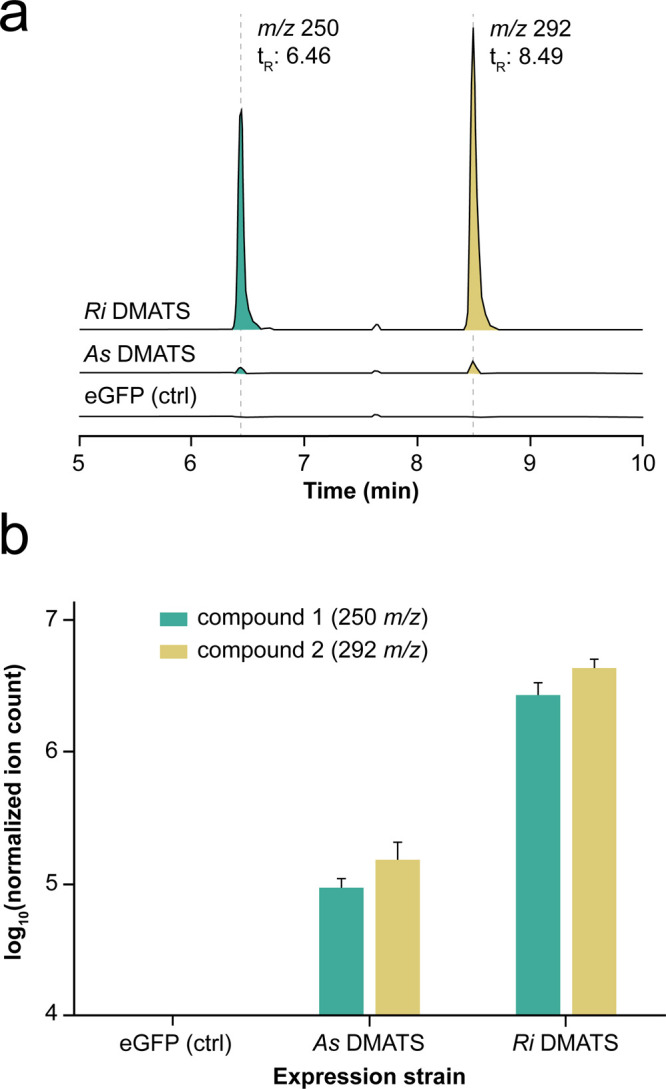
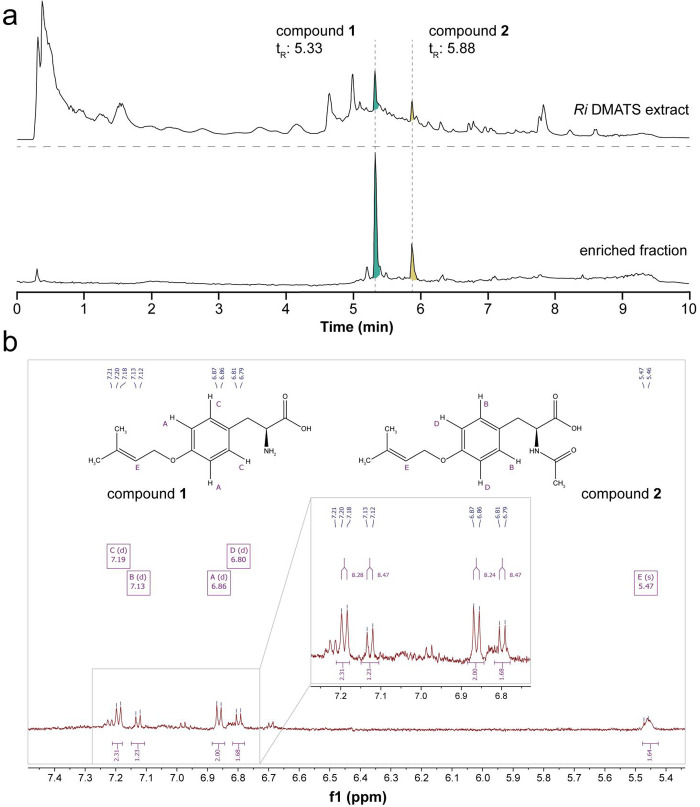
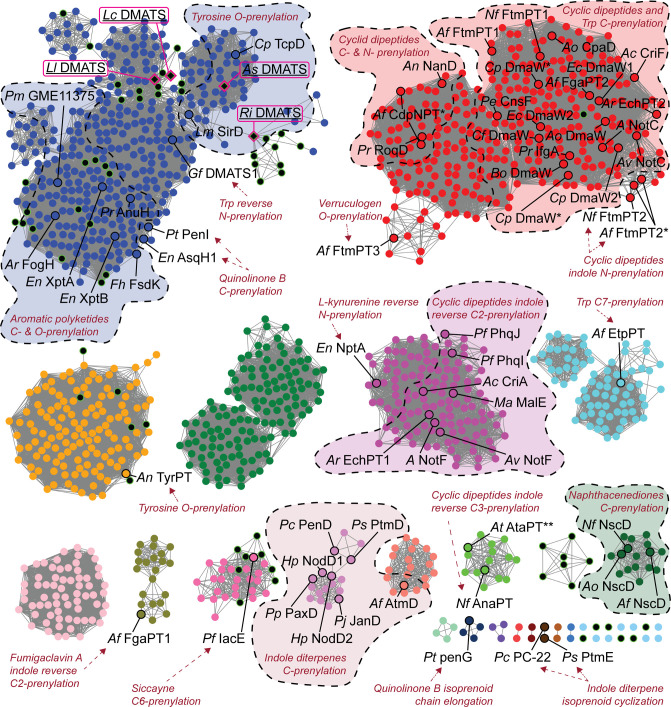
Fungal DMATS-type aromatic prenyltransferases are a family of biosynthetic enzymes that catalyze the prenylation of a range of aromatic substrates during the biosynthesis of bioactive indole alkaloids, diketopiperazines, and meroterpenoids. Together with their broad substrate scope and soluble nature, this makes DMATS-type prenyltransferases particularly adept for applications in biocatalysis, for example to derivatize aromatic drug leads and improve their bioactivity. Here, we investigated four putative DMATS-type prenyltransferases from lichen-forming fungi, an underexplored group of organisms that produce more than 1,000 unique metabolites. We were able to successfully express two functional lichen prenyltransferases in the heterologous host A. oryzae , which allowed us to identify them as 4-O-dimethylallyltyrosine synthases. Our extensive bioinformatic analysis shows that related lichen prenyltransferases are likely not active on indoles but rather on aromatic polyketides and phenylpropanoids, common metabolites in these organisms. Overall, our work not only provides new insights into fungal DMATS-type prenyltransferases at the family level, but it also enables future efforts aimed at identifying new candidates for biocatalytic transformations of aromatic compounds.
Overview
The claims and statistics of this paper haven’t been checked yet.
Run the check — free, no account needed. It reads the open-access text and checks the sources it cites.
Integrity signals
Registry
Cites
Statistics
Figures
Verification
Claims the paper makes
The claims and statistics of this paper haven’t been checked yet.
Run the check — free, no account needed. It reads the open-access text and checks the sources it cites.
Self-check
Percentages, sums and reported differences re-computed from the paper’s own numbers.
The self-check needs the paper’s full text.
Citations
Cites
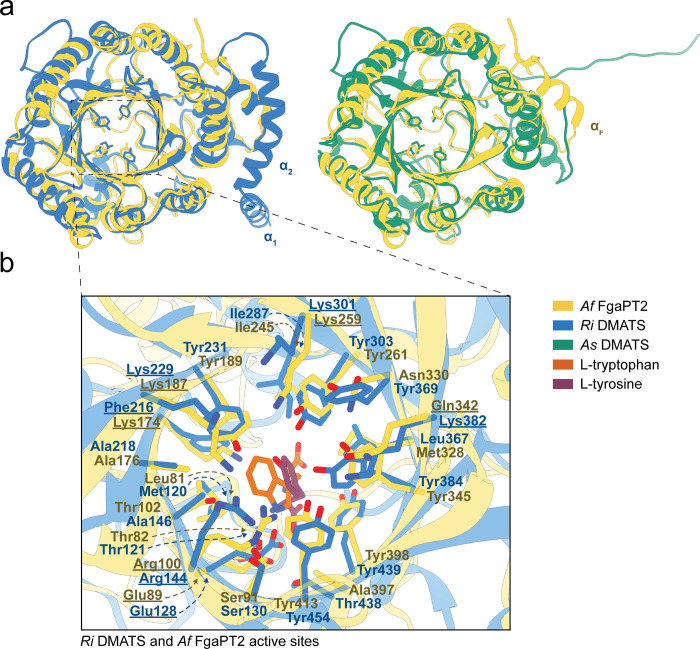
Highly accurate protein structure prediction with AlphaFold
Jumper, J., Evans, R., Pritzel, A., Green, T., Figurnov, M., Ronneberger, O., Tunyasuvunakool, K., Bates, R., Žídek, A., Potapenko, A., et al. (2021) · Nature · doi:10.1038/s41586-021-03819-2 · Cited by 43,764
Research works printed but not linked: 45
- 10.1038/s41579-018-0121-1 · DOI
- 10.1093/bioscience/45.3.124 · DOI
- 2010, Lichens as a potential natural source of bioactive compounds: A review, Phytochem Rev, 9, 303, 10.1007/s11101-010-9189-6 · DOI
- 10.1007/978-3-319-96397-6_57 · DOI
- 10.3389/fmicb.2023.1177123 · DOI
- 10.1007/978-3-642-56359-1 · DOI
- 10.1016/j.ygeno.2020.06.006 · DOI
- 10.1038/s41598-022-21438-3 · DOI
- 10.1038/s41598-024-51895-x · DOI
- 10.1002/slct.201901762 · DOI
- 10.3390/jof9020160 · DOI
- 10.1007/s002940050536 · DOI
- 10.1016/j.mec.2021.e00172 · DOI
- 10.1128/mBio.01111-21 · DOI
- 10.1073/pnas.0904897106 · DOI
- 10.1371/journal.pone.0027336 · DOI
- 10.1039/D3NP00036B · DOI
- 10.1016/j.matpr.2021.09.189 · DOI
- 10.1007/978-3-031-41648-4_6 · DOI
- 10.1186/s40694-023-00170-1 · DOI
- 10.1093/nar/gkab335 · DOI
- 10.1093/nar/gkad344 · DOI
- Hackl T , Ankenbrand M , van Adrichem B. gggenomes: A Grammar of Graphics for Comparative Genomics. R package version 1.0.0. 2024; https://github.com/thackl/gggenomes · DOI
- 10.1016/j.femsle.2004.08.025 · DOI · Paper page
- 10.1039/c4np00084f · DOI
- 10.1093/nar/gkac993 · DOI
- 10.1016/j.jmb.2023.168018 · DOI
- 10.1007/978-1-59745-535-0_4 · DOI
- 10.1093/nar/gkac1052 · DOI · Paper page
- 10.1021/acs.jnatprod.3c01120 · DOI
- 10.1007/s00253-015-6452-1 · DOI
- 10.1021/acschembio.7b01059 · DOI
- 10.1039/B606983P · DOI
- 10.1039/C4NP00062E · DOI
- 10.1093/nar/gkac1049 · DOI
- 10.1002/cbic.201100413 · DOI
- 10.1007/s00253-011-3351-y · DOI
- 10.1002/cbic.201300372 · DOI
- 10.1038/nchembio.2263 · DOI
- 10.1099/mic.0.033886-0 · DOI
- 10.1007/s00253-014-5872-7 · DOI
- 10.1093/nar/gkab1061 · DOI · Paper page
- 10.1074/jbc.M114.623413 · DOI
- 10.1016/j.cbpa.2018.12.007 · DOI
- 10.1016/j.cbpa.2020.06.003 · DOI
Metadata
- Authors
- Iacovelli, R., He, S., Sokolova, N., Lokhorst, I., Borg, M., Fodran, P., & Haslinger, K.
- Affiliations
- University of Groningen (NL)
- Corresponding author
- Haslinger, Kristina
- Venue
- Journal of Natural Products
- Publisher
- openRxiv
- Published
- 2024-03-25
- Volume
- 87
- Issue
- 9
- Pages
- 2243-2254
- ISSN
- 0163-3864 (ISSN-L)
- PMC
- PMC11443524
- OpenAlex
- W4402405433
- Cited by
- 5
- References
- 1
- Citations by year
- 2026: 1 · 2025: 3 · 2024: 1
- FWCI
- 1.42
- Type
- journal article
- Language
- en
- Open access
- hybrid
- doi.org
- Licence
- cc-by
- Locations
- Journal of Natural Products (publishedVersion, cc-by)
- bioRxiv (Cold Spring Harbor Laboratory) (acceptedVersion, cc-by-nc)
- PubMed Central (publishedVersion, cc-by)
- PubMed (publishedVersion)
- University of Groningen research database (University of Groningen / Centre for Information Technology) (publishedVersion, cc-by)
- University of Groningen research database (University of Groningen / Centre for Information Technology) (submittedVersion, cc-by-nc)
- Funders
- Rijksuniversiteit Groningen
- China Scholarship Council (201806300121)
- Teknologian Tutkimuskeskus VTT
- Topics
- Life Sciences › Immunology and Microbiology › Applied Microbiology and Biotechnology › Microbial Natural Products and Biosynthesis
- Life Sciences › Biochemistry, Genetics and Molecular Biology › Molecular Biology › Plant biochemistry and biosynthesis
- Life Sciences › Biochemistry, Genetics and Molecular Biology › Molecular Biology › Enzyme Catalysis and Immobilization
- Keywords
- aromatic prenyltransferase, lichen-forming fungi, heterologous expression, Aspergillus oryzae, biocatalysis, aromatic polyketides, phenylpropanoids, lichen metabolites
- MeSH terms
- Aspergillus oryzae, Dimethylallyltranstransferase, Lichens, Molecular Structure, Prenylation
About these checks
Registry, retraction, Cites and statistics results are computed, not judged, with one exception: a printed reference that no index lists is read once by a model before it counts as a citation error. Claims are extracted by a model and kept only when their quote appears verbatim in the text; each cited source is then checked, with a model’s help, for whether it says what the claim relies on. Those verdicts can be wrong — read the claim’s quote and the cited source before relying on one.
Statistics and arithmetic are recomputed, not judged.
Confidence bands are shown only for fields calibrated on our annotated test set. None is calibrated yet, so no band is shown.
What counts as a claim ›How we measure confidence ›How we check this ›
Are you an author, or do you see a problem with this page? Request a review
How to cite
Cite CoChat for the checks on this page, and the paper for its own findings.
- This page
- CoChat. (2026). Citation check: Discovery and heterologous expression of functional 4-O-dimethylallyl-L-tyrosine synthases from lichen-forming fungi. https://app.cochat.ai/papers/10.1101/2024.03.23.586307
- The paper
- Iacovelli, R., He, S., Sokolova, N., Lokhorst, I., Borg, M., Fodran, P., & Haslinger, K. (2024). Discovery and heterologous expression of functional 4-O-dimethylallyl-L-tyrosine synthases from lichen-forming fungi. Journal of Natural Products. https://doi.org/10.1101/2024.03.23.586307
Data sources
Bibliographic data: Semantic Scholar, OpenAlex, Crossref.
Contains information from the Semantic Scholar Academic Graph Datasets, made available under the ODC Attribution License (ODC-BY 1.0).
Semantic Scholar’s data is described in: Kinney, R., et al. (2023). The Semantic Scholar Open Data Platform. arXiv:2301.10140.
