

The DOI matches its Crossref record; its reference list is not available.
Self-Rehabilitation Strategy for Rural Community-dwelling Stroke Survivors in a Lower-Middle Income Country: A Delphi Study
Open accessPreprint — published as 10.1371/journal.pone.0303658
Abstract
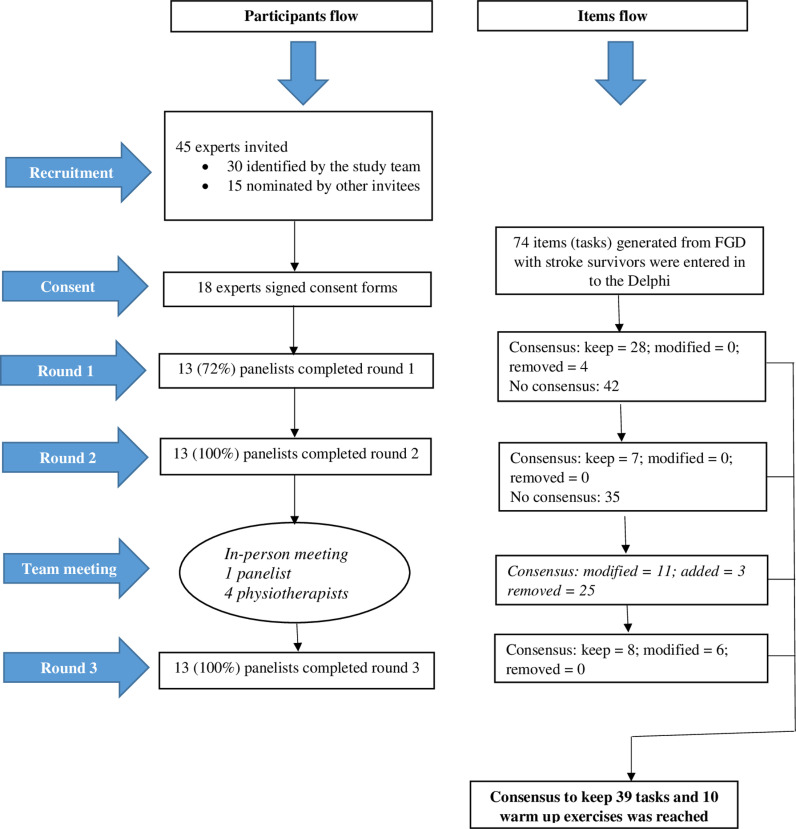
Background: More than half of stroke survivors in LMICs lack access to stroke rehabilitation services. The promotion of self-rehabilitation could be promising in an attempt to address the stroke rehabilitation inadequacies in LMICs. Self-rehabilitation interventions can easily be accepted by many community-dwelling stroke survivors, and therefore, have the potential to drive towards the successful realization of Sustainable Development Goals and other WHO rehabilitation goals. We report a consensus building process that sought to identify which task training is relevant to include in a task-specific self-rehabilitation strategy for the rural community-dwelling stroke survivors. Methods: We used an iterative two-staged mixed-method consensus-building approach: (1) focus group discussions (n = 5) with rural community-dwelling stroke survivors were conducted to explore personal life experiences in performing daily activities, and the results were used to developed a lists of candidate task trainings that could be included in a task-specific self-rehabilitation intervention model for improving functional ability post-stroke survivors; (2) a three-round Delphi exercise with a panel of stroke rehabilitation experts to establish consensus on the importance/relevance of the developed task trainings. Consensus was pre-defined to be the point where the proportion of items giving a rating of 3 (quite relevant) or 4 (highly relevant) by raters would be ≥ 0.8. Results: A list of 74 task training was generated from the results of the focus groups and grouped as follows: training for the upper extremity (37); lower extremity training (21); while 7 and 9 task trainings were grouped under the trunk and balance training respectively. A panel of 13 experts in the Delphi reviewed these task trainings and consensus was achieved on keeping 28 task trainings in the first round and an additional 7 in the second round. In the study team’s analysis of open text responses, several areas of debate were identified and some task trainings were modified. The exercise yielded 49 trainings (66% of 74) on which there was consensus (the mean proportion of items giving a rating of 3 or 4 by raters was 0.93) to keep 3 task training groups relating to: upper extremity (27), lower extremity/balance (8), trunk strength (4) and warm up exercises (10). Conclusions: The study provides a consensus-based view of the features of a task-specific self-rehabilitation training strategy to improve outcomes following a stroke. This self-rehabilitation training strategy can be used as an intervention approach to augment and promote stroke rehabilitation among the rural community-dwelling stroke survivors, especially in SSA.
Overview
The claims and statistics of this paper haven’t been checked yet.
Run the check — free, no account needed. It reads the open-access text and checks the sources it cites.
Integrity signals
Registry
Cites
Statistics
Figures
Verification
Claims the paper makes
The claims and statistics of this paper haven’t been checked yet.
Run the check — free, no account needed. It reads the open-access text and checks the sources it cites.
Self-check
Percentages, sums and reported differences re-computed from the paper’s own numbers.
The self-check needs the paper’s full text.
Citations
No citation lists for this paper
No citation lists for this paper yet — checked again daily.
References 33 · Cited by 1
Research works printed but not linked: 24
- 10.1016/S0140-6736(11)60325-5 · DOI · Paper page
- 10.2471/BLT.16.181636 · DOI · Paper page
- 10.4102/aosis.2020.BK85.01 · DOI
- 10.1186/s12939-023-01896-5 · DOI
- 10.1016/j.ensci.2016.02.011 · DOI
- 10.1177/0269215513481045 · DOI
- 10.1016/j.rehab.2020.03.017 · DOI
- 10.1080/13611260500069947 · DOI
- 10.1371/journal.pmed.1004326 · DOI · Paper page
- 10.1371/journal.pone.0286920 · DOI
- LeCompte MD , Schensul JJ . Designing and conducting ethnographic research: an introduction. Lanham, MD: AltaMira Press; 2010.
- 10.1136/bmj.311.7001.376 · DOI · Paper page
- 10.1186/1471-2288-5-37 · DOI · Paper page
- Keenyey S , Hasson F , McKenna H . The Delphi Technique in Nursing and Health Research. A John Wiley & Sons, Ltd., Publication; 2011. 1–210 p · DOI
- 10.1080/02701367.2014.930087 · DOI
- 10.1371/journal.pone.0216563 · DOI
- 10.1186/1471-2334-14-1 · DOI
- 10.1002/nur.20147 · DOI · Paper page
- 10.1016/s0897-1897(05)80008-4 · DOI · Paper page
- 10.1002/(SICI)1098-240X(199706)20:3<269::AID-NUR9>3.0.CO;2-G · DOI
- Polit D , Beck C . Nursing research: Principles and methods. 7th ed. Philadelphia: Lippincott, Williams & Wilkins; 2004.
- 10.1046/j.1365-2648.2000.01567.x · DOI · Paper page
- 1990, The committee meeting alternative. Using the Delphi technique, J Nurs Adm, 20, 30
- 10.1046/j.1365-2524.1999.00176.x · DOI
Metadata
- Authors
- Ibrahim, R., Joseph, C., Stewart, A., & Lawal, I. U.
- Affiliations
- Stellenbosch University (ZA)
- University of the Witwatersrand (ZA)
- Bayero University Kano (NG)
- Venue
- PLoS ONE
- Publisher
- openRxiv
- Published
- 2024-05-04
- Volume
- 20
- Issue
- 2
- Pages
- e0303658-e0303658
- ISSN
- 1932-6203 (ISSN-L)
- PMC
- PMC11856556
- OpenAlex
- W4407940231
- Cited by
- 1
- References
- 33
- Citations by year
- 2025: 1
- FWCI
- 0.34
- Type
- journal article
- Language
- en
- Open access
- gold
- doi.org
- Licence
- cc-by
- Locations
- PLoS ONE (publishedVersion, cc-by)
- medRxiv (acceptedVersion, cc-by)
- PubMed Central (publishedVersion, cc-by)
- PubMed (publishedVersion)
- RePEc: Research Papers in Economics (submittedVersion)
- DOAJ (DOAJ: Directory of Open Access Journals) (submittedVersion, cc-by-sa)
- Topics
- Health Sciences › Medicine › Rehabilitation › Stroke Rehabilitation and Recovery
- Health Sciences › Health Professions › Physical Therapy, Sports Therapy and Rehabilitation › Medical Practices and Rehabilitation
- Health Sciences › Health Professions › Speech and Hearing › Dysphagia Assessment and Management
- Keywords
- self-rehabilitation, stroke rehabilitation, task-oriented training, functional capacity, upper extremity training, trunk training, balance training, expert consensus, lower-middle-income countries, Sustainable Development Goals
- MeSH terms
- Stroke Rehabilitation, Activities of Daily Living, Aged, Delphi Technique, Developing Countries, Female, Humans, Male, Middle Aged, Rural Population, Focus Groups, Survivors, Stroke, Independent Living
About these checks
Registry, retraction, Cites and statistics results are computed, not judged, with one exception: a printed reference that no index lists is read once by a model before it counts as a citation error. Claims are extracted by a model and kept only when their quote appears verbatim in the text; each cited source is then checked, with a model’s help, for whether it says what the claim relies on. Those verdicts can be wrong — read the claim’s quote and the cited source before relying on one.
Statistics and arithmetic are recomputed, not judged.
Confidence bands are shown only for fields calibrated on our annotated test set. None is calibrated yet, so no band is shown.
What counts as a claim ›How we measure confidence ›How we check this ›
Are you an author, or do you see a problem with this page? Request a review
How to cite
Cite CoChat for the checks on this page, and the paper for its own findings.
- This page
- CoChat. (2026). Citation check: Self-Rehabilitation Strategy for Rural Community-dwelling Stroke Survivors in a Lower-Middle Income Country: A Delphi Study. https://app.cochat.ai/papers/10.1101/2024.05.03.24306686
- The paper
- Ibrahim, R., Joseph, C., Stewart, A., & Lawal, I. U. (2024). Self-Rehabilitation Strategy for Rural Community-dwelling Stroke Survivors in a Lower-Middle Income Country: A Delphi Study. PLoS ONE. https://doi.org/10.1101/2024.05.03.24306686
