

The DOI matches its Crossref record; 1 of the 1 references it cites were found in a registry or an index.
PneumoBrowse 2: An integrated visual platform for curated genome annotation and multiomics data analysis of Streptococcus pneumoniae
Open accessPreprint — published as 10.1093/nar/gkae923 · Paper page
Abstract
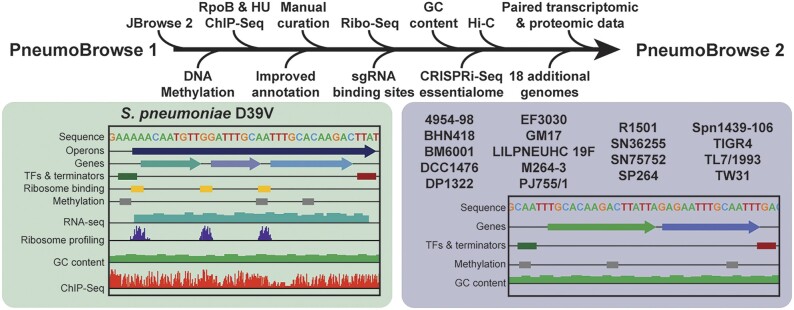
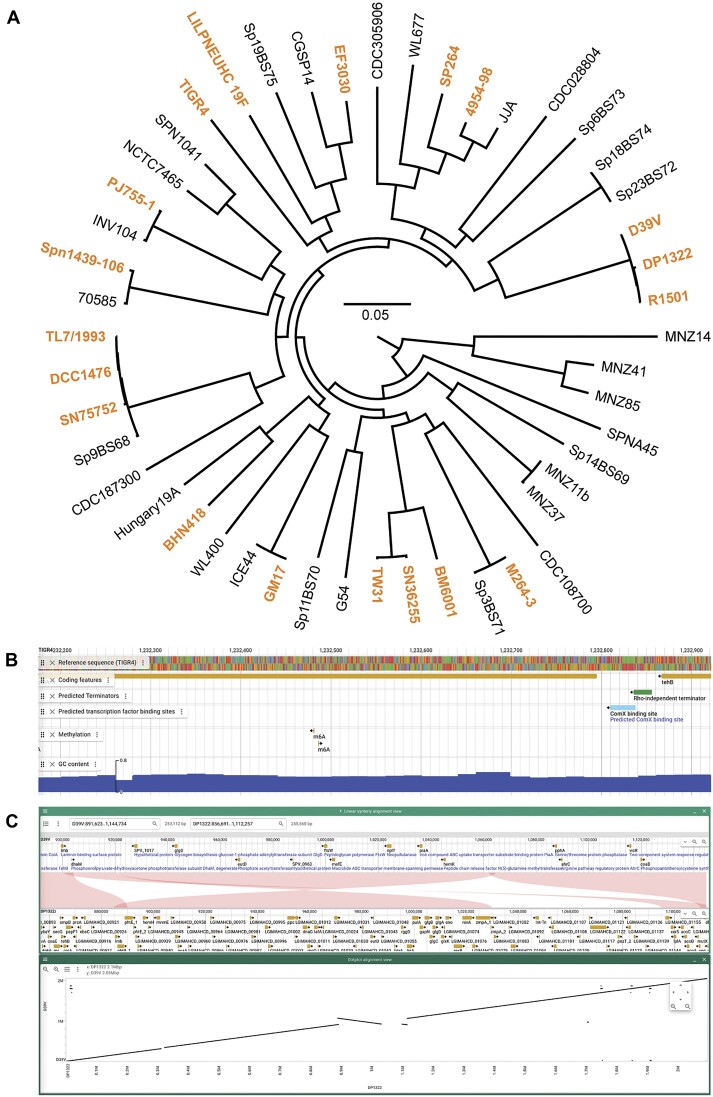
Streptococcus pneumoniae is an opportunistic human pathogen responsible for high morbidity and mortality rates. Extensive genome sequencing revealed its large pangenome, serotype diversity, and provided insight into genome dynamics. However, functional genome analysis has lagged behind, as that requires detailed and time-consuming manual curation of genome annotations, and integration of genomic and phenotypic data. To remedy this, PneumoBrowse was presented in 2018; a user-friendly interactive online platform, which provided the detailed annotation of the S. pneumoniae D39V genome, alongside transcriptomic data. Since 2018, many new studies on S. pneumoniae genome biology and protein functioning have been performed. Here, we present PneumoBrowse 2 ( https://veeninglab.com/pneumobrowse ) , fully rebuilt in JBrowse 2. We updated annotations for transcribed and transcriptional regulatory features in the D39V genome. We added genome-wide data tracks for high-resolution chromosome conformation capture (Hi-C) data, chromatin immunoprecipitation coupled to high-throughput sequencing (ChIP-Seq), ribosome profiling, CRISPRi-seq gene essentiality data and more. Additionally, we included 18 phylogenetically diverse S. pneumoniae genomes and their annotations. By providing easy access to diverse high-quality genome annotations, and links to other databases (including UniProt and AlphaFold), PneumoBrowse 2 will further accelerate research and development into preventive and treatment strategies, through increased understanding of the pneumococcal genome. Graphical abstract:
Overview
The claims and statistics of this paper haven’t been checked yet.
Run the check — free, no account needed. It reads the open-access text and checks the sources it cites.
Integrity signals
Registry
Cites
Statistics
Figures
Verification
Claims the paper makes
The claims and statistics of this paper haven’t been checked yet.
Run the check — free, no account needed. It reads the open-access text and checks the sources it cites.
Self-check
Percentages, sums and reported differences re-computed from the paper’s own numbers.
The self-check needs the paper’s full text.
Citations
Cites
Highly accurate protein structure prediction with AlphaFold
Jumper, J., Evans, R., Pritzel, A., Green, T., Figurnov, M., Ronneberger, O., Tunyasuvunakool, K., Bates, R., Žídek, A., Potapenko, A., et al. (2021) · Nature · doi:10.1038/s41586-021-03819-2 · Cited by 43,764
Research works printed but not linked: 69
- 10.1016/s1473-3099(18)30310-4 · DOI
- 10.1038/s41579-018-0001-8 · DOI
- 1944, Studies on the chemical nature of the substance inducing transformation of pneumococcal types: Induction of transformation by a desoxyribonucleic acid fraction isolated from pneumococcus type III, J. Exp. Med, 79, 2
- 2018, Deep genome annotation of the opportunistic human pathogen Streptococcus pneumoniae D39, Nucleic Acids Res, 46, 9971
- 2018, High-resolution analysis of the pneumococcal transcriptome under a wide range of infection-relevant conditions, Nucleic Acids Res, 46, 9990
- Slager, J. , Aprianto, R. and Veening, J.W . (2019) Refining the pneumococcal competence regulon by RNA sequencing. J. Bacteriol., 201. · DOI
- 10.1186/s13059-016-1054-5 · DOI
- 2019, Redefining the small regulatory RNA transcriptome in Streptococcus pneumoniae serotype 2 strain D39, J. Bacteriol, 201, e00764
- 10.1128/JB.01204-09 · DOI
- 10.1128/JB.185.1.359-370.2003 · DOI
- 2021, Exploration of bacterial bottlenecks and Streptococcus pneumoniae pathogenesis by CRISPRi-Seq, Cell Host Microbe, 29, 107, 10.1016/j.chom.2020.10.001 · DOI
- 10.15252/msb.20167449 · DOI
- 2022, Discovery of unannotated small open reading frames in Streptococcus pneumoniae D39 involved in quorum sensing and virulence using ribosome profiling, MBio, 13, e0124722, 10.1128/mbio.01247-22 · DOI
- 10.1186/s13059-023-02907-y · DOI
- 10.1126/science.1061217 · DOI
- 10.1128/jb.166.3.972-977.1986 · DOI
- 10.1128/AAC.13.4.577 · DOI
- 10.1164/rccm.201503-0542OC · DOI
- 2023, Effect of 13-valent pneumococcal conjugate vaccine on experimental carriage of Streptococcus pneumoniae serotype 6B in Blantyre, Malawi: a randomised controlled trial and controlled human infection study, The Lancet Microbe, 4, e683, 10.1016/S2666-5247(23)00178-7 · DOI
- 2021, Extracellular pneumococcal serine proteases affect nasopharyngeal colonization, Front. Cell. Infect. Microbiol, 10, 613467, 10.3389/fcimb.2020.613467 · DOI
- 2021, CcrZ is a pneumococcal spatiotemporal cell cycle regulator that interacts with FtsZ and controls DNA replication by modulating the activity of DnaA, Nat. Microbiol, 6, 1175, 10.1038/s41564-021-00949-1 · DOI
- 10.1016/j.celrep.2018.11.007 · DOI
- Clark, T.A. , Murray, I.A. , Morgan, R.D. , Kislyuk, A.O. , Spittle, K.E. , Boitano, M. , Fomenkov, A. , Roberts, R.J. and Korlach, J . (2012) Characterization of DNA methyltransferase specificities using single-molecule, real-time DNA sequencing. Nucleic Acids Res., 40. · DOI
- Wick, R.R. , Judd, L.M. , Gorrie, C.L. and Holt, K.E . (2017) Unicycler: resolving bacterial genome assemblies from short and long sequencing reads. PLoS Comput. Biol., 13. · DOI
- 10.1093/bioinformatics/btu153 · DOI
- 10.1186/1471-2105-11-119 · DOI
- 10.1093/nar/gkh152 · DOI
- 10.1093/bioinformatics/btr545 · DOI
- 10.1186/1471-2105-8-209 · DOI
- 10.1093/nar/gkr367 · DOI · Paper page
- 10.1186/gb-2007-8-2-r22 · DOI
- 10.1093/bioinformatics/btr064 · DOI · Paper page
- 10.1093/nar/gkv416 · DOI
- 10.1093/nar/gky1085 · DOI
- 10.1101/2021.06.03.446934 · DOI
- 10.1038/75556 · DOI · Paper page
- 10.1093/genetics/iyad031 · DOI
- 2023, KEGG for taxonomy-based analysis of pathways and genomes, Nucleic Acids Res, 51, D587, 10.1093/nar/gkac963 · DOI · Paper page
- Darling, A.E. , Mau, B. and Perna, N.T . (2010) progrssiveMauve: multiple genome alignment with gene gain, loss and rearrangement. PLoS One, 5. · DOI · Paper page
- 2017, Gene acquisition by a distinct Pphyletic group within Streptococcus pneumoniae promotes adhesion to the ocular epithelium, mSphere, 2, 1
- 10.1093/nar/gku1196 · DOI
- 10.1093/molbev/msp077 · DOI · Paper page
- Gibson, P.S. , Bexkens, E. , Zuber, S. , Cowley, L.A. and Veening, J.W. (2022) The acquisition of clinically relevant amoxicillin resistance in Streptococcus pneumoniae requires ordered horizontal gene transfer of four loci. · DOI
- 10.1186/s13059-016-0924-1 · DOI
- 2019, RocS drives chromosome segregation and nucleoid protection in Streptococcus pneumoniae, Nat. Microbiol, 4, 1661, 10.1038/s41564-019-0472-z · DOI
- 2023, A novel aquaporin subfamily imports oxygen and contributes to pneumococcal virulence by controlling the production and release of virulence factors, MBio, 12, e01309
- 2020, Molecular determinants of substrate selectivity of a pneumococcal Rgg-regulated peptidase-containing ABC transporter, MBio, 11, e02502
- 2023, Identification and characterization of negative regulators of Rgg1518 quorum sensing in Streptococcus pneumoniae, J. Bacteriol, 205, 1
- Novichkov, P.S. , Kazakov, A.E. , Ravcheev, D.A. , Leyn, S.A. , Kovaleva, G.Y. , Sutormin, R.A. , Kazanov, M.D. , Riehl, W. , Arkin, A.P. , Dubchak, I. , et al. (2013) RegPrecise 3.0 - A resource for genome-scale exploration of transcriptional regulation in bacteria. BMC Genomics, 14. · DOI · Paper page
- 10.1093/nar/gkaa1100 · DOI · Paper page
- 10.1038/s41598-018-23276-8 · DOI
- 10.1111/mmi.13721 · DOI
- 10.1111/j.1365-2958.2007.05900.x · DOI
- 10.1038/ncomms6055 · DOI
- 2020, Chromosome organization in bacteria: mechanistic insights into genome structure and function, Nat. Rev. Genet, 21, 227, 10.1038/s41576-019-0185-4 · DOI
- 10.3390/ijms13033134 · DOI
- 2024, Fast and accurate protein structure search with Foldseek, Nat. Biotechnol, 42, 243, 10.1038/s41587-023-01773-0 · DOI · Paper page
- 10.1093/NAR/GKAB1061 · DOI · Paper page
- 10.1128/mSystems.00039-17 · DOI
- 10.1128/JB.01148-06 · DOI
- 2010, The pneumococcal serine-rich repeat protein is an intraspecies bacterial adhesin that promotes bacterial aggregation in vivo and in biofilms, PLoS Pathog, 6, 33
- 10.1128/JB.00341-21 · DOI · Paper page
- 10.1073/pnas.92.24.11140 · DOI
- 10.1093/genetics/164.4.1279 · DOI
- Baptista, R.P. , Reis-Cunha, J.L. , DeBarry, J.D. , Chiari, E. , Kissinger, J.C. , Bartholomeu, D.C. and Macedo, A.M . (2018) Assembly of highly repetitive genomes using short reads: the genome of discrete typing unit III Trypanosoma cruzi strain 231. Microb . genomics, 4. · DOI
- 10.1093/nar/gkz841 · DOI · Paper page
- 10.1111/j.1365-2958.2010.07189.x · DOI
- 10.1093/database/baz149 · DOI
- 2024, The Genome Explorer genome browser, mSystems, 9, e00267
Metadata
- Authors
- Janssen, A. B., Gibson, P. S., Bravo, A. M., de Bakker, V., Slager, J., & Veening, J.-W.
- Affiliations
- University of Lausanne (CH)
- University Medical Center Groningen (NL)
- Corresponding author
- Veening, Jan-Willem
- ORCID
- Venue
- Nucleic Acids Research
- Publisher
- openRxiv
- Published
- 2024-08-07
- Volume
- 53
- Issue
- D1
- Pages
- D839-D851
- ISSN
- 0305-1048 (ISSN-L)
- PMC
- PMC11701578
- OpenAlex
- W4403646540
- Cited by
- 18
- References
- 1
- Citations by year
- 2026: 8 · 2025: 10
- FWCI
- 2.45
- Type
- journal article
- Language
- en
- Open access
- gold
- doi.org
- Licence
- Locations
- Nucleic Acids Research (publishedVersion, cc-by)
- bioRxiv (Cold Spring Harbor Laboratory) (acceptedVersion, cc-by)
- PubMed Central (publishedVersion, cc-by)
- PubMed (publishedVersion)
- SERVAL (Université de Lausanne) (submittedVersion, cc-by)
- IRIS (submittedVersion, cc-by)
- University of Groningen research database (University of Groningen / Centre for Information Technology) (submittedVersion, cc-by)
- Funders
- National Science Foundation
- Università degli Studi di Siena
- Schweizerischer Nationalfonds zur Förderung der Wissenschaftlichen Forschung (310 030_192 517, TMPFP3_210 202, 51NF40_180 541 792, 310 030_200)
- Karolinska Institutet
- Université de Lausanne
- RWTH Aachen University
- Universität Greifswald
- National Center for Chronic Disease Prevention and Health Promotion (R36 DP001322)
- Faculté de Biologie et de Médecine, Université de Lausanne
- Topics
- Life Sciences › Biochemistry, Genetics and Molecular Biology › Molecular Biology › Genomics and Phylogenetic Studies
- Health Sciences › Medicine › Epidemiology › Pneumonia and Respiratory Infections
- Life Sciences › Biochemistry, Genetics and Molecular Biology › Genetics › Bacterial Genetics and Biotechnology
- Keywords
- Streptococcus pneumoniae, genome annotation, multi-omics integration, JBrowse, Hi-C, ChIP-seq, ribosome profiling, gene essentiality, transcriptional regulation, pan-genome, serotype diversity
- MeSH terms
- Multiomics, Humans, Software, Streptococcus pneumoniae, Genome, Bacterial, Genomics, Databases, Genetic, Molecular Sequence Annotation
About these checks
Registry, retraction, Cites and statistics results are computed, not judged, with one exception: a printed reference that no index lists is read once by a model before it counts as a citation error. Claims are extracted by a model and kept only when their quote appears verbatim in the text; each cited source is then checked, with a model’s help, for whether it says what the claim relies on. Those verdicts can be wrong — read the claim’s quote and the cited source before relying on one.
Statistics and arithmetic are recomputed, not judged.
Confidence bands are shown only for fields calibrated on our annotated test set. None is calibrated yet, so no band is shown.
What counts as a claim ›How we measure confidence ›How we check this ›
Are you an author, or do you see a problem with this page? Request a review
How to cite
Cite CoChat for the checks on this page, and the paper for its own findings.
- This page
- CoChat. (2026). Citation check: PneumoBrowse 2: An integrated visual platform for curated genome annotation and multiomics data analysis of Streptococcus pneumoniae. https://app.cochat.ai/papers/10.1101/2024.08.07.606308
- The paper
- Janssen, A. B., Gibson, P. S., Bravo, A. M., de Bakker, V., Slager, J., & Veening, J.-W. (2024). PneumoBrowse 2: An integrated visual platform for curated genome annotation and multiomics data analysis of Streptococcus pneumoniae. Nucleic Acids Research. https://doi.org/10.1101/2024.08.07.606308
