

The DOI matches its Crossref record; 1 of the 1 references it cites were found in a registry or an index.
Vibrio cholerae RbmB is an α−1,4-polysaccharide lyase with biofilm-dispersal activity against Vibrio Polysaccharide (VPS)
Open accessPreprint — published as 10.1371/journal.ppat.1012750 · Paper page
Abstract
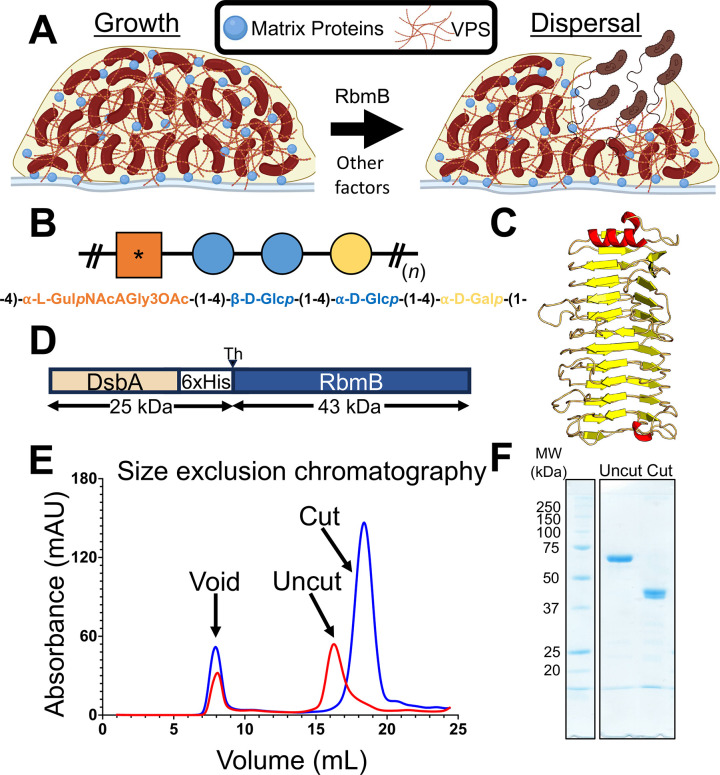
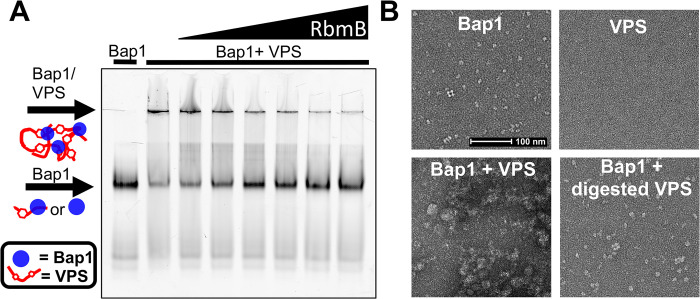
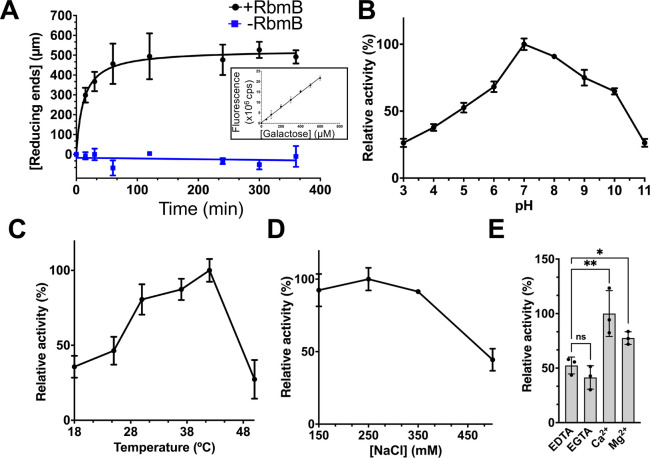
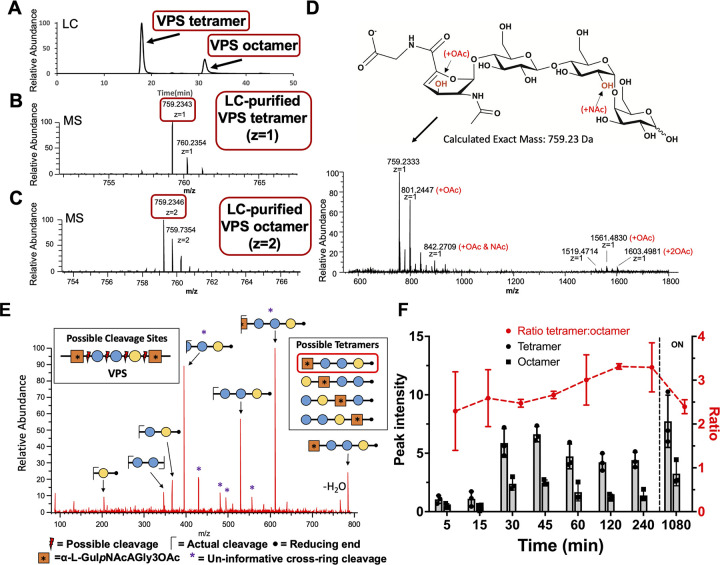
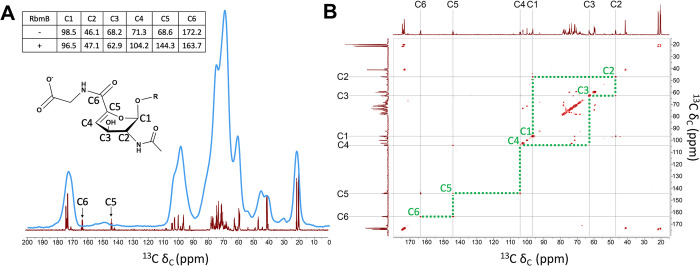
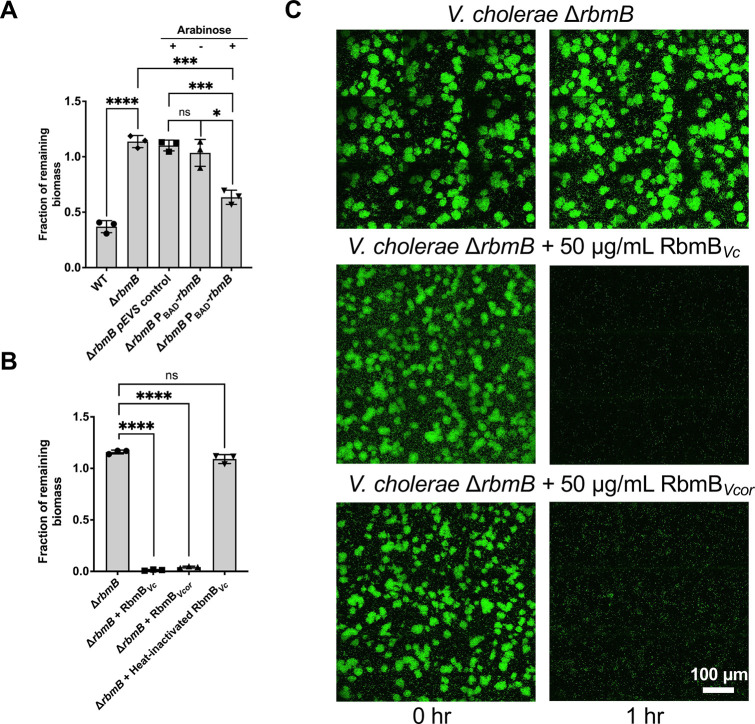
Many pathogenic bacteria form biofilms as a protective measure against environmental and host hazards. The underlying structure of the biofilm matrix consists of secreted macromolecules, usually including exopolysaccharides. To escape the biofilm, bacteria may produce a number of matrix-degrading enzymes, including glycosidic enzymes that digest exopolysaccharide scaffolds. The human pathogen Vibrio cholerae assembles and secretes an exopolysaccharide called VPS ( V ibrio p oly s accharide) which is essential in most cases for the formation of biofilms and consists of a repeating tetrasaccharide unit. Previous studies have indicated that a secreted glycosidase called RbmB is involved in Vibrio cholerae biofilm dispersal, although the mechanism by which this occurs is not understood. To approach the question of RbmB function, we recombinantly expressed and purified RbmB and tested its activity against purified VPS. Using a fluorescence-based biochemical assay, we show that RbmB specifically cleaves VPS in vitro under physiological conditions. Analysis of the cleavage products using mass spectrometry, solid-state NMR, and solution NMR indicates that RbmB cleaves VPS at a specific site (at the α−1,4 linkage between D-galactose and a modified L-guluronic acid) into a mixture of tetramers and octamers. We demonstrate that the product of the cleavage contains a double bond in the modified-guluronic acid ring, strongly suggesting that RbmB is cleaving using a glycoside lyase mechanism. Finally, we show that recombinant RbmB from Vibrio cholerae and the related aquatic species Vibrio coralliilyticus are both able to disperse living Vibrio cholerae biofilms. Our results support the role of RbmB as a polysaccharide lyase involved in biofilm dispersal as well as an additional glycolytic enzyme to add to the toolbox of potential therapeutic antibacterial enzymes. Author summary: Biofilms are protective sheaths produced by many bacteria that play important roles in survival in the environment and in hosts during infection. Understanding how biofilms form and disperse is essential in the fight against harmful bacterial pathogens. Vibrio cholerae is a historically significant human pathogen that forms biofilms made of a polysaccharide called VPS and secreted accessory proteins. Within the V. cholerae biofilm gene cluster is a gene encoding a protein called RbmB, which is known to play a role in biofilm dispersal. Using a combination of biochemical and analytical tools, we show that RbmB indeed cleaves VPS into 4- and 8-monosaccharide fragments at a unique site and demonstrate that it falls into the family of polysaccharide lyase enzymes (as opposed to the more common hydrolases). Furthermore, recombinant RbmB disperses living V. cholerae biofilms further indicating that it may play a role in VPS processing or degradation.
Overview
The claims and statistics of this paper haven’t been checked yet.
Run the check — free, no account needed. It reads the open-access text and checks the sources it cites.
Integrity signals
Registry
Cites
Statistics
Figures
Verification
Claims the paper makes
The claims and statistics of this paper haven’t been checked yet.
Run the check — free, no account needed. It reads the open-access text and checks the sources it cites.
Self-check
Percentages, sums and reported differences re-computed from the paper’s own numbers.
The self-check needs the paper’s full text.
Citations
Cites
Highly accurate protein structure prediction with AlphaFold
Jumper, J., Evans, R., Pritzel, A., Green, T., Figurnov, M., Ronneberger, O., Tunyasuvunakool, K., Bates, R., Žídek, A., Potapenko, A., et al. (2021) · Nature · doi:10.1038/s41586-021-03819-2 · Cited by 43,764
Research works printed but not linked: 45
- 10.3389/fmicb.2021.686793 · DOI
- 10.1038/s41579-022-00791-0 · DOI
- 10.1111/mmi.13698 · DOI
- 10.1038/s41579-020-0385-0 · DOI
- 10.1016/j.jmb.2005.03.082 · DOI
- 10.1128/JB.185.16.4693-4698.2003 · DOI · Paper page
- 10.1038/nrmicro3433 · DOI
- 10.1146/annurev-micro-111021-053553 · DOI
- 10.1128/IAI.00048-10 · DOI
- 10.1073/pnas.1916571117 · DOI
- 10.1073/pnas.0237386100 · DOI
- 10.1073/pnas.96.7.4028 · DOI
- 10.1099/mic.0.040196-0 · DOI
- 10.1128/JB.188.3.1049-1059.2006 · DOI
- 10.1128/JB.01569-06 · DOI
- 10.1126/science.1222981 · DOI
- 10.1371/journal.ppat.1002210 · DOI
- 10.1038/s41467-023-37660-0 · DOI
- 10.1016/j.bpj.2014.10.015 · DOI
- 10.1073/pnas.2021166117 · DOI
- 10.1371/journal.pone.0086751 · DOI
- 10.1038/s41579-022-00712-1 · DOI · Paper page
- 10.1093/nar/gkab1112 · DOI · Paper page
- 10.1126/science.8502994 · DOI
- 10.1093/nar/gkac993 · DOI
- 10.1093/nar/gkaa1079 · DOI · Paper page
- 10.1093/nar/gkaa937 · DOI
- 10.1021/ja00420a036 · DOI
- 10.1038/ismej.2017.33 · DOI
- 10.1016/j.ijbiomac.2020.07.199 · DOI
- 10.1074/jbc.M116.766030 · DOI
- 10.1371/journal.ppat.1008745 · DOI
- 10.1038/nature05267 · DOI
- 10.1146/annurev.biochem.75.103004.142545 · DOI
- 10.3389/fcimb.2020.00379 · DOI
- 10.1016/j.bioflm.2021.100061 · DOI
- 10.1021/acs.chemrev.0c01338 · DOI
- 10.1002/pro.102 · DOI
- 10.1074/jbc.RA119.008335 · DOI
- 10.1016/0003-2697(80)90143-8 · DOI
- 10.1016/0003-2697(89)90004-3 · DOI
- 10.1021/pr7008252 · DOI
- 10.1063/1.470372 · DOI
- 10.1016/S1090-7807(03)00082-X · DOI
- 10.1007/BF01049915 · DOI
Metadata
- Authors
- Weerasekera, R., Moreau, A., Huang, X., Nam, K.-M., Hinbest, A., Huynh, Y., Liu, X., Ashwood, C., Pepi, L. E., Paulson, E., Cegelski, L., Yan, J., & Olson, R.
- Affiliations
- Wesleyan University (US)
- Yale University (US)
- Stanford University (US)
- Beth Israel Deaconess Medical Center (US)
- Corresponding author
- Olson, Rich
- ORCID
- Venue
- PLoS Pathogens
- Publisher
- openRxiv
- Published
- 2024-08-27
- Volume
- 20
- Issue
- 12
- Pages
- e1012750-e1012750
- ISSN
- 1553-7366 (ISSN-L)
- PMC
- PMC11637428
- OpenAlex
- W4404914127
- Cited by
- 9
- References
- 1
- Citations by year
- 2026: 5 · 2025: 3 · 2024: 1
- FWCI
- 2.67
- Type
- journal article
- Language
- en
- Open access
- gold
- doi.org
- Licence
- Locations
- PLoS Pathogens (publishedVersion, cc-by)
- bioRxiv (Cold Spring Harbor Laboratory) (acceptedVersion)
- PubMed Central (publishedVersion, cc-by)
- PubMed (publishedVersion)
- DOAJ (DOAJ: Directory of Open Access Journals) (submittedVersion)
- Funders
- National Science Foundation (2205006)
- Alfred P. Sloan Foundation (FG-2023-20857)
- Yale University
- National Institutes of Health
- National Institute of General Medical Sciences (DP2GM146253, R15GM152959, R01GM117278)
- Division of Materials Research
- Topics
- Life Sciences › Immunology and Microbiology › Microbiology › Vibrio bacteria research studies
- Life Sciences › Biochemistry, Genetics and Molecular Biology › Molecular Biology › Bacterial biofilms and quorum sensing
- Life Sciences › Agricultural and Biological Sciences › Food Science › Polysaccharides Composition and Applications
- Keywords
- Vibrio cholerae, biofilm dispersal, biofilm matrix degradation, Vibrio coralliilyticus, antibacterial enzymes, glycolytic enzymes
- MeSH terms
- Bacterial Proteins, Cholera, Humans, Polysaccharide-Lyases, Polysaccharides, Bacterial, Vibrio cholerae, Biofilms
About these checks
Registry, retraction, Cites and statistics results are computed, not judged, with one exception: a printed reference that no index lists is read once by a model before it counts as a citation error. Claims are extracted by a model and kept only when their quote appears verbatim in the text; each cited source is then checked, with a model’s help, for whether it says what the claim relies on. Those verdicts can be wrong — read the claim’s quote and the cited source before relying on one.
Statistics and arithmetic are recomputed, not judged.
Confidence bands are shown only for fields calibrated on our annotated test set. None is calibrated yet, so no band is shown.
What counts as a claim ›How we measure confidence ›How we check this ›
Are you an author, or do you see a problem with this page? Request a review
