PreprintCited by 1SARS-CoV-2 and COVID-19 ResearchDNA Repair MechanismsDNA and Nucleic Acid Chemistry

The DOI matches its Crossref record; 1 of the 1 references it cites were found in a registry or an index.

Nsp1 stalls DNA Polymerase α at DNA hairpins

Open access

Preprint — published as 10.1038/s41598-025-00982-8

Abstract

The human primosome, a four-subunit complex of DNA primase and DNA polymerase alpha (Polα), plays a critical role in DNA replication by initiating RNA and DNA synthesis on both chromosome strands. A recent study has shown that a major virulence factor in the SARS-CoV-2 infection, Nsp1 (non-structural protein 1), forms a stable complex with Polα but does not affect the primosome activity. Here we show that Nsp1 inhibits DNA synthesis across inverted repeats prone to hairpin formation. Analysis of current structural data revealed the overlapping binding sites for Nsp1 and the winged helix-turn-helix domain of RPA (wHTH) on Polα, indicating a competition between them. Comparison of the inhibitory effect of Nsp1 and wHTH on DNA hairpin bypass by Polα showed an 8-fold lower IC 50 value for Nsp1 (1 µM). This study provides a valuable insight into the mechanism of inhibition of human DNA replication by Nsp1 during a SARS-CoV-2 infection.

Overview

The claims and statistics of this paper haven’t been checked yet.

Run the check — free, no account needed. It reads the open-access text and checks the sources it cites.

A few free checks a day · papers already verified open instantly · results are public

Integrity signals

Registry

Crossref · 10.1101/2024.09.03.608162

Cites

1 of 1 references verified0 citation errors · 0 not checkable

Statistics

Figures

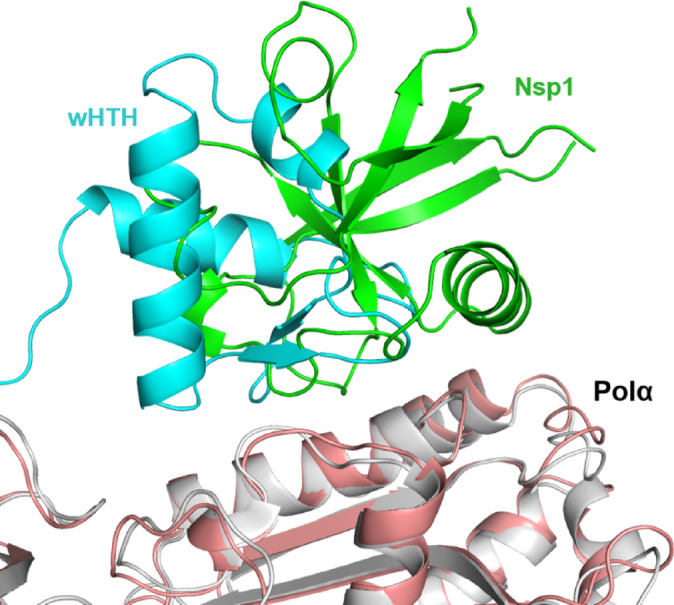
Fig. 1 Nsp1 and the wHTH domain of RPA have overlapping docking sites on Polα. Nsp1, wHTH, and Polα in the complexes with Nsp1 and wHTH are represented as cartoons and colored green, cyan, gray, and salmon, respectively. The coordinates of Nsp1/primosome and RPAcore/PolαCD/DNA complexes were used for figure preparation (pdb codes 7opl and 9mj5, respectively). Two complexes were superposed using the Polα region 612–661 involved in interaction. PyMol Molecular Graphics System (version 1.8, Schrödinger, LLC) was used for alignment and figure preparation.
Fig. 1 Nsp1 and the wHTH domain of RPA have overlapping docking sites on Polα. Nsp1, wHTH, and Polα in the complexes with Nsp1 and wHTH are represented as cartoons and colored green, cyan, gray, and salmon, respectively. The coordinates of Nsp1/primosome and RPAcore/PolαCD/DNA complexes were used for figure preparation (pdb codes 7opl and 9mj5, respectively). Two complexes were superposed using the Polα region 612–661 involved in interaction. PyMol Molecular Graphics System (version 1.8, Schrödinger, LLC) was used for alignment and figure preparation.CC BY-NC-ND · PubMed Central
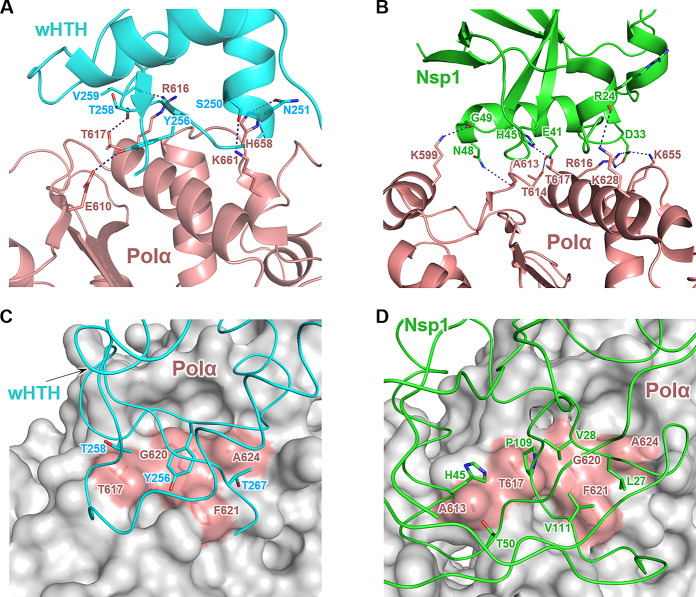
Fig. 2 Nsp1 has a larger interaction interface with Polα than the wHTH domain of RPA. (A) and (B), analysis of potential hydrogen bonds at the wHTH-Polα and Nsp1-Polα interfaces, respectively. Nsp1, wHTH, and Polα are represented as cartoons and colored green, cyan, and salmon, respectively. H-bonds are depicted as dark-blue dashed lines. A position of the Lys599 side-chain was adjusted for optimal H-bond formation with Gly49 (C) and (D), analysis of potential hydrophobic contacts at the wHTH-Polα and Nsp1-Polα interfaces, respectively. Polα is represented as a surface. Polα residues, involved in hydrophobic interactions with Nsp1 or wHTH, are shown as sticks and colored salmon. Nsp1 and wHTH are represented as ribbon and colored green and cyan, respectively. Their residues, involved in hydrophobic interactions with Polα, are shown as sticks. PyMol Molecular Graphics System and the coordinates of Nsp1/primosome and RPAcore/PolαCD/DNA complexes were used for figure preparation (pdb codes 7opl and 9mj5, respectively).
Fig. 2 Nsp1 has a larger interaction interface with Polα than the wHTH domain of RPA. (A) and (B), analysis of potential hydrogen bonds at the wHTH-Polα and Nsp1-Polα interfaces, respectively. Nsp1, wHTH, and Polα are represented as cartoons and colored green, cyan, and salmon, respectively. H-bonds are depicted as dark-blue dashed lines. A position of the Lys599 side-chain was adjusted for optimal H-bond formation with Gly49 (C) and (D), analysis of potential hydrophobic contacts at the wHTH-Polα and Nsp1-Polα interfaces, respectively. Polα is represented as a surface. Polα residues, involved in hydrophobic interactions with Nsp1 or wHTH, are shown as sticks and colored salmon. Nsp1 and wHTH are represented as ribbon and colored green and cyan, respectively. Their residues, involved in hydrophobic interactions with Polα, are shown as sticks. PyMol Molecular Graphics System and the coordinates of Nsp1/primosome and RPAcore/PolαCD/DNA complexes were used for figure preparation (pdb codes 7opl and 9mj5, respectively).CC BY-NC-ND · PubMed Central
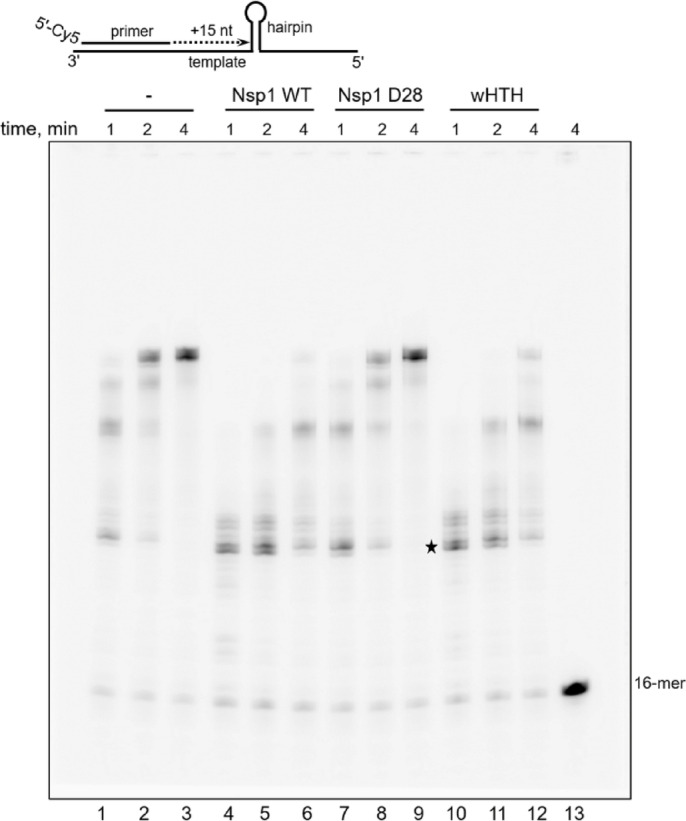
Fig. 3 Nsp1 inhibits DNA synthesis across a 9-bp hairpin by the RPA/Polα complex. The DNA synthesis activity of Polα in extension of a 16-mer DNA primer with a Cy5-fluorophore attached to the 5′-end was tested in a 10 μl reaction containing 0.25 μM template:primer, 20 nM Polα, 0.7 µM RPA, and 25 μM dNTPs; 8 µM Nsp1 or 40 µM wHTH were added as indicated on the figure. Lane 13 is a control incubation in the absence of proteins. The star denotes the pause site at the beginning of a hairpin located 15 nucleotides from the 3’-end of the primer. Reactions were incubated at 35 °C, and the products were resolved by 20% Urea-PAGE and visualized by imaging on Typhoon FLA 9500. The substrate schematic is shown at the top.
Fig. 3 Nsp1 inhibits DNA synthesis across a 9-bp hairpin by the RPA/Polα complex. The DNA synthesis activity of Polα in extension of a 16-mer DNA primer with a Cy5-fluorophore attached to the 5′-end was tested in a 10 μl reaction containing 0.25 μM template:primer, 20 nM Polα, 0.7 µM RPA, and 25 μM dNTPs; 8 µM Nsp1 or 40 µM wHTH were added as indicated on the figure. Lane 13 is a control incubation in the absence of proteins. The star denotes the pause site at the beginning of a hairpin located 15 nucleotides from the 3’-end of the primer. Reactions were incubated at 35 °C, and the products were resolved by 20% Urea-PAGE and visualized by imaging on Typhoon FLA 9500. The substrate schematic is shown at the top.CC BY-NC-ND · PubMed Central
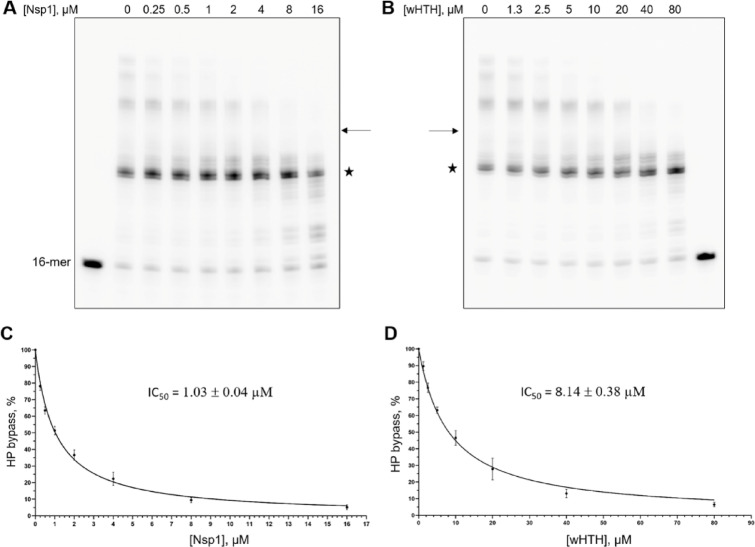
Fig. 4 Comparison of the inhibitory effect of Nsp1 and wHTH on hairpin bypass by RPA/Polα. (A) and (B), representative gels showing titration of DNA-synthetic activity by Nsp1 and wHTH, respectively. The star denotes the pause site at the beginning of a hairpin. The bands above the arrow were counted as products of hairpin bypass. Reactions were incubated for 1 min at 35 °C, and the products were resolved by 20% Urea-PAGE and visualized by imaging on Typhoon FLA 9500. Original images of the gels are presented in Supplementary Fig. S4. (C) and (D), the mean value of the percent of hairpin bypass is plotted against Nsp1 and wHTH concentrations, respectively. Error bars denote the standard deviation. The IC50 values were calculated from three independent experiments using GraphPad Prism.
Fig. 4 Comparison of the inhibitory effect of Nsp1 and wHTH on hairpin bypass by RPA/Polα. (A) and (B), representative gels showing titration of DNA-synthetic activity by Nsp1 and wHTH, respectively. The star denotes the pause site at the beginning of a hairpin. The bands above the arrow were counted as products of hairpin bypass. Reactions were incubated for 1 min at 35 °C, and the products were resolved by 20% Urea-PAGE and visualized by imaging on Typhoon FLA 9500. Original images of the gels are presented in Supplementary Fig. S4. (C) and (D), the mean value of the percent of hairpin bypass is plotted against Nsp1 and wHTH concentrations, respectively. Error bars denote the standard deviation. The IC50 values were calculated from three independent experiments using GraphPad Prism.CC BY-NC-ND · PubMed Central

Verification

Claims the paper makes

The claims and statistics of this paper haven’t been checked yet.

Run the check — free, no account needed. It reads the open-access text and checks the sources it cites.

A few free checks a day · papers already verified open instantly · results are public

Self-check

Percentages, sums and reported differences re-computed from the paper’s own numbers.

The self-check needs the paper’s full text.

Citations

Cites

Research works printed but not linked: 14

  1. 10.3892/etm.2021.10444 · DOI
  2. 10.1016/j.virusres.2014.11.019 · DOI
  3. Gordon, D.E. , Hiatt, J. , Bouhaddou, M. , Rezelj, V.V. , Ulferts, S. , Braberg, H. , Jureka, A.S. , Obernier, K. , Guo, J.Z. , Batra, J. et al. (2020) Comparative host-coronavirus protein interaction networks reveal pan-viral disease mechanisms. Science, 370. · DOI
  4. 10.1002/pro.4220 · DOI
  5. Baranovskiy, A.G. , Morstadt, L.M. , Babayeva, N.D. and Tahirov, T.H. (2024) Human primosome requires replication protein A when copying DNA with inverted repeats. bioRxiv preprint. · DOI
  6. Evans, R. , O’Neill, M. , Pritzel, A. , Antropova, N. , Senior, A. , Green, T. , Zidek, A. , Bates, R. , Blackwell, S. , Yim, J. et al. (2022) Protein complex prediction with AlphaFold-Multimer. bioRxiv preprint. · DOI · Paper page
  7. 10.1038/s41586-022-05040-1 · DOI · Paper page
  8. 10.1016/j.ajhg.2019.03.006 · DOI
  9. 10.1038/ni.3409 · DOI
  10. Ragu, S. , Matos-Rodrigues, G. and Lopez, B.S. (2020) Replication Stress, DNA Damage, Inflammatory Cytokines and Innate Immune Response. Genes (Basel), 11. · DOI
  11. 2021, Cytosolic DNA sensing by cGAS: regulation, function, and human diseases, Signal Transduct Target Ther, 6, 170, 10.1038/s41392-021-00554-y · DOI
  12. 2021, Structural characterization of nonstructural protein 1 from SARS-CoV-2, iScience, 24, 101903, 10.1016/j.isci.2020.101903 · DOI
  13. 10.1016/j.pep.2006.12.006 · DOI
  14. Gasteiger, E. , Hoogland, C. , Gattiker, A. , Duvaud, S. , Wilkins, M.R. , Appel, R.D. and Bairoch, A. (2005) In Walker, J. M. (ed.), The Proteomics Protocols Handbook.. Humana Press, pp. 571–607. · DOI

Metadata

Authors
Baranovskiy, A. G., Morstadt, L. M., Babayeva, N. D., & Tahirov, T. H.
Affiliations
Fred and Pamela Buffett Cancer Center (US)
Corresponding author
Tahirov, Tahir H.
Venue
Scientific Reports
Publisher
openRxiv
Published
2024-09-05
Volume
15
Issue
1
Pages
17666-17666
ISSN
2045-2322 (ISSN-L)
OpenAlex
W4410563333
Cited by
1
References
1
Citations by year
2025: 1
FWCI
0.76
Type
journal article
Language
en
Open access
Locations
  • Scientific Reports (publishedVersion, cc-by-nc-nd)
  • bioRxiv (Cold Spring Harbor Laboratory) (acceptedVersion, cc-by-nc-nd)
  • SSRN Electronic Journal (acceptedVersion)
  • PubMed Central (publishedVersion, cc-by-nc-nd)
  • PubMed (publishedVersion)
  • PubMed Central (submittedVersion, cc-by-nc-nd)
  • DOAJ (DOAJ: Directory of Open Access Journals) (submittedVersion, cc-by-sa)
Funders
National Institute of General Medical Sciences (R35GM152032)
Topics
  • Health Sciences › Medicine › Infectious Diseases › SARS-CoV-2 and COVID-19 Research
  • Life Sciences › Biochemistry, Genetics and Molecular Biology › Molecular Biology › DNA Repair Mechanisms
  • Life Sciences › Biochemistry, Genetics and Molecular Biology › Molecular Biology › DNA and Nucleic Acid Chemistry
Keywords
Nsp1, SARS-CoV-2, DNA polymerase alpha, primosome, DNA hairpins, inverted repeats, DNA replication inhibition, protein-protein interaction, viral virulence factors, RNA priming

About these checks

Registry, retraction, Cites and statistics results are computed, not judged, with one exception: a printed reference that no index lists is read once by a model before it counts as a citation error. Claims are extracted by a model and kept only when their quote appears verbatim in the text; each cited source is then checked, with a model’s help, for whether it says what the claim relies on. Those verdicts can be wrong — read the claim’s quote and the cited source before relying on one.

Statistics and arithmetic are recomputed, not judged.

Confidence bands are shown only for fields calibrated on our annotated test set. None is calibrated yet, so no band is shown.

What counts as a claim ›How we measure confidence ›How we check this ›

Are you an author, or do you see a problem with this page? Request a review