PreprintCited by 4Protein Structure and DynamicsEvolution and Genetic DynamicsRNA and protein synthesis mechanisms

The DOI matches its Crossref record; 1 of the 1 references it cites were found in a registry or an index.

Thermal Adaptation of Cytosolic Malate Dehydrogenase Revealed by Deep Learning and Coevolutionary Analysis

Open access
Shukla, D, Martin, J, Morcos, F, Potoyan, DA·2024·Journal of Chemical Theory and Computation

Preprint — published as 10.1021/acs.jctc.4c01774 · Paper page

Abstract

Protein evolution has produced enzymes that maintain stability and function across various thermal environments. While sequence variation, structural dynamics, and intermolecular interactions are known to influence an enzyme’s thermal adaptation, how these factors collectively govern stability and function across diverse temperatures remains unresolved. Cytosolic malate dehydrogenase (cMDH), a citric acid cycle enzyme, is an ideal model for studying these mechanisms due to its temperature-sensitive flexibility and broad presence in species from diverse thermal environments. In this study, we employ techniques inspired by deep learning and statistical mechanics to uncover how sequence variation and structural dynamics shape patterns of cMDH’s thermal adaptation. By integrating coevolutionary models with variational autoencoders (VAE), we generate a latent generative landscape (LGL) of cMDH sequence space, enabling us to explore evolutionary pathways and predict fitness using direct coupling analysis (DCA). Structural predictions via AlphaFold and molecular dynamics simulations further illuminate how variations in hydrophobic interactions and conformational flexibility contribute to the thermal stability of warm- and cold-adapted cMDH orthologs. The integrative computational framework employed in this study provides powerful insights into protein adaptation at both sequence and structural levels, offering new perspectives on the evolution of thermal stability and creating avenues for the rational design of proteins with optimized thermal properties for biotechnological applications.

Overview

The claims and statistics of this paper haven’t been checked yet.

Run the check — free, no account needed. It reads the open-access text and checks the sources it cites.

A few free checks a day · papers already verified open instantly · results are public

Integrity signals

Registry

Crossref · 10.1101/2024.10.08.617074

Cites

1 of 1 references verified0 citation errors · 0 not checkable

Statistics

Figures

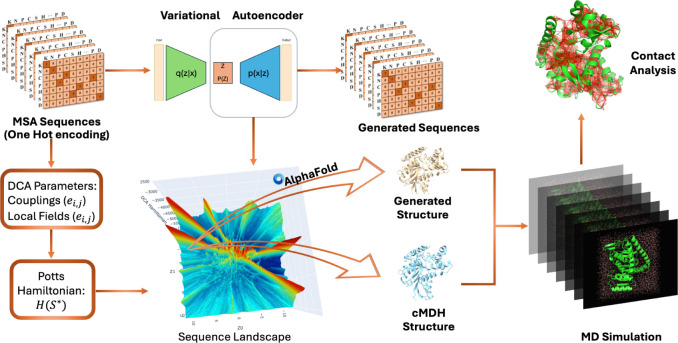
Figure 1 Workflow for cMDH landscape generation and structural analysis. The workflow begins with multiple sequence alignments (MSA) encoded using one-hot encoding. These sequences are then processed through a Variational Autoencoder (VAE) to produce a two-dimensional representation of the sequence space. Fitness is assessed using a Potts Hamiltonian, with parameters infrared from Direct Coupling Analysis (DCA) of MSA data. The combination of these features generates a comprehensive evolutionary landscape containing natural and synthetic sequences. Predicted sequences are input into AlphaFold for three-dimensional structure prediction, including the cytosolic variant of malate dehydrogenase (cMDH). Molecular dynamics simulations are subsequently used to explore the dynamic properties of the structures, with contact analysis revealing variations in hydrophobic contact networks.
Figure 1 Workflow for cMDH landscape generation and structural analysis. The workflow begins with multiple sequence alignments (MSA) encoded using one-hot encoding. These sequences are then processed through a Variational Autoencoder (VAE) to produce a two-dimensional representation of the sequence space. Fitness is assessed using a Potts Hamiltonian, with parameters infrared from Direct Coupling Analysis (DCA) of MSA data. The combination of these features generates a comprehensive evolutionary landscape containing natural and synthetic sequences. Predicted sequences are input into AlphaFold for three-dimensional structure prediction, including the cytosolic variant of malate dehydrogenase (cMDH). Molecular dynamics simulations are subsequently used to explore the dynamic properties of the structures, with contact analysis revealing variations in hydrophobic contact networks.CC BY-NC-ND · PubMed Central
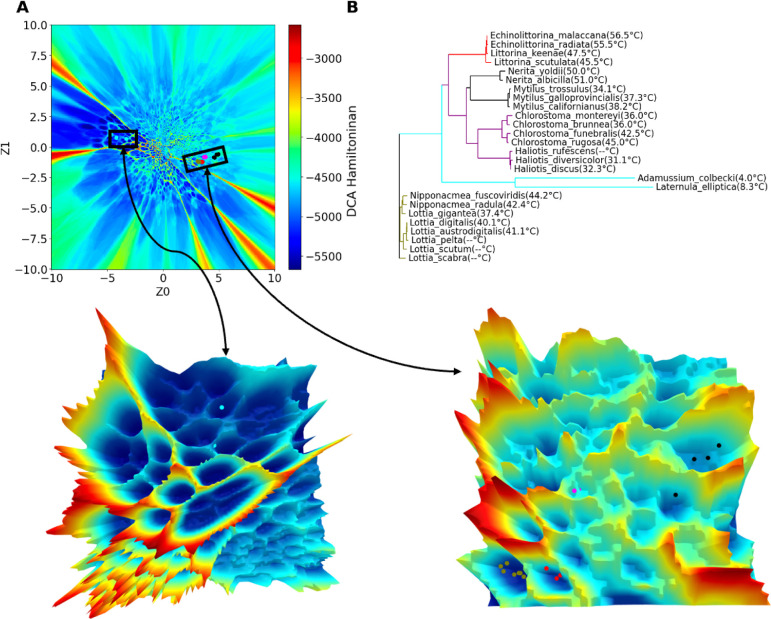
Figure 2 Clustering in the MDH evolutionary landscape. (A) An evolutionary landscape plot visualizes the distribution of Direct Coupling Analysis (DCA) scores for cytosolic malate dehydrogenase (cMDH) sequence variants generated by a Variational Autoencoder (VAE). The color gradient, ranging from blue to red, indicates DCA scores, with red representing regions of higher (unfavorable) scores. (B) The phylogenetic tree for cMDH, generated using Clustal Omega, is constructed from a distance matrix derived through pairwise sequence comparisons.
Figure 2 Clustering in the MDH evolutionary landscape. (A) An evolutionary landscape plot visualizes the distribution of Direct Coupling Analysis (DCA) scores for cytosolic malate dehydrogenase (cMDH) sequence variants generated by a Variational Autoencoder (VAE). The color gradient, ranging from blue to red, indicates DCA scores, with red representing regions of higher (unfavorable) scores. (B) The phylogenetic tree for cMDH, generated using Clustal Omega, is constructed from a distance matrix derived through pairwise sequence comparisons.CC BY-NC-ND · PubMed Central
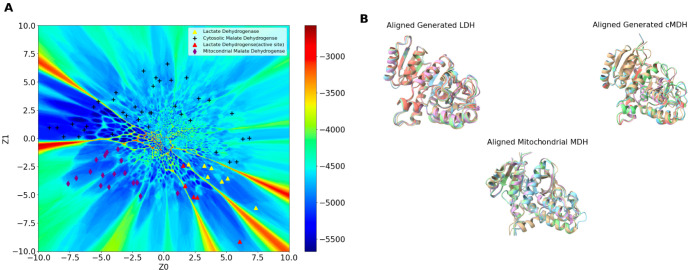
Figure 3 Generated structures from the evolutionary landscape. scatter points represent the positions of generated structures within the evolutionary landscape. (A) Scatter points indicating the positions of generated structures in the landscape, where four types of structures (cMDH with active site, cMDH without active site, lactate dehydrogenase (LDH), and mitochondrial MDH) are clustered based on their RMSD values. (B) Cytosolic malate dehydrogenase (cMDH), mitochondrial malate dehydrogenase (MDH), and lactate dehydrogenase (LDH) structures aligned with generated sequence structures, all with root-mean-square deviation (RMSD) < 2.0 Å.
Figure 3 Generated structures from the evolutionary landscape. scatter points represent the positions of generated structures within the evolutionary landscape. (A) Scatter points indicating the positions of generated structures in the landscape, where four types of structures (cMDH with active site, cMDH without active site, lactate dehydrogenase (LDH), and mitochondrial MDH) are clustered based on their RMSD values. (B) Cytosolic malate dehydrogenase (cMDH), mitochondrial malate dehydrogenase (MDH), and lactate dehydrogenase (LDH) structures aligned with generated sequence structures, all with root-mean-square deviation (RMSD) < 2.0 Å.CC BY-NC-ND · PubMed Central
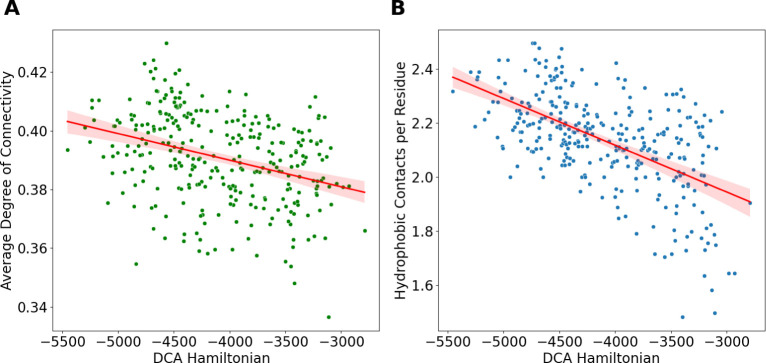
Figure 4 Relationship between DCA hamiltonian and normalized hydrophobic contacts in protein structures. (A) Scatter plot shows the correlation between DCA Hamiltonian values and the average degree of connectivity, for 400 protein structures generated from the VAE landscape. The red trend line indicates a decreasing degree of connectivity as the DCA Hamiltonian, plotted on the x-axis, increases. (B) Scatter plot depicts the correlation between DCA Hamiltonian values and the normalized number of hydrophobic contacts per residue across 400 protein structures generated from the VAE landscape. The red trend line indicates a decreasing number of hydrophobic contacts as the DCA Hamiltonian, plotted on the x-axis, increases.
Figure 4 Relationship between DCA hamiltonian and normalized hydrophobic contacts in protein structures. (A) Scatter plot shows the correlation between DCA Hamiltonian values and the average degree of connectivity, for 400 protein structures generated from the VAE landscape. The red trend line indicates a decreasing degree of connectivity as the DCA Hamiltonian, plotted on the x-axis, increases. (B) Scatter plot depicts the correlation between DCA Hamiltonian values and the normalized number of hydrophobic contacts per residue across 400 protein structures generated from the VAE landscape. The red trend line indicates a decreasing number of hydrophobic contacts as the DCA Hamiltonian, plotted on the x-axis, increases.CC BY-NC-ND · PubMed Central
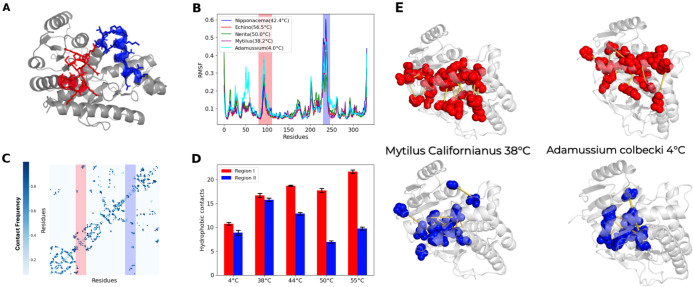
Figure 5 Molecular dynamics analysis of side chain movements (RMSF) of cMDH across various species at ambient temperature. (A) Structure of cytosolic malate dehydrogenase (cMDH) highlighting functionally active residues. The catalytic loop (residues 91–105), region 1, is shown in red, while the additional catalytic region (residues 230–245), region 2, is depicted in blue. (B) Root Mean Square Fluctuation (RMSF) profiles at 298 K for cMDH from five species: Echinolittorina malaccana, Nerita yoldi, Mytilus californianus, Adamussium colbecki, and Nipponacmea radula. Peaks in RMSF at residues 91–105 and 230–245, marked in red and blue, respectively, indicate regions of significant fluctuation. (C) The contact map highlights that the region containing catalytically active residues forms long-range hydrophobic contacts. (D) Permanent hydrophobic contacts in region I (residues 80–110) and region II (residues 230–260) across different cMDH families, with psychrophilic enzymes on the left and thermophilic enzymes on the right, emphasizing differences in contact dynamics related to thermal adaptation. (E) The structures illustrate permanent hydrophobic contacts in region 1 (red) and region 2 (blue) of cMDH from Mytilus californianus and Adamussium colbecki.
Figure 5 Molecular dynamics analysis of side chain movements (RMSF) of cMDH across various species at ambient temperature. (A) Structure of cytosolic malate dehydrogenase (cMDH) highlighting functionally active residues. The catalytic loop (residues 91–105), region 1, is shown in red, while the additional catalytic region (residues 230–245), region 2, is depicted in blue. (B) Root Mean Square Fluctuation (RMSF) profiles at 298 K for cMDH from five species: Echinolittorina malaccana, Nerita yoldi, Mytilus californianus, Adamussium colbecki, and Nipponacmea radula. Peaks in RMSF at residues 91–105 and 230–245, marked in red and blue, respectively, indicate regions of significant fluctuation. (C) The contact map highlights that the region containing catalytically active residues forms long-range hydrophobic contacts. (D) Permanent hydrophobic contacts in region I (residues 80–110) and region II (residues 230–260) across different cMDH families, with psychrophilic enzymes on the left and thermophilic enzymes on the right, emphasizing differences in contact dynamics related to thermal adaptation. (E) The structures illustrate permanent hydrophobic contacts in region 1 (red) and region 2 (blue) of cMDH from Mytilus californianus and Adamussium colbecki.CC BY-NC-ND · PubMed Central
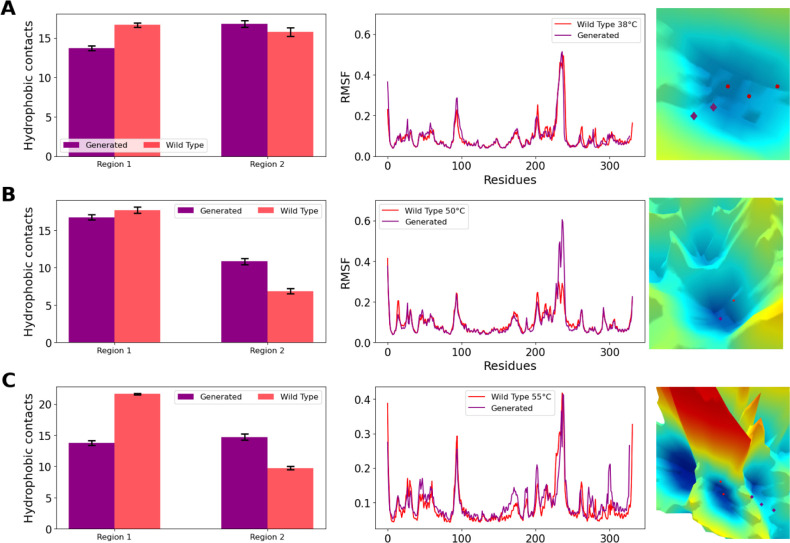
Figure 6 Comparison of changes in structural properties of generated proteins relative to their corresponding wild-type counterparts across varying Hamiltonian scores. Panels A, B, and C illustrate the differences in dynamic hydrophobic contacts (left), root-mean-square fluctuations (RMSF) across residues (center), and Hamiltonian energy differences (right) between the generated and wild-type structures. The data highlight structural and dynamic deviations influenced by Hamiltonian score variations.
Figure 6 Comparison of changes in structural properties of generated proteins relative to their corresponding wild-type counterparts across varying Hamiltonian scores. Panels A, B, and C illustrate the differences in dynamic hydrophobic contacts (left), root-mean-square fluctuations (RMSF) across residues (center), and Hamiltonian energy differences (right) between the generated and wild-type structures. The data highlight structural and dynamic deviations influenced by Hamiltonian score variations.CC BY-NC-ND · PubMed Central
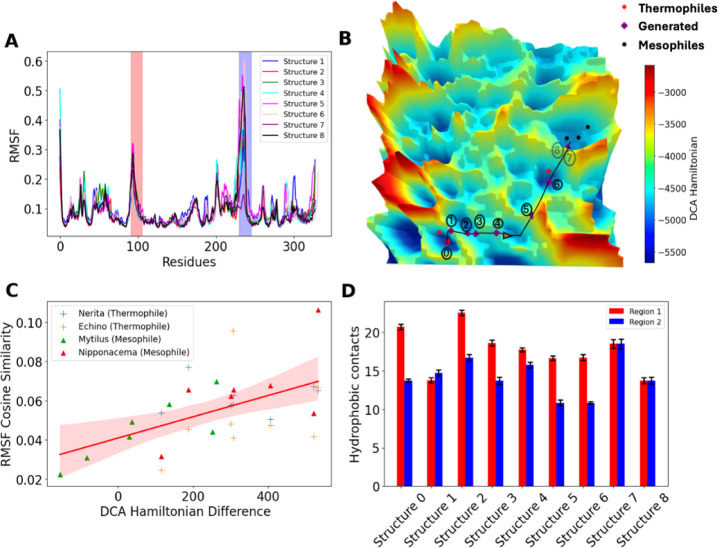
Figure 7 Change in the dynamics and thermal stability along a path connecting the cMDH thermophile to mesophile clusters. (A) Root Mean Square Fluctuation (RMSF) profiles at 298 K for eight generated structures along a trajectory connecting the Echinolittorina, Nerita, and Mytilus families. (B) The shortest path between families in the landscape. (C) Correlation between the cosine similarity of root-mean-square fluctuation (RMSF) profiles of the wild-type structure and those of structures generated from varying Hamiltonian values near the clustering of wild-type sequences. (D) Hydrophobic contacts in both regions, residues 80–110 and residues 220–260.
Figure 7 Change in the dynamics and thermal stability along a path connecting the cMDH thermophile to mesophile clusters. (A) Root Mean Square Fluctuation (RMSF) profiles at 298 K for eight generated structures along a trajectory connecting the Echinolittorina, Nerita, and Mytilus families. (B) The shortest path between families in the landscape. (C) Correlation between the cosine similarity of root-mean-square fluctuation (RMSF) profiles of the wild-type structure and those of structures generated from varying Hamiltonian values near the clustering of wild-type sequences. (D) Hydrophobic contacts in both regions, residues 80–110 and residues 220–260.CC BY-NC-ND · PubMed Central

Verification

Claims the paper makes

The claims and statistics of this paper haven’t been checked yet.

Run the check — free, no account needed. It reads the open-access text and checks the sources it cites.

A few free checks a day · papers already verified open instantly · results are public

Self-check

Percentages, sums and reported differences re-computed from the paper’s own numbers.

The self-check needs the paper’s full text.

Citations

Cites

Show all 1 references

Research works printed but not linked: 66

  1. 2011, Cloning, sequencing and functional expression of cytosolic malate dehydrogenase from Taenia solium: Purification and characterization of the recombinant enzyme, Exp Parasitol, 128, 217, 10.1016/j.exppara.2011.03.008 · DOI
  2. 2002, Malate dehydrogenases--structure and function, Gen Physiol Biophys, 21, 257
  3. 10.1021/bi00429a004 · DOI
  4. 10.1042/bj2580221 · DOI
  5. 2020, High-throughput quantification of protein structural change reveals potential mechanisms of temperature adaptation in Mytilus mussels, BMC Evol Biol, 20, 28, 10.1186/s12862-020-1593-y · DOI
  6. 10.1016/j.sbi.2016.12.007 · DOI
  7. 10.1073/pnas.1718910115 · DOI
  8. 2021, A Minireview on Temperature Dependent Protein Conformational Sampling, Protein J, 40, 545, 10.1007/s10930-021-10012-x · DOI
  9. 2023, Unsupervisedly prompting AlphaFold2 for accurate few-shot protein structure prediction, J Chem Theory Comput, 19, 8460, 10.1021/acs.jctc.3c00528 · DOI
  10. 10.1146/annurev.biochem.75.103004.142723 · DOI
  11. 10.1016/S0969-2126(00)00133-7 · DOI
  12. 10.1128/MMBR.65.1.1-43.2001 · DOI
  13. 10.1146/annurev.ph.57.030195.000355 · DOI
  14. 10.1038/nrmicro773 · DOI · Paper page
  15. 10.1038/nrg1672 · DOI
  16. 10.1126/science.1169375 · DOI
  17. 10.1073/pnas.0901522106 · DOI
  18. 10.1073/pnas.1111471108 · DOI · Paper page
  19. 10.1371/journal.pone.0028766 · DOI · Paper page
  20. 10.7554/eLife.03430 · DOI · Paper page
  21. 10.7554/eLife.02030 · DOI · Paper page
  22. 10.1093/bioinformatics/btu458 · DOI
  23. 10.1007/978-1-4939-0366-5 · DOI
  24. 10.1073/pnas.0805923106 · DOI · Paper page
  25. 2014, Fast pseudolikelihood maximization for direct-coupling analysis of protein structure from many homologous amino-acid sequences, J Comput Phys, 276, 341, 10.1016/j.jcp.2014.07.024 · DOI
  26. Brookes DH , Park H , Listgarten J. Conditioning by adaptive sampling for robust design. arXiv [cs.LG]. 2019. Available: http://arxiv.org/abs/1901.10060 · arXiv
  27. 2020, A generative neural network for maximizing fitness and diversity of synthetic DNA and protein sequences, Cell Syst, 11, 49, 10.1016/j.cels.2020.05.007 · DOI · Paper page
  28. 10.1021/acs.jcim.7b00028 · DOI
  29. 2017, Protein Function Prediction Using Deep Restricted Boltzmann Machines, Biomed Res Int, 2017, 1729301
  30. 2018, Deep generative models of genetic variation capture the effects of mutations, Nat Methods, 15, 816, 10.1038/s41592-018-0138-4 · DOI · Paper page
  31. 10.1038/s41467-023-37958-z · DOI
  32. 10.1371/journal.pcbi.1002195 · DOI · Paper page
  33. 10.1093/nar/gkr367 · DOI · Paper page
  34. 10.1038/msb.2011.75 · DOI
  35. Kingma DP , Welling M. Auto-Encoding Variational Bayes. arXiv [stat.ML]. 2013. Available: http://arxiv.org/abs/1312.6114v11 · arXiv
  36. 10.1038/S41592-022-01488-1 · DOI · Paper page
  37. 10.1371/journal.pcbi.1005659 · DOI · Paper page
  38. 10.1063/1.445869 · DOI
  39. 10.1021/jz500737m · DOI
  40. 10.1063/1.467468 · DOI
  41. 10.1002/jcc.21787 · DOI
  42. Gowers R , Linke M , Barnoud J , Reddy T , Melo M , Seyler S , et al. MDAnalysis: A python package for the rapid analysis of molecular dynamics simulations. Proceedings of the Python in Science Conference. SciPy; 2016. pp. 98–105. · DOI
  43. 2021, Explore Protein Conformational Space With Variational Autoencoder, Front Mol Biosci, 8, 781635, 10.3389/fmolb.2021.781635 · DOI · Paper page
  44. 2022, Learning meaningful representations of protein sequences, Nat Commun, 13, 1914, 10.1038/s41467-022-29443-w · DOI
  45. 10.1093/nar/gkz280 · DOI
  46. 10.1126/science.aba3304 · DOI · Paper page
  47. 10.1093/molbev/msw188 · DOI
  48. 10.1093/molbev/msv211 · DOI
  49. 10.1093/molbev/msab321 · DOI · Paper page
  50. 10.1073/pnas.1817455116 · DOI
  51. 10.1093/bioinformatics/bts541 · DOI
  52. 10.1093/bioinformatics/btm006 · DOI
  53. 10.1016/j.bpj.2020.05.015 · DOI
  54. 10.1093/NAR/GKAC993 · DOI
  55. 10.1073/pnas.83.21.8069 · DOI
  56. 10.1039/b304038k · DOI
  57. 10.1042/bj3301087 · DOI
  58. 10.1016/j.tibs.2010.05.001 · DOI
  59. 1999, Structural basis for cold adaptation, Sequence, biochemical properties, and crystal structure of malate dehydrogenase from a psychrophile Aquaspirillium arcticum. J Biol Chem, 274, 11761
  60. 10.1021/bi010808b · DOI
  61. 10.1016/j.bpj.2009.10.050 · DOI
  62. 10.1016/j.bpc.2010.02.004 · DOI
  63. 10.1111/febs.13343 · DOI
  64. 10.1101/2023.01.02.522497 · DOI
  65. 10.1371/journal.pcbi.1000592 · DOI
  66. 10.1146/annurev.es.09.110178.000245 · DOI

Metadata

Authors
Shukla, D., Martin, J., Morcos, F., & Potoyan, D.
Affiliations
  • Iowa State University (US)
  • The University of Texas at Dallas (US)
Venue
Journal of Chemical Theory and Computation
Publisher
openRxiv
Published
2024-10-11
Volume
21
Issue
6
Pages
3277-3287
ISSN
1549-9618 (ISSN-L)
OpenAlex
W4408413780
Cited by
4
References
1
Citations by year
2026: 4
FWCI
1.20
Type
journal article
Language
en
Open access
Locations
  • Journal of Chemical Theory and Computation (publishedVersion, cc-by-nc-nd)
  • bioRxiv (Cold Spring Harbor Laboratory) (acceptedVersion)
  • Europe PMC (PubMed Central) (publishedVersion, cc-by-nc-nd)
  • PubMed Central (publishedVersion, cc-by-nc-nd)
  • PubMed (publishedVersion)
Funders
  • National Institute of General Medical Sciences (R35GM133631, R35GM138243)
  • National Institute of Allergy and Infectious Diseases (R01AI178692)
Topics
  • Life Sciences › Biochemistry, Genetics and Molecular Biology › Molecular Biology › Protein Structure and Dynamics
  • Life Sciences › Biochemistry, Genetics and Molecular Biology › Genetics › Evolution and Genetic Dynamics
  • Life Sciences › Biochemistry, Genetics and Molecular Biology › Molecular Biology › RNA and protein synthesis mechanisms
Keywords
cytosolic malate dehydrogenase, thermal adaptation, protein thermal stability, coevolution, variational autoencoder, direct coupling analysis, hydrophobic interactions, conformational flexibility, citric acid cycle enzymes, mutational pathways, protein evolution
MeSH terms
Deep Learning, Cytosol, Enzyme Stability, Malate Dehydrogenase, Protein Conformation, Temperature, Evolution, Molecular, Molecular Dynamics Simulation, Hydrophobic and Hydrophilic Interactions

About these checks

Registry, retraction, Cites and statistics results are computed, not judged, with one exception: a printed reference that no index lists is read once by a model before it counts as a citation error. Claims are extracted by a model and kept only when their quote appears verbatim in the text; each cited source is then checked, with a model’s help, for whether it says what the claim relies on. Those verdicts can be wrong — read the claim’s quote and the cited source before relying on one.

Statistics and arithmetic are recomputed, not judged.

Confidence bands are shown only for fields calibrated on our annotated test set. None is calibrated yet, so no band is shown.

What counts as a claim ›How we measure confidence ›How we check this ›

Are you an author, or do you see a problem with this page? Request a review

How to cite

Cite CoChat for the checks on this page, and the paper for its own findings.

This page
CoChat. (2026). Citation check: Thermal Adaptation of Cytosolic Malate Dehydrogenase Revealed by Deep Learning and Coevolutionary Analysis. https://app.cochat.ai/papers/10.1101/2024.10.08.617074
The paper
Shukla, D., Martin, J., Morcos, F., & Potoyan, D. (2024). Thermal Adaptation of Cytosolic Malate Dehydrogenase Revealed by Deep Learning and Coevolutionary Analysis. Journal of Chemical Theory and Computation. https://doi.org/10.1101/2024.10.08.617074