CoChat

An Acyclic nucleoside phosphonate effectively blocks the egress of the malaria parasite by inhibiting the synthesis of cyclic GMP

Open access

Preprint — published as 10.1126/sciadv.ady2859

The DOI matches its Crossref record; 1 of the 1 references it cites were found in a registry or an index.

Abstract

The urgent need for new antimalarial therapies arises from the alarming spread of malaria parasite resistance to existing drugs. A promising candidate, UA2239, an acyclic nucleoside phosphonate with a guanine as nucleobase, demonstrates rapid and irreversible cytotoxic effects on Plasmodium parasites, both in vitro and in an animal model. It blocks the active exit process, named egress, of merozoites and gametes from infected erythrocytes. UA2239 disrupts the essential cGMP-dependent egress pathway by decreasing cGMP levels in the parasite, making guanylate cyclase ( Pf GCα) the most likely target. We also uncovered the remarkable molecular mechanism of resistance developed by parasites after prolonged exposure to the drug, which involves mutating not the target itself, but a downstream effector. The unique mechanism action of UA2239 makes it a valuable first-in-class candidate for further development and its ability to inhibit both parasite growth and transmission highlights its therapeutic potential as a dual-stage antimalarial agent.

Overview

The claims and statistics of this paper haven’t been checked yet.

Free: it reads the open-access text and checks the first 5 claims that cite a source we can check. Create a free account to check every claim.

A few free checks a day · papers already verified open instantly · results are public

Integrity signals

Registry

Crossref · 10.1101/2025.04.01.645218

Cites

1 of 1 references verified0 citation errors · 0 not checkable

Statistics

Figures

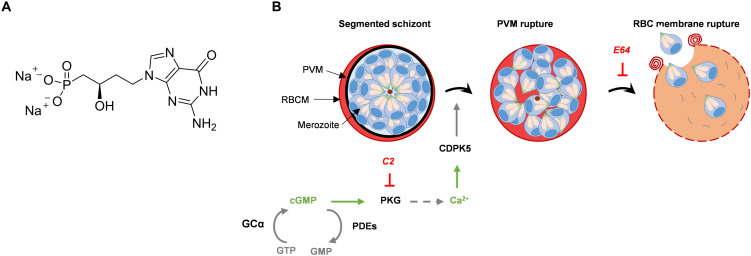
Fig. 1. Chemical structure of UA2239 (A) and schematic representation of merozoite egress and the signaling cascades (B). PVM, parasitophorous vacuole membrane; RBC, red blood cell; RBCM, RBC membrane; PKG, cGMP-dependent protein kinase; GCα, guanylyl cyclase alpha; PDEs, phosphodiesterases; CDPK5, calcium-dependent protein kinase 5. Inhibitions by C2 and E64 are indicated in red.
Fig. 1. Chemical structure of UA2239 (A) and schematic representation of merozoite egress and the signaling cascades (B). PVM, parasitophorous vacuole membrane; RBC, red blood cell; RBCM, RBC membrane; PKG, cGMP-dependent protein kinase; GCα, guanylyl cyclase alpha; PDEs, phosphodiesterases; CDPK5, calcium-dependent protein kinase 5. Inhibitions by C2 and E64 are indicated in red.CC BY · PubMed Central
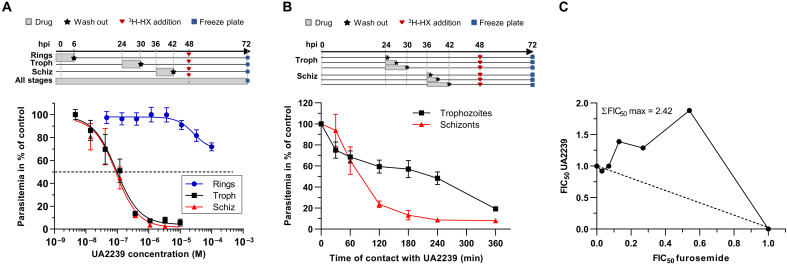
Fig. 2. Activity of UA2239 on asexual blood stage parasites. (A) Activity of UA2239 on ring, trophozoite, and schizont stages after 6 hours of contact with various concentrations of UA2239 (n = 3, means ± SEM). The experimental setup is indicated at the top. Gray bars correspond to the time of drug contact. (B) Time course of P. falciparum growth inhibition by UA2239 depending on the parasite stage. Synchronous cultures at the trophozoite stage (24 hpi) or schizont stage (36 hpi) were treated with 750 nM UA2239 for the indicated time. Cells were then washed and resuspended in fresh media as shown in the scheme at the top (n = 3; means ± SEM). (C) Interaction between UA2239 and furosemide represented as an isobologram. Data presented are from one typical experiment (n = 3). The maximal sum of FICs of UA2239 and furosemide in combination (ΣFIC50 max) is indicated on the graph.
Fig. 2. Activity of UA2239 on asexual blood stage parasites. (A) Activity of UA2239 on ring, trophozoite, and schizont stages after 6 hours of contact with various concentrations of UA2239 (n = 3, means ± SEM). The experimental setup is indicated at the top. Gray bars correspond to the time of drug contact. (B) Time course of P. falciparum growth inhibition by UA2239 depending on the parasite stage. Synchronous cultures at the trophozoite stage (24 hpi) or schizont stage (36 hpi) were treated with 750 nM UA2239 for the indicated time. Cells were then washed and resuspended in fresh media as shown in the scheme at the top (n = 3; means ± SEM). (C) Interaction between UA2239 and furosemide represented as an isobologram. Data presented are from one typical experiment (n = 3). The maximal sum of FICs of UA2239 and furosemide in combination (ΣFIC50 max) is indicated on the graph.CC BY · PubMed Central
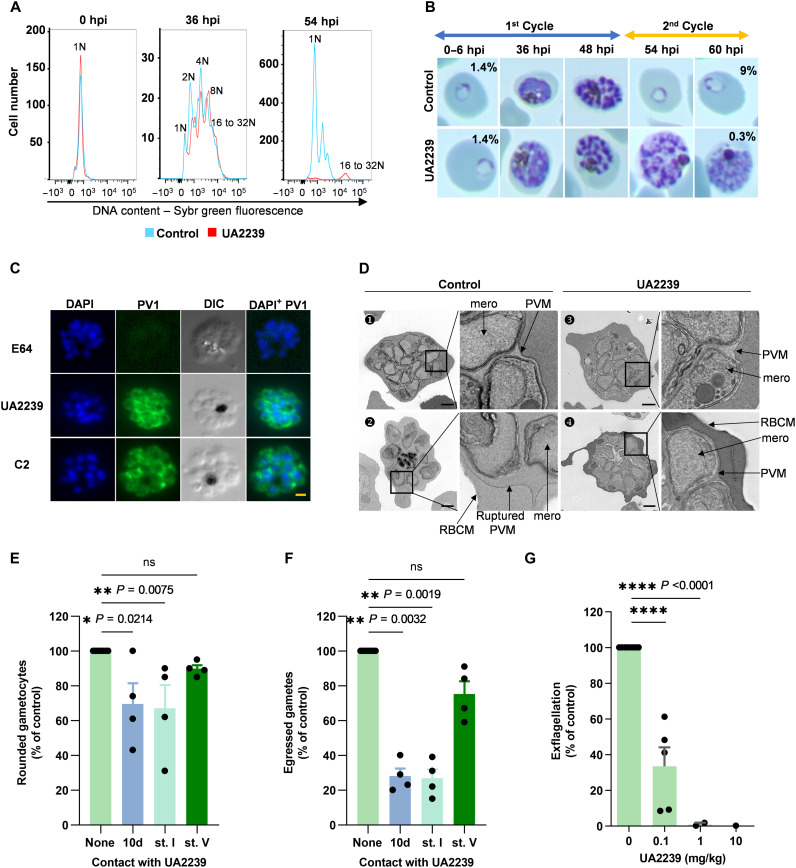
Fig. 3. UA2239 inhibits the egress step in asexual blood stage parasites and gametocytes. (A) Effect of UA2239 on DNA content determined by flow cytometry. N represents the genome equivalents. (B) Effect of UA2239 on parasite development followed by colored thin blood smears. Parasitemia is indicated for 6 and 60 hpi. Data are from one of two independent experiments. For (A) and (B), UA2239 concentration was 2 μM. (C) IFA on PV1-GFP P. falciparum parasites. Late schizont stage parasites were incubated for 4 hours with UA2239, C2, or E64. The intact PVM is visualized by immunofluorescence detection of PV1-GFP. Nuclei were stained with Hoechst (blue). Scale bar, 1 μm. (n = 3). (D) Electron microscopy images of control and UA2239-treated RBCs infected with segmented schizonts. The right panels are close-up views of the framed area on the left panels. (1) Untreated iRBC with intact PVM, (2) untreated iRBC with a ruptured PVM, (3) iRBCs treated with UA2239 from 6 to 44 to 46 hpi, and (4) iRBCs treated with UA2239 from 36 hpi to 44 to 46 hpi. mero, merozoite. Scale bar, 1 μm. (E and F) Effect of UA2239 (10 × IC50) on P. falciparum gametogenesis. Gametocytes were treated or not with UA2239 for 10 days (10d) (from stage I to stage V), for 24 hours at stage I (st. I) or for 24 h at stage V (st. V). On day 10, rounding-up (E) and gamete egress (F) were quantified relative to untreated controls (n = 4, means ± SEM). A Kruskal-Wallis nonparametric test was used to calculate P values (ns, not significant). (G) Effect of UA2239 on P. berghei gametogenesis after intraperitoneal treatment. No exflagellation center was detected after treatment with 10 mg/kg. (n = 2 to 5, means ± SD). Two-tailed Student’s t test was used to calculate P value (P < 0.0001).
Fig. 3. UA2239 inhibits the egress step in asexual blood stage parasites and gametocytes. (A) Effect of UA2239 on DNA content determined by flow cytometry. N represents the genome equivalents. (B) Effect of UA2239 on parasite development followed by colored thin blood smears. Parasitemia is indicated for 6 and 60 hpi. Data are from one of two independent experiments. For (A) and (B), UA2239 concentration was 2 μM. (C) IFA on PV1-GFP P. falciparum parasites. Late schizont stage parasites were incubated for 4 hours with UA2239, C2, or E64. The intact PVM is visualized by immunofluorescence detection of PV1-GFP. Nuclei were stained with Hoechst (blue). Scale bar, 1 μm. (n = 3). (D) Electron microscopy images of control and UA2239-treated RBCs infected with segmented schizonts. The right panels are close-up views of the framed area on the left panels. (1) Untreated iRBC with intact PVM, (2) untreated iRBC with a ruptured PVM, (3) iRBCs treated with UA2239 from 6 to 44 to 46 hpi, and (4) iRBCs treated with UA2239 from 36 hpi to 44 to 46 hpi. mero, merozoite. Scale bar, 1 μm. (E and F) Effect of UA2239 (10 × IC50) on P. falciparum gametogenesis. Gametocytes were treated or not with UA2239 for 10 days (10d) (from stage I to stage V), for 24 hours at stage I (st. I) or for 24 h at stage V (st. V). On day 10, rounding-up (E) and gamete egress (F) were quantified relative to untreated controls (n = 4, means ± SEM). A Kruskal-Wallis nonparametric test was used to calculate P values (ns, not significant). (G) Effect of UA2239 on P. berghei gametogenesis after intraperitoneal treatment. No exflagellation center was detected after treatment with 10 mg/kg. (n = 2 to 5, means ± SD). Two-tailed Student’s t test was used to calculate P value (P < 0.0001).CC BY · PubMed Central
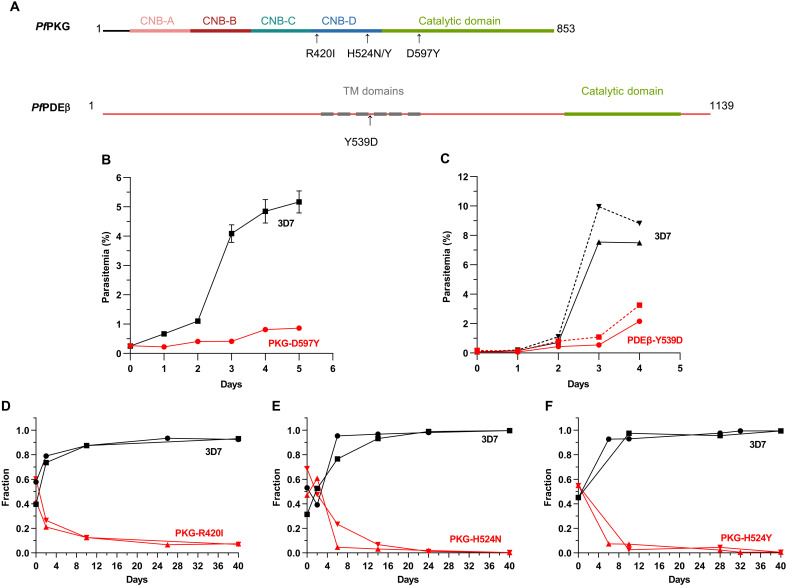
Fig. 4. Mutations conferring resistance to UA2239 have a fitness cost for the parasite. (A) Schematic representation of the PfPKG and PfPDEβ domain organization. PfPKG consists of four CNB domains designated CNB-A, CNB-B, CNB-C, and CNB-D, followed by a C-terminal catalytic domain. PfPDEβ comprises six transmembrane (TM) domains and a C-terminal catalytic domain. The positions of the identified mutations are indicated. (B) Growth of PKG-D597Y GER-parasites was followed by stained thin blood smears over 6 days (n = 3). Some error bars are within the size of the symbols. (C) Growth of PDEβ-Y539D GER-parasites was followed by stained thin blood smears over 5 days. Two independent experiments starting at different initial parasitemia are shown. (D to F) Pairwise competitive growth assays with the 3D7 strain quantified by qPCR on genomic DNA for GER-parasites mutated in PfPKG. (D) PKG-R420I, (E) PKG-H524N, and (F) PKG-H524Y. Cultures were started at comparable parasitemia levels for both strains, corresponding to a fraction of 0.5. The fraction increases to 1 for the faster-growing strain when it accounts for 100% of the parasite population (n = 2).
Fig. 4. Mutations conferring resistance to UA2239 have a fitness cost for the parasite. (A) Schematic representation of the PfPKG and PfPDEβ domain organization. PfPKG consists of four CNB domains designated CNB-A, CNB-B, CNB-C, and CNB-D, followed by a C-terminal catalytic domain. PfPDEβ comprises six transmembrane (TM) domains and a C-terminal catalytic domain. The positions of the identified mutations are indicated. (B) Growth of PKG-D597Y GER-parasites was followed by stained thin blood smears over 6 days (n = 3). Some error bars are within the size of the symbols. (C) Growth of PDEβ-Y539D GER-parasites was followed by stained thin blood smears over 5 days. Two independent experiments starting at different initial parasitemia are shown. (D to F) Pairwise competitive growth assays with the 3D7 strain quantified by qPCR on genomic DNA for GER-parasites mutated in PfPKG. (D) PKG-R420I, (E) PKG-H524N, and (F) PKG-H524Y. Cultures were started at comparable parasitemia levels for both strains, corresponding to a fraction of 0.5. The fraction increases to 1 for the faster-growing strain when it accounts for 100% of the parasite population (n = 2).CC BY · PubMed Central
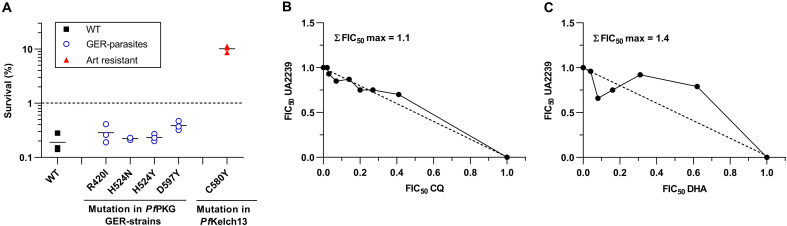
Fig. 5. Interaction of UA2239 with other antimalarial drugs. (A) Sensitivity of UA2239-resistant strains to DHA. Sensitivity of GER-parasites to DHA was determined using RSA. A survival rate <1% (dashed line) indicates sensitive strains. 3D7 WT strain served as the sensitive control (black squares) and the NF54 Kelch13 C580Y line (red triangles) as resistant control (74) (n = 3 biological replicates). (B and C) In vitro interaction between UA2239 and CQ (B) or DHA (C) for their antimalarial activities against the 3D7 strain represented as an isobologram. Data presented are from one representative experiment (n = 3). The maximal ΣFIC50 (ΣFIC50 max) of the presented experiments are indicated on the graphs.
Fig. 5. Interaction of UA2239 with other antimalarial drugs. (A) Sensitivity of UA2239-resistant strains to DHA. Sensitivity of GER-parasites to DHA was determined using RSA. A survival rate <1% (dashed line) indicates sensitive strains. 3D7 WT strain served as the sensitive control (black squares) and the NF54 Kelch13 C580Y line (red triangles) as resistant control (74) (n = 3 biological replicates). (B and C) In vitro interaction between UA2239 and CQ (B) or DHA (C) for their antimalarial activities against the 3D7 strain represented as an isobologram. Data presented are from one representative experiment (n = 3). The maximal ΣFIC50 (ΣFIC50 max) of the presented experiments are indicated on the graphs.CC BY · PubMed Central
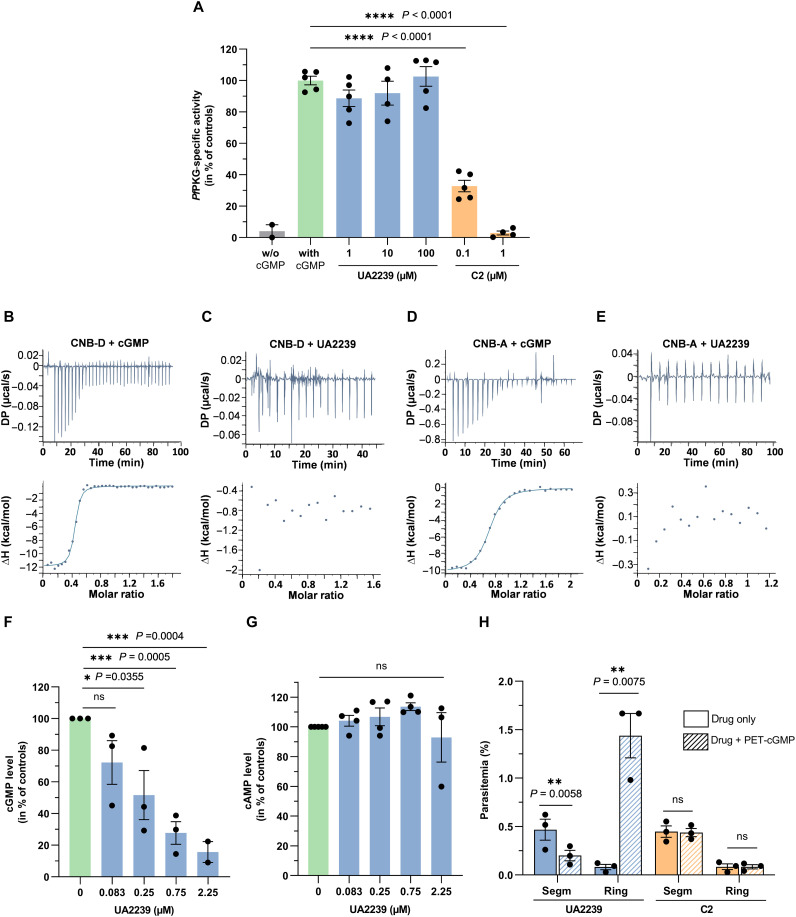
Fig. 6. Mechanism of action of UA2239 on cGMP-dependent egress pathway. (A) Specific activity of the recombinant full-length PfPKG was determined in presence of 10 μM cGMP or without (w/o) cGMP using ADP-Glo kinase kit. A final concentration of 50 nM PfPKG was used. UA2239 was added at 1, 10, or 100 μM and C2 at 0.1 or 1 μM, n = 4 to 5 independent experiments (means ± SEM). For the condition in the absence of cGMP, n = 2 (means ± SD). Student’s t test was used to calculate P values (**** <0.0001). There was no significant difference between UA2239-treated (blue bars) and untreated control (green bar) samples. (B to E) ITC binding curves for the CNB-D and CNB-A constructs to cGMP or UA2239. Top and bottom panels display the ITC titration curves and the binding isotherms, respectively. The dissociation constant of cGMP for the CNB-D and CNB-A domains is 0.035 ± 0.005 and 1.03 ± 0.11 μM, respectively. UA2239 does not bind to the CNB-D or CNB-A domain. (F) Effect of UA2239 on intracellular cGMP levels (G) Effect of UA2239 on intracellular cAMP levels. For (F) and (G), purified 3D7 schizonts were allowed to develop in the presence of 1.5 μM C2 (to prevent egress) either without or with various concentrations of UA2239. Segmented schizonts were lysed with 0.1 M HCl and cGMP and cAMP levels were determined. Data are expressed in % of the untreated samples (n = 3 or 4 independent experiments, means ± SEM). Two-tailed Student’s t test was used to calculate P value. (H) Treatment with PET-cGMP reverses the UA2239-induced egress block, leading to next-generation ring-stages. Data are expressed as parasitemia for segmented (segm) or ring stage parasites. Ratio paired Students’s t test was used to calculate P value (ns, not significant).
Fig. 6. Mechanism of action of UA2239 on cGMP-dependent egress pathway. (A) Specific activity of the recombinant full-length PfPKG was determined in presence of 10 μM cGMP or without (w/o) cGMP using ADP-Glo kinase kit. A final concentration of 50 nM PfPKG was used. UA2239 was added at 1, 10, or 100 μM and C2 at 0.1 or 1 μM, n = 4 to 5 independent experiments (means ± SEM). For the condition in the absence of cGMP, n = 2 (means ± SD). Student’s t test was used to calculate P values (**** <0.0001). There was no significant difference between UA2239-treated (blue bars) and untreated control (green bar) samples. (B to E) ITC binding curves for the CNB-D and CNB-A constructs to cGMP or UA2239. Top and bottom panels display the ITC titration curves and the binding isotherms, respectively. The dissociation constant of cGMP for the CNB-D and CNB-A domains is 0.035 ± 0.005 and 1.03 ± 0.11 μM, respectively. UA2239 does not bind to the CNB-D or CNB-A domain. (F) Effect of UA2239 on intracellular cGMP levels (G) Effect of UA2239 on intracellular cAMP levels. For (F) and (G), purified 3D7 schizonts were allowed to develop in the presence of 1.5 μM C2 (to prevent egress) either without or with various concentrations of UA2239. Segmented schizonts were lysed with 0.1 M HCl and cGMP and cAMP levels were determined. Data are expressed in % of the untreated samples (n = 3 or 4 independent experiments, means ± SEM). Two-tailed Student’s t test was used to calculate P value. (H) Treatment with PET-cGMP reverses the UA2239-induced egress block, leading to next-generation ring-stages. Data are expressed as parasitemia for segmented (segm) or ring stage parasites. Ratio paired Students’s t test was used to calculate P value (ns, not significant).CC BY · PubMed Central
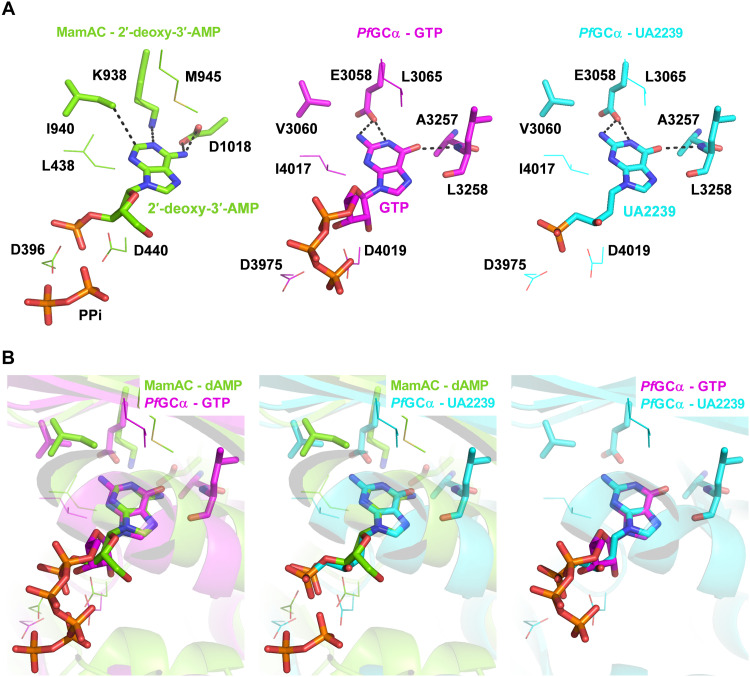
Fig. 7. Docking of UA2239 into the substrate/product-binding site of the PfGCα 3D model. (A) Binding pockets of MamAC in complex with 2′-deoxy-3′-AMP and PPi (PDB 1CS4) (left), of the PfGCα model in complex with the substrate GTP (middle) or with UA2239 (right). (B) Overlays of MamAC (green) and PfGCα (pink GTP ligand or blue UA2239 ligand) (left and middle) and overlay of PfGCα with GTP or UA2239 (right). The ligands are shown as sticks. The residues sharing conserved interactions with the ligands in the two binding sites are shown as lines. The residues allowing the selective interactions with either an adenine or a guanine base are shown as sticks.
Fig. 7. Docking of UA2239 into the substrate/product-binding site of the PfGCα 3D model. (A) Binding pockets of MamAC in complex with 2′-deoxy-3′-AMP and PPi (PDB 1CS4) (left), of the PfGCα model in complex with the substrate GTP (middle) or with UA2239 (right). (B) Overlays of MamAC (green) and PfGCα (pink GTP ligand or blue UA2239 ligand) (left and middle) and overlay of PfGCα with GTP or UA2239 (right). The ligands are shown as sticks. The residues sharing conserved interactions with the ligands in the two binding sites are shown as lines. The residues allowing the selective interactions with either an adenine or a guanine base are shown as sticks.CC BY · PubMed Central
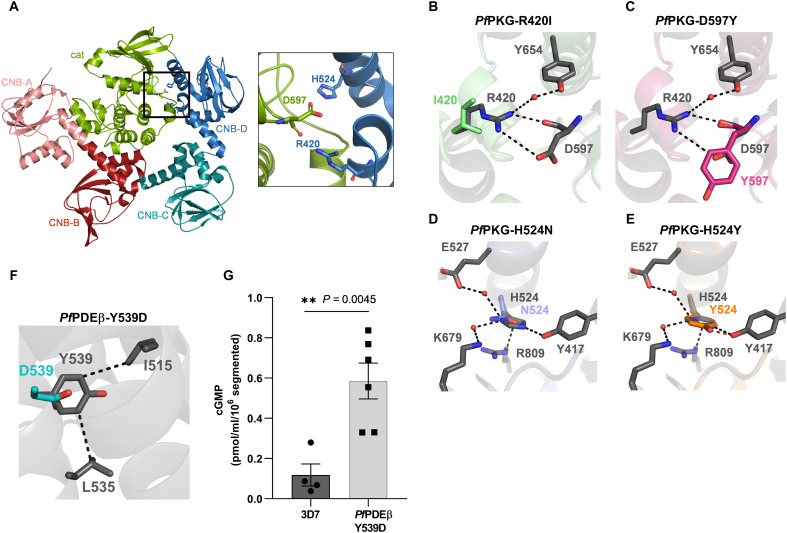
Fig. 8. Mechanism of resistance to UA2239. (A) Localization of the mutated amino acids on the 3D structure of PfPKG. Left: X-ray 3D structure of the full-length PfPKG (PDB: 5DYK) (39) showing the mutated residues conferring resistance to UA2239 (black square) at the interface between the catalytic domain (green) and the CNB-D domain (blue). Right: close-up view of the interface showing the three mutated amino acids in the resistant strains. The colors of the domains are the same as in the schematic representation of the PfPKG in Fig. 4A. (B to E) Close-up views of the superimposition of WT PfPKG (gray) and the mutated PfPKG (colored). [(B) and (C)] Interactions between R420 and D597 are lost in PfPKG-R420I (green) and in PfPKG-D597Y (pink). (D) Stacking between H524 and R809 is lost in PfPKG-H524N (purple). (E) Hydrogen bounds between H524 and two water molecules are lost in PfPKG-H524Y (orange). In addition, this mutation leads to a clash with Y417 shown as red dashed lines. (F) Close-up view of the superimposition of WT PfPDEβ (gray) and the mutated PfPDEβ-Y539D (cyan). Interactions between are Y539 and two hydrophobic residues, I515 and L535, are lost in the PfPDEβ-Y539D mutant. (G) Intracellular cGMP levels in 3D7 and PfPDEβ-Y539D GER-parasites. Experiments were conducted as for Fig. 6F. (n = 4 and 6 independent experiments for 3D7 and PfPDEβ-Y539D, respectively, means ± SEM). Two-tailed Student’s t test was used to calculate P value.
Fig. 8. Mechanism of resistance to UA2239. (A) Localization of the mutated amino acids on the 3D structure of PfPKG. Left: X-ray 3D structure of the full-length PfPKG (PDB: 5DYK) (39) showing the mutated residues conferring resistance to UA2239 (black square) at the interface between the catalytic domain (green) and the CNB-D domain (blue). Right: close-up view of the interface showing the three mutated amino acids in the resistant strains. The colors of the domains are the same as in the schematic representation of the PfPKG in Fig. 4A. (B to E) Close-up views of the superimposition of WT PfPKG (gray) and the mutated PfPKG (colored). [(B) and (C)] Interactions between R420 and D597 are lost in PfPKG-R420I (green) and in PfPKG-D597Y (pink). (D) Stacking between H524 and R809 is lost in PfPKG-H524N (purple). (E) Hydrogen bounds between H524 and two water molecules are lost in PfPKG-H524Y (orange). In addition, this mutation leads to a clash with Y417 shown as red dashed lines. (F) Close-up view of the superimposition of WT PfPDEβ (gray) and the mutated PfPDEβ-Y539D (cyan). Interactions between are Y539 and two hydrophobic residues, I515 and L535, are lost in the PfPDEβ-Y539D mutant. (G) Intracellular cGMP levels in 3D7 and PfPDEβ-Y539D GER-parasites. Experiments were conducted as for Fig. 6F. (n = 4 and 6 independent experiments for 3D7 and PfPDEβ-Y539D, respectively, means ± SEM). Two-tailed Student’s t test was used to calculate P value.CC BY · PubMed Central

Verification

Claims the paper makes

The claims and statistics of this paper haven’t been checked yet.

Free: it reads the open-access text and checks the first 5 claims that cite a source we can check. Create a free account to check every claim.

A few free checks a day · papers already verified open instantly · results are public

Self-check

Percentages, sums and reported differences re-computed from the paper’s own numbers.

The self-check needs the paper’s full text.

Citations

Cites

Research works printed but not linked: 70

  1. 2024, Safety and efficacy of malaria vaccine candidate R21/Matrix-M in African children: a multicentre, double-blind, randomised, phase 3 trial, The Lancet, 403, 533, 10.1016/S0140-6736(23)02511-4 · DOI
  2. 10.1038/s41579-024-01065-7 · DOI
  3. 10.1056/NEJMc0805011 · DOI · Paper page
  4. J. N. Burrows , S. Duparc , W. E. Gutteridge , R. Hooft Van Huijsduijnen, W. Kaszubska, F. Macintyre, S. Mazzuri, J. J. Möhrle, T. N. C. Wells, New developments in anti-malarial target candidate and product profiles. Malar J 16, 26 (2017). · DOI · Paper page
  5. 10.1128/MMBR.00059-13 · DOI
  6. 10.2217/fmb.11.108 · DOI
  7. 10.1021/acs.jmedchem.0c00131 · DOI
  8. 10.1038/nrd4010 · DOI · Paper page
  9. 2018, The evolution of nucleoside analogue antivirals: A review for chemists and non-chemists, Part, 1, 66
  10. M. S. Y. Tan , M. J. Blackman , Malaria parasite egress at a glance. Journal of Cell Science 134, jcs257345 (2021). · DOI
  11. 10.1146/annurev-micro-041320-020659 · DOI
  12. 10.1371/journal.ppat.1003344 · DOI
  13. A. C. Balestra , K. Koussis , N. Klages , S. A. Howell , H. R. Flynn , M. Bantscheff , C. Pasquarello , A. J. Perrin , L. Brusini , P. Arboit , O. Sanz , L. P.-B. Castaño , C. Withers-Martinez , A. Hainard , S. Ghidelli-Disse , A. P. Snijders , D. A. Baker , M. J. Blackman , M. Brochet , Ca2+ signals critical for egress and gametogenesis in malaria parasites depend on a multipass membrane protein that interacts with PKG. Sci. Adv. 7, eabe5396 (2021). · DOI
  14. D. A. Baker , L. G. Drought , C. Flueck , S. D. Nofal , A. Patel , M. Penzo , E. M. Walker , Cyclic nucleotide signalling in malaria parasites. Open Biol 7, 170213 (2017). · DOI
  15. 2021, Plasmodium falciparum Guanylyl Cyclase-Alpha and the Activity of Its Appended P4-ATPase Domain Are Essential for cGMP Synthesis and Blood-Stage Egress, mBio, 12, e02694
  16. 2024, Apicomplexan phosphodiesterases in cyclic nucleotide turnover: conservation, function, and therapeutic potential, mBio, 15, e03056
  17. 10.1016/j.molbiopara.2006.05.003 · DOI
  18. D. A. Baker , A. N. Matralis , S. A. Osborne , J. M. Large , M. Penzo , Targeting the Malaria Parasite cGMP-Dependent Protein Kinase to Develop New Drugs. Front Microbiol 11, 602803 (2020). · DOI
  19. D. A. Baker , L. B. Stewart , J. M. Large , P. W. Bowyer , K. H. Ansell , M. B. Jiménez-Díaz , M. El Bakkouri , K. Birchall , K. J. Dechering , N. S. Bouloc , P. J. Coombs , D. Whalley , D. J. Harding , E. Smiljanic-Hurley , M. C. Wheldon , E. M. Walker , J. T. Dessens , M. J. Lafuente , L. M. Sanz , F.-J. Gamo , S. B. Ferrer , R. Hui , T. Bousema , I. Angulo-Barturén , A. T. Merritt , S. L. Croft , W. E. Gutteridge , C. A. Kettleborough , S. A. Osborne , A potent series targeting the malarial cGMP-dependent protein kinase clears infection and blocks transmission. Nat Commun 8, 430 (2017). · DOI · Paper page
  20. 10.1016/j.chembiol.2020.04.001 · DOI · Paper page
  21. 10.1016/j.ijpara.2008.05.016 · DOI
  22. 10.1021/cb501004q · DOI
  23. 10.1371/journal.pbio.3000154 · DOI
  24. P.-J. Gomez-Gonzalez , A. Gupta , L. G. Drought , A. Patel , J. Okombo , M. van der Watt , R. Walker-Gray , K. A. Schindler , A. Y. Burkhard , T. Yeo , S. K. Narwal , T. S. Bloxham , C. Flueck , E. M. Walker , J. A. Rey , K. J. Fairhurst , J. Reader , H. Park , H. G. Pollard , L. B. Stewart , L. Brandner-Garrod , M. Kristan , G.-J. Sterk , Y. M. van Nuland , E. Manko , D. A. van Schalkwyk , Y. Zheng , R. Leurs , K. J. Dechering , A. C. C. Aguiar , R. V. C. Guido , D. B. Pereira , P. K. Tumwebaze , S. L. Nosbya , P. J. Rosenthal , R. A. Cooper , M. Palmer , T. Parkinson , J. N. Burrows , A.-C. Uhlemann , L.-M. Birkholtz , J. L. Small-Saunders , J. Duffy , D. A. Fidock , A. Brown , M. Gardner , D. A. Baker , Inhibitors of malaria parasite cyclic nucleotide phosphodiesterases block asexual blood-stage development and mosquito transmission. Science Advances 10, eadq1383 (2024). · DOI
  25. 10.1371/journal.ppat.1000599 · DOI
  26. 10.1007/s00232-003-0646-7 · DOI
  27. 10.1016/S0021-9258(17)41868-0 · DOI · Paper page
  28. 10.3389/fphar.2019.01222 · DOI · Paper page
  29. 10.1021/acs.jmedchem.9b00182 · DOI
  30. 10.2174/156802611796575911 · DOI
  31. 2015, Aza-acyclic Nucleoside Phosphonates Containing a Second Phosphonate Group As Inhibitors of the Human, Plasmodium falciparum and vivax 6-Oxopurine Phosphoribosyltransferases and Their Prodrugs As Antimalarial Agents. J. Med. Chem, 58, 827
  32. L. Eyer , R. Nencka , E. de Clercq , K. Seley-Radtke , D. Růžek , Nucleoside analogs as a rich source of antiviral agents active against arthropod-borne flaviviruses. Antivir Chem Chemother 26, 2040206618761299 (2018). · DOI
  33. 10.1371/journal.pone.0018396 · DOI
  34. 10.1074/jbc.M305252200 · DOI
  35. G. Bouyer , D. Barbieri , F. Dupuy , A. Marteau , A. Sissoko , M.-E. N’Dri , G. Neveu , L. Bedault , N. Khodabux , D. Roman , S. Houzé , G. Siciliano , P. Alano , R. M. Martins , J.-J. Lopez-Rubio , J. Clain , R. Duval , S. Egée , C. Lavazec , Plasmodium falciparum sexual parasites regulate infected erythrocyte permeability. Commun Biol 3, 726 (2020). · DOI
  36. P. Suaréz-Cortés , F. Silvestrini , P. Alano , A fast, non-invasive, quantitative staining protocol provides insights in Plasmodium falciparum gamete egress and in the role of osmiophilic bodies. Malar J 13, 389 (2014). · DOI
  37. 10.1073/pnas.1905558116 · DOI
  38. 10.1371/journal.ppat.1004639 · DOI
  39. 10.1371/journal.ppat.1002964 · DOI · Paper page
  40. 10.1126/science.aan6042 · DOI · Paper page
  41. 10.1371/journal.pbio.0060139 · DOI
  42. 10.1074/jbc.RA120.013070 · DOI
  43. 10.1016/j.ajps.2013.12.006 · DOI
  44. K. Seley-Radtke , J. Deval , Advances in antiviral nucleoside analogues and their prodrugs. Antivir Chem Chemother 26, 2040206618781410 (2018). · DOI
  45. E. Groaz , S. De Jonghe , Overview of Biologically Active Nucleoside Phosphonates. Front. Chem. 8, 616863 (2021). · DOI
  46. 10.1074/jbc.M001021200 · DOI
  47. 10.1128/mbio.01635-22 · DOI
  48. R. M. Kuehnel , E. Ganga , A. C. Balestra , C. Suarez , M. Wyss , N. Klages , L. Brusini , B. Maco , N. Brancucci , T. S. Voss , D. Soldati , M. Brochet , A Plasmodium membrane receptor platform integrates cues for egress and invasion in blood forms and activation of transmission stages. Sci. Adv. 9, eadf2161 (2023). · DOI
  49. 10.1038/s41467-020-17306-1 · DOI
  50. 10.1371/journal.ppat.1012455 · DOI
  51. 10.1101/2024.07.16.603783 · DOI
  52. 10.1021/acsinfecdis.7b00222 · DOI
  53. 10.1128/AAC.16.6.710 · DOI · Paper page
  54. 10.1128/AAC.47.8.2590-2597.2003 · DOI
  55. 10.1093/infdis/137.2.122 · DOI · Paper page
  56. 10.1128/AAC.46.5.1510-1515.2002 · DOI
  57. 10.1111/j.1365-2958.2007.05767.x · DOI · Paper page
  58. 10.1093/bioinformatics/btp324 · DOI · Paper page
  59. 10.1093/bioinformatics/btu170 · DOI · Paper page
  60. 10.1101/gr.107524.110 · DOI · Paper page
  61. 10.1093/bioinformatics/bts378 · DOI · Paper page
  62. MalariaGEN, M. M. Abdel Hamid, M. H. Abdelraheem, D. O. Acheampong, A. Ahouidi, M. Ali, J. Almagro-Garcia, A. Amambua-Ngwa, C. Amaratunga, L. Amenga-Etego, B. Andagalu, T. Anderson, V. Andrianaranjaka, I. Aniebo, E. Aninagyei, F. Ansah, P. O. Ansah, T. Apinjoh, P. Arnaldo, E. Ashley, S. Auburn, G. A. Awandare, H. Ba, V. Baraka, A. Barry, P. Bejon, G. I. Bertin, M. F. Boni, S. Borrmann, T. Bousema, M. Bouyou-Akotet, O. Branch, P. C. Bull, H. Cheah, K. Chindavongsa, T. Chookajorn, K. Chotivanich, A. Claessens, D. J. Conway, V. Corredor, E. Courtier, A. Craig, U. D’Alessandro, S. Dama, N. Day, B. Denis, M. Dhorda, M. Diakite, A. Djimde, C. Dolecek, A. Dondorp, S. Doumbia, C. Drakeley, E. Drury, P. Duffy, D. F. Echeverry, T. G. Egwang, S. M. M. Enosse, B. Erko, R. M. Fairhurst, A. Faiz, C. A. Fanello, M. Fleharty, M. Forbes, M. Fukuda, D. Gamboa, A. Ghansah, L. Golassa, S. Goncalves, G. L. A. Harrison, S. A. Healy, J. A. Hendry, A. Hernandez-Koutoucheva, T. T. Hien, C. A. Hill, F. Hombhanje, A. Hott, Y. Htut, M. Hussein, M. Imwong, D. Ishengoma, S. A. Jackson, C. G. Jacob, J. Jeans, K. J. Johnson, C. Kamaliddin, E. Kamau, J. Keatley, T. Kochakarn, D. S. Konate, A. Konaté, A. Kone, D. P. Kwiatkowski, M. P. Kyaw, D. Kyle, M. Lawniczak, S. K. Lee, M. Lemnge, P. Lim, C. Lon, K. M. Loua, C. I. Mandara, J. Marfurt, K. Marsh, R. J. Maude, M. Mayxay, O. Maïga-Ascofaré, O. Miotto, T. Mita, V. Mobegi, A. O. Mohamed, O. A. Mokuolu, J. Montgomery, C. M. Morang’a, I. Mueller, K. Murie, P. N. Newton, T. Ngo Duc, T. Nguyen, T.-N. Nguyen, T. Nguyen Thi Kim, H. Nguyen Van, H. Noedl, F. Nosten, R. Noviyanti, V. N.-N. Ntui, A. Nzila, L. I. Ochola-Oyier, H. Ocholla, A. Oduro, I. Omedo, M. A. Onyamboko, J.-B. Ouedraogo, K. Oyebola, W. A. Oyibo, R. Pearson, N. Peshu, A. P. Phyo, C. V. Plowe, R. N. Price, S. Pukrittayakamee, H. H. Quang, M. Randrianarivelojosia, J. C. Rayner, P. Ringwald, A. Rosanas-Urgell, E. Rovira-Vallbona, V. Ruano-Rubio, L. Ruiz, D. Saunders, A. Shayo, P. Siba, V. J. Simpson, M. S. Sissoko, C. Smith, X.-Z. Su, C. Sutherland, S. Takala-Harrison, A. Talman, L. Tavul, N. V. Thanh, V. Thathy, A. M. Thu, M. Toure, A. Tshefu, F. Verra, J. Vinetz, T. E. Wellems, J. Wendler, N. J. White, G. Whitton, W. Yavo, R. W. van der Pluijm , Pf7: an open dataset of Plasmodium falciparum genome variation in 20,000 worldwide samples. Wellcome Open Res 8, 22 (2023). · DOI · Paper page
  63. 10.1093/nar/gkz365 · DOI · Paper page
  64. 10.1038/s41598-017-03984-3 · DOI · Paper page
  65. 10.1073/pnas.94.20.10931 · DOI
  66. 10.1016/S1473-3099(13)70252-4 · DOI · Paper page
  67. 10.1038/nbt.2925 · DOI · Paper page
  68. O. Korb , T. Stützle , T. E. Exner , “PLANTS: Application of Ant Colony Optimization to Structure-Based Drug Design” in Ant Colony Optimization and Swarm Intelligence, M. Dorigo, L. M. Gambardella, M. Birattari, A. Martinoli, R. Poli, T. Stützle, Eds. (Springer, Berlin, Heidelberg, 2006), pp. 247–258. · DOI · Paper page
  69. 10.1016/j.pt.2021.04.006 · DOI
  70. 10.1101/2022.04.08.487609 · DOI · Paper page

Metadata

Authors
Ali, M., Dura, R., Guery, M.-A., Colard-Itté, E., Cheviet, T., Robresco, L., Berry, L., Lionne, C., Lavazec, C., Claessens, A., Peyrottes, S., Wengelnik, K., Wein, S., & Cerdan, R.
Affiliations
  • LPHI, University of Montpellier, CNRS, Inserm, 34095 Montpellier, France
  • Centre National de la Recherche Scientifique (FR)
  • École Nationale Supérieure de Chimie de Montpellier (FR)
Corresponding author
  • Wein, Sharon
  • Cerdan, Rachel
Venue
Science Advances
Publisher
openRxiv
Published
2025-04-01
Volume
11
Issue
47
Pages
eady2859-eady2859
ISSN
2375-2548 (ISSN-L)
OpenAlex
W4416515879
Cited by
0
References
1
FWCI
0.00
Type
journal article
Language
en
Open access
Locations
  • Science Advances (publishedVersion, cc-by)
  • bioRxiv (Cold Spring Harbor Laboratory) (acceptedVersion, cc-by-nc-nd)
  • Europe PMC (PubMed Central) (publishedVersion, cc-by)
  • PubMed (publishedVersion)
  • HAL (submittedVersion, cc-by)
Funders
  • Fondation Méditerranée Infection
  • Agence Nationale de la Recherche (ANR-21-CE18-0057, ANR-10)
  • Umeå Universitet
  • Université de Montpellier
  • French Infrastructure for Integrated Structural Biology (ANR-10-INBS-0.5)
Topics
  • Health Sciences › Medicine › Public Health, Environmental and Occupational Health › Malaria Research and Control
  • Life Sciences › Pharmacology, Toxicology and Pharmaceutics › Drug Discovery › Phytochemical compounds biological activities
  • Health Sciences › Medicine › Physiology (medical) › Erythrocyte Function and Pathophysiology
Keywords
acyclic nucleoside phosphonates, antimalarial drugs, Plasmodium falciparum, merozoite egress, cyclic GMP, drug resistance, resistance mechanisms, malaria transmission
MeSH terms
Animals, Antimalarials, Erythrocytes, Cyclic GMP, Humans, Malaria, Nucleosides, Plasmodium falciparum, Malaria, Falciparum, Merozoites, Organophosphonates

About these checks

Registry, retraction, Cites and statistics results are computed, not judged, with one exception: a printed reference that no index lists is read once by a model before it counts as a citation error. Claims are extracted by a model and kept only when their quote appears verbatim in the text; each cited source is then checked, with a model’s help, for whether it says what the claim relies on. Those verdicts can be wrong — read the claim’s quote and the cited source before relying on one.

Statistics and arithmetic are recomputed, not judged.

Confidence bands are shown only for fields calibrated on our annotated test set. None is calibrated yet, so no band is shown.

What counts as a claim ›How we measure confidence ›How we check this ›

Are you an author, or do you see a problem with this page? Request a review

Data sources

Bibliographic data: Semantic Scholar, OpenAlex, Crossref.

Contains information from the Semantic Scholar Academic Graph Datasets, made available under the ODC Attribution License (ODC-BY 1.0).

Semantic Scholar’s data is described in: Kinney, R., et al. (2023). The Semantic Scholar Open Data Platform. arXiv:2301.10140.