

AI-Enhanced Marker-Assisted Selection Concept for The Multifunctional Honey Bee (Hymenoptera: Apidea) Protein Vitellogenin (Vg)
Open accessPreprint — published as 10.1093/jee/toaf187
The DOI matches its Crossref record; 1 of the 1 references it cites were found in a registry or an index.
Abstract
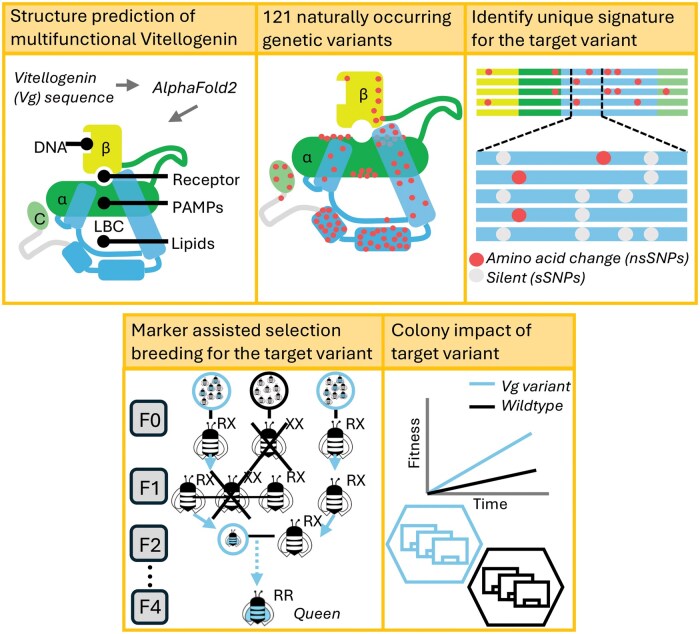
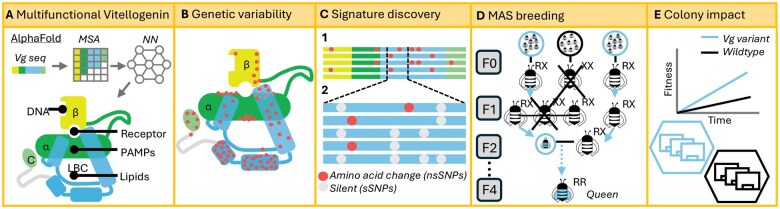
Managed honey bees (Hymenoptera: Apidae: Apis mellifera L) have experienced unsustainably high rates of annual loss driven by several interacting factors, most notably pests, pathogens, pesticides, and poor nutrition. Breeding bee stocks that can cope with these challenges is a priority. Advanced molecular methods (marker-assisted selection, MAS) have enhanced the breeding efficiency of domesticated animals in recent years, but have not contributed strongly to honey bee stock improvements. This is largely because desirable traits of bees usually emerge from collective phenotypes of workers (sterile females) instead of from the breeding individuals (queens and male drones). For collective phenotypes, single genes typically have small, additive effects, so identifying impactful MAS targets is challenging. Here, we provide proof of concept for a new approach to honey bee breeding through MAS using the multifunctional protein Vitellogenin (Vg), a protein known to interact with and mitigate the primary drivers of colony loss. Our pipeline leverages cutting-edge, artificial intelligence (AI)-driven protein structure modeling algorithms to predict the effects of genetic variants of Vg on relevant molecular functions including lipid, zinc, and DNA binding. Following the AI-powered Vg variant selection step, we use a combination of standard apicultural techniques and DNA sequencing validation to breed honey bee queens homozygous for the desirable Vg allele. Our protocol can kick-start a new area of modernized bee breeding: an AI-enhanced MAS system that allows cost-effective and nimble development of stocks to meet urgent and long-term needs of stakeholders.
Overview
The claims and statistics of this paper haven’t been checked yet.
Free: it reads the open-access text and checks the first 5 claims that cite a source we can check. Create a free account to check every claim.
Integrity signals
Registry
Cites
Statistics
Figures
Verification
Claims the paper makes
The claims and statistics of this paper haven’t been checked yet.
Free: it reads the open-access text and checks the first 5 claims that cite a source we can check. Create a free account to check every claim.
Self-check
Percentages, sums and reported differences re-computed from the paper’s own numbers.
The self-check needs the paper’s full text.
Citations
Cites
Highly accurate protein structure prediction with AlphaFold
Jumper, J., Evans, R., Pritzel, A., Green, T., Figurnov, M., Ronneberger, O., Tunyasuvunakool, K., Bates, R., Žídek, A., Potapenko, A., et al. (2021) · Nature · doi:10.1038/s41586-021-03819-2 · Cited by 43,764
Research works printed but not linked: 59
- 10.1093/jee/97.3.741 · DOI
- 10.1007/s00040-005-0812-2 · DOI
- 10.1186/1472-6750-3-1 · DOI · Paper page
- 10.1016/S0969-2126(98)00091-4 · DOI
- 10.1080/00218839.2023.2264601 · DOI
- 10.1093/gerona/glt134 · DOI
- 10.1002/ece3.17 · DOI
- 10.1101/gr.5680406 · DOI · Paper page
- 10.1080/00218839.2022.2158586 · DOI
- 10.1002/etc.4383 · DOI
- 10.1111/gcb.14791 · DOI
- 10.1603/EC12175 · DOI
- 10.1016/j.cois.2015.05.007 · DOI · Paper page
- 10.1016/j.cois.2015.05.014 · DOI
- 10.1098/RSOS.181803 · DOI
- 10.1016/j.cois.2018.02.006 · DOI · Paper page
- 10.1016/j.chemosphere.2020.127542 · DOI
- 10.1016/j.cub.2024.03.039 · DOI
- 10.1038/s41598-017-08464-2 · DOI
- 10.1051/apido:2003068 · DOI
- 10.3390/ani13101588 · DOI
- 10.1111/j.1469-185X.1947.tb00330.x · DOI
- 10.1080/00218839.1986.11100687 · DOI
- 10.1016/j.jinsphys.2018.12.006 · DOI
- 10.1016/j.scitotenv.2024.175125 · DOI
- 10.1016/j.anbehav.2010.02.009 · DOI
- 10.1038/s41598-022-24946-4 · DOI
- 10.1016/j.jmb.2019.04.009 · DOI · Paper page
- 10.1093/bib/bbx108 · DOI · Paper page
- 10.1016/j.dci.2023.104709 · DOI
- 10.1093/bioinformatics/bty036 · DOI · Paper page
- 10.1093/molbev/msy096 · DOI · Paper page
- 10.1007/s00114-002-0371-6 · DOI · Paper page
- 10.1002/pro.4369 · DOI
- 10.1002/2211-5463.13316 · DOI
- 10.1007/s00114-008-0413-9 · DOI
- 10.2135/cropsci2000.402329x · DOI
- 10.1371/journal.pbio.0050062 · DOI · Paper page
- 10.1242/jeb.050393 · DOI · Paper page
- 10.1242/jeb.089243 · DOI
- 10.2527/2000.783570x · DOI · Paper page
- 10.1038/hortres.2017.6 · DOI
- 10.1073/pnas.1818371116 · DOI · Paper page
- 10.1093/jhered/esh072 · DOI
- 10.1371/journal.pone.0273289 · DOI
- 10.1073/pnas.0502681103 · DOI · Paper page
- 10.1673/031.007.5201 · DOI
- 10.1371/journal.pone.0152685 · DOI · Paper page
- 10.1051/apido:19960407 · DOI
- 10.1080/00218839.1993.11101300 · DOI
- 10.1007/s13353-024-00921-9 · DOI
- 10.1016/j.scitotenv.2016.11.178 · DOI · Paper page
- 10.1371/journal.pone.0048276 · DOI
- 10.1371/journal.pgen.1000896 · DOI
- 10.1093/bioinformatics/btp033 · DOI · Paper page
- 10.1186/1471-2105-13-134 · DOI · Paper page
- 10.1046/j.1439-0523.2000.00514.x · DOI
- 10.1111/gcb.17219 · DOI
- 10.1093/nar/gki524 · DOI · Paper page
Metadata
- Authors
- Leipart, V., Amdam, G. V., O’Brien, S., Pigott, E., Dodds, G., & Ihle, K. E.
- Affiliations
- University College London (GB)
- Norwegian University of Life Sciences (NO)
- Honey Bee Breeding, Genetics, and Physiology Laboratory (US)
- Corresponding author
- Leipart, Vilde
- Venue
- Journal of Economic Entomology
- Publisher
- openRxiv
- Published
- 2025-05-16
- Volume
- 118
- Issue
- 5
- Pages
- 2133-2144
- ISSN
- 0022-0493 (ISSN-L)
- PMC
- PMC12534086
- OpenAlex
- W4413419201
- Cited by
- 3
- References
- 1
- Citations by year
- 2026: 3
- FWCI
- 2.26
- Type
- journal article
- Language
- en
- Open access
- hybrid
- doi.org
- Licence
- Locations
- Journal of Economic Entomology (publishedVersion, cc-by)
- bioRxiv (Cold Spring Harbor Laboratory) (acceptedVersion, cc-by)
- Europe PMC (PubMed Central) (publishedVersion, cc-by)
- PubMed (publishedVersion)
- Funders
- U.S. Department of Agriculture
- Norges Forskningsråd (335244, 350231)
- Norges Miljø- og Biovitenskapelige Universitet
- University of Illinois at Urbana-Champaign
- Topics
- Life Sciences › Agricultural and Biological Sciences › Insect Science › Insect and Pesticide Research
- Life Sciences › Biochemistry, Genetics and Molecular Biology › Genetics › Genetic and phenotypic traits in livestock
- Life Sciences › Agricultural and Biological Sciences › Insect Science › Insect and Arachnid Ecology and Behavior
- Keywords
- marker-assisted selection, vitellogenin, honey bee breeding, Apis mellifera, artificial intelligence, protein structure prediction, genetic variants, colony losses, queen rearing, multifunctional proteins, lipid binding, zinc binding, DNA binding
- MeSH terms
- Animals, Artificial Intelligence, Bees, Breeding, Female, Male, Selection, Genetic, Vitellogenins, Insect Proteins
About these checks
Registry, retraction, Cites and statistics results are computed, not judged, with one exception: a printed reference that no index lists is read once by a model before it counts as a citation error. Claims are extracted by a model and kept only when their quote appears verbatim in the text; each cited source is then checked, with a model’s help, for whether it says what the claim relies on. Those verdicts can be wrong — read the claim’s quote and the cited source before relying on one.
Statistics and arithmetic are recomputed, not judged.
Confidence bands are shown only for fields calibrated on our annotated test set. None is calibrated yet, so no band is shown.
What counts as a claim ›How we measure confidence ›How we check this ›
Are you an author, or do you see a problem with this page? Request a review
Data sources
Bibliographic data: Semantic Scholar, OpenAlex, Crossref.
Contains information from the Semantic Scholar Academic Graph Datasets, made available under the ODC Attribution License (ODC-BY 1.0).
Semantic Scholar’s data is described in: Kinney, R., et al. (2023). The Semantic Scholar Open Data Platform. arXiv:2301.10140.
