

PED-X-Bench: A Benchmark of Adult-to-Pediatric Extrapolation Decisions in FDA Drug Labels
Open accessThe DOI matches its Crossref record; 12 of the 12 references it cites were found in a registry or an index; 11 of the 25 sources its claims cite were checked for support.
Abstract
Abstract Pediatric trials are ethically and logistically difficult, so the U.S. FDA often extrapolates adult data to children when justified. Yet no public resource systematically documents these decisions. We present PED-X-Bench , the first dataset and benchmark that encodes FDA pediatric-extrapolation outcomes as a four-way classification task ( Full, Partial, None, Unlabeled ). PED-X-Bench contains 737 FDA drug-label sections (≈ 1 M words of source text) for approvals issued 2007–2024 across all therapeutic areas. A two-stage o3-mini prompting pipeline mined full FDA label text; nine domain reviewers then adjudicated a stratified sample of 135 labels yielding an accuracy F1 of 0.74 and 0.63 respectively (inter-annotator κ = 0.678) and spot-checking the remainder. For every drug we release the ground-truth label, concise efficacy and pharmacokinetic/safety summaries, and harmonized study metadata. To showcase utility we release two baseline models: (i) a logistic-regression classifier that uses structured metadata from FDA’s pediatric-labeling dataset, and (ii) a fine-tuned BigBird BERT that ingests full label text. Both base-lines perform modestly, leaving ample headroom for future work. PED-X-Bench enables research on pediatric drug development, clinical NLP and drug safety; dataset card and code are made available here: github.com/tatonetti-lab/PedXBench huggingface.co/datasets/apoorvasrinivasan/Ped-X-Bench
Overview
CoChat Summary
TL;DR
PED-X-Bench is the first open dataset encoding FDA adult-to-pediatric extrapolation decisions as a four-way classification task (Full, Partial, None, Unlabeled) over 737 FDA drug-label sections from 2007–2024. Two baseline models (metadata logistic regression and a fine-tuned BigBird transformer) both perform modestly, leaving headroom for future work.
Key findings
- The corpus contains 737 FDA drug-label sections (≈1M words) for approvals issued 2007–2024; a two-stage o3-mini pipeline labelled them, with nine domain reviewers adjudicating a stratified sample of 135 labels (accuracy 0.74, macro-F1 0.63; inter-annotator κ = 0.678 in the abstract, κ = 0.72 after consensus discussion in Methods).
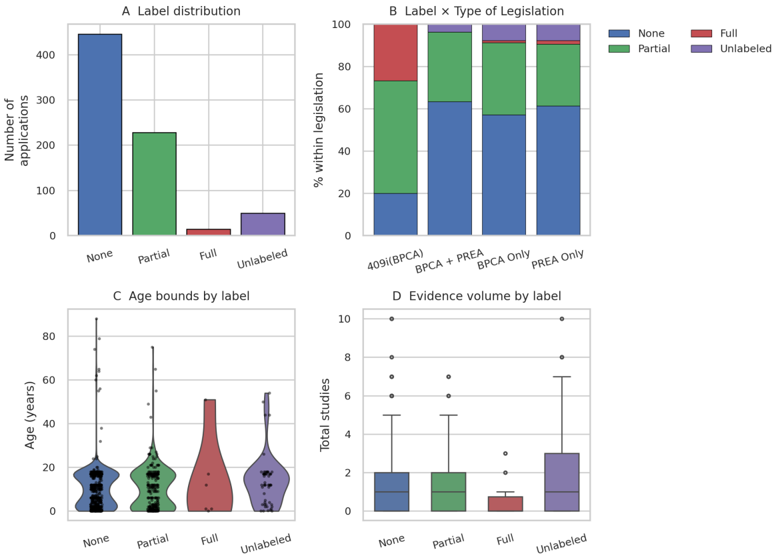
- Outcome distribution is skewed: None dominates at 60% (445/737), Partial 31%, Full borrowing is rare at 3%, and 6% are Unlabeled; only 22 fully extrapolated cases exist.
- Ablations: two-stage o3-mini reached accuracy 0.740 / macro-F1 0.633; swapping to gpt-4o-mini dropped to 0.534 / 0.294; single-stage reached 0.725 / 0.637; single-stage plus verifier reached 0.804 accuracy but macro-F1 fell to 0.538.
- On the blind test split (34 labels), logistic regression on metadata achieved accuracy 0.647 / macro-F1 0.359, matching BigBird's accuracy (0.647) while doubling its macro-F1 (0.240, loss 0.810).
Methods
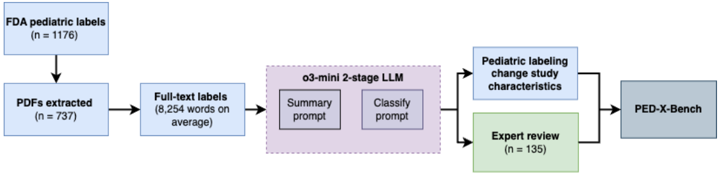
- Data source: FDA's pediatric labeling-change spreadsheet (BPCA, PREA, legacy Pediatric Rule since 1998); after removing veterinary/device entries and collapsing reformulations, 737 human drugs with English PDF labels were retained, converted with pdftotext.
- Annotation: a two-stage chain-of-thought o3-mini pipeline (evidence extraction, then four-way classification with rationale and ≤150-word efficacy/safety summaries); 135 randomly sampled labels were independently reviewed by nine annotators (eight biomedical data scientists, one clinician) to form a gold test/validation set, with the remaining 602 machine-labelled records as silver training data.
- Baselines: multinomial logistic regression on a 253-dimensional sparse feature vector (z-scored numeric features, one-hot categoricals, class-balanced weights) and fine-tuned google/bigbird-roberta-base on 4096-token label text, evaluated on a fixed 687/85/34 train/dev/test split using accuracy, macro-F1, and cross-entropy loss.
Limitations
- Stated: the dataset inherits biases of public labels (negative trials, interim analyses, and unpublished regulatory correspondence are absent); severe class imbalance with only 22 fully extrapolated cases; annotations capture a single 2007–2024 snapshot requiring periodic refresh; and labels address extrapolation at the whole-product level rather than per indication or dosage form.
- Evident from the text: the gold-standard test set is small (34 labels in the blind test split; 135 adjudicated overall), and the reported inter-annotator agreement differs between the abstract (κ = 0.678) and Methods (κ = 0.72), which the text does not reconcile.
Model-written summary. Check it against the paper before relying on it.
Integrity signals
Registry
Cites
Statistics
Figures
Verification
Claims the paper makes
5 Valid · 0 Not valid · 9 Not checked · 45 Own results and interpretations
The cited sources support only part of this claim — read each source’s verdict below.
In the paper
“to date, no public dataset has systematically annotated or categorized extrapolation decisions in FDA drug labels.”
What the sources say
- Could not verifycites [11] [11] Haihao Sun, Jean W. Temeck, Wiley Chambers, Ginger Perkins, Renan Bonnel, and Dianne Murphy. Extrapolation of efficacy in pediatric drug development and evidence-based medicine: Progress and lessons learned. 52(2):199-205. ISSN 2168-4790, 2168-4804. doi: 10.1177/ 2168479017725558. URL http://link.springer.com/10.1177/2168479017725558 . It is made available under a CC-BY 4.0 International license . is the author/funder, who has granted medRxiv a license to display the preprint in perpetuity. (which was not certified by peer review) medRxiv preprint doi: https://doi.org/10.1101/2025.05.22.2 sourceExperimental — accuracy not yet measured
The Methods and Results (pages not provided) describe the authors’ own systematic classification of pediatric extrapolation decisions using FDA study records and labeling. They do not address whether a public dataset of annotated decisions existed; searches for public datasets and labeling classifications found no such statement. (LLM, conf=0.76)
- Partly supportedcites [12] [12] Jake Silberg, Kyle Swanson, Elana Simon, Angela Zhang, Zaniar Ghazizadeh, Scott Ogden, Hisham Hamadeh, and James Zou. UniTox: Leveraging LLMs to curate a unified dataset of drug-induced toxicity from FDA labels. URL http://medrxiv.org/lookup/doi/10. 1101/2024.06.21.24309315 . - sourceExperimental — accuracy not yet measured
Our copy supports only part of what is attributed: the Introduction (p. null) enumerates limitations of existing public toxicity datasets (small size, differing methodologies, not searchable by toxicity status, in vitro basis, exclusion of biologics, single-organ coverage), and the Limitations text in 3.4 (p. null) shows that extrapolation-type judgements — toxicity only in animals, only at clinically irrelevant high doses, only in other drugs of the same class, only in predisposed populations — 'were often discussed in detail in GPT-4o's generated summaries but were lost in the binary or ternary ratings', i.e. even UniTox does not systematically categorize them. However, the paper nowhere makes the universal negative that 'no public dataset has systematically annotated or categorized extrapolation decisions'; it never uses the term 'extrapolation', and its stated novelty claims (largest human in vivo cross-toxicity dataset, unified format 'not previously available', Section 3.4 conclusion) concern scale, unification across eight toxicities and LLM-based toxicity rating, not annotation of extrapolation decisions. That specific gap statement is therefore not attributable to this source. (LLM, conf=0.66)
- Could not verifycites [13] [13] Leihong Wu, Hong Fang, Yanyan Qu, Joshua Xu, and Weida Tong. Leveraging FDA labeling documents and large language model to enhance annotation, profiling, and classification of drug adverse events with AskFDALabel. . ISSN 0114-5916, 11791942. doi: 10.1007/s40264-025-01520-1. URL https://link.springer.com/10.1007/ s40264-025-01520-1 . - sourceExperimental — accuracy not yet measured
The Introduction discusses datasets annotated for adverse events and drug toxicity, and Materials and Methods describes adverse-event profiling datasets; page numbers are unavailable in our copy. Searches for extrapolation decisions and pediatric drug development found no passage addressing whether a public dataset of extrapolation decisions exists. (LLM, conf=0.74)
- Not checked — no full text of the sourcecites [14] [14] Leihong Wu, Joshua Xu, Shraddha Thakkar, Magnus Gray, Yanyan Qu, Dongying Li, and Weida Tong. A framework enabling LLMs into regulatory environment for transparency and trustworthiness and its application to drug labeling document. 149:105613, . ISSN 02732300. doi: 10.1016/j.yrtph.2024.105613. URL https://linkinghub.elsevier.com/retrieve/ pii/S0273230024000540 . - source
plain- Asserted: passes — The authors put it forward as true.
- Checkable: passes — It can be checked against evidence.
- Load-bearing: passes — The paper’s conclusions depend on it.
- Based: passes — The paper gives a reason why it holds.
- Could not verify
The sources with a verdict support this claim; the rest weren’t checked yet, have no full text we could read, or their verdicts aren’t rated yet.
In the paper
“recent NLP work on FDA labels targets toxicity or adverse-event extraction [12, 13] or general summarisation [14], not extrapolation.”
What the sources say
- Not checked yetcites [12] [12] Jake Silberg, Kyle Swanson, Elana Simon, Angela Zhang, Zaniar Ghazizadeh, Scott Ogden, Hisham Hamadeh, and James Zou. UniTox: Leveraging LLMs to curate a unified dataset of drug-induced toxicity from FDA labels. URL http://medrxiv.org/lookup/doi/10. 1101/2024.06.21.24309315 . - source
Checked before — its earlier verdict is held back until a new check runs.
- Supportedcites [13] [13] Leihong Wu, Hong Fang, Yanyan Qu, Joshua Xu, and Weida Tong. Leveraging FDA labeling documents and large language model to enhance annotation, profiling, and classification of drug adverse events with AskFDALabel. . ISSN 0114-5916, 11791942. doi: 10.1007/s40264-025-01520-1. URL https://link.springer.com/10.1007/ s40264-025-01520-1 . - source
The Introduction describes using FDA labels for adverse-event extraction and toxicity annotation. The Methods describe AskFDALabel experiments in liver-injury classification, cardiotoxicity classification, and adverse-event profiling from labels. This supports the extraction and classification work for which this source is cited; the separate general-summarisation citation is not assessed here. (LLM, conf=0.90)
- Not checked — no full text of the sourcecites [14] [14] Leihong Wu, Joshua Xu, Shraddha Thakkar, Magnus Gray, Yanyan Qu, Dongying Li, and Weida Tong. A framework enabling LLMs into regulatory environment for transparency and trustworthiness and its application to drug labeling document. 149:105613, . ISSN 02732300. doi: 10.1016/j.yrtph.2024.105613. URL https://linkinghub.elsevier.com/retrieve/ pii/S0273230024000540 . - source
plain- Asserted: passes — The authors put it forward as true.
- Checkable: passes — It can be checked against evidence.
- Load-bearing: passes — The paper’s conclusions depend on it.
- Based: passes — The paper gives a reason why it holds.
- Not checked yet
The cited sources support only part of this claim — read each source’s verdict below.
In the paper
“Previous work has involved manual review of extrapolation of a relatively small number of pediatric studies from internal FDA documents which are not publicly available [11].”
What the sources say
- Partly supportedcites [11] [11] Haihao Sun, Jean W. Temeck, Wiley Chambers, Ginger Perkins, Renan Bonnel, and Dianne Murphy. Extrapolation of efficacy in pediatric drug development and evidence-based medicine: Progress and lessons learned. 52(2):199-205. ISSN 2168-4790, 2168-4804. doi: 10.1177/ 2168479017725558. URL http://link.springer.com/10.1177/2168479017725558 . It is made available under a CC-BY 4.0 International license . is the author/funder, who has granted medRxiv a license to display the preprint in perpetuity. (which was not certified by peer review) medRxiv preprint doi: https://doi.org/10.1101/2025.05.22.2 sourceExperimental — accuracy not yet measured
The Methods (page not provided) describe reviewing and tabulating pediatric studies retrieved from FDA’s DARRTS system or Document Room; the Results report 388 studies across 157 products. The paper does not say that the underlying documents are not publicly available, or characterize the number of studies as relatively small. (LLM, conf=0.82)
plain- Asserted: passes — The authors put it forward as true.
- Checkable: passes — It can be checked against evidence.
- Load-bearing: passes — The paper’s conclusions depend on it.
- Based: passes — The paper gives a reason why it holds.
- Partly supported
A result the paper states — it cites no source for it, so there is none to check. The quote shows it is in the paper.
In the paper
“We present PED-X-Bench , the first dataset and benchmark that encodes FDA pediatric-extrapolation outcomes as a four-way classification task ( Full , Partial , None , Unlabeled ).”
- Also stated in: § 2 The PED-X-Bench Dataset · p. 3 · plain
“PED-X-Bench is the first openly available corpus that encodes FDA extrapolation decisions as a four-class classification task.”
plain- Asserted: passes — The authors put it forward as true.
- Checkable: passes — It can be checked against evidence.
- Load-bearing: passes — The paper’s conclusions depend on it.
- Based: passes — The paper gives a reason why it holds.
- Also stated in: § 2 The PED-X-Bench Dataset · p. 3 · plain
A result the paper reports from its own data — it cites no other source for it, so there is none to check. The quote shows it is in the paper.
In the paper
“class imbalance is severe, with only 22 fully extrapolated cases”
plainn = 22- Asserted: passes — The authors put it forward as true.
- Checkable: passes — It can be checked against evidence.
- Load-bearing: passes — The paper’s conclusions depend on it.
- Based: passes — The paper gives a reason why it holds.
21 more claims
Create a free account to see all 59 claims and to verify the 1 reference still open.
- It may state two separate claims as one. 25
- Probably not a substantial claim. 13
- The quote only partly states this claim. 1
Self-check
Percentages, sums and reported differences re-computed from the paper’s own numbers.
Each contradiction between two passages listed here was confirmed by an independent check.
Rated major: it would touch a result — a value a result rests on, reported and recomputed p-values on opposite sides of the significance level, two passages that conflict with no sign which is right, or a cited work retracted before this paper was published.
In the paper
“We benchmark two complementary models on a fixed train / dev / test split of 687 / 85 / 34 labels.”
Reported 737 · recomputed 806
Rated major: it would touch a result — a value a result rests on, reported and recomputed p-values on opposite sides of the significance level, two passages that conflict with no sign which is right, or a cited work retracted before this paper was published.
In the paper
§ 2 The PED-X-Bench Dataset · p. 3
“Full is assigned when disease progression, treatment response, and exposure-response are sufficiently concordant for pediatric PK (with or without targeted safety data) to substitute for efficacy evidence.”
§ Prompt: · p. 4
“- -Full - only PK / exposure modelling; no pediatric safety cohort”
Rated minor: it would not touch a result — a value no result rests on, a p-value that stays on the same side of the significance level, or a conflict that is clerical, resolved elsewhere in the paper, or outside its own findings.
In the paper
“a metadata-only logistic model matches BigBird's accuracy while doubling its macro-F1”
Reported 2 · recomputed 1.495833
Citations
Cites
Big Bird: Transformers for Longer Sequences
Zaheer, M., Guruganesh, G., Dubey, A., Ainslie, J., Alberti, C., Ontanon, S., Pham, P., Ravula, A., Wang, Q., Yang, L., et al. (2020) · arXiv · doi:10.48550/arxiv.2007.14062 · Cited by 1,349 · cited 1×
“To demonstrate the utility of the dataset, we built two baseline models, logistic regression and a fine-tuned BigBird transformer model [15], to benchmark extrapolation classification.”
Extrapolation of Adult Data and Other Data in Pediatric Drug-Development Programs
Dunne, J., Rodriguez, W. J., Murphy, M. D., Beasley, B. N., Burckart, G. J., Filie, J. D., Lewis, L. L., Sachs, H. C., Sheridan, P. H., Starke, P., et al. (2011) · Pediatrics · doi:10.1542/peds.2010-3487 · Cited by 318 · cited 1×
“[9].”
Pediatric Information in Drug Product Labeling
Avant, D. (2012) · JAMA · doi:10.1001/jama.2012.3435 · Cited by 132
Bellis, J. R., Kirkham, J. J., Nunn, A. J., & Pirmohamed, M. (2014) · British Journal of Clinical Pharmacology · doi:10.1111/bcp.12222 · Cited by 120 · cited 1×
“Because growth and maturation reshape both pharmacokinetics and disease biology, transplanting adult evidence into children can yield sub-therapeutic dosing, diminished efficacy, or an elevated risk of adverse reactions [2–4].”
Impact of Pediatric Exclusivity on Drug Labeling and Demonstrations of Efficacy
Wharton, G. T., Murphy, M. D., Avant, D., Goldsmith, J. V., Chai, G., Rodriguez, W. J., & Eisenstein, E. L. (2014) · Pediatrics · doi:10.1542/peds.2013-2987 · Cited by 90 · cited 1×
“These initiatives have led to over 800 pediatric labeling changes [7], dramatically increasing the number of drugs with age-specific safety, efficacy, and dosing guidance for children.”
Sun, H., Temeck, J. W., Chambers, W., Perkins, G., Bonnel, R., & Murphy, D. (2018) · Therapeutic Innovation & Regulatory Science · doi:10.1177/2168479017725558 · Cited by 70 · cited 1×
“Previous work has involved manual review of extrapolation of a relatively small number of pediatric studies from internal FDA documents which are not publicly available [11].”
Smits, A., Annaert, P., Cavallaro, G., De Cock, P. A. J. G., de Wildt, S. N., Kindblom, J. M., Lagler, F. B., Moreno, C., Pokorna, P., Schreuder, M. F., et al. (2022) · British Journal of Clinical Pharmacology · doi:10.1111/bcp.14958 · Cited by 55 · cited 1×
“Because growth and maturation reshape both pharmacokinetics and disease biology, transplanting adult evidence into children can yield sub-therapeutic dosing, diminished efficacy, or an elevated risk of adverse reactions [2–4].”
Tefera, Y. G., Gebresillassie, B. M., Mekuria, A. B., Abebe, T. B., Erku, D. A., Seid, N., & Beshir, H. B. (2017) · Pharmacology Research & Perspectives · doi:10.1002/prp2.304 · Cited by 21
Wu, L., Fang, H., Qu, Y., Xu, J., & Tong, W. (2025) · Drug Safety · doi:10.1007/s40264-025-01520-1 · Cited by 20 · cited 1×
“On the other hand, recent NLP work on FDA labels targets toxicity or adverse-event extraction [12, 13] or general summarisation [14], not extrapolation.”
UniTox: Leveraging LLMs to Curate a Unified Dataset of Drug-Induced Toxicity from FDA Labels
Silberg, J., Swanson, K., Simon, E. P., Zhang, A., Ghazizadeh, Z., Ogden, S., Hamadeh, H. K., & Zou, J. (2024) · neural information processing systems · doi:10.52202/079017-0385 · Cited by 19
Metadata
- Authors
- Srinivasan, A., Berkowitz, J., Friedrich, N. A., Tsang, K., Kuchi, A., Acitores, J., Zietz, M., Czarny, R. S., Liu, H., & Tatonetti, N. P.
- Affiliations
- Cedars-Sinai Medical Center (US)
- Corresponding author
- Srinivasan, Apoorva
- ORCID
- Venue
- medRxiv
- Publisher
- openRxiv
- Published
- 2025-05-23
- OpenAlex
- W4410746186
- Cited by
- 0
- References
- 11
- Type
- posted content
- Language
- en
- Open access
- green
- doi.org
- Licence
- Locations
- medRxiv (acceptedVersion, cc-by)
- Topics
- Health Sciences › Medicine › Pediatrics, Perinatology and Child Health › Pharmaceutical studies and practices
- Health Sciences › Medicine › Health Informatics › Biomedical Text Mining and Ontologies
- Life Sciences › Pharmacology, Toxicology and Pharmaceutics › Toxicology › Pharmacovigilance and Adverse Drug Reactions
- Keywords
- FDA drug labels, pediatric drug development, drug safety, efficacy claims, pharmacokinetics, annotated dataset, benchmark, clinical natural language processing, drug approval
About these checks
Registry, retraction, Cites and statistics results are computed, not judged, with one exception: a printed reference that no index lists is read once by a model before it counts as a citation error. Claims are extracted by a model and kept only when their quote appears verbatim in the text; each cited source is then checked, with a model’s help, for whether it says what the claim relies on. Those verdicts can be wrong — read the claim’s quote and the cited source before relying on one.
The claim verdicts this report counts are experimental: their accuracy is not yet measured.
A language model drew the claims from the paper on 2026-10-10, under version 3 of the claim definition (model deepseek-v4.1-flash, prompt extract-v3).
A second model labelled each claim on 2026-10-10 (model jev-1.13-20260917, definition revision gold-guideline-v0.2).
Cited sources are checked with a language model’s help (gpt-6-sol and qwen3.8-omni-flash).
Statistics and arithmetic are recomputed, not judged.
Confidence bands are shown only for fields calibrated on our annotated test set. None is calibrated yet, so no band is shown.
What counts as a claim ›How we measure confidence ›How we check this ›
Are you an author, or do you see a problem with this page? Request a review
Data sources
Bibliographic data: Semantic Scholar, OpenAlex, Crossref.
Contains information from the Semantic Scholar Academic Graph Datasets, made available under the ODC Attribution License (ODC-BY 1.0).
Semantic Scholar’s data is described in: Kinney, R., et al. (2023). The Semantic Scholar Open Data Platform. arXiv:2301.10140.
