

Cholesterol promotes the formation of dimers and oligomers of the receptor tyrosine kinase ROR1
Open accessPreprint — published as 10.1016/j.jbc.2025.111000 · Paper page
The DOI matches its Crossref record; 69 of the 69 references it cites were found in a registry or an index.
Abstract
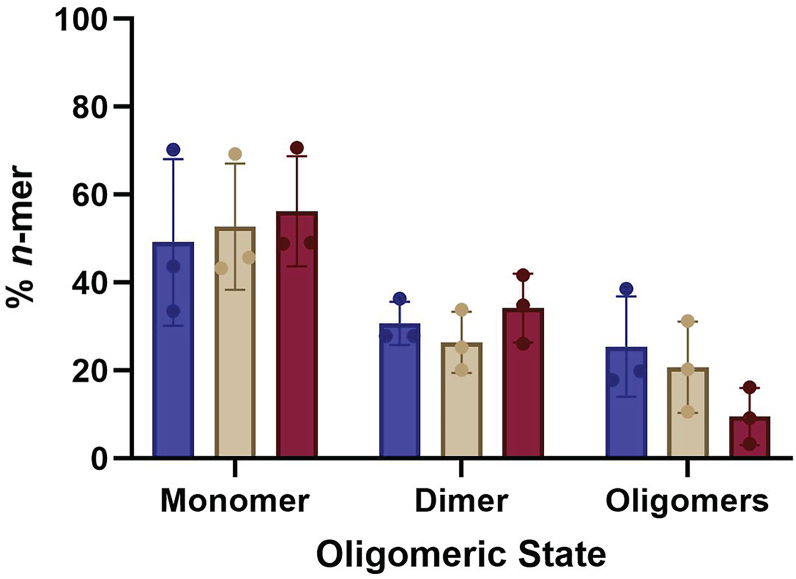
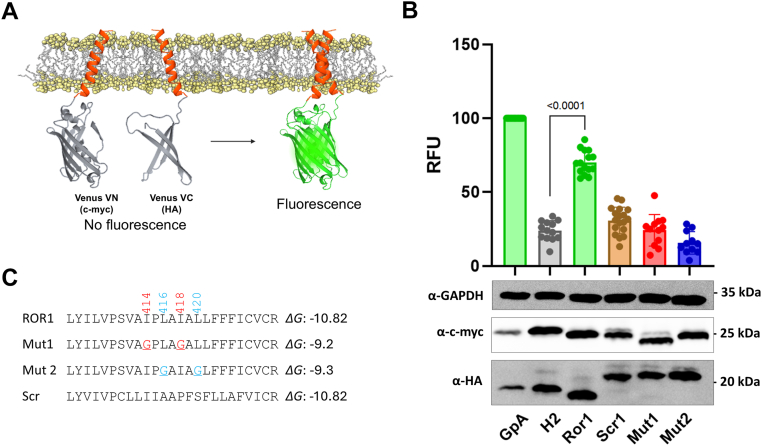
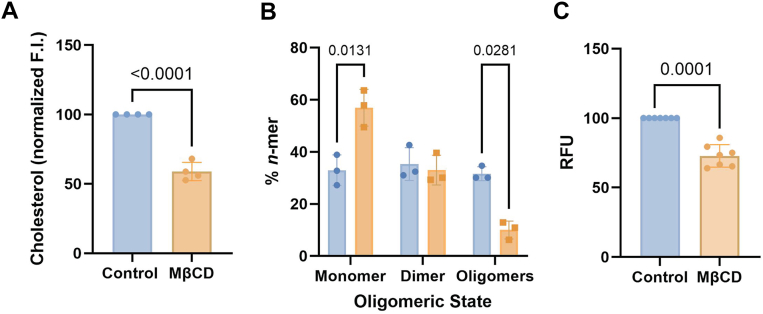
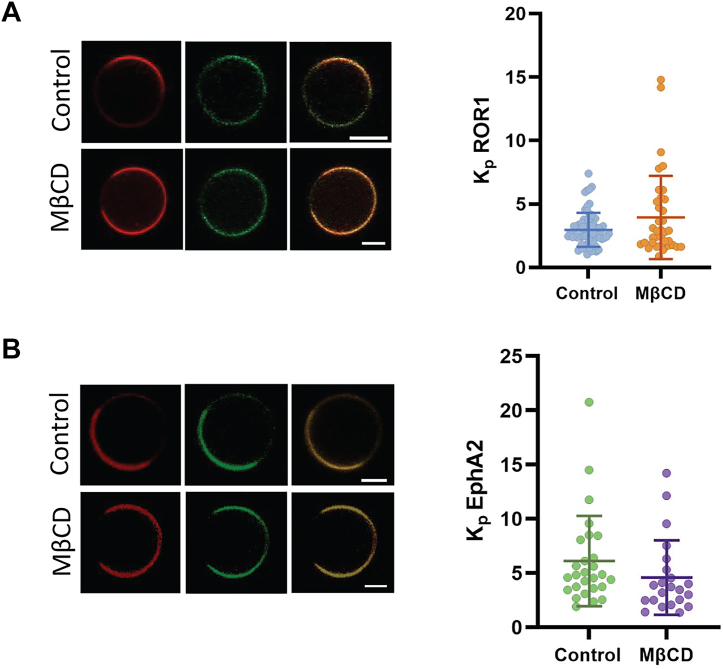
ROR1 is a member of the receptor tyrosine kinase (RTK) family that plays a crucial role during organogenesis of bone and neural systems by regulating non-canonical Wnt signaling. Misregulation of ROR1 is additionally a causative factor for carcinogenesis in solid and liquid tumors. However, we have a poor understanding of how ROR1 activity is regulated. We employed a recently developed single-molecule method termed SiMPull-POP to study the oligomeric state of ROR1. RTK function is typically triggered by ligand binding, which promotes self-assembly of RTKs to form dimers and in some cases oligomers. However, our data indicate that ROR1 does not follow this paradigm. Instead, ROR1 forms dimers and oligomers in a process that is not affected by the presence of the ROR1 ligand Wnt5a. Additional experiments indicate that the transmembrane domain of ROR1 has a strong tendency to self-assemble, suggesting that this domain modulates ROR1 dimerization. Investigation into a regulatory mechanism for ROR1 self-assembly led to evaluation of the role of the lipid cholesterol, which plays pleiotropic roles in Wnt signaling. Cholesterol was found to promote the assembly of ROR1, and our results point to the transmembrane domain as the region where cholesterol exerts the regulatory effect. Taken together, our results indicate that ROR1 self-assembles in human cells; however, unlike other RTKs, this process is not stabilized by ligand binding but is instead facilitated by membrane cholesterol.
Overview
The claims and statistics of this paper haven’t been checked yet.
Free: it reads the open-access text and checks the first 5 claims that cite a source we can check. Create a free account to check every claim.
Integrity signals
Registry
Cites
Statistics
Figures
Verification
Claims the paper makes
The claims and statistics of this paper haven’t been checked yet.
Free: it reads the open-access text and checks the first 5 claims that cite a source we can check. Create a free account to check every claim.
Self-check
Percentages, sums and reported differences re-computed from the paper’s own numbers.
The self-check needs the paper’s full text.
Citations
Cites
Highly accurate protein structure prediction with AlphaFold
Jumper, J., Evans, R., Pritzel, A., Green, T., Figurnov, M., Ronneberger, O., Tunyasuvunakool, K., Bates, R., Žídek, A., Potapenko, A., et al. (2021) · Nature · doi:10.1038/s41586-021-03819-2 · Cited by 43,764
Wnt/β-catenin signalling: function, biological mechanisms, and therapeutic opportunities
Liu, J., Xiao, Q., Xiao, J., Niu, C., Li, Y., Zhang, X., Zhou, Z., Shu, G., & Yin, G. (2022) · Signal Transduction and Targeted Therapy · doi:10.1038/s41392-021-00762-6 · Cited by 2,519
Purified Wnt5a Protein Activates or Inhibits β-Catenin–TCF Signaling Depending on Receptor Context
Mikels, A. J., & Nusse, R. (2006) · PLoS Biology · doi:10.1371/journal.pbio.0040115 · Cited by 1,252
A Transmembrane Helix Dimer: Structure and Implications
MacKenzie, K. R., Prestegard, J. H., & Engelman, D. M. (1997) · Science · doi:10.1126/science.276.5309.131 · Cited by 954
Large-scale fluid/fluid phase separation of proteins and lipids in giant plasma membrane vesicles
Baumgart, T., Hammond, A. T., Sengupta, P., Hess, S. T., Holowka, D. A., Baird, B. A., & Webb, W. W. (2007) · Proceedings of the National Academy of Sciences · doi:10.1073/pnas.0611357104 · Cited by 800
Palmitoylation regulates raft affinity for the majority of integral raft proteins
Levental, I., Lingwood, D., Grzybek, M., Coskun, Ü., & Simons, K. (2010) · Proceedings of the National Academy of Sciences · doi:10.1073/pnas.1016184107 · Cited by 549
Elucidating membrane structure and protein behavior using giant plasma membrane vesicles
Sezgin, E., Kaiser, H.-J., Baumgart, T., Schwille, P., Simons, K., & Levental, I. (2012) · Nature Protocols · doi:10.1038/nprot.2012.059 · Cited by 527
Fluorescence probe partitioning between Lo/Ld phases in lipid membranes
Baumgart, T., Hunt, G., Farkas, E. R., Webb, W. W., & Feigenson, G. W. (2007) · Biochimica et Biophysica Acta (BBA) - Biomembranes · doi:10.1016/j.bbamem.2007.05.012 · Cited by 518
Sequence specificity in the dimerization of transmembrane .alpha.-helixes
Lemmon, M. A., Flanagan, J. M., Treutlein, H. R., Zhang, J., & Engelman, D. M. (1992) · Biochemistry · doi:10.1021/bi00166a002 · Cited by 495
Critical Fluctuations in Plasma Membrane Vesicles
Veatch, S. L., Cicuta, P., Sengupta, P., Honerkamp-Smith, A., Holowka, D., & Baird, B. (2008) · ACS Chemical Biology · doi:10.1021/cb800012x · Cited by 468
Research works printed but not linked: 3
- Bengoa-Vergniory N. Gorroño-Etxebarria I. López-Sánchez I. Marra M. Di Chiaro P. Kypta R. Identification of noncanonical wnt receptors required for Wnt-3a-Induced early differentiation of human neural stem cells Mol. Neurobiol 54 2017 6213 6224 27709494
- Stefanski K.M. Russell C.M. Westerfield J.M. Lamichhane R. Barrera F.N. PIP(2) promotes conformation-specific dimerization of the EphA2 membrane region J. Biol. Chem. 296 2021 100149 PMC7900517 33277361
- [preprint] Hiroshima M. Abe M. Tomishige N. Hullin-Matsuda F. Makino A. Ueda M. Membrane cholesterol interferes with tyrosine phosphorylation but facilitates the clustering and signal transduction of EGFR bioRxiv 2021 10.1101/2021.08.28.457965 · DOI
Metadata
- Authors
- Ward, A., Baeza-Ballesteros, L. J., Schuck, R. J., García-Murria, M. J., Lamichhane, R., Mingarro, I., & Barrera, F. N.
- Affiliations
- University of Tennessee at Knoxville (US)
- Universitat de València (ES)
- Corresponding author
- Barrera, Francisco N.
- Venue
- Journal of Biological Chemistry
- Publisher
- openRxiv
- Published
- 2025-06-22
- Volume
- 302
- Issue
- 1
- Pages
- 111000-111000
- ISSN
- 0021-9258 (ISSN-L)
- PMC
- PMC12800696
- OpenAlex
- W4416957809
- Semantic Scholar
- 20c7e1a5fec42377d055053dc9c2f4ba2f3a8fa7
- Cited by
- 4
- References
- 69
- Citations by year
- 2026: 3 · 2025: 1
- FWCI
- 1.20
- Type
- journal article
- Language
- en
- Open access
- gold
- doi.org
- Licence
- Locations
- Journal of Biological Chemistry (publishedVersion, cc-by)
- bioRxiv (Cold Spring Harbor Laboratory) (acceptedVersion, cc-by)
- PubMed (publishedVersion)
- PubMed Central (publishedVersion, cc-by)
- PubMed Central (submittedVersion, cc-by)
- Funders
- National Institutes of Health (R35GM140846)
- Topics
- Life Sciences › Biochemistry, Genetics and Molecular Biology › Molecular Biology › Wnt/β-catenin signaling in development and cancer
- Life Sciences › Biochemistry, Genetics and Molecular Biology › Molecular Biology › Lipid Membrane Structure and Behavior
- Life Sciences › Biochemistry, Genetics and Molecular Biology › Molecular Biology › Protein Kinase Regulation and GTPase Signaling
- Keywords
- ROR1, receptor tyrosine kinase, cholesterol, receptor dimerization, receptor oligomerization, Wnt5a, non-canonical Wnt signaling, membrane lipid regulation, receptor activation
About these checks
Registry, retraction, Cites and statistics results are computed, not judged, with one exception: a printed reference that no index lists is read once by a model before it counts as a citation error. Claims are extracted by a model and kept only when their quote appears verbatim in the text; each cited source is then checked, with a model’s help, for whether it says what the claim relies on. Those verdicts can be wrong — read the claim’s quote and the cited source before relying on one.
Statistics and arithmetic are recomputed, not judged.
Confidence bands are shown only for fields calibrated on our annotated test set. None is calibrated yet, so no band is shown.
What counts as a claim ›How we measure confidence ›How we check this ›
Are you an author, or do you see a problem with this page? Request a review
How to cite
Cite CoChat for the checks on this page, and the paper for its own findings.
- This page
- CoChat. (2026). Citation check: Cholesterol promotes the formation of dimers and oligomers of the receptor tyrosine kinase ROR1. https://app.cochat.ai/papers/10.1101/2025.06.19.660507
- The paper
- Ward, A., Baeza-Ballesteros, L. J., Schuck, R. J., García-Murria, M. J., Lamichhane, R., Mingarro, I., & Barrera, F. N. (2025). Cholesterol promotes the formation of dimers and oligomers of the receptor tyrosine kinase ROR1. Journal of Biological Chemistry. https://doi.org/10.1101/2025.06.19.660507
Data sources
Bibliographic data: Semantic Scholar, OpenAlex, Crossref.
Contains information from the Semantic Scholar Academic Graph Datasets, made available under the ODC Attribution License (ODC-BY 1.0).
Semantic Scholar’s data is described in: Kinney, R., et al. (2023). The Semantic Scholar Open Data Platform. arXiv:2301.10140.
